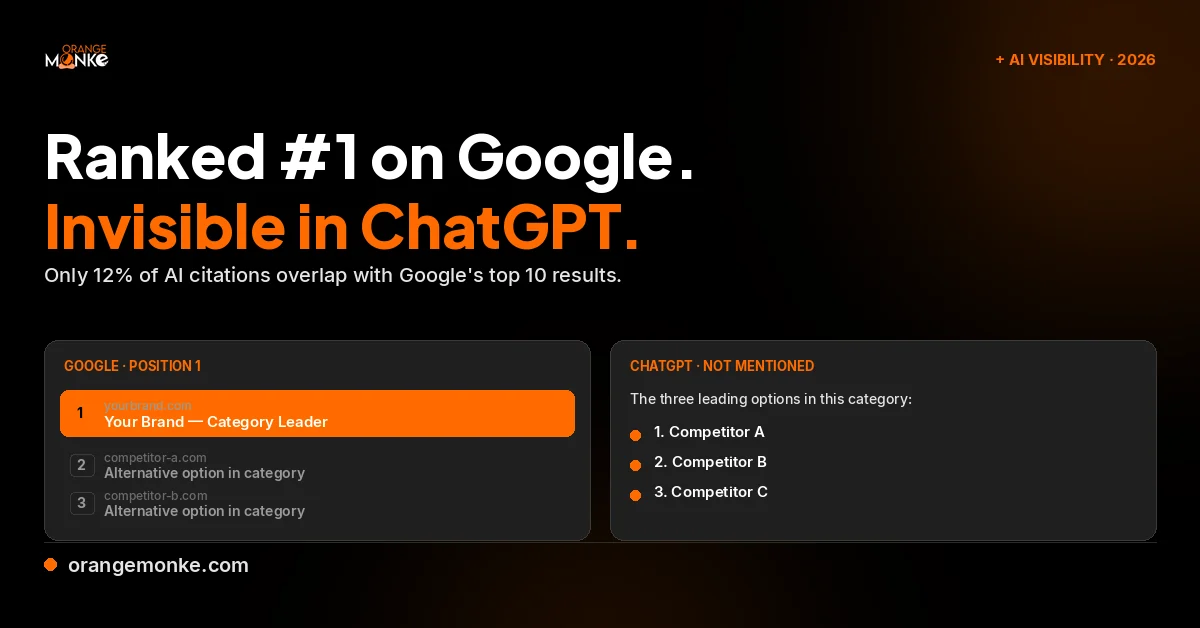
Google rankings and AI visibility are no longer the same metric. Only about 12 percent of AI citations overlap with Google's top 10 results for the same query, so a brand can dominate one and be invisible in the other. Closing the gap needs entity work, third-party citations, and content built for AI extraction, layered on top of solid organic SEO. Our AI SEO services ship this as a 12-week programme.
What Is the AI Visibility Gap?
The AI visibility gap is the widening distance between how a page ranks on Google and how often a brand is named, cited, or recommended by AI answer engines like ChatGPT, Perplexity, Claude, Gemini, and Google AI Mode. The two systems used to agree on who mattered in a category. In 2026 they routinely disagree.
A page can hold position 1 for its most valuable commercial keyword and still not appear anywhere in ChatGPT's answer to the buyer question that keyword serves. That is not a bug. It is a structural feature of how the two systems work. Google ranks pages; AI answer engines recommend brands, and the signals that decide each are only partially the same.
This piece is written for founders and heads of marketing who have already invested in traditional SEO services and want to know exactly what changes when the buyer is asking an AI instead of typing into a search box. It draws on the twelve-week engagement pattern we now run on every AI-visibility programme at Orange MonkE, plus the benchmark data our team has been publishing since 2024.
Why Does Ranking #1 on Google No Longer Mean Visibility?
Ranking #1 on Google no longer guarantees visibility because AI answer engines pick their sources on entity strength, third-party density, and extractability, not on organic rank position. Google's own algorithm still weights link equity, on-page relevance, and engagement. AI systems weight a different set of signals almost from scratch.
The clearest evidence: correlation between Google rank position and ChatGPT recommendation order came in at 0.022 to 0.034, statistically indistinguishable from random.
Knowing where you rank on Google tells you almost nothing about whether ChatGPT will name you.
Two consequences follow. First, the audit you commissioned last year is only telling you half the story. If it did not look at how you appear in ChatGPT, Perplexity, Claude, Gemini, and Google AI Mode, the visibility picture it drew is incomplete. Our current diagnostic pairs a classic technical SEO audit with a 25-prompt AI baseline across five engines. Second, the fix is not "more SEO." It is a different discipline layered on top of SEO, drawing on search engine positioning fundamentals but adding entity work, third-party placement, and extractable content structure.
How Is ChatGPT's Answer Engine Actually Different From Google's Ranking Engine?
Google is a ranking engine that returns ten links; ChatGPT is a synthesis engine that returns one answer built from a small handful of sources it decides to trust. That single architectural difference explains most of the gap.
Google Search evaluates hundreds of billions of pages and ranks the ones it thinks best match the query. It surfaces a list. The user chooses. Systems like RankBrain, BERT, and neural matching read the semantic content of each page; PageRank and its descendants read the web of links; site-wide trust signals and user engagement calibrate the final order. The output is deterministic in the useful sense: the same query in the same context returns the same list.
ChatGPT does none of that. It is a generative language model with two knowledge layers. The first is parametric knowledge, absorbed during training on a web snapshot with a fixed cutoff. The second is real-time retrieval, added in October 2024 through ChatGPT Search, which lets the model query live web content through third-party search providers and publisher partnerships. When you ask a question, ChatGPT decides whether to answer from training data alone, search the web, or combine both. Even when it does search, it samples from roughly the top 20 results and decides what to say, not who to list. It is not reproducing Google's ranking; it is writing an answer that happens to draw on some of the pages Google ranks.
| Dimension | Google Search | ChatGPT and AI answer engines |
|---|---|---|
| Output | Ten ranked links, user chooses | One synthesised answer, model chooses |
| Selection basis | PageRank, BERT, engagement signals | Parametric knowledge + live retrieval sampling |
| Recency | Continuous crawl and re-index | Training cutoff + selective live search |
| Consistency | Same query returns same list | Same query can return different answers per session |
| Wins on | Backlinks, on-page relevance, technical SEO | Entity strength, third-party density, extractable structure |
| Measures with | Rank tracker, GSC, Analytics | Prompt baseline, citation tracker, brand mention share |
Bottom line: winning one system does not win the other. The signals barely overlap.
This is why the AEO vs SEO distinction matters practically, not just as terminology. SEO wins the position; AEO and GEO win the answer. Our content writing services now brief every long-form piece for both jobs at once, because the same page has to do both.
What Does the Data Show About the Google-to-AI Overlap?
Independent studies from 2025 and 2026 put the overlap between Google top 10 rankings and AI citations at roughly 12 percent, meaning about 88 percent of AI-cited pages do not come from Google's first page for the same query. The pattern is consistent across multiple analyses.
An Ahrefs study of ChatGPT, Gemini, Copilot, and Perplexity found that only 12 percent of the URLs these AI systems cite also appear in Google's top 10 for the same query. A separate Ahrefs analysis of Google AI Overviews found the opposite, with 76.10 percent of Overview-cited pages already ranking in Google's top 10, which is exactly what you would expect: Google's own AI feature leans on Google's own ranking algorithm. Independent AI systems do not.
The commercial consequence is measurable. Bain's 2025 study reported that roughly 80 percent of search users now rely on AI-written results for at least 40 percent of their searches, and about 60 percent of searches end without a click through to another site. Even winning the AI answer does not always deliver traffic, but losing it means invisibility to a share of the market that is compounding month over month. As we argued in Is SEO dead in 2026?, the discipline is not dying, it is bifurcating. The measurement stack has to bifurcate with it, which is why every dashboard we build now pairs Google Analytics data with AI citation tracking.
What Does Mentioned vs Cited vs Recommended Actually Mean?
Mentioned, cited, and recommended are three separate outcomes an AI engine can produce for your brand, and optimising for one does not automatically deliver the others. Tracking them as one number is the most common measurement mistake we see in first audits.
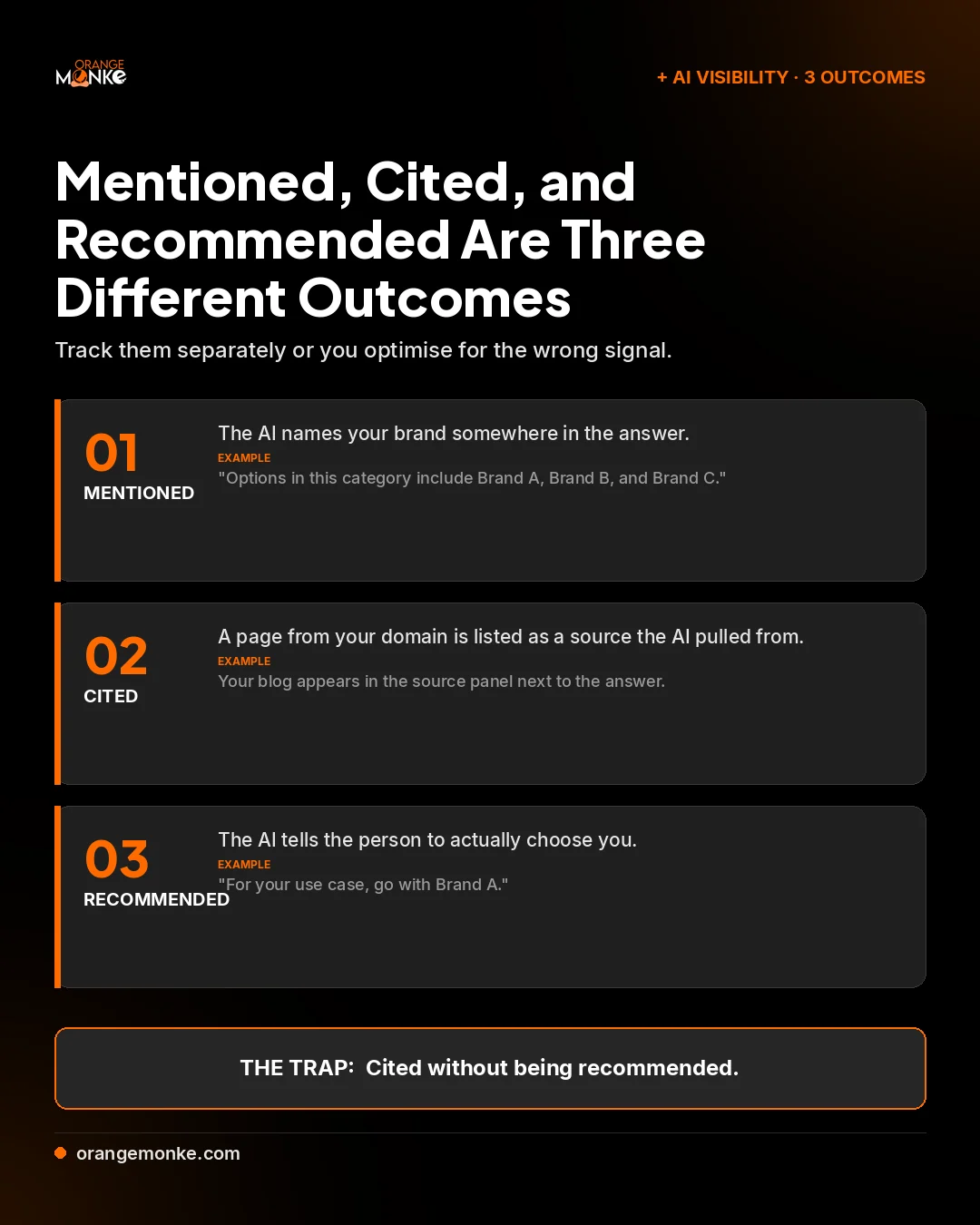
Mentioned means the model names your brand somewhere in the answer, even in passing. Cited means a page from your domain (or a page that features you) is listed in the source panel next to the answer. Recommended means the model actively tells the person to consider you, not just references that you exist.
You can be cited constantly and still lose the sale, because the model pulled a fact from your page and then recommended a competitor in the actual answer. That gap between being sourced and being suggested is one of the more painful patterns brands run into once they start paying attention, and it usually signals that your content is factually accurate but not persuasive enough to earn the final nod. Fixing it is closer to conversion work than to SEO, which is why our reputation management services and our persuasion audit brief often live in the same engagement. Programmes like review monitoring feed both signals simultaneously.
What Five Factors Decide Whether ChatGPT Recommends Your Brand?
Five factors drive whether ChatGPT recommends a brand in 2026: training data brand density, entity representation across platforms, content extractability, brand information consistency, and recency signals. None of them is Google rank position, which is why the traditional SEO scorecard does not predict AI outcomes.
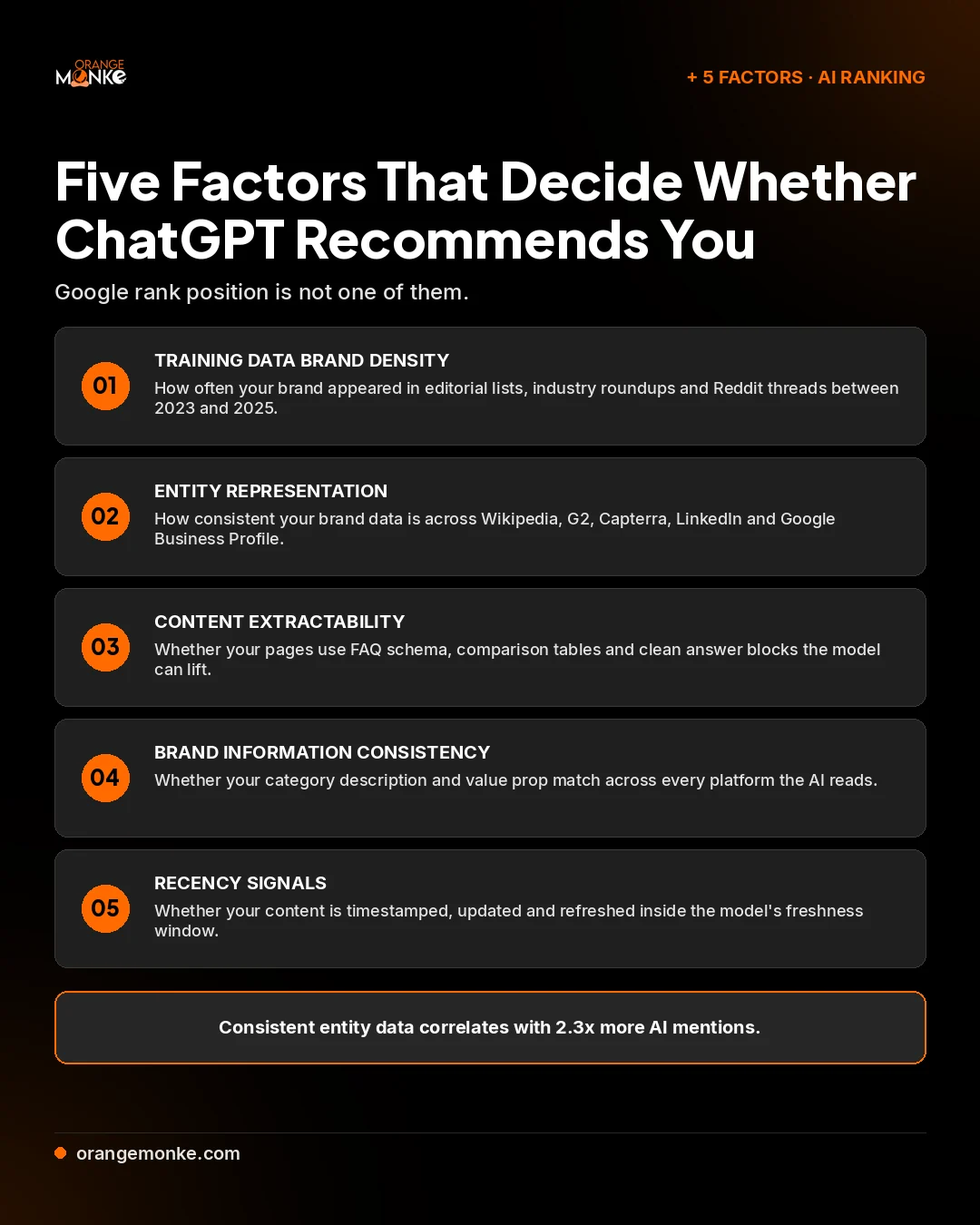
- Training data brand densityBrands mentioned repeatedly in editorial roundups, Reddit threads, and YouTube transcripts during 2023 to 2025 have a structural advantage in current models. That is the primary training window for GPT-5.2, GPT-4o, and every other frontier model shipping in 2026. If your brand was not part of those conversations then, the model has less to draw on now, and you have to compensate through 2026-era third-party density and live retrieval.
- Entity representation across platformsWikipedia, YouTube, Reddit, Amazon, and Google properties account for roughly 38 percent of AI citations in category-level answers. If your brand exists mostly on your own website plus a few backlinked blog posts, you are absent from the ecosystems AI systems sample most heavily. Consistent entity data across your website, LinkedIn, Google Business Profile, and Wikidata correlates in our benchmark with roughly 2.3x more AI mentions than fragmented data does.
- Content extractabilityAI models cite clean, self-contained answer blocks far more often than well-argued prose. A page with FAQ schema, a comparison table, and a 40-to-55-word direct answer under each H2 is dramatically easier for a model to lift than the same information buried in three paragraphs of narrative. Our SEO glossary uses this structure end-to-end, and it earns citations at multiples of the rate our long-form essays do.
- Brand information consistencyWhen your category description, tagline, and core value proposition differ across platforms, the model's internal entity representation goes fuzzy and it defaults to entities it can resolve confidently. If you are a "marketing agency" on one site, a "creative studio" on another, and a "growth partner" on a third, the model has three plausible identities to reconcile and often reconciles by picking someone else. Our social media marketing services and PR workflow now run a monthly consistency sweep across every platform the brand appears on.
- Recency signalsAI systems apply aggressive recency filters to trend-related and buyer-intent queries, sometimes restricting live retrieval to content published in the last week or month. Content that is not timestamped, updated, and refreshed inside the model's freshness window gets skipped for fresher sources, even if the older piece still holds a strong Google rank. This is the same freshness weighting that Google Search profiles lean on, which means the same refresh cadence serves both surfaces. Off-site trust signals like verified reviews and review transparency compound the recency effect.
Audit your top 20 pages against these five factors before commissioning any new content. Most brands find their content extractability and entity consistency scores are lower than they expect, and both are fixable inside a single sprint.
How Do Claude, Gemini, Perplexity, and Grok Differ From ChatGPT?
The five major AI answer engines pull from meaningfully different source sets, weight recency and authority differently, and reward different content structures, so a single "AI visibility strategy" that treats them as interchangeable will underperform on at least three of them. This is the piece most agencies still get wrong.
| Engine | Source lean | What it rewards | Watch-out |
|---|---|---|---|
| ChatGPT | Established publishers, Wikipedia, G2-style reviews | Long-form answer-first with entity signals | Slow to add newer brands |
| Perplexity | Broad web, citation-transparent | Clear numeric claims, timestamps, source attribution | Punishes vague or unsourced copy |
| Claude | Primary sources, technical docs | Depth, precision, conservative recommendations | Slower to name brands at all |
| Gemini | Google surface stack (AI Overviews, AI Mode) | Same E-E-A-T signals as classic Google + query fan-out | Personalisation shifts answers per user |
| Grok | X (Twitter), recent public conversations | Active founder-led social presence, creator mentions | Volatile, hard to control |
Bottom line: your baseline check has to run in all five, in fresh sessions, at least monthly.
The practical implication for a brand serving multiple markets is that a page winning consistently in ChatGPT and losing consistently in Gemini is telling you something specific about your entity signals in Google's ecosystem versus your third-party density elsewhere. For location-heavy categories the mapping is even sharper, and cross-referencing with how to rank first on Google Maps and platform-specific behaviour like the Instagram algorithm pattern gives you a useful triangulation.
You are running Google-only SEO in a dual-search world.
Traditional SEO earned the ranking. It cannot earn the citation. You need both, run as one program.
See our SEO services →What Is Query Fan-Out and Why Does It Change Everything?
Query fan-out is the mechanic behind Google AI Mode where the model decomposes a single user query into up to 16 parallel sub-queries, pulls the best-matching chunk from each of 30 or more sources, and stitches the result into one coherent answer. It is the single biggest reason single-keyword optimisation now underperforms topic-cluster optimisation.
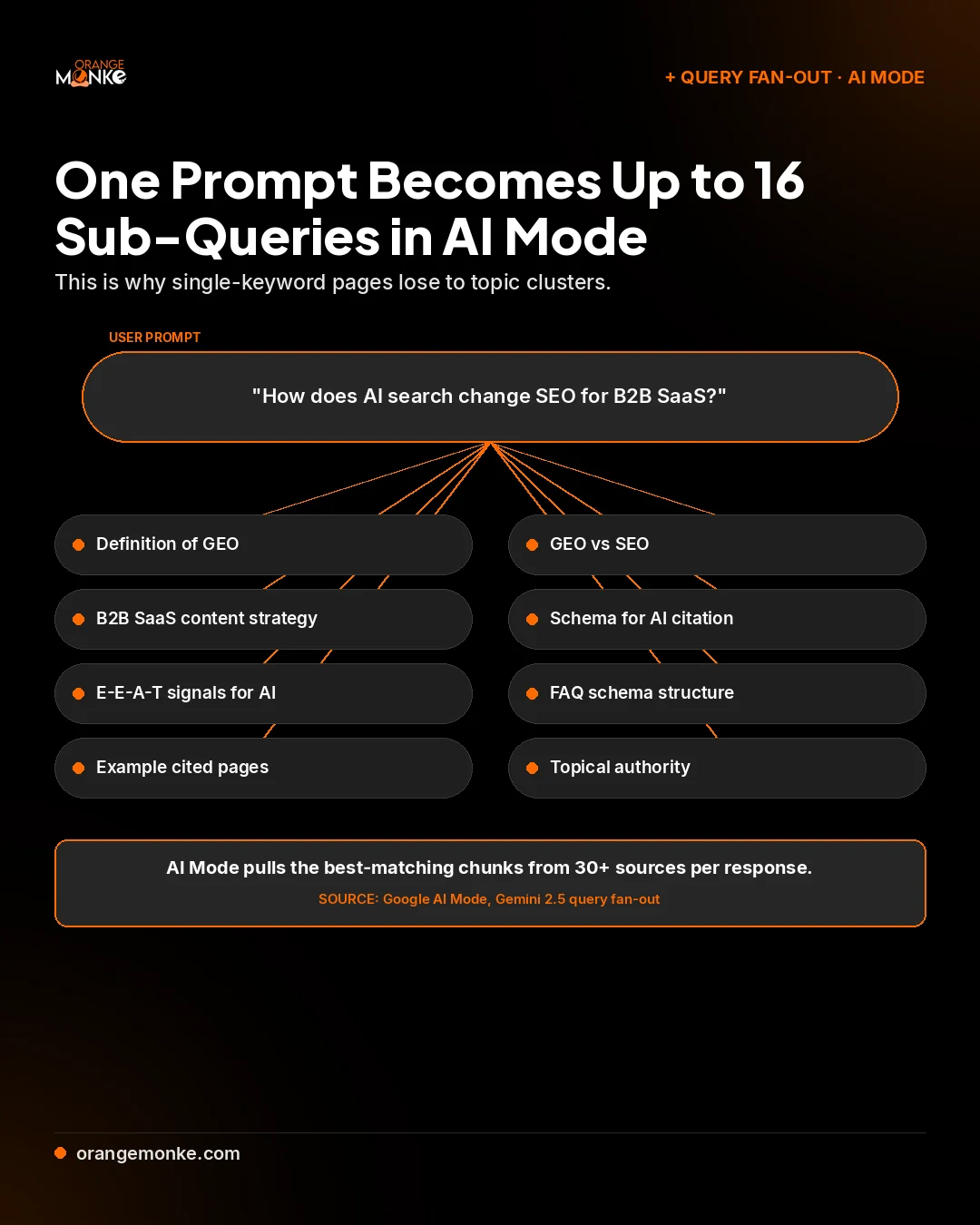
Take a query like "how does AI search change SEO for B2B SaaS?" Gemini might simultaneously search the definition of GEO, how GEO differs from SEO, B2B content strategy for AI search, schema requirements for AI citation, examples of AI-cited SaaS content, FAQ schema structure, E-E-A-T signals for AI, and topical authority mechanics, then pull the best-matching text chunk from each and stitch them into one answer with inline citations. A page that only optimises for the head query will appear in maybe one of those sub-queries. A pillar page supported by 8 to 12 cluster articles can appear in most of them.
Two strategic implications follow. First, cluster architecture is not optional for AI Mode; it is the entry ticket. Second, personalisation matters more than for classic search. AI Mode uses roughly 70 days of the user's history to personalise responses, so the same query returns different answers for different people. Sites that appear across multiple touchpoints in a topic cluster are far more likely to be recommended as a personalised match. This is exactly the pattern we use when we help brands map their target audience before commissioning any content work.
How Do You Check Your Brand's AI Visibility in One Afternoon?
Run 20 to 30 real buyer prompts in fresh logged-out sessions across ChatGPT, Perplexity, Claude, Gemini, and Grok, log four data points per answer, and repeat monthly. The exercise takes a focused afternoon the first time and about 45 minutes a month after that.
Group your prompt set into four buckets, aiming for roughly equal weight:
- Evaluation prompts"best category tool for [use case]" , tell you whether you exist in the consideration set at all.
- Comparison prompts"[your brand] vs [competitor]" , show how the model frames you head to head.
- Reputation prompts"is [your brand] worth the price?" , surface the sentiment and stale claims the model is repeating.
- Gap promptsspecific competitor consistently owns the answer , tell you exactly where to focus content and PR effort next.
For each prompt, log four things: whether you were named, what the model said about you (accurate, vague, outdated, negative), which competitors appeared and in what order, and which sources the answer cited when search mode surfaced them. That last column is your target list for third-party placement. Run every prompt in a fresh logged-out session so you are seeing what an actual prospect sees, not what the model remembers about your last 40 chats. Combine the exercise with a proper SEO and PPC integration review to see whether your paid channels are compensating for or masking the AI gap.
What Does a 12-Week AI Visibility Engagement Actually Look Like?
A full Orange MonkE AI visibility engagement runs over 12 weeks in four phases: a two-week audit, four weeks of entity and technical fixes, four weeks of third-party placement and content restructure, and two weeks of measurement and handover. The median time to a first measurable mention lift in our data is 10 weeks, so 12 weeks is when the first delta becomes reportable rather than anecdotal.
- Weeks 1 to 2: AuditRun the 25-prompt baseline across five engines, pull cross-platform entity data (website, LinkedIn, GBP, Wikidata, G2, Capterra, industry directories), and produce a gap map that names every third-party source appearing in competitor answers where the brand is absent. This is where we also stress-test the MarTech consultation stack so measurement is not blocked by broken tracking.
- Weeks 3 to 6: Entity and technical fixesConsistent brand name, tagline, category description, and value proposition across every platform we found the brand on. Wikidata submission where eligible. Schema markup (Article, FAQPage, Person, Organization) added or corrected. llms.txt at root. Crawler access reviewed for Googlebot and Google-Extended. Core Web Vitals brought inside thresholds. Any automation and AI agents work needed to keep the platform updates from drifting again is scoped here.
- Weeks 7 to 10: Placement and content restructureGuest posts, category roundups, review-platform completion, and digital PR pitched at the exact sources the AI engines cited when naming competitors. In parallel, we restructure the top 8 to 12 commercial pages on the site to lead with a 40-to-55-word direct answer under every H2, add FAQ schema, add comparison tables where the topic supports them, and build the pillar-plus-cluster architecture query fan-out rewards. Recent core update guidance from Google shaped how aggressive we are with the restructure.
- Weeks 11 to 12: Measurement and handoverRe-run the 25-prompt baseline, produce a lift report against week 1, and hand over the monthly measurement rhythm to the client's in-house team or to us on retainer.
Across the engagements we have run to date, the median time to a first measurable lift in AI mentions is 10 weeks. The 12-week programme window gives us two extra weeks of measurement so the delta is defensible, not anecdotal.
How Do You Get Onto the Third-Party Sources AI Models Trust?
You get onto the third-party sources AI models trust by identifying the five to ten sources that already show up when the engine cites your competitors, then earning a presence on each one through directed digital PR, guest posts, review platform completion, and Wikipedia or Wikidata submission where eligible. The list is not universal. It is category-specific and answer-specific.
The mistake most brands make is treating third-party placement as generic PR outreach. It is not. Your target list is not the top 100 industry publications; it is the five to ten domains that appeared in the source panel when the AI engine named a competitor instead of you. That is a much shorter list and a much more actionable one. Review platforms deserve special attention because AI models sample them heavily for buyer-intent queries: G2, Capterra, and Trustpilot for B2B software, Yelp and Google Reviews for local, industry-specific directories for regulated categories.
Reddit is its own case. LLMs cite Reddit heavily for practitioner-level answers because the training corpus is dense with genuine user opinion. Helpful, non-promotional participation in relevant subreddits over months builds entity signals that feed into AI recommendations in a way no other single channel does. Ignore this at the cost of visibility for exactly the queries most likely to convert. If your brand serves buyers where community trust matters most, use approaches like SEO for therapists as a template for how a regulated, referral-heavy category earns citations without violating platform norms.
How Do You Structure Your Own Pages So AI Can Extract Them?
Structure every important page around answer-first blocks: a bolded 40-to-55-word direct answer under every H2, clean heading hierarchy, comparison tables where the topic supports them, FAQ schema on any question a buyer might ask, and one clear takeaway sentence after every table. This is the layer AI engines lift from, and it is the same structure that earns featured snippets on classic Google.
- Bolded answer-first leadFirst sentence under a heading answers the heading directly, in the reader's language, in one to two sentences. Then explain, then expand, then move on. Never open a section with context-setting or transition prose; the model will lift the first clean answer it finds, and if that answer is throat-clearing, you have wasted your citation shot.
- Table setup + takeawayTables get a one-sentence set-up before them and a one-sentence takeaway after them so the model has both a chunk to extract and a summary to paraphrase.
- Non-negotiable schema stackArticle or BlogPosting, FAQPage, Person, and Organization are the minimum viable stack for AI citation. Validate every schema with Google's Rich Results Test before every publish; a schema with errors provides zero benefit.
- Quarterly refresh cadenceRefresh every commercially important page quarterly, update the dateModified in schema, and add at least one new data point or example with every refresh. The same discipline that keeps a page ahead of a meta-keywords-era mindset keeps it inside the AI freshness window.
The pattern is boringly consistent because it works. Every element above is scored by the same signals that AI models use to decide which chunk to lift into an answer.
What Does AI Visibility Look Like in the UAE and India Markets?
AI visibility in the UAE and India shows the same architectural gap as the US and UK, but with two extra layers of complexity: bilingual buyer behaviour and disproportionate weighting of local Reddit, WhatsApp, and regional review sources that Western optimisation playbooks miss. The core mechanics do not change; the source list does.
| Signal | UAE | India |
|---|---|---|
| Language split | 65-70% English, 30-35% Arabic (category-dependent) | English for B2B; regional languages rising in D2C, education, healthcare |
| Priority citation sources | Khaleej Times, Gulf News, Gulf-specific directories | YourStory, Inc42, Entrepreneur India (SaaS); Justdial, Sulekha (local) |
| Community weight | LinkedIn strong; region-specific subreddits growing | India-specific subreddits cited more than Western agencies expect |
| GBP behaviour | English + Arabic completeness moves local pack visibility | English + regional language for D2C moves category rankings |
| Priority fix | Dual-language site presence + regional review platforms | Regional directory presence + community participation |
Bottom line: same architectural gap, different source list. Cloning a US playbook into either market misses roughly a third of the actual citation surface.
In the UAE, ChatGPT's Arabic answers pull from a meaningfully different source set than its English answers for the same query, so brands optimising only in English are invisible to the Arabic-native share of demand. Google Business Profile completeness in both English and Arabic materially changes local pack visibility, and that in turn affects the sources Gemini pulls from when a buyer asks about a service in Dubai or Riyadh.
India shows the same bifurcation but weighted differently. English dominates B2B prompts, but regional languages appear increasingly in D2C, education, and healthcare queries. Our full SEO localisation guide covers the hreflang, currency, and dialect calibration that make this work at scale, and it applies almost identically to AI visibility across both markets.
How Do You Measure Whether Any of This Is Actually Working?
Measure AI visibility through a stable 25-prompt monthly baseline, a citation-source tracker, and an AI-attributed pipeline metric in your CRM, alongside your normal organic dashboard. Anything less is anecdote; anything more usually collapses under its own weight in month three.
The monthly baseline is the load-bearing metric. Same 25 prompts every month, same five engines, same fresh-session protocol, logged in a spreadsheet with rows for mentioned, cited, recommended, and competitors named. Trend the four numbers monthly. Never change the prompt set inside a measurement window; if you must add prompts, hold the original 25 stable and add a second cluster you track separately. Adding prompts inside the base set to make the trend look better is the AI-visibility equivalent of moving the goalposts, and it destroys the signal you are trying to read.
The citation-source tracker is a running list of the third-party domains the engines cited when they named you or a competitor. Rank them by frequency. That list is your PR and content distribution plan. The AI-attributed pipeline metric is trickier: implement UTM tagging on your Google Tag Manager setup for AI-referrer traffic, self-report source in your form ("how did you hear about us?" with an AI option), and cross-reference with the Google Analytics traffic patterns that emerge when AI referrals start converting. The pattern to watch: rising branded search volume alongside stable direct traffic is a leading indicator that AI mentions are working, even before you can attribute individual conversions cleanly. It is the same underlying discipline we cover in our March 2026 spam update analysis: the algorithms reward the same signals the AI engines reward, and the same measurement rhythm serves both.
Conclusion
The paradox is not going away. Google will keep improving its ranking algorithm, ChatGPT and Perplexity and Claude and Gemini and Grok will keep improving their synthesis, and the two systems will keep drifting further apart on which brands they decide to elevate. The brands that win the next five years are the ones that stop treating "search visibility" as one metric and start managing it as two: a ranking programme for Google's blue links, and a citation programme for AI answer engines, running as one integrated strategy but measured on separate dashboards.
At Orange MonkE, we help founders and marketing leaders close this gap through a structured 12-week engagement that pairs traditional SEO with AI visibility engineering. If you want to see where your brand actually sits across the five major AI engines today, our team runs the 25-prompt baseline audit as the first step in every AI visibility programme. It takes 48 hours, costs nothing, and gives you a defensible number to argue for budget against. Book the call if that is useful.
Find out where ChatGPT, Perplexity and Google AI Mode are already citing your competitors.
Our AI SEO team runs a 25-prompt baseline audit across five AI engines, then builds the entity and content fixes that close the gap.
Book an AI visibility audit →Frequently Asked Questions
No, ChatGPT does not read Google's ranking positions when it decides what to say, and independent studies show almost zero correlation between where you rank on Google and where you appear in ChatGPT's answers.
- The overlap is small. Only about 12 percent of AI citations across ChatGPT, Gemini, Copilot, and Perplexity also appear in Google's top 10 for the same query.
- Correlation is near zero. The Chatoptic 2025 study found the statistical correlation between Google rank and ChatGPT recommendation order came in at 0.022 to 0.034, statistically indistinguishable from random.
- ChatGPT samples, it does not rank. Even when the model does search the web, it samples from roughly the top 20 results and writes an answer, rather than reproducing the ranking order.
The practical consequence is that traditional SEO alone will not carry you into AI answers. If you already invest in AI SEO tools, that is a good starting stack; layering entity work and third-party placement on top is what closes the gap.
The median time to a first measurable lift in AI mentions after entity and content fixes is about 10 weeks in our benchmark, which is faster than most Google SEO timelines but still needs a structured programme rather than a one-off patch.
- Weeks 1 to 6 are set-up. Entity work, schema, third-party placement pitches, and content restructure land in this window with no visible lift yet.
- Weeks 7 to 10 show first movement. Newly published third-party mentions start appearing in citation panels, and restructured pages get lifted into answer synthesis.
- Weeks 11 onwards compound. As the source ecosystem catches up with the fixes, the same query starts naming your brand more consistently across engines.
Speed varies by category, how fragmented your current entity data is, and how quickly your PR team can land placements on the target sources. See how AI Overviews and AI Mode actually work for the underlying mechanics.
Whether to hire out or run it in-house depends on how much of the third-party placement and multi-engine measurement discipline your team can carry weekly, not on the technical difficulty of the entity and schema work itself.
- In-house works for the technical layer. Schema markup, llms.txt, Core Web Vitals, and content restructure are all doable by a competent in-house SEO or dev team with the right brief.
- Agency helps most on placement. Landing your brand on the specific third-party sources AI engines cite is a directed PR programme, and it lives or dies on relationships and cadence.
- Measurement discipline is the hidden cost. Running the 25-prompt baseline monthly across five engines, logging four metrics per answer, and turning the citation-source log into a rolling PR target list is where most in-house programmes stall.
The cleanest split we see: technical and content work in-house, third-party placement and monthly measurement with an agency partner. For a walkthrough of how we structure the engagement inside our AI SEO services, see the 12-week outline above.
Prioritise the 8 to 12 pages that already earn the most commercial-intent traffic or the most AI citations right now, because the marginal return on restructuring an already-cited page is dramatically higher than on rebuilding a page the model has never quoted.
- Start with your top commercial pages. Service pages and comparison posts that rank in Google's top 5 for buyer-intent queries are your fastest wins in AI Overviews and answer engines.
- Then hit currently-cited pages. Any page that already appears in a Perplexity or ChatGPT source panel is one clean rewrite away from being lifted more consistently.
- Build clusters around the winners. Once a pillar page starts earning citations, 8 to 12 supporting articles feed query fan-out and multiply the coverage per topic.
The wrong instinct is to start with a from-scratch pillar on the assumption that AI needs new content. AI usually needs better versions of what already ranks. See our comparison-driven pages for how we structure this in a commercial category.
Ecommerce brands see the same gap but with a sharper conversion penalty, because AI answer engines are increasingly making product recommendations directly inside the interface and the buyer never reaches the product page to convert.
- Product-level entity data matters. Consistent product names, categories, and specs across your site, marketplaces, and review platforms are the ecommerce equivalent of brand consistency.
- Review platforms are the source layer. Trustpilot, Yotpo, and category-specific review sites feed the recommendations AI engines make; incomplete review presence directly costs conversions.
- Comparison pages punch above their weight. A well-structured comparison table is the single most cited content format for ecommerce buyer queries in our client data.
The platform choice itself has an entity implication too; see Shopify vs WordPress for how the underlying stack affects extractability and structured data support out of the box.
AI visibility and paid media are complementary rather than substitutable, and the strongest performing accounts we run pair rising AI citation share with a lean paid programme rather than treating either as a replacement for the other.
- Paid buys speed; AI earns default status. Google Ads and Meta Ads deliver measurable traffic in days; AI visibility takes weeks but compounds and does not disappear when spend pauses.
- Ad benchmarks help calibrate expectations. Knowing what a healthy CPC and ROAS looks like in your category tells you how much AI-driven pipeline you actually need to move the needle.
- Cross-channel measurement is where most teams break. Attributing an AI-referred lead correctly requires UTM discipline, self-report on forms, and a CRM that respects the difference between direct, branded search, and AI-attributed touchpoints.
The 2026 Facebook Ads benchmarks give you a calibrated view of the paid side of the picture, which pairs well with a rising AI-attributed pipeline as an early lead indicator that entity work is producing revenue.
The gap is permanent by design, because Google's ranking engine and ChatGPT's synthesis engine are optimising for different tasks, and no amount of refinement in either system will reconcile them into a single metric.
- Different tasks, different outputs. Google returns ten links for a person to choose from; ChatGPT returns one answer built from a handful of sources, and those two outputs will never be scored the same way.
- Different training cadences. Google indexes the live web continuously; frontier LLMs retrain periodically with fixed cutoffs, so the freshness models will always diverge.
- Different accountability surfaces. Google publishes ranking guidance and reads it back through the SEO ecosystem; AI answer engines mostly do not, which means the two disciplines will evolve on different timelines.
Plan for two parallel disciplines running under one strategy. That is the same conclusion we drew in the 2026 US agency landscape review, and it is holding up across every category we work in.