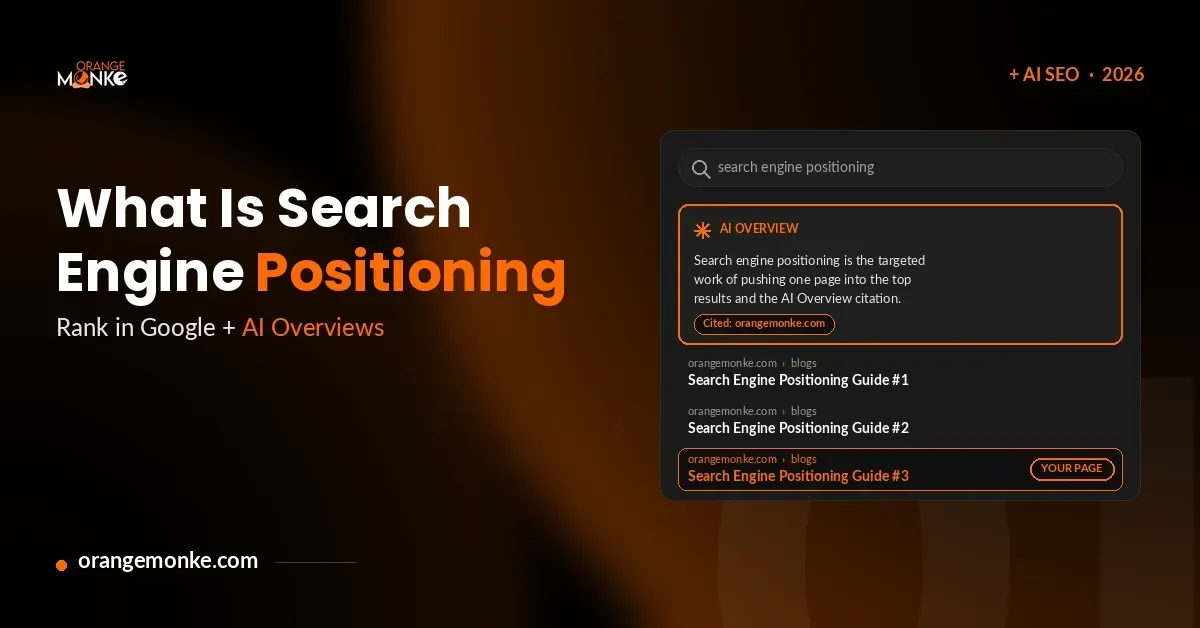
Search engine positioning is the work of getting one page to appear as high as possible on Google for one search term, including inside Google's AI Overview answer box. It is the part of SEO that focuses on a single page at a time, and in 2026 it decides whether readers ever see your page or click one above it.
Search engine positioning is the work of getting one page to appear as high as possible on Google for one search term. In 2026 that also means getting the page mentioned inside Google's AI Overview, the short answer box that now sits above the classic blue links.
It is different from broader SEO. SEO improves your whole website over months. Positioning targets a single page and one keyword, and often shows results in weeks because the page already exists and Google already knows it.
Success in 2026 comes down to three things.
- Classic Google rankingsGoogle's usual signals still work. Match the search intent, cover the topic in depth, link the page from other strong pages on your site, and make sure it loads fast.
- AI Overview mentionsGoogle's AI answer box picks pages that answer fast, add original insight, and stay current. Only 38 percent of the pages it quotes also rank in the top 10.
- Fewer clicks to go aroundAI Overviews now show up on about half of all searches, and when they do, the top-ranked result loses more than half its clicks.
This guide explains what search engine positioning is, why it matters more in 2026, and how to improve your pages so they win both the Google ranking and the AI Overview mention.
What Is Search Engine Positioning (SEO)?
Search engine positioning is a specific kind of SEO work. You pick one page, you pick one search term, and you make small, focused changes to push that page higher on Google for that term. It is sometimes called web search engine positioning or your search engine ranking position, but the meaning is the same.
Think of it like this. SEO improves the whole website. Positioning improves one page. SEO is a long game across everything you publish. Positioning is a short, sharp push on a page that already has a chance of ranking.
What changed in 2026 is what a "top spot" actually means. Type a question into Google today and you often see an AI Overview at the top, a video carousel, People Also Ask, and sitelinks before you ever reach a normal blue link. Positioning is no longer just about the number-one link. It is about winning any of those slots for your target keyword, especially the AI Overview mention. Our breakdown of 2026 SEO trends shows how the result page has changed.
Search Engine Positioning vs SEO
Positioning and SEO are not the same thing. SEO is broad and slow. Positioning is narrow and fast. The table below lays out the difference so you know which one you actually need for the job in front of you.
| Search Engine Positioning | SEO | |
|---|---|---|
| Focus | A few specific pages and keywords | The entire website |
| Scope of work | On-page edits, internal links, answer formatting | Architecture, technical health, content, links, UX |
| Timeline | Days to weeks, since the page is already known to Google | Around 3 to 12 months across the site |
| Goal | Own the result page for one target term | Lift overall visibility and authority |
| 2026 layer | Win the AI Overview citation for that term | Build the site-wide trust that makes citation possible |
Positioning is the fast, page-level work; SEO is the slow, site-wide foundation that makes it possible.
You cannot position one page well if the rest of the site is weak. If your site is new, or has fewer than a few dozen pages indexed on Google, do broader SEO first. If you are wondering whether SEO still works at all in a world of AI answers, we tackle that head-on in Is SEO Dead in 2026?
Why Search Engine Positioning Matters in 2026?
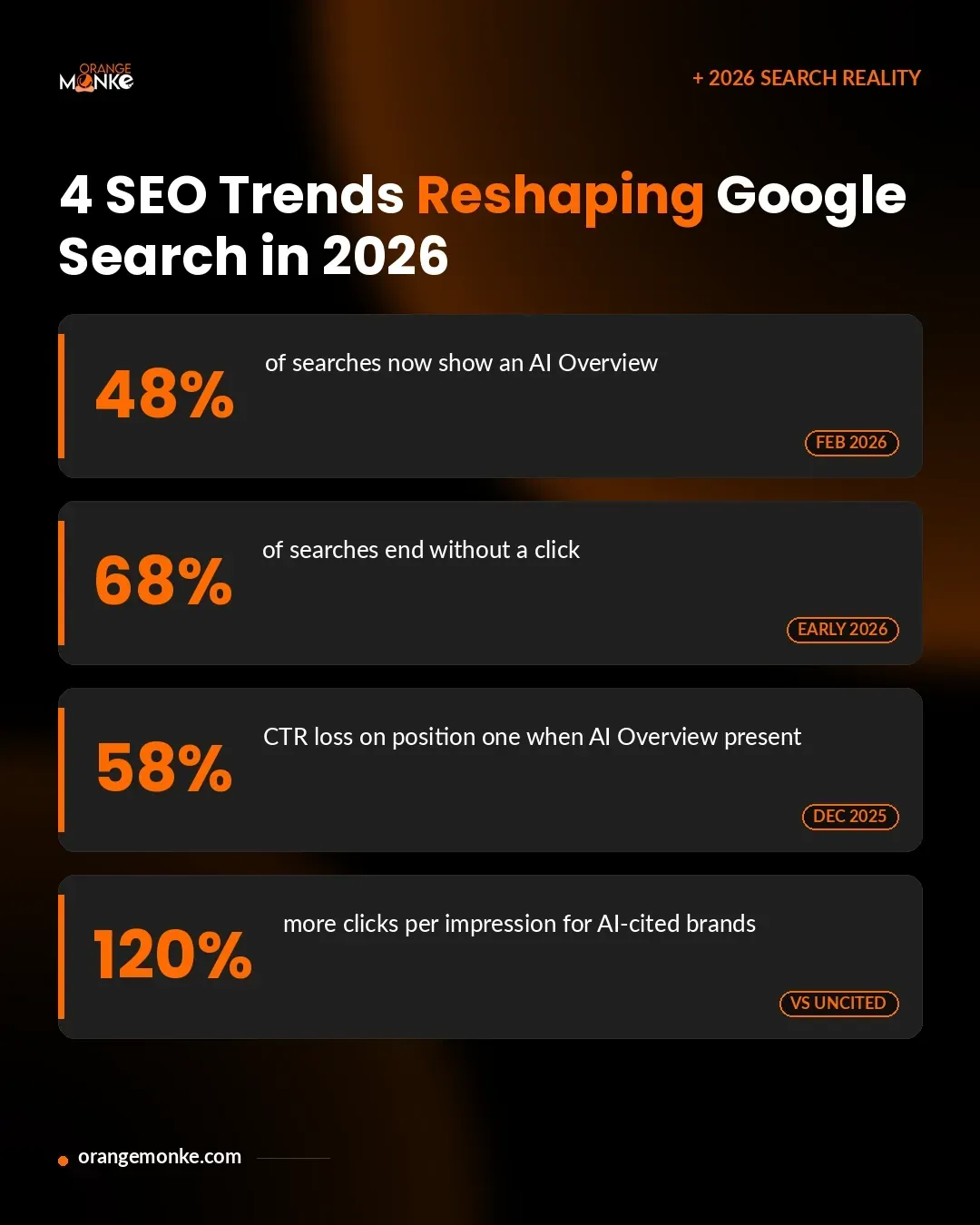
Positioning matters more today than it has in the last ten years. The reason is simple. Google now answers many searches itself, right on the results page, so fewer people click through to any website at all. The clicks that still happen go to the top-placed pages and to the ones Google quotes inside its AI Overview. That makes those spots much more valuable than they were even a year ago. The four numbers below show the shift.
Most Google searches now end without a click
Roughly half of all Google searches now show an AI Overview, and about 68 percent of searches end without anyone clicking through to a website (as of early 2026). Google is answering more questions directly on its own page, so the traffic that still reaches websites is smaller and more concentrated. If your page is one of the ones that still gets seen, it carries far more weight than it did a year ago.
The clicks that remain go to the very top
When an AI Overview shows up on a search, the top result loses about 58 percent of its clicks (as of December 2025), and click-through across the whole page drops by around 61 percent. Whatever traffic is left almost all goes to the highest-placed, most-quoted pages. That is exactly the kind of page positioning targets.
Being quoted in an AI Overview is the new number one
Brands mentioned inside an AI Overview get about 120 percent more clicks per impression than brands not mentioned on the same search. And when someone lands on your site from an AI search tool (ChatGPT, Perplexity, Gemini, or similar), they buy at about 4.4 times the rate of a normal Google visitor. AI users have already done their research inside the chat, so by the time they click your link they are close to a decision.
A top-10 ranking no longer means you get quoted
Only 38 percent of the pages Google quotes in an AI Overview also rank in the top 10 for that search (as of February 2026). A year ago, roughly 76 percent of quoted pages were also in the top 10, so the overlap has fallen sharply. Getting to page one is no longer enough. You have to shape the page to be quotable, which is exactly what positioning does.
As Google gives more of the answer away itself, owning a specific spot for your key search terms is worth more, not less. Investing in SEO in 2026 is really an investment in being visible inside the AI answer, not just under it.
Search Engine Positioning Examples
Positioning is easiest to understand through examples. Here are four common situations that show what the work looks like on a single page.
- A service page stuck on page 2. Your "SEO services" page sits at position 12 on Google, which is the second page. Positioning means tightening the page for the exact term you want to rank for, adding a short answer near the top, and linking to it from your homepage and best blog posts. That work usually pushes the page into the top five, where buyers actually look.
- A blog post just outside the top ten. A guide ranks at position 8. You rewrite the opening as a straight answer to the question, add a section the higher-ranked pages cover that you skipped, and Google's AI Overview starts to quote your page. Both the rank and the visibility go up.
- A "best of" or comparison search. For a term like "best accounting software for small business", positioning means building a page around exactly that comparison, with a clear table, a stated recommendation, and real reasoning. A generic list will not win that search. A page built specifically for it does.
- Two slots on the same result page. A strong page plus a short video on the same keyword can take two spots on the result page, which doubles the space you own for that search. Choose your target with proper keyword research first.
A real example, step by step
Imagine a local plumbing website whose "emergency boiler repair Manchester" page sits at position 11 on Google. Three focused changes lift it into the top three within six weeks. First, the opening line is rewritten as a direct answer to the search question. Second, three of the site's strongest pages link to it, using the exact search term as the link text. Third, the page adds one thing no competitor lists, a plain "what we charge per call-out" price. Google moves the page to position three, starts quoting it inside the AI Overview for that search, and the page's conversion rate roughly doubles because people arriving are already ready to buy. None of that needed new backlinks. It needed careful work on one page.
How Do You Improve Your Search Engine Positioning?
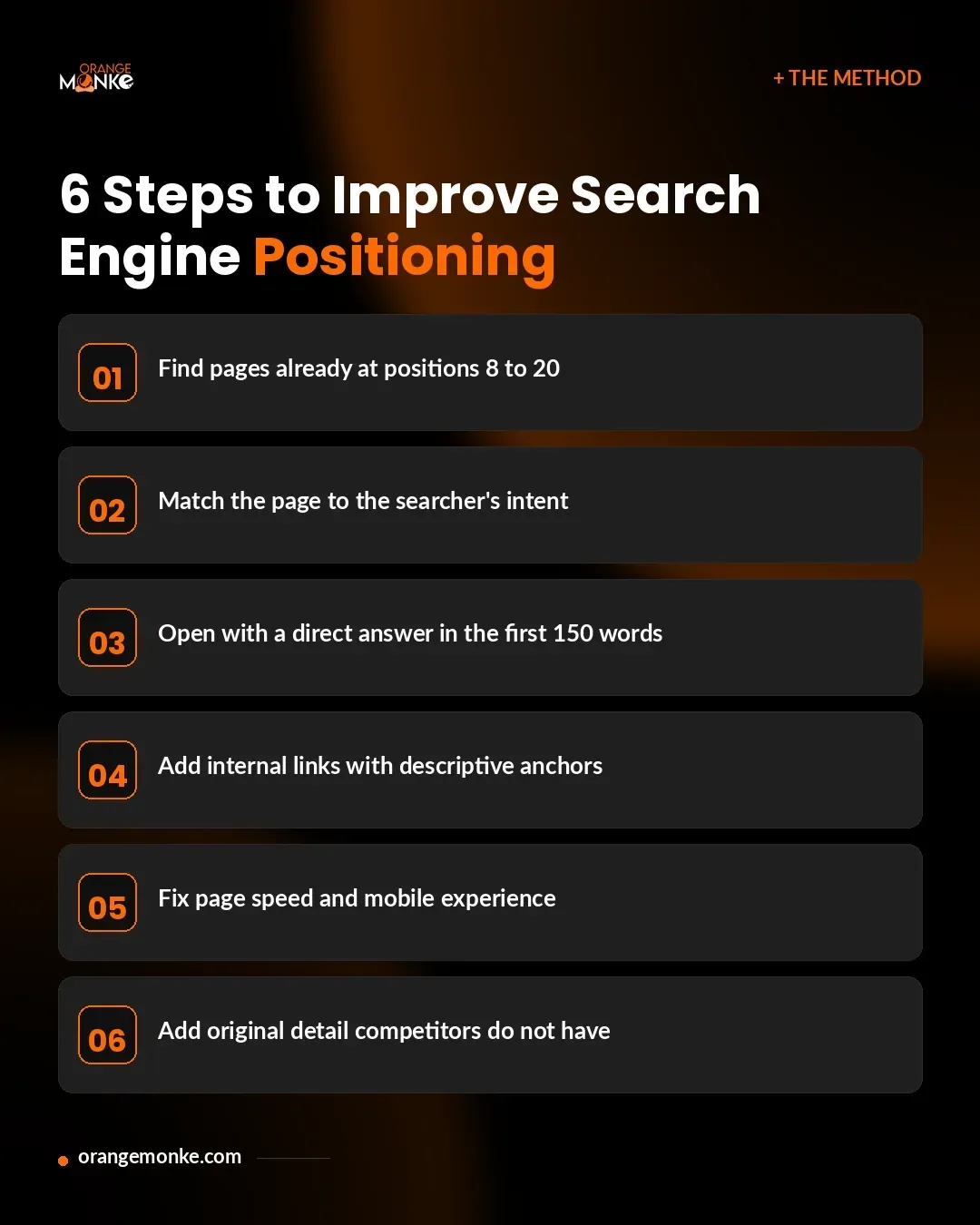
The fastest way to improve positioning is to work on pages that already rank in positions 8 to 20. Google already trusts them, so small, targeted changes can push them into the top five and into the AI Overview. Work through these six steps in order.
Step 1: Find the pages that already sit close to page one
Open Google Search Console, sort your pages by average position, and list every page ranking between positions 8 and 20. These are your best targets. Google already sees them as relevant to their terms, so a small improvement can move them onto page one. Brand-new pages on competitive terms take much longer, so start with what is already halfway there.
Step 2: Match the page to what the searcher actually wants
Search your target keyword and look at the top three results. Are they how-to guides? Product pages? Comparison articles? Whatever format Google is rewarding is the format your page needs to be in. If your page is a how-to but the winning pages are all product pages, no amount of tweaking will fix that mismatch. Reshape the page to match the intent first. We cover this in more depth in what searchers actually want.
Step 3: Rewrite the opening as a direct answer
Put a clear, complete answer to the search question in the first 150 words of the page, then expand. AI Overviews and Google's AI Mode pull their quotes from pages that answer fast. Keep your paragraphs short, two or three sentences, so a machine can lift them cleanly. Our guide to SEO-optimised blog posts that rank shows the full structure.
Step 4: Add internal links with descriptive anchor text
Link to the page you are trying to rank from your strongest related pages, and use the target search term as the link text, not "click here". Internal links pass authority from one page to another and tell Google what the linked page is about. Two or three of them often move a page more than a month of other work.
Step 5: Fix the basics that hold rankings back
Slow pages and clunky mobile layouts drag rankings down even when the writing is strong. Compress large images, remove scripts you do not use, and check that the page loads comfortably on a phone. Speed and mobile experience alone will not lift a weak page, but they remove a ceiling on a good one.
Step 6: Add something the other results do not have
Give the page one thing no competitor has published, a first-hand example, a number you have measured, a real screenshot, or a strong opinion. Original detail is also what makes AI Overviews harder to replace, because a machine cannot summarise what does not exist anywhere else. This is the step that turns a page from "good" into "the one Google trusts most".
Where a search term is important right now, run paid ads on it while you work on the organic positioning. Paid coverage catches the traffic today while your positioning changes take hold over the following weeks. See our guide to search engine marketing for how to combine the two.
Your priority pages can climb faster with the right hands on them
The six-step work, done by senior SEOs who position pages into both the top results and the AI Overview every week.
Talk to our SEO team →Why Is Your Page Stuck?
Most stuck pages fail for one of five reasons. The table below matches a symptom you can see inside Google Search Console to the most likely cause, plus the quickest fix. Find the row that describes your page, then apply the fix in the third column.
| Symptom | Likely cause | Fix |
|---|---|---|
| Indexed but stuck at position 8 to 20 | Page is close but under-optimised for the term | Tighten the opening to a direct answer, add a missing subtopic, strengthen internal links |
| Ranks well but gets few clicks | An AI Overview or featured snippet is taking the click | Format for citation, short answer block, clear lists, original detail |
| Was ranking, then dropped after an update | Quality or intent no longer matches the current results | Re-check intent against the live top three, refresh depth and accuracy |
| Brand-new page, no movement at all | No authority or internal links yet | Link from strong related pages, build the wider site first |
| Right keyword, wrong page ranking | Two pages compete for the same term | Consolidate or differentiate, point internal links at the page you want to rank |
Stuck pages are rarely a mystery. Match the pattern, apply the fix, and most pages move within a few weeks.
How Do You Measure and Track Search Engine Positioning?
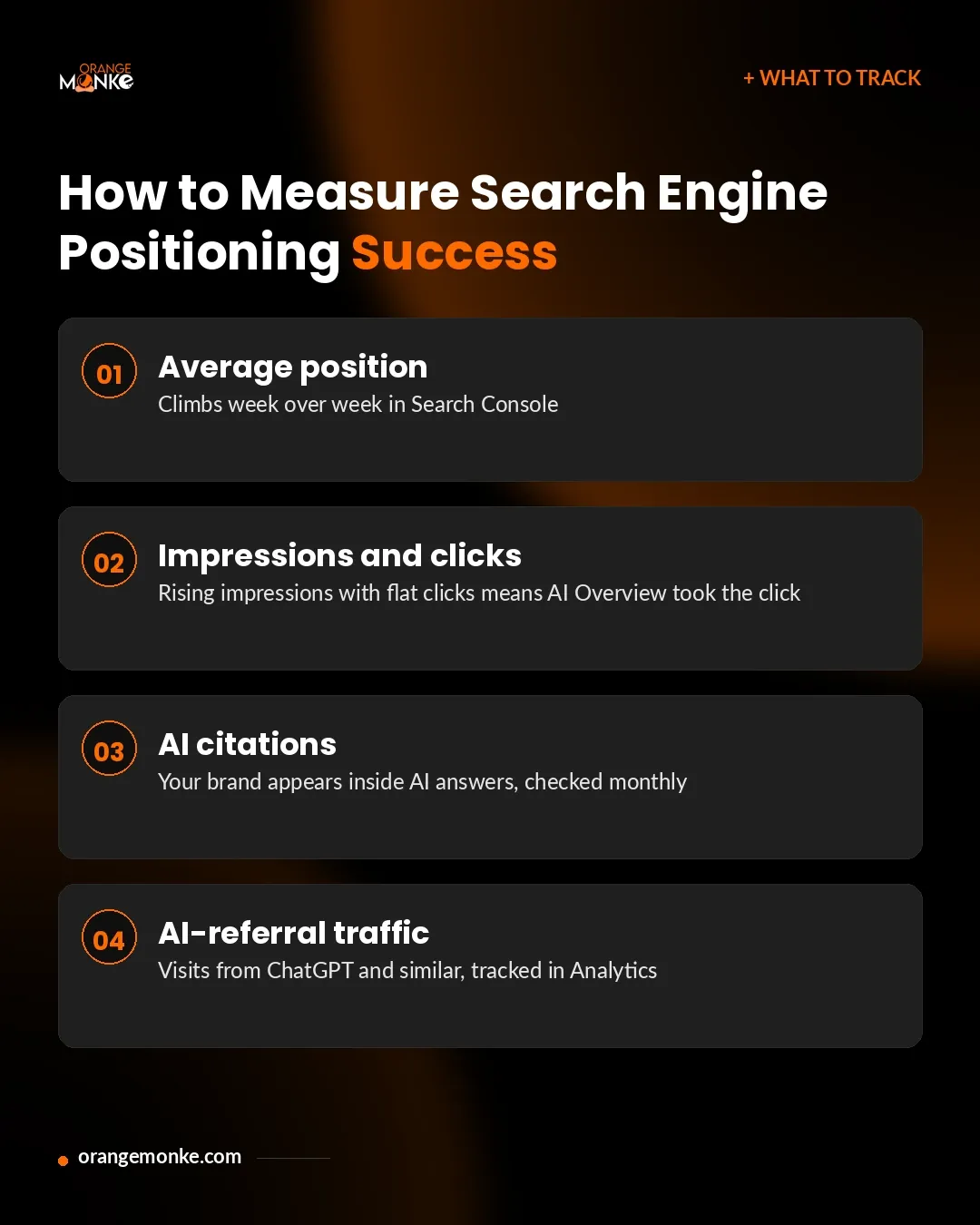
Track your positioning with Google Search Console as your free starting point, and add a rank tracker and an AI-citation checker as you grow. In 2026 you need to watch four things together. No single one of them tells you the full story on its own.
Signal 1, Average position and clicks together
Inside Google Search Console's Performance report, look at average position and clicks together, not separately. A page can hold a strong position and still lose clicks because an AI Overview is answering the question instead. If that is happening, reformat the page so it gets quoted, do not chase the rank higher.
Signal 2, A rank tracker for day-to-day movement
A rank tracker checks your target keywords every day and compares you against competitors, which Search Console cannot do well. A weekly summary is enough for most small sites. You want to see the trend, not react to daily noise.
Signal 3, Impressions as an AI-visibility hint
Search Console counts AI Overview appearances as impressions in web search. So if your impressions are climbing but clicks are flat, you are almost certainly being shown inside an AI answer without getting the click. Treat that as visibility earned, and rework the page to be more clickable.
Signal 4, Direct AI citation tracking
To see whether ChatGPT, Gemini, or Google's AI answers actually quote your page, use one AI-visibility tool and check it monthly. Pair this with Google Analytics to watch how much traffic is arriving from AI assistants. That traffic is now its own channel worth measuring.
What good looks like, a worked example
Picture a page that has climbed from position 14 to position 6 in four weeks, but its clicks are roughly flat while impressions are three times higher. That is the classic signature of an AI Overview eating your clicks. The right move is not to chase the rank higher. It is to reformat the page so the AI answer quotes it, with a short direct answer at the top, a clear table, and one piece of original detail. Then watch whether the citation appears and the click line recovers.
Bottom Line for 2026
In 2026, search engine positioning means winning both the top Google link and the AI Overview mention for the search terms that matter to your business. The websites that win are not the biggest ones. They are the ones that choose the right pages to improve, write answers people can quote, and earn placement one page at a time.
That is the work we do every day. Orange MonkE moves priority pages into the top Google results and into the AI answers your customers read first. Talk to our team about the pages you most want to rank.
Stop watching competitors get cited first
We position your high-value pages for the AI Overview citation, so the readers who do click arrive ready to buy.
Get your positioning audit →Frequently Asked Questions
Search engine positioning is a subset of SEO, not a separate practice. SEO improves your entire website over months, while positioning focuses on a few specific pages and keywords and usually shows results faster, because those pages are already known to Google.
Where they differ:
- Scope. SEO works across the whole site; positioning targets one page and one search term at a time.
- Timeline. SEO usually takes 3 to 12 months; positioning often moves a page in days to weeks because Google already knows it.
- 2026 goal. Both now aim to win the AI Overview citation, not just the blue-link rank.
The two work together rather than against each other, as we cover in our breakdown of AEO vs SEO.
Positioning a page already at positions 8 to 20 usually shows meaningful movement within a few weeks. Brand-new pages on competitive terms take longer, typically a few months, because Google needs time to trust and rank them.
What to expect by starting point:
- Pages at positions 8 to 20. Small, targeted changes can lift them onto page one within a few weeks.
- Brand-new pages. Expect a few months while Google builds trust in the page.
- Starting from zero. Do broader SEO first, following how to start SEO for a small website.
AI Overviews do not replace positioning; they change what positioning aims at. The goal now includes being the page an AI Overview cites, since cited brands earn far more clicks per impression than uncited ones on the same query.
How the target has shifted:
- The old aim. Rank as high as possible in the classic blue links.
- The 2026 aim. Also earn the AI Overview citation, where cited brands get about 120 percent more clicks per impression.
- Same work, wider goal. Clear answers, real depth, and original detail win both slots.
Our breakdown on optimising for Google AI Overviews and AI Mode covers what that looks like in practice.
The fastest way to improve your search engine position is to start with pages already ranking near the top, match each page to what searchers actually want, and rewrite the opening as a direct answer.
The three highest-impact moves:
- Start close to page one. Prioritise pages already sitting at positions 8 to 20.
- Match the intent. Reshape the page into the format Google is already rewarding for that term.
- Answer first. Put a clear, complete answer in the first 150 words so AI Overviews can quote it.
We walk through the exact structure in our guide on writing SEO-optimised blog posts that rank.
Small businesses gain the most from search engine positioning, because it lets a small site win specific high-value terms without competing across an entire industry.
Why it suits a smaller team:
- Focused effort. One strong page can win a valuable term without a site-wide campaign.
- Faster returns. Existing pages near page one move quickest, so results show sooner.
- Lower cost. You improve pages Google already knows rather than building authority from scratch.
If you want help moving priority pages into the top results and the AI Overview, our SEO team does exactly that work.
Search engine positioning cost depends on the term's competition and the work the page already has behind it. A page sitting at position 12 with strong content usually costs less to move than a brand-new page on a high-volume keyword, because the foundational work is already done.
Three factors drive the price:
- Page condition. A strong page near page one is cheaper to lift than a thin or new one.
- Keyword competition. High-volume, competitive terms need more work and more budget.
- Existing foundation. Where the content and links already exist, the remaining work is smaller.
Our breakdown of how much SEO costs goes into the ranges in detail.
Do search engine positioning in-house if your team has the time to diagnose pages, rewrite openings, and track placement week to week. Hire an agency when you need the work done faster than your team can handle, or when you need senior judgement on which pages to pick.
A quick way to decide:
- In-house fits when. You have the time to diagnose pages, rewrite openings, and track placement weekly.
- An agency fits when. You need the work done faster, or need senior judgement on which pages to prioritise.
- Either way. The method is the same six-step process, applied to the pages that matter most.
Our SEO services team builds positioning programs for both situations.
Search engine ranking is where a page sits on the result page; search engine positioning is the deliberate work of moving it there. Ranking is the outcome, positioning is the practice.
Put simply:
- Ranking. The position your page currently holds for a search term.
- Positioning. The deliberate, ongoing work that moves the page to that position.
- Why it matters now. In 2026 the target includes the AI Overview citation, not just the blue-link rank.
Our piece on whether SEO is dead in 2026 explains why this distinction matters more now than it used to.