Search engine optimisation (SEO) in 2026 blends classic Google ranking factors with new AI search optimisation. This SEO glossary explains 154 key terms in plain English, grouped into ten simple categories, for marketers, founders and writers working across Google and AI tools like ChatGPT and Perplexity. Think of it as a quick SEO dictionary you can scan in seconds.
SEO has always been full of jargon, and 2026 added a whole new set of AI terms on top. Today a marketer has to know everything from older ideas like Core Web Vitals to newer ones like AI Overviews and generative engine optimisation. That is a lot of search engine optimization terms to keep straight, and fresh SEO terminologies show up every year.
This glossary explains the terms that actually matter, in plain English. These SEO glossary terms are grouped by topic, not A to Z, so related ideas sit together, which makes the SEO vocabulary easier to learn. Here is how to get the most from this glossary for SEO:
- Jump, do not read end to end: use the contents list above, or press Ctrl or Cmd plus F, to land on any term in seconds.
- Start where you work: marketers and founders get the most from AI Search, Content and Local; practitioners live in Technical, Links and Algorithm Updates.
- Bookmark and return: keep it open during audits, briefs and content planning, and come back whenever an unfamiliar term shows up.
Here Is Our SEO Glossary
Here is our full SEO glossary: 154 terms across ten categories, each explained in one simple line. Start with the category that matches your work, or use the contents list to jump straight to a term. Every definition is written to be read fast, so you get the meaning and move on.
Search Engine Basics
Search engine basics are the first things to learn in SEO: how search engines find, store and show your pages.
These basic SEO terms explain how a page travels from your site to the results, the search engine optimization basics that everything else builds on. If you learn one part of this search engine glossary, make it this one, because good search engine positioning starts here.
- CrawlingHow search engines discover pages, following links and reading sitemaps to queue new URLs for fetching.
- IndexingStoring a crawled page in the search index so it can be returned as a result. A page can be crawled and still never indexed.
- RenderingThe stage where the engine runs a page's JavaScript and builds the final DOM it actually indexes.
- SERPThe search engine results page: the mix of organic listings, ads and features a user sees after a query.
- QueryThe words a person types or speaks into a search engine. The engine reads its intent and expands it with related terms.
- Search intentThe goal behind a query, usually informational, navigational, commercial or transactional. Matching it is the single biggest ranking lever.
- robots.txtA file at your site root that tells crawlers which paths they may fetch. It controls crawling, not indexing.
- SitemapAn XML file listing the URLs you want found, with optional metadata like the last modified date. It assists discovery.
- noindexA directive that keeps a page out of the index even though engines may still crawl it.
- nofollowA link attribute asking engines not to pass authority through the link. Google now treats it as a hint rather than a rule.
- Organic resultA listing earned through relevance and authority rather than paid for, as opposed to an ad.
- SERP featureAny result beyond the ten blue links, such as a featured snippet, People Also Ask box, image pack or knowledge panel.
- Click-through rate (CTR)Clicks divided by impressions. The clearest read on how appealing your snippet is in the results.
- ImpressionOne appearance of your result on a results page, whether or not anyone clicked it.
- PositionWhere your result ranks on the page, averaged across impressions in Google Search Console.
- GooglebotGoogle's main crawler. It works mobile-first, so the mobile version of your page is the one that gets indexed.
On-Page SEO
On-page SEO is everything you can change by editing a page yourself: its title, headings, links, images and URL.
These are the signals you fully control. Get them right once and every new page keeps the habit, which is what good on-page SEO work comes down to.
- Title tagThe clickable headline shown in the results and browser tab. Still one of the strongest on-page signals.
- Meta descriptionThe summary under your title in the results. Not a direct ranking factor, but it heavily shapes click-through rate.
- H1The main heading on a page. One per page, mirroring what the page is actually about, remains best practice.
- Heading tags (H2 to H6)Sub-headings that form the document outline, helping readers scan and engines understand structure.
- Alt textThe text description on an image, used by screen readers and image search to understand what the image shows.
- Internal linkingLinks between pages on your own site. They pass topical context and authority to the pages you want to rank.
- URL slugThe readable final part of a URL. Short, accurate slugs beat long parameter strings.
- Canonical tagA tag that names the preferred version of a page when duplicate or near-duplicate URLs exist.
- HreflangAn attribute that tells engines the language and region a page targets, used for international SEO.
- Meta keywordsA legacy tag for declaring page keywords. Google has ignored it since 2009, so we cover the meta keywords tag and why to skip it separately.
- Open Graph tagsMeta tags that control how your page looks when shared on social platforms.
- Anchor textThe clickable words of a link. A strong topical signal for both internal and external links.
- Keyword stuffingForcing a target term in beyond natural use. A black-hat spam signal, not a ranking tactic.
- Descriptive URLA URL that tells a human what the page is about, like /blogs/seo-glossary rather than /?p=1234.
- Orphan pageA page with no internal links pointing to it, which crawlers and readers can easily miss.
- Content refreshUpdating an existing page with current data, examples and links so it stays accurate and keeps ranking.
Technical SEO
Technical SEO is the speed, code and structure layer that decides whether search engines can read and trust your pages.
Think of it as the plumbing behind the site. When rankings drop for no clear content reason, the problem usually hides here, which is where technical SEO earns its place.
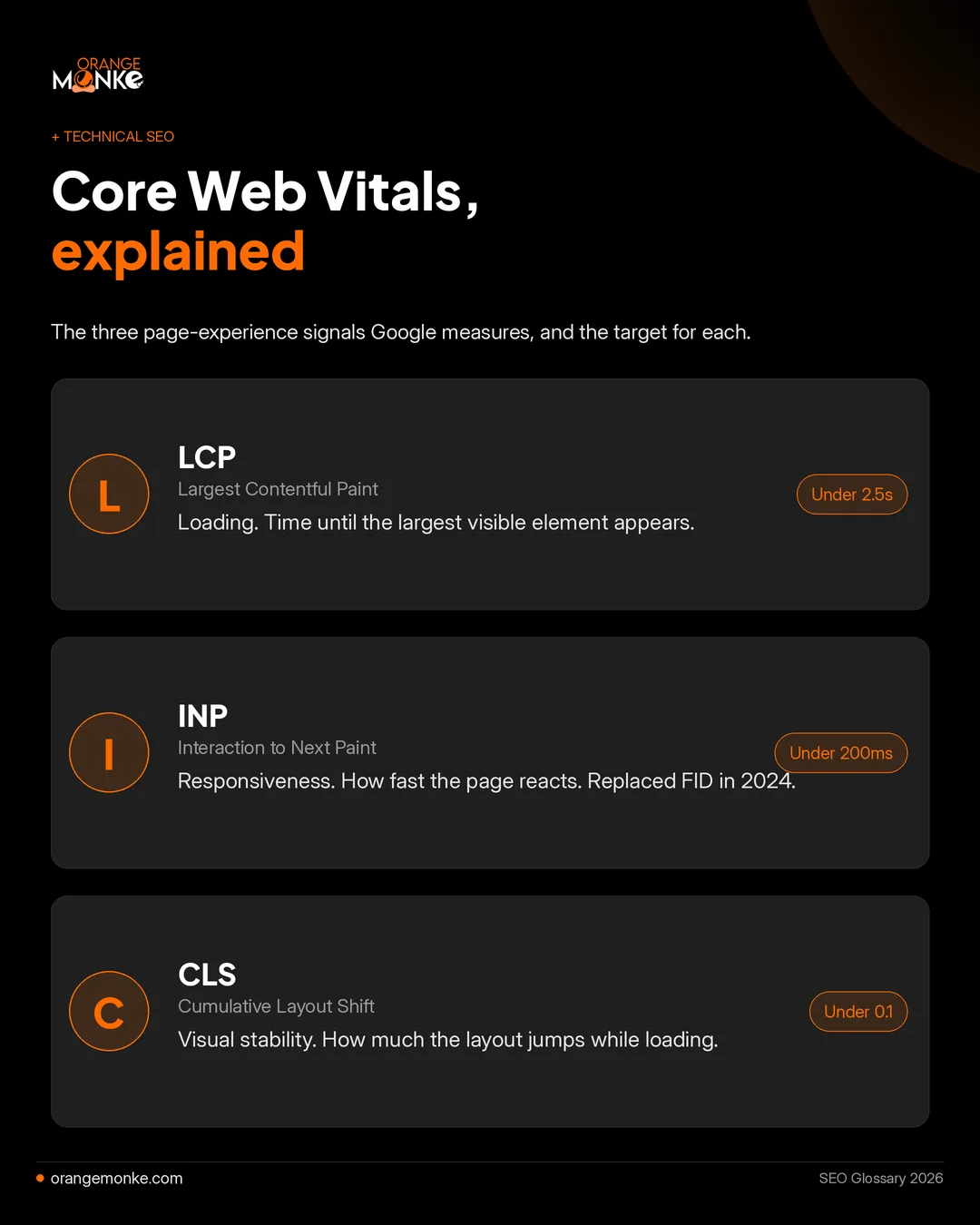
- Core Web VitalsGoogle's three page-experience metrics for loading, responsiveness and visual stability: LCP, INP and CLS.
- LCP (Largest Contentful Paint)How long until the biggest visible element loads. Aim for under 2.5 seconds.
- INP (Interaction to Next Paint)How quickly the page responds to interactions. It replaced FID in 2024. Aim for under 200 milliseconds.
- CLS (Cumulative Layout Shift)How much the layout jumps around while loading. Aim for under 0.1.
- Schema markupA shared vocabulary from schema.org for describing your content in a machine-readable way.
- Structured dataAny machine-readable data on a page, usually schema.org written as JSON-LD.
- JSON-LDGoogle's preferred format for adding structured data, kept separate from the visible HTML.
- Rich resultA results listing enhanced by structured data, such as star ratings, FAQs or recipe cards.
- Mobile-first indexingGoogle indexes and ranks the mobile version of your page. The default since 2020.
- Server-side rendering (SSR)Building the HTML on the server before sending it, so engines get content without waiting on JavaScript.
- Static site generation (SSG)Pre-building pages at deploy time. The fastest option for content that has to rank.
- Crawl budgetHow many pages Googlebot will fetch on your site in a given window. It mainly matters for large sites.
- Duplicate contentThe same or near-identical content on more than one URL, which splits ranking signals. Fixed with canonicals.
- Thin contentPages with little unique value, a common trigger for Helpful Content demotions.
- Status codeThe HTTP response a server returns, such as 200 OK, 301 moved or 404 not found, which crawlers read differently.
- PageSpeed InsightsGoogle's free tool that combines lab and real-world field data on your Core Web Vitals.
Link Building and Authority
Link building and authority terms cover the off-site signals search engines use to judge how trusted your site is.
Chasing link volume stopped working years ago; quality and fit win now. The cleanest way to earn links is steady off-page SEO and white-hat link building that you actually deserve.
- BacklinkA link from another site to yours. Still one of the strongest ranking signals in 2026.
- Referring domainA unique domain that links to you, however many individual links it sends.
- Domain Rating (DR)Ahrefs' 0 to 100 score for the strength of a site's backlink profile.
- Domain Authority (DA)Moz's equivalent 0 to 100 prediction of a domain's ranking ability. A third-party metric, not a Google score.
- PageRankGoogle's original link-based authority algorithm. No longer public, but the idea still runs under the hood.
- Link equityThe authority a link passes to its target, sometimes called link juice.
- rel=sponsoredA link attribute declaring the link was paid for or exchanged, introduced by Google in 2019.
- rel=ugcA link attribute marking links from user-generated content such as comments and forum posts.
- Editorial linkA link an author placed on merit, without you asking. The most valuable and most white-hat kind of backlink.
- Guest postContent you contribute to another site for exposure and a link. Kept clean it is white-hat; done at scale for links alone it drifts into grey-hat territory.
- Digital PREarning high-authority editorial links through outreach, data stories and newsworthy content.
- Linkable assetA resource built to attract links, such as a data study, calculator or a glossary like this one.
- DisavowA Search Console tool that asks Google to ignore specific backlinks. Rarely needed today.
- Toxic backlinkA link from a spammy or penalised site. Modern Google usually ignores these rather than penalising you.
- Anchor text profileThe spread of anchor texts across your backlinks. A profile skewed to exact-match anchors looks manipulated.
Content SEO
Content SEO terms are the writing and keyword ideas you use to plan and measure content that ranks.
Most SEO happens here. It runs from keyword research to writing blog posts that rank, and our content writing team works in it every day.
- E-E-A-TExperience, Expertise, Authoritativeness and Trustworthiness. Google's quality framework, with trust at the centre.
- YMYLYour Money or Your Life content on health, finance, legal or safety topics, held to a higher quality bar.
- Topical authorityThe depth and breadth of expertise a site shows on a subject, built through connected coverage rather than one page.
- Content pillarA broad, comprehensive page on a topic that links out to narrower supporting articles.
- Topic clusterA pillar page plus its supporting articles, all interlinked to reinforce topical depth.
- Keyword researchFinding and prioritising the queries people actually search, so you build pages that have demand.
- Seed keywordA broad starting term you expand into a fuller keyword list.
- Long-tail keywordA longer, more specific query with lower volume but clearer intent and easier competition.
- Search volumeThe estimated number of monthly searches for a keyword in a given location.
- Keyword difficulty (KD)A third-party score for how hard it is to reach page one for a keyword.
- Featured snippetThe answer box pulled from a ranking page and shown above the standard results. Still worth winning.
- People Also Ask (PAA)The expandable list of related questions on the results page. A useful source of subtopics and FAQs.
- Knowledge panelThe entity box, usually on the right, sourced from Google's Knowledge Graph.
- Entity SEOOptimising content and schema so engines recognise your brand, products and people as distinct entities.
- Content gapA topic or query your competitors cover that your site does not yet answer.
- Information gainThe genuinely new insight a page adds beyond what already ranks. A Google concept worth designing for.
AI Search, AEO and GEO
AI search terms are the newest part of SEO: how AI tools find, summarise and cite your content.
This is the fastest-moving section, and the one worth reading twice. It sits at the heart of AI SEO, drives the 2026 SEO trends, and answers part of the question about whether SEO is dead. It is not. It just moved.
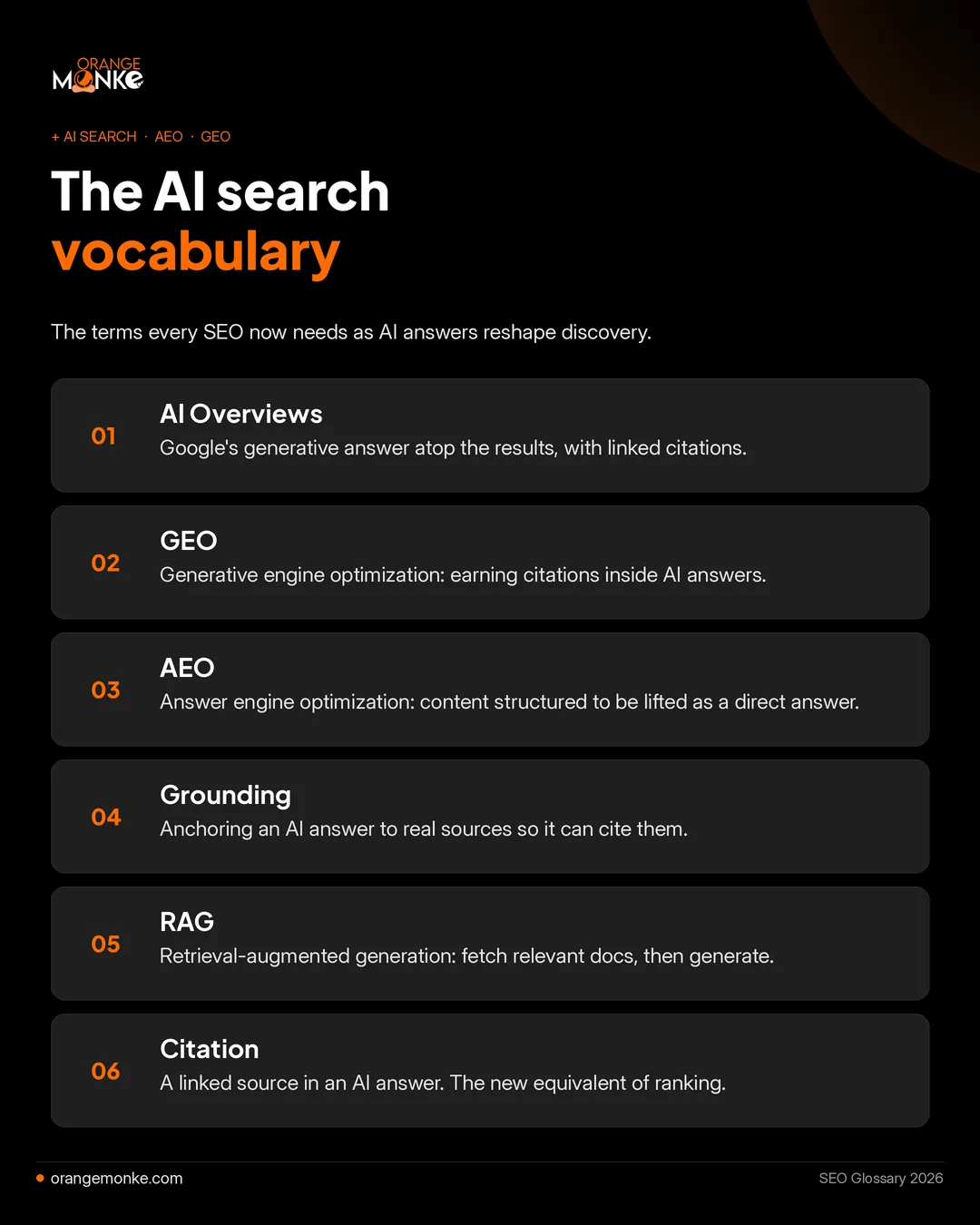
- AI OverviewsGoogle's generative summary at the top of the results, with links to the sources it drew from.
- Google AI ModeA full AI-first search experience, offered alongside the standard results page.
- Generative Engine Optimization (GEO)Optimising content so AI answer engines surface and cite it. In Google's own words, good GEO is good SEO.
- Answer Engine Optimization (AEO)Structuring content so it can be lifted as a direct answer by snippets, voice and AI summaries.
- LLMA large language model, the kind of AI system, such as GPT, Claude or Gemini, that powers modern AI search.
- GroundingAnchoring an AI answer to retrieved web sources so it can cite them, rather than answering from memory alone.
- Retrieval-augmented generation (RAG)A setup where a retriever fetches relevant documents that the model then uses to write its answer.
- CitationA linked source credited in an AI answer. In AI search, being cited is the new equivalent of ranking.
- HallucinationA confident AI statement that is not actually supported by any retrieved source.
- EmbeddingA numerical representation of text used to compare meaning, and the basis of how AI retrieval finds passages.
- Semantic searchMatching a query on meaning rather than exact keywords, powered by embeddings.
- Zero-click answerA result resolved on the page or inside an AI answer, so the user never clicks through to a source.
- Query fan-outWhen one user question is split into several sub-queries run in parallel, each pulling passages from different pages.
- Agentic searchAI agents that browse and synthesise on your behalf, replacing multi-step manual research.
- AI crawlerBots such as GPTBot, ClaudeBot and PerplexityBot that fetch content for AI training or live retrieval.
- LLMs.txtA proposed file that summarises your site for AI systems. Google does not use it, and adoption is still uneven.
Know the terms. Now put them to work on your rankings.
We turn this vocabulary into an audit, a plan and measurable organic growth across Google and AI answers.
Get a free SEO audit →Local SEO
Local SEO terms are the ones that help you rank for nearby searches and show up in Google Maps and the local pack.
If you serve a specific area, this is your key list. It pairs with SEO localization, feeds how you rank on Google Maps, and supports both Google Business Profile optimization and our wider local SEO services.
- Google Business Profile (GBP)The free listing that controls how a local business shows in Maps and the local pack.
- Local packThe map plus the three business listings shown for local-intent searches.
- NAPName, Address and Phone: the core identity data that must match everywhere your business is listed.
- NAP consistencyKeeping your name, address and phone identical across every listing. Mismatches erode trust signals.
- Local citationA mention of your business on a directory, with or without a link, that reinforces your NAP.
- Near-me queryA search with local intent, spoken or implied, that triggers local results.
- Primary categoryYour main GBP category. The single strongest ranking lever inside the profile.
- Review countThe total Google reviews on your profile. A direct local-pack ranking factor.
- Review velocityHow steadily you earn new reviews. Recent reviews carry more weight than old ones.
- ProximityHow close the searcher is to your business. The most powerful local ranking factor, and the one you cannot change.
- ProminenceGoogle's read of your overall local reputation, from links and reviews to offline mentions.
- Relevance (local)How well your profile matches the query, driven by categories, services and your website content.
- Local landing pageA city or region page built to rank for geo-modified searches.
- LocalBusiness schemaStructured data that gives engines your name, address, hours and services in a machine-readable form.
- Service area business (SAB)A GBP type for businesses that serve customers at their location rather than from a storefront.
SEO Tools and Metrics
SEO tools and metrics are the platforms and numbers you use every day to track crawling, ranking and traffic.
Definitions mean little without measurement. Start with the free tools, Google Analytics for traffic and Search Console, before paying for anything, and use them to earn organic traffic.
- Google Search Console (GSC)Google's free tool showing your crawl, index and search performance data for a verified site.
- Bing Webmaster ToolsMicrosoft's equivalent, covering Bing and the products that draw on it, including Copilot.
- GA4Google Analytics 4, the event-based analytics platform that replaced Universal Analytics in 2023.
- AhrefsAn SEO platform known for its backlink index and keyword tools.
- SemrushAn SEO suite strong in competitive research and advertising data.
- Screaming FrogA desktop crawler used for technical and on-page audits at scale.
- LighthouseGoogle's open-source tool for auditing performance, accessibility and SEO.
- CrUXThe Chrome User Experience Report: real-world field data on how your pages perform for actual visitors.
- Rank trackerA tool that records your keyword positions over time, by device and location.
- Share of voiceYour estimated share of the total clicks available across a set of tracked keywords.
- Organic sessionsAnalytics sessions attributed to the organic search channel.
- Conversion rateThe share of sessions or users that complete a defined goal, such as a form or a sale.
- Site auditA structured review of your technical, on-page and content health.
- URL Inspection toolThe Search Console feature that shows how Google sees a specific URL, including the rendered version.
Algorithm Updates
Algorithm update terms name the big Google changes that shaped, and keep changing, how pages rank.
You cannot explain a traffic drop without these words. Each named update tells you what Google was trying to reward or clean up at the time.
- Core updateA broad, scheduled adjustment to Google's ranking systems that affects many queries and sites at once.
- Spam updateA targeted update to Google's spam systems, covering link spam, site reputation abuse and more.
- Helpful Content Update (HCU)A 2022 system that demoted unhelpful, search-first content. Folded into the core ranking systems in March 2024.
- PandaA 2011 update that targeted thin, low-quality content, later absorbed into core ranking.
- PenguinA 2012 update that cracked down on manipulative link schemes. It has run in real time since 2016.
- BERTA 2019 language model that helped Google understand conversational queries far better.
- MUMThe Multitask Unified Model, announced in 2021, built for multimodal and multilingual understanding.
- SpamBrainGoogle's AI spam-detection system, disclosed publicly in 2018.
- Site reputation abuseA 2024 policy targeting third-party content published on authoritative sites purely to rank.
- Scaled content abuseA 2024 policy addressing large volumes of low-value pages, often AI-generated, made to game search.
- March 2024 core updateA combined core and spam update that folded the Helpful Content system into core ranking.
- Manual actionA penalty issued by a human reviewer, shown in Search Console, distinct from an algorithmic drop.
- Algorithmic demotionA traffic fall caused by a change in the ranking systems rather than a manual penalty.
- VolatilityHow much the results move day to day, tracked by tools like Semrush Sensor and Mozcast.
- Core update recoveryRegaining lost rankings after a core update, which usually needs substantial, site-wide quality work. Our June 2026 spam update guide walks through a real recovery.
Modern 2026 SEO
Modern 2026 SEO terms are the everyday words for search now that AI answers and passage-level results change how people find you.
This is where things are heading. Learn these and you speak the same language as the search engines, which is the base of good SEO best practices in 2026.
- Zero-click searchA search that ends with no outward click, resolved on the results page or inside an AI answer.
- Passage indexingGoogle's ability, since 2020, to rank a specific passage within a long page for a narrow query.
- Semantic HTMLUsing tags such as article, section and nav by meaning, which helps both accessibility and crawlers.
- Entity salienceHow central an entity is to a page's overall topic, as scored by language systems.
- Brand SERPThe results page for your own brand name, often the first real impression a buyer forms of you.
- AI visibilityHow often and how prominently your brand is cited across AI answer engines.
- AI trafficVisits that arrive from ChatGPT, Perplexity, Copilot, AI Overviews and similar surfaces.
- Programmatic SEOGenerating many similar, template-based pages from structured data, common in large e-commerce SEO catalogues. Powerful when useful, risky when thin.
- AI-generated contentContent produced mainly by AI. Allowed by Google when it is helpful, penalised when scaled to manipulate rankings.
- Content decayThe slow traffic decline a page suffers as competition and relevance shift, and the cue to refresh it.
- Voice searchQueries made by speaking to an assistant, which overlap heavily with long-tail, conversational AEO.
- Visual searchImage-based queries, including Google Lens and multimodal AI inputs.
- Multimodal searchA single query that mixes text, image, audio or video, handled by one model.
- AI-ready contentContent written with clear claims, citations and schema so AI systems can extract and attribute it accurately.
- Content velocityThe pace at which your team can publish genuinely good content, sustainably. A core editorial-operations metric.
Terms People Confuse
A handful of SEO terms get mixed up constantly, and the confusion costs real time and rankings.
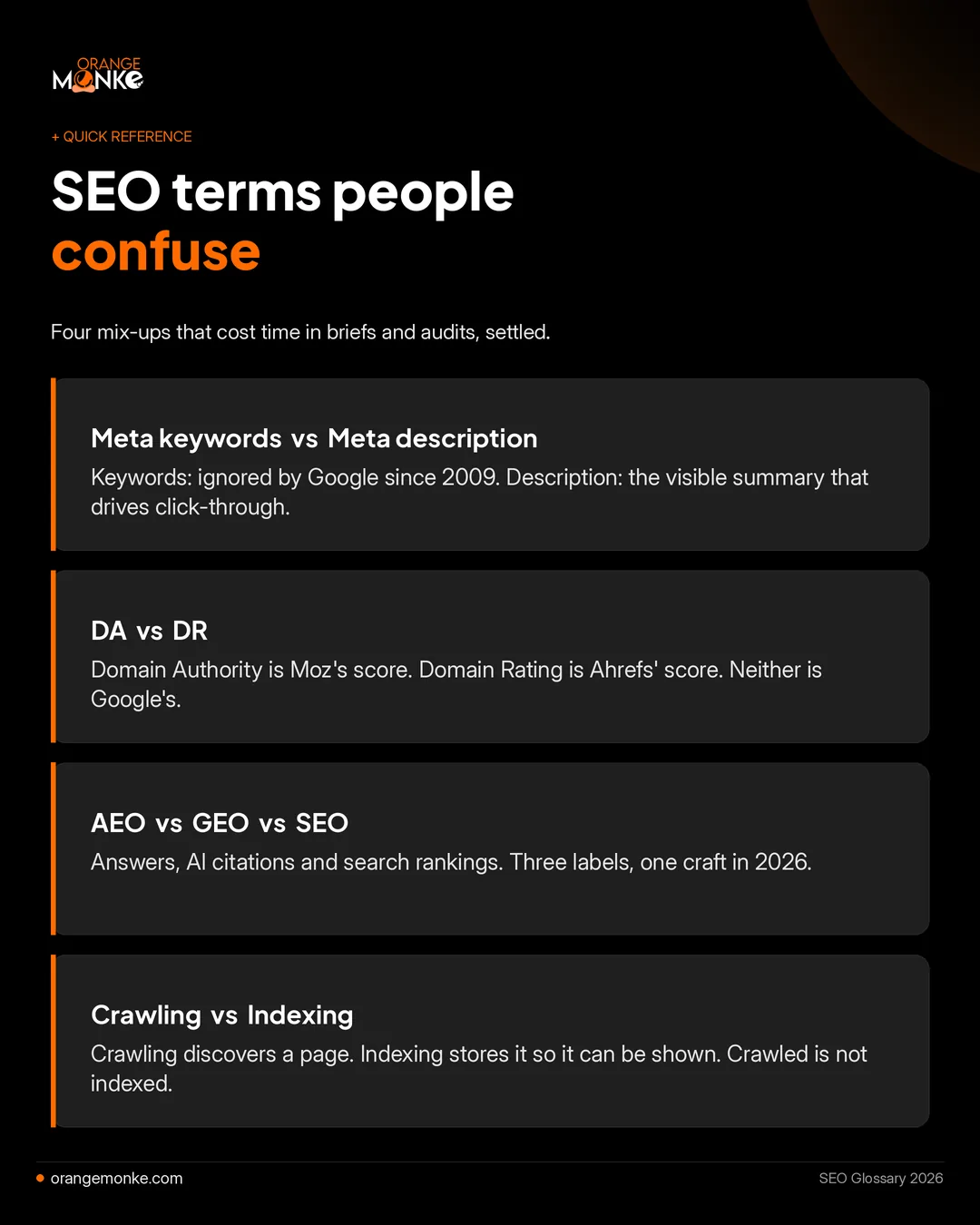
These are the pairs we see mislabelled most often in briefs and audits. The table sorts them out in one line each; the graphic keeps them straight when you need a fast reminder.
| Commonly confused | The one-line distinction |
|---|---|
| Meta keywords vs meta description | The keywords tag is ignored by Google; the description is the visible summary that drives click-through. Full story in our meta keywords guide. |
| DA vs DR | Domain Authority is Moz's score, Domain Rating is Ahrefs' score. Both are third-party estimates, neither is Google's. |
| AEO vs GEO vs SEO | Answers, AI citations and search rankings. Three labels, one craft in 2026. |
| Crawling vs indexing | Crawling is discovering a page; indexing is storing it so it can be shown. A page can be crawled and never indexed. |
Get these four straight and most SEO conversations suddenly make sense.
How Do You Use This Glossary?
Use this glossary as a working reference, not a document to read end to end.
The best habit is to bookmark the category you work in and come back when a new term shows up in a brief, an audit or a meeting. If you lead marketing, the AI Search, AEO and GEO section is the most useful read this year. If you do the hands-on work, Technical SEO and Algorithm Updates are the quickest way to work out why rankings moved. Learning the core search engine terminology and the SEO related words you meet at work pays off for years.
Definitions on their own do not move rankings; applied discipline does. When you are ready to turn this vocabulary into results, that is where our SEO services and AI SEO services come in.
Conclusion
SEO has always come with a lot of words, and 2026 added a whole AI layer on top. The 154 terms above, from crawling and Core Web Vitals to GEO, AEO and passage indexing, are the SEO marketing terms that really come up in strategy, audits and content work today.
You do not need to memorise them. You just need to recognise them, know where each one fits, and know which ones matter for the job in front of you. Keep this page bookmarked and it will do that for you.
And remember, the basics still win. Clear content, fast pages, strong links and honest authority matter more than any single term, on Google and inside AI answers alike. Learn the words, then spend your time on the work that actually moves rankings.
If you would rather skip the jargon and just get results, that is what we do. Our SEO services cover everything on this list, from technical fixes and on-page work to content, links and AI search, all tied to the rankings and traffic that grow your business.
At Orange MonkE, we turn this vocabulary into rankings, organic traffic and AI citations for businesses across the US, UAE, Australia and India. When definitions are not enough, we are the team that does the work.
Want to be the source AI engines quote, not just a blue link?
Our AI SEO service engineers your pages for AI Overviews, ChatGPT, Perplexity and Claude, where your buyers now ask their questions.
Talk to an AI SEO strategist →Frequently Asked Questions
An SEO glossary, also called a glossary of SEO terms, is a simple list that explains the words used in SEO, and it works best as a quick lookup, not a read-through.
- Scan by category: the ten sections here group related terms so you can jump to the domain you are working in.
- Use browser find: press Ctrl or Cmd plus F to land on any single term in seconds.
- Bookmark and return: keep it open during audits, briefs and meetings, and come back when a term appears you do not know.
Treat it as the shared vocabulary your whole team works from, then turn the definitions into action with our SEO services.
AEO and GEO both mean optimising for AI answers, and Google treats them as part of SEO, not a separate job.
- AEO: answer engine optimization, structuring content so it can be lifted as a direct answer by snippets, voice and AI summaries.
- GEO: generative engine optimization, earning citations inside AI answers from tools like ChatGPT, Perplexity and Google AI Overviews.
- The overlap: the clean technical and content work that ranks you on Google is the same work that gets you cited by AI.
You do not run two checklists, you run one well, which is exactly how our AI SEO services approach it.
Technical SEO still matters as much as ever, because AI Overviews run on the same crawling, indexing and speed signals as normal search results.
- Retrieval needs access: if Googlebot cannot crawl and render your page, no AI feature can cite it.
- Core Web Vitals stay in play: LCP, INP and CLS still shape rankings and user experience regardless of surface.
- Structure helps extraction: clean, self-contained sections are easier for both engines and AI to lift.
AI did not replace the fundamentals, it raised the reward for getting them right, which is the core of our SEO services.
Meta keywords and meta descriptions are both meta tags, but only the meta description still does anything useful in 2026.
- Meta keywords: a hidden list of terms that Google has ignored since 2009 and Bing may read as a spam signal.
- Meta description: the visible summary under your title that shapes click-through rate, even though it is not a direct ranking factor.
- The verdict: skip the keywords tag, write a strong description for every page.
We cover the full story, and why the tag is safe to drop, in our guide to meta keywords in SEO.
E-E-A-T stands for Experience, Expertise, Authoritativeness and Trust, and it matters because it is how Google and AI tools decide whether to trust your content.
- Experience: first-hand use of what you write about, the signal that separates real expertise from summary.
- Expertise and authoritativeness: demonstrable knowledge and recognition in your field.
- Trust: the centre of the framework, built on accuracy, citations and a credible, identifiable author.
It is a people-first standard, not a trick, and it shapes every one of our SEO best practices.
LLMs.txt is a proposed file that summarises your site for AI systems, and for Google Search specifically you do not need one.
- What it is: a markdown file at your root meant to give AI models a site-authored summary to ingest.
- Google's position: Google has said it does not use llms.txt for Search, so it will not help you there.
- When to bother: only if a non-Google service you care about actually consumes it.
Chasing files like this is a distraction from work that moves rankings, which is where our AI SEO services keep the focus.
Domain Authority and Domain Rating are the same idea from two different companies, and neither is a Google metric.
- Domain Authority (DA): Moz's 0 to 100 prediction of how well a domain can rank.
- Domain Rating (DR): Ahrefs' 0 to 100 measure of a domain's backlink strength.
- How to use them: treat both as directional third-party estimates, useful for comparison, never as the score Google uses.
We explain how much these actually matter when choosing a partner in our roundup of the best SEO companies.
An SEO terms glossary should be reviewed at least twice a year, because search vocabulary now shifts fast, especially around AI.
- AI terms move quickly: GEO, AEO, agentic search and AI Overviews all changed meaning within the last two years.
- Core terms are stable: crawling, indexing and Core Web Vitals rarely change, so they need only light checks.
- Freshness is a signal: engines and AI systems both prefer recently maintained references.
Keeping a resource current is the same discipline that helps you earn organic traffic over the long run.