If you have ever explored a webpage's source code and stumbled upon <meta name="keywords">, you have just uncovered one of SEO's oldest relics. Once considered a shortcut to ranking higher on search engines, meta keywords were a go-to tactic for website owners trying to tell search engines exactly what their content was about.
But here is the catch: SEO has evolved. What worked in the early 2000s does not necessarily work today. Many website owners still wonder whether meta keywords actually help, whether they are hurting their rankings, or whether they are simply irrelevant now.
In this guide, we break down exactly what meta keywords are, why they became obsolete, and what you should focus on instead to improve your rankings in 2026.
Meta keywords do not improve your Google rankings. Google officially stated in 2009 that it does not use the meta keywords tag as a ranking factor, and nothing has changed since. Skip the meta keywords tag entirely and focus on the 5 tags covered later in this guide.
What Are Meta Keywords?
Meta keywords are a type of HTML meta tag placed inside the <head> section of a webpage. They are invisible to ordinary visitors, live purely in the source code, and were originally designed to tell search engines what topics a page covers.
Here is a meta keywords example in HTML:
The tag has two parts: the name="keywords" attribute, which tells the browser this is a keywords meta tag, and the content="" attribute, where you list your keywords separated by commas.
Unlike your page title or meta description, meta keywords are completely hidden from your visitors. They only appear if someone views your page's source code.
Meta Keywords vs. Regular Keywords
Do not confuse meta keywords with SEO keywords in general. Regular SEO keywords are the words and phrases that appear throughout your visible content, in your headings, paragraphs, image descriptions, and page title. Those absolutely still matter for rankings. Meta keywords, by contrast, are a specific hidden HTML tag that search engines largely ignore today.
The table below sums up the difference at a glance.
| Aspect | Meta Keywords | Regular Keywords (SEO Keywords) |
|---|---|---|
| Definition | Keywords added in the HTML meta tag of a webpage | Keywords naturally used within the content (blogs, headings, URLs) |
| Purpose | Historically used to tell search engines what the page is about | Help search engines understand relevance and match search intent |
| Usage location | Placed in the <meta name="keywords"> tag | Titles, headings, body, URLs, alt text, internal links |
| SEO importance (2026) | Not used by Google anymore | Highly important for rankings and visibility |
| Impact on ranking | No direct impact | Strong impact when used strategically |
| Risk of overuse | High (keyword stuffing was common) | Moderate (overuse can still trigger penalties) |
| Examples | "meta keywords, seo, meta tags, keyword optimization" | "what are meta keywords", "do meta keywords matter", "meta keywords vs meta description" |
| Search engine support | Ignored by major engines like Google | Actively used by all search engines |
| Best practice | Not necessary to include | Focus on intent-based, long-tail, and semantic keywords |
| Current recommendation | Avoid using or do not prioritize | Essential for SEO strategy and content optimization |
Bottom line: the hidden tag does nothing for you, while keywords in your visible content do the real work.
How Meta Keywords Became Obsolete
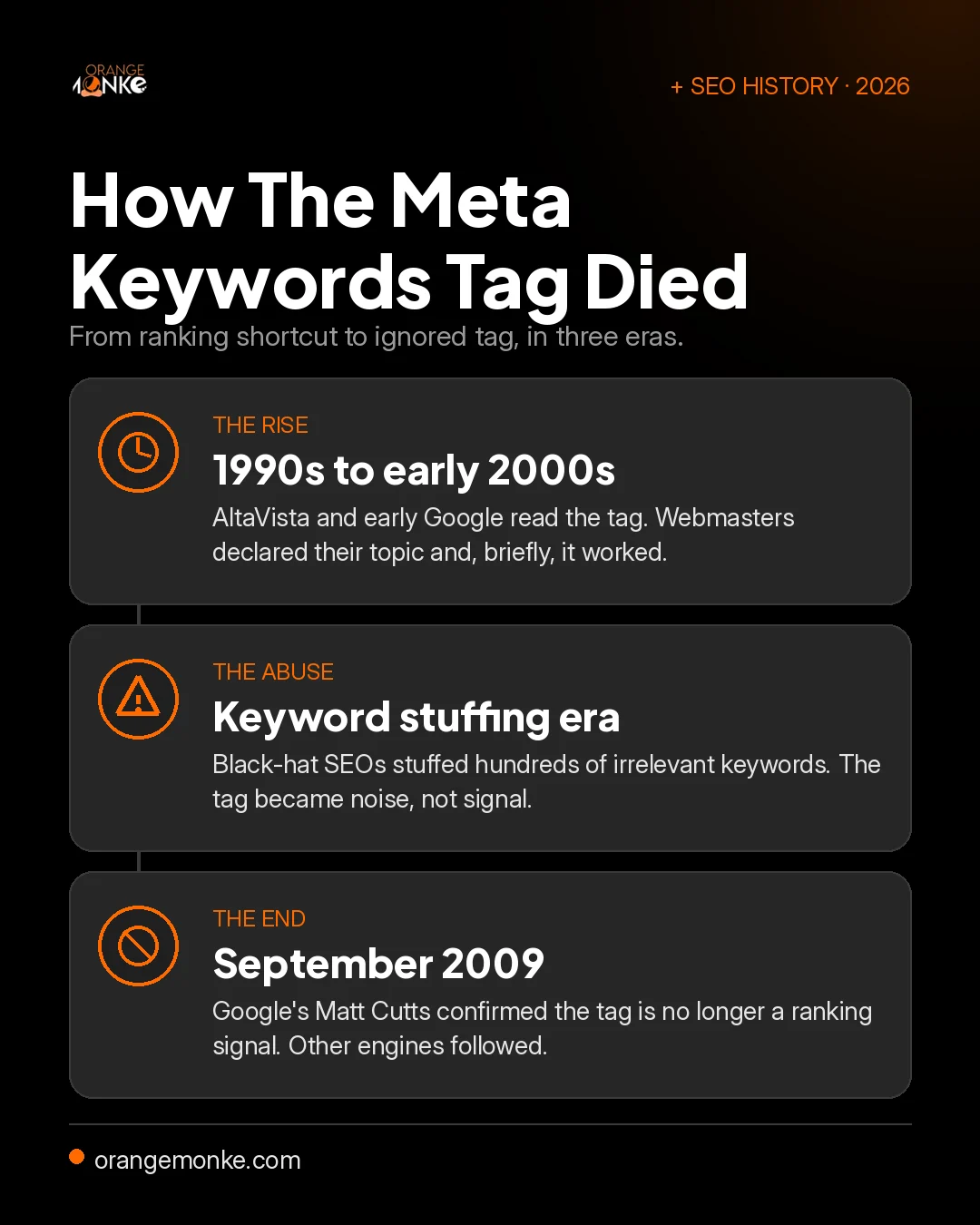
To understand why meta keywords do not matter today, it helps to understand why they existed in the first place and how they became one of SEO's most notorious dead ends. The tag moved through three clear eras, shown below.
The early days (1990s to early 2000s)
When search engines like AltaVista and early Google were finding their footing, they needed quick signals to understand what a page was about. The meta keywords tag seemed like a logical solution: webmasters could declare their topic, and search engines would know where to rank them. For a brief window, this actually worked.
The abuse era
Predictably, people began to abuse it. Black-hat SEOs stuffed dozens, sometimes hundreds, of irrelevant high-volume keywords into their meta tags, tricking search engines into ranking mediocre or spammy pages for popular searches. A page selling kitchen supplies might stuff in keywords like "free mortgage calculator" simply to capture traffic. This practice, known as keyword stuffing, poisoned the reliability of the tag and cluttered search results with low-quality pages.
Google drops the tag (2009)
In September 2009, Google's Matt Cutts officially announced that Google would no longer use the meta keywords tag as a ranking signal. The reason was simple: the tag had been so systematically abused that it offered more noise than signal. Other search engines followed, and the tag's relevance in SEO was effectively over.
Do Meta Keywords Still Work in 2026?
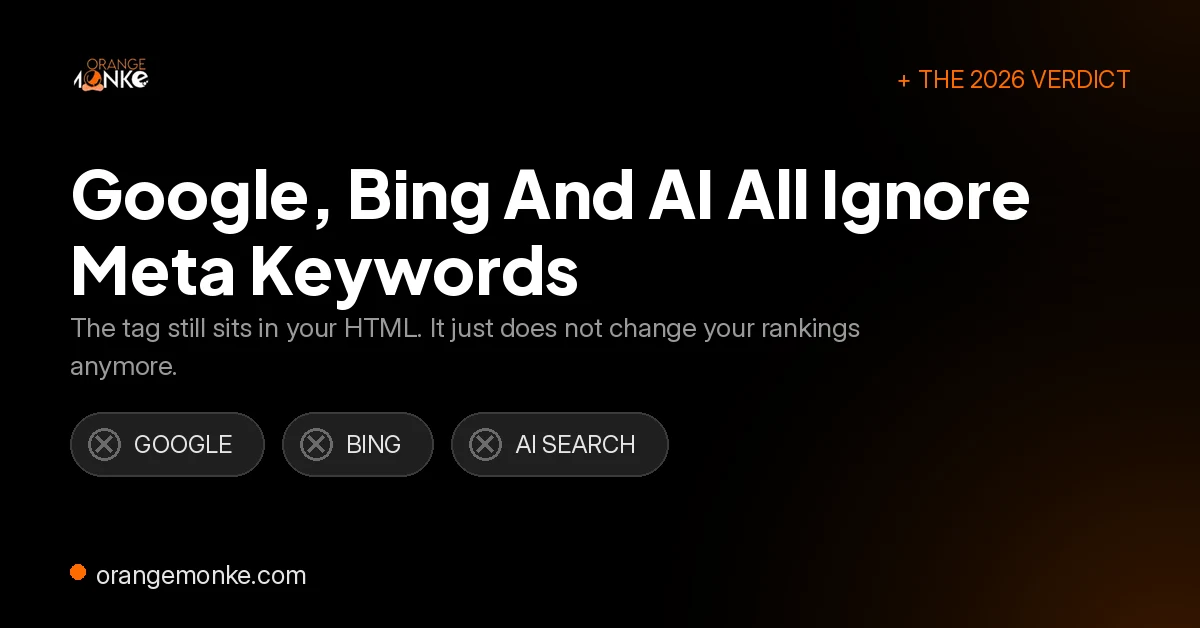
No, meta keywords do not work in 2026, at least not for the rankings that matter. The tag still exists in HTML, but no major search engine uses it to decide where your page ranks. Here is exactly what that means engine by engine.
Google: confirmed not used
Google has been unambiguous since 2009. The meta keywords tag is not used as a ranking signal in web search. Google's crawlers and natural language algorithms understand page content without any hints from hidden meta tags.
You will still see people searching for "meta keywords 2016" or "meta keywords 2017" hoping the advice changed after 2009. It did not. Google has ignored the meta keywords tag every year since Matt Cutts confirmed it in 2009.
Bing: treats it as a spam signal
Bing's position is even more dangerous for careless SEOs. Bing does not use meta keywords as a positive ranking factor, and it has explicitly stated that excessive meta keywords can be treated as a spam signal. On Bing, adding meta keywords does not help you, it can actively hurt you.
Yahoo, Yandex, and others
Yahoo, which largely uses Bing's index, shares this approach. Yandex, the dominant engine in Russia, has mentioned meta keywords as a very weak signal, but the influence is negligible. Baidu, the leading Chinese engine, likely does not support meta keywords either.
| Search Engine | Meta Keywords Policy | Effect on Rankings | Risk |
|---|---|---|---|
| Officially ignored since 2009 | Zero impact | None | |
| Bing | Not a ranking signal | Zero impact | Spam signal risk |
| Yahoo | Uses Bing's index | Zero impact | Same as Bing |
| Yandex | Very weak signal | Negligible | Low |
| Baidu | Likely not supported | Zero impact | Unknown |
| DuckDuckGo | Uses multiple sources | Zero impact | Minimal |
Across every major engine the story is the same: no upside, and on Bing a real downside.
Adding meta keywords to your site does not help with any major search engine. For Bing, excessive meta keywords can actively work against you by triggering spam filters. The risk-to-reward ratio is entirely negative.
Should you use meta keywords?
No, you should not use meta keywords in 2026. They give you zero ranking benefit on Google, can trigger spam filters on Bing, and expose your keyword strategy to competitors. Spend that time on content, titles, and links instead.
How many meta keywords should you use?
You should use zero meta keywords. The old guidance capped the tag at around 10 keywords, but since the tag carries no benefit and a Bing penalty risk, the correct number in 2026 is none.
Will Removing Meta Keywords Drop My Organic Traffic?
No, removing meta keywords will not drop your organic traffic. Because Google has ignored the meta keywords tag since 2009, deleting it changes nothing about how Google ranks your pages, and on Bing it can only help by removing a possible spam signal. Removing the tag has no downside for your rankings, only upside on Bing.
When dealing with a legacy site of that scale, manual removal is impossible, and doing it wrong can break your pages. Here is a highly efficient, automated framework for handling this cleanup without affecting your live site.
- Edit your theme header onceRemove the single line in your theme's header.php or functions.php that prints the keywords tag, and it disappears from every page at once.
- Use your SEO plugin's bulk toolsRank Math, Yoast, or SEOPress let you clear legacy meta fields across all posts from one settings screen, with no page-by-page editing.
- Run a safe database find-and-replaceWP-CLI or a plugin like Better Search Replace can strip the stored keyword values in bulk, always on a staging copy first.
- Add a filter to suppress the tagA short code snippet can force the keywords output to render empty across the whole site without touching individual pages.
- Test on staging, then deployClone the site, apply the cleanup, spot-check a sample of pages, and only then push live so nothing breaks in production.
Removing thousands of legacy tags is a routine part of a healthy technical SEO cleanup, and done on staging first, it carries no risk to the traffic you already have.
Are Meta Keywords Important for AI SEO?
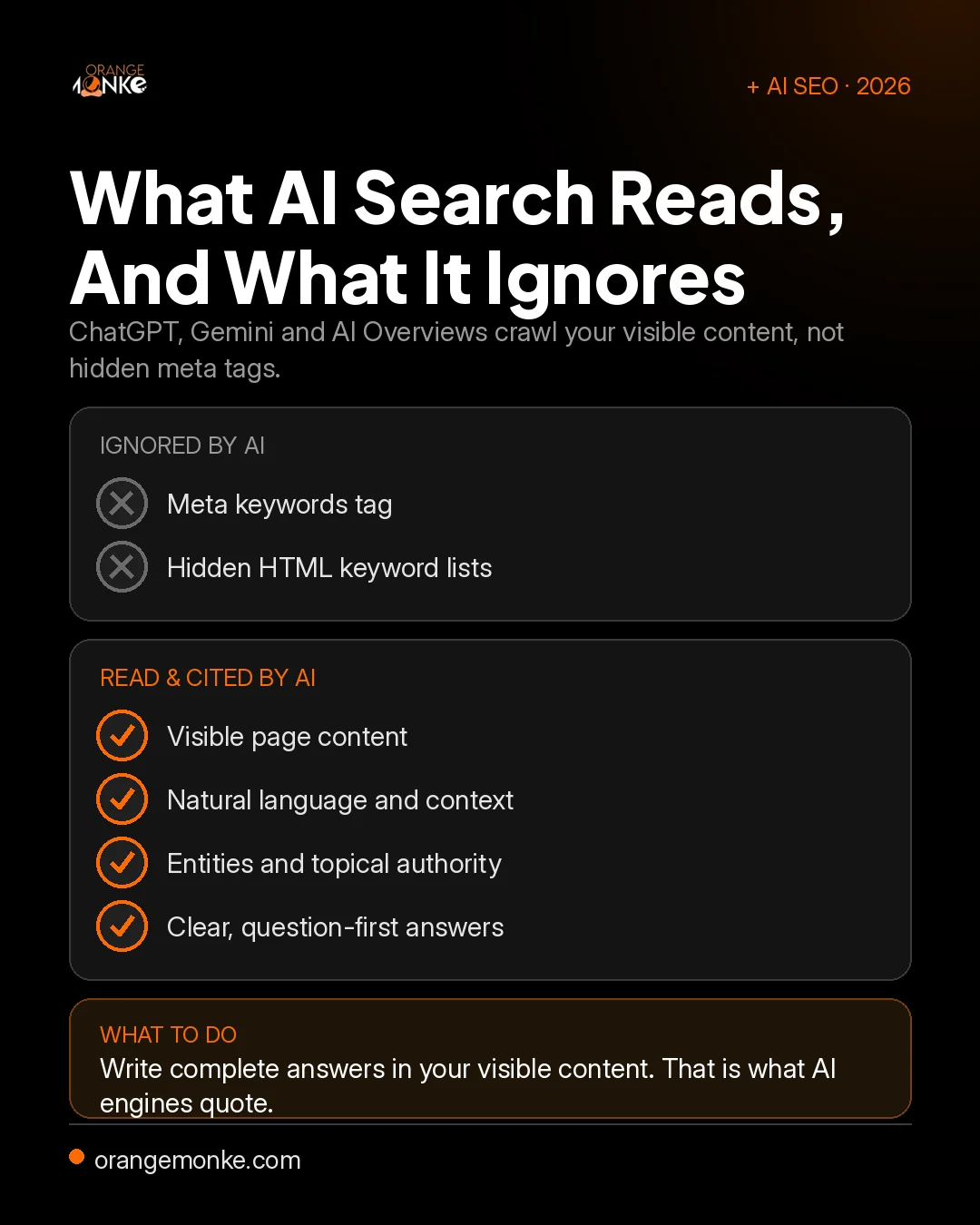
No. Meta keywords are useless for AI SEO and modern search. Both Google and AI models like ChatGPT and Gemini ignore the meta keywords tag completely.
AI systems crawl and interpret your actual visible content, natural language, and context, not hidden meta tags. So earning AI citations works the same way as ranking on Google: answer the question clearly in your visible copy. The graphic below shows what AI search reads and what it skips.
Here is what to focus on instead of the meta keywords tag:
- Entity SEO. Establish your brand and content as a clear, authoritative entity so AI models can confidently cite you as a primary source.
- Conversational long-tail keywords. Put the exact questions people ask into your H1 and H2 headings to match how users and AI phrase things.
- Meta descriptions and titles. They do not rank your page directly, but they control how your result looks, which drives click-through rate.
This is the same shift covered in the biggest SEO trends for 2026, where GEO and AI Overviews reward clear, citable answers over hidden tags. SEO professionals on Reddit, the r/SaaS community, Search Engine Land, and Google's own developer documentation all agree: the tag is dead for ranking, and AI changes nothing about that.
What People Say About Meta Keywords on Reddit?
On Reddit, the consensus on meta keywords is blunt: do not bother. Across r/SEO, r/SaaS, and r/webdev, practitioners describe the tag as dead weight, agree Google dropped it in 2009, and steer newcomers toward content and authority instead.
We researched several Reddit threads across r/SEO, r/SaaS, r/webdev and r/DigitalMarketing and combined the recurring takeaways here for you. The observations below are paraphrased summaries of community sentiment, each linked to its source thread.
The recurring view in r/SEO is that meta keywords are a waste of time, Google stopped reading the tag back in 2009, and adding it changes nothing for rankings.
Paraphrased from r/SEO, "Meta keywords, yay or nay?"A common warning in r/SaaS is that the tag has no upside and a real downside: it publicly exposes your target keywords to any competitor who views your page source.
Paraphrased from r/SaaS, "Why you should not use the keywords meta tag"Developers in r/webdev draw a clear line: the meta description and title tag still matter for how your result looks, but the keywords meta tag specifically does nothing.
Paraphrased from r/webdev, "When are meta tags for SEO important?"In r/DigitalMarketing the focus has shifted entirely toward AI: the advice is to build entity authority and get cited by AI answers, not to fiddle with hidden tags.
Paraphrased from r/DigitalMarketing, "Is SEO becoming less important because of AI?"Is SEO Dead?
No, SEO is not dead. But old SEO practices, like adding a meta keywords tag, are dead. SEO is not dead, outdated SEO tactics are. The fundamentals still work: quality content, strong titles, fast pages, and genuine authority matter more than ever, especially now that AI search rewards those same signals.
Questions like "do meta keywords matter" or "is SEO dead" usually come from confusing one dead tactic with the whole discipline. We unpack the bigger question in our guide on whether SEO is dead, and the short version is that search is not disappearing, it is just rewarding better work.
Why Do So Many News Sites Still Add Meta Keywords to Their Blogs?
News sites still add meta keywords, and sometimes a separate news_keywords tag, mostly out of habit and legacy CMS defaults, not because it helps them rank. If you inspect a big publisher's source code, you will often still find a keywords meta tag sitting there doing nothing.
There are three practical reasons the habit survives in newsrooms:
- Legacy CMS defaults. Many large publishing systems auto-insert a keywords field, so editors fill it in without questioning whether it does anything.
- The old news_keywords tag. Google once supported a dedicated news_keywords meta tag for Google News, which is why newsroom templates still ship with one, even though Google has since scaled back its use and it is not a general web-search ranking factor.
- No harm, low priority. The tag does no damage on Google, and removing it across thousands of daily articles is rarely worth a busy newsroom's time.
For news publishers, the meta keywords tag is a harmless legacy habit, not a ranking advantage. The same effort spent on strong headlines, fast pages, and structured data will do far more to drive real organic traffic.
How to Add or Remove Meta Keywords on Your Website
Even if you never want to use meta keywords, you should know how to add and remove them, because you will run into the tag on sites you audit or take over. Adding it is a single line of HTML; removing thousands of them cleanly takes a bit more care. The tag sits inside the <head> section, before the closing </head> tag.
Adding meta keywords in WordPress
If you use WordPress with an SEO plugin like Yoast SEO or Rank Math, you will notice there is no dedicated meta keywords field in modern versions. That is intentional. These plugins removed the field years ago because it offers no ranking benefit. If you are using an older plugin that still offers it, simply leave the field blank.
Adding meta keywords in other CMS platforms
In Shopify, Magento, Squarespace, Wix, and Weebly, the meta keywords tag is either not exposed in the UI at all or clearly marked as optional or deprecated. On Magento the meta keywords field still appears in product and category settings, and Weebly may show a keywords box in some older themes, but filling either one provides no ranking benefit. If you searched for how to set meta keywords in Weebly, the honest answer is that you can safely leave it blank. This reflects the current consensus across the SEO industry.
Meta keywords best practices
The only real meta keywords best practice in 2026 is to stop relying on the tag. If a legacy system forces a value into it, keep it under 10 genuinely relevant terms, never stuff it, and never expose keywords you would not want a competitor to copy. For both Google and Bing, that effort is far better spent on your title tag, meta description, and content.
Removing meta keywords at scale
If your site already has thousands of legacy keyword tags, do not edit them page by page. Use the automated cleanup framework in the section on removing meta keywords above: change the tag at the theme or plugin level, test on staging, then deploy.
5 Reasons You Should Avoid Meta Keywords
Meta keywords are outdated, ignored by search engines, may signal spam, reveal your strategy, and waste effort. Here are the five reasons to leave them out and focus on modern SEO instead.
- They provide zero ranking benefit on GoogleGoogle, which handles over 90% of global search traffic, has categorically stated it ignores the tag. Any time spent on meta keywords could go toward content, link building, or technical SEO that actually moves the needle.
- Bing may penalize you for using themBing's engineers have confirmed that heavy use of the tag can be read as a spam signal. If you target Bing or Yahoo traffic, stuffing the tag could push your rankings down rather than up.
- Competitors can steal your keyword strategyMeta keywords are visible in your source code to anyone who selects View Page Source. Any competitor can instantly see exactly which terms you are targeting and use that against you.
- They signal outdated SEO knowledgeIf a client or auditor finds meta keywords tags, it suggests your SEO knowledge is stuck in the early 2000s. Modern SEO is about content quality, user experience, and genuine authority.
- They waste development and maintenance timeEvery minute spent writing and updating meta keywords is time not spent on optimizations search engines actually reward. For large sites, this wasted effort compounds significantly.
Outdated tags won't get you found in 2026. Let's fix what actually moves rankings.
We replace dead tactics with content, structure and authority that rank on Google and get cited by AI.
Get a free SEO audit →What Every Major Search Engine Thinks About Meta Keywords
"Google doesn't use the keywords meta tag in our web search ranking."
That statement from Google is the most definitive word we have on the subject. But every major engine has taken a position on the tag, and none of them treat it as a ranking advantage. The table below lays out where each one stands and what it means for you.
| Search Engine | Official position on meta keywords | What it means for you |
|---|---|---|
| States plainly it does not use the keywords meta tag for web-search ranking | Ignore the tag; it has zero effect on Google rankings | |
| Bing | Says the tag is used mainly by spammers on its platform | Remove it; heavy use can make your domain look spam-like |
| Yahoo | Runs on Bing's index, so it follows Bing's stance | No benefit; the same cleanup applies |
| DuckDuckGo | Pulls results from Bing and other sources | No benefit from the tag |
| Yandex | Has described it as a very weak signal at most | Negligible; not worth the effort |
| Baidu | No meaningful support for the tag | No benefit for Chinese search either |
Every major engine lands in the same place: the meta keywords tag is either ignored or a liability, never an advantage.
Bing's search team has stated that the meta keywords tag is used only by spammers on their platform. They position it as a historical artifact that legitimate websites have no business using. If your site has thousands of pages with keyword-stuffed meta tags, you could be flagging your entire domain as spam-like in Bing's eyes.
What About Internal Search Engines?
Internal site search is the one niche where meta keywords can still have some relevance. Some older or custom-built internal search tools, meaning the search bar within your own website rather than Google or Bing, might use meta keywords to categorize content. Similarly, some ad networks have historically used them to serve contextually relevant ads.
However, these are edge cases. For the vast majority of websites, these internal systems have been replaced by far more sophisticated content-indexing methods that do not rely on meta tags at all.
5 Tags That Actually Improve Your Rankings
If meta keywords are dead, where should you focus? These five HTML elements are genuinely valued by search engines and directly impact your rankings, click-through rates, and organic traffic.
Tag 01: Title tag
The single most important on-page SEO element. It appears in search results as the clickable headline. Keep it under 60 characters and lead with your target keyword.
Tag 02: Meta description
Your organic ad copy. It appears below the title in search results. While not a direct ranking signal, a compelling meta description dramatically improves click-through rate. Meta tags like the title and description are important for SEO; the keywords meta tag is the one exception that is not.
Tag 03: Heading tags (H1 to H6)
Structure your content with keyword-rich headings. Your H1 should match or closely mirror your title tag, and H2 and H3 tags help search engines understand your content hierarchy.
Tag 04: Image alt tags
Text descriptions for images. Search engines cannot see images, so alt tags give them context. Include relevant keywords naturally, and they help your images rank in Google Images too.
Tag 05: Canonical tag
Tells search engines which version of a page is the official one. It is critical for preventing duplicate content issues that dilute ranking power across similar pages.
Meta title vs meta description vs meta keywords
These three get confused constantly, so here is the difference at a glance.
| Tag | Does it rank? | What it actually does |
|---|---|---|
| Meta title | Yes | Your clickable headline in search results and a real ranking factor |
| Meta description | Not directly | The summary under your title that drives click-through rate |
| Meta keywords | No | Ignored by Google, a spam signal on Bing, safe to skip |
Spend your time on the title and description. Skip the meta keywords tag.
SEO Best Practices: What to Do Instead of Meta Keywords
If you have been relying on meta keywords as part of your SEO strategy, here is a practical roadmap for what to focus on instead. These are the fundamentals of SEO that genuinely drive organic traffic in 2026.
- Create content that matches search intentBefore writing any page, ask what the person searching this keyword actually wants: information, a product, a local service, or a specific website. Your content must deliver exactly that.
- Place keywords where they actually countKeyword placement in your visible content matters far more than any meta tag. Use your primary keyword in the title tag, H1, first paragraph, at least one subheading, image alt text, and the URL slug.
- Build topical authorityBuild clusters of related content that demonstrate deep expertise rather than targeting isolated keywords. Twenty interconnected articles signal far more authority than one stuffed page.
- Optimize for Core Web VitalsGoogle's algorithm incorporates page speed, visual stability, and interactivity. A slow, unstable page underperforms regardless of how well-optimized the content is.
- Earn quality backlinksLinks from authoritative, relevant sites remain one of the strongest signals Google uses. One link from a high-authority industry site beats hundreds of low-quality directory links.
- Use structured data (schema markup)Schema helps search engines understand your content and can unlock rich results that dramatically increase click-through rates.
Keywords still matter enormously in SEO, just not in the meta keywords tag. Use them in your title tag, headings, body content, image alt text, and URL. That is where search engines actually look, and where keywords in your visible content do the real ranking work.
Conclusion
Meta keywords may still exist in the HTML world, but in terms of modern SEO they are completely outdated. They do not help your rankings, may pose risks on certain search engines, and distract from what truly matters: high-quality content, search intent, and user experience.
To stay competitive in today's search landscape, shift your focus toward proven strategies like optimized content, strong technical SEO, and authority-building through backlinks. That is where real growth happens.
At Orange MonkE, we help businesses move beyond outdated tactics and build future-ready SEO and AI SEO strategies that drive traffic, visibility, and conversions. Because in 2026, it is not about shortcuts, it is about doing SEO right.
Want to show up in AI Overviews and ChatGPT, not just blue links?
Our AI SEO service makes your pages the answer AI engines quote, where your buyers now search.
Talk to an AI SEO strategist →Frequently Asked Questions
The meta keyword tag serves virtually no purpose in modern SEO. It is ignored by Google and treated as a potential spam signal by Bing. The only marginal use cases are some internal site search systems and certain legacy ad networks, neither of which justify its use for most websites. Your time is far better spent on title tags, meta descriptions, content quality, and link building.
Yes, if your site currently uses meta keywords tags, it is a good idea to remove them, especially if they contain many keywords, as this could trigger Bing's spam filters. For a small site, the removal effort is minimal. For large enterprise sites with thousands of pages, it may be a lower priority, but it should be on your technical SEO cleanup list.
The general guidance has always been a maximum of around 10 highly relevant keywords per page. But given the lack of any benefit and the potential downside with Bing, the real answer in 2026 is zero. Do not use meta keywords at all.
No, Bing does not use meta keywords as a positive ranking signal. In fact, Bing has explicitly said that websites using excessive meta keywords may be flagged for spam. To improve your Bing rankings, focus on quality content, authoritative backlinks, social signals, and a well-structured site, the same fundamentals that work for Google.
Meta keywords and meta descriptions are both meta tags in the HTML head, but they serve very different purposes. Meta keywords (dead, ignored) were meant to label a page's topics. Meta descriptions (still very important) are short summaries that appear under your title in search results, influence click-through rate, and help users decide whether to visit. Always write a compelling, unique meta description for every page through strong on-page SEO.
No, meta keywords do not affect Local SEO. Local rankings are influenced by Google Business Profile optimization, local citations, reviews, proximity, and on-page signals like your location in title tags and content. The meta keywords tag plays no role in local search rankings whatsoever.
Yes, "metadata keywords," "meta tag keywords," and "HTML keywords meta tag" all refer to the same thing: the HTML element. The different terms are just used interchangeably across the SEO industry.
Yes, competitors can see your meta keywords. They are part of your page's HTML source code, which is publicly accessible. Anyone can right-click your page, choose "View Page Source," and search for name="keywords" to see every keyword you listed. This is another strong reason to keep your keyword strategy in your content, not in a visible meta tag.