May 29, 2026
  15 Min Read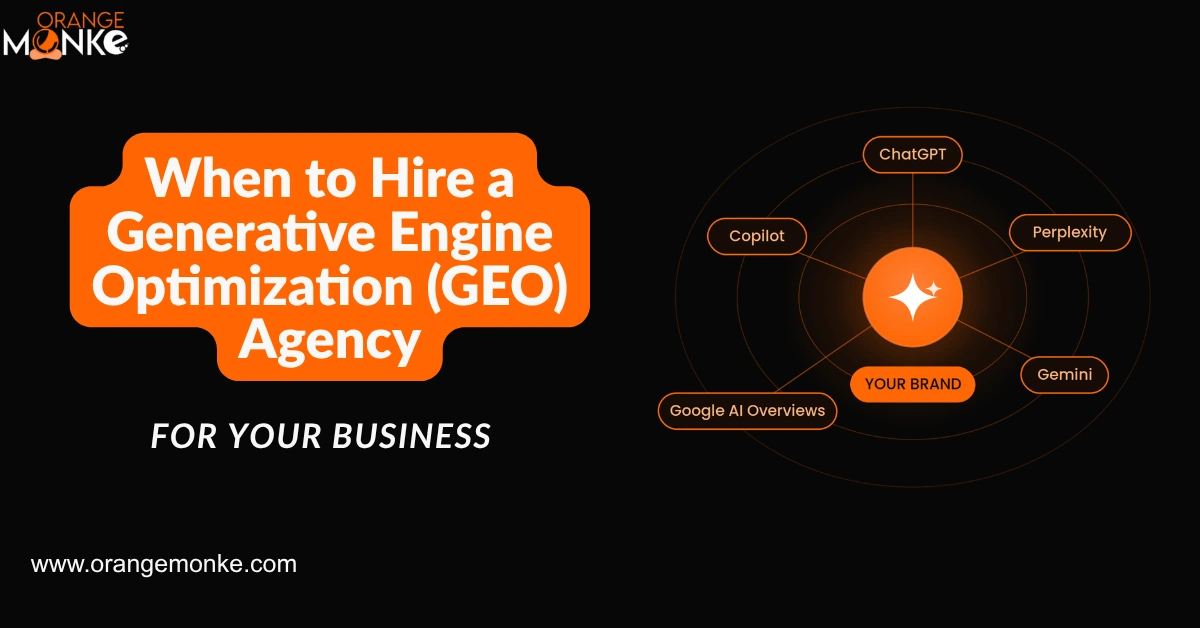
| A Generative Engine Optimization (GEO) agency helps businesses improve visibility in AI-powered search platforms like ChatGPT, Google AI Overviews, Perplexity, Claude, and Copilot. Companies should consider hiring a GEO agency if they are not appearing in AI-generated answers, losing visibility to competitors, scaling content without AI traction, or lacking in-house GEO expertise. GEO focuses on optimizing content for AI citations, topical authority, structured data, and answer-focused visibility — extending traditional SEO strategies into the AI-search era. |
You’ve been doing SEO for years. You rank on Google. Your content team is pumping out articles. Traffic looks decent.
But here’s the uncomfortable truth: a growing chunk of your potential customers never see you, because they’re asking ChatGPT, Perplexity, Google AI Overviews, or Claude instead of scrolling through search results.
And right now, your competitors are the ones being recommended.
That’s the gap a Generative Engine Optimization (GEO) agency is built to close.
This guide breaks down exactly what a GEO agency does, the clear signs you need one, who doesn’t need one yet, and how to choose the right GEO partner.
What Is Generative Engine Optimization (GEO)?
Before jumping into whether you need a GEO agency, let’s get clear on what GEO actually means.
Generative Engine Optimization (GEO) is the practice of optimizing your content and digital presence so that AI-powered tools, like ChatGPT, Google AI Overviews, Perplexity, Copilot, and Claude — cite, reference, and recommend your brand in their responses.
Unlike traditional SEO, which focuses on ranking in a list of blue links, GEO is about becoming the answer — the source an AI chooses to quote when someone asks a relevant question.
Think of it this way:
| Traditional SEO | Generative Engine Optimization (GEO) |
| Rank in Google’s top 10 | Get cited in AI-generated answers |
| Focus on keywords & backlinks | Focus on authority, structure & clarity |
| Drive clicks to your site | Build brand mention & trust with AI |
| Measured by SERP position | Measured by AI citation frequency |
| Optimized for crawlers | Optimized for language models |
GEO doesn’t replace SEO — it extends it into the AI era.
What Does a GEO Agency Actually Do?
A GEO agency specializes in making your business visible inside AI-generated answers. Here’s what their work typically covers:
- AI content strategy — structuring content so language models understand and prefer your brand
- Topical authority building — creating comprehensive, expert-level content clusters that AI models trust as reliable sources
- Schema markup & structured data — helping AI crawlers extract and use your content accurately
- Citation optimization — ensuring your brand gets mentioned and attributed in AI responses
- Answer Engine Optimization (AEO) — formatting content to directly answer the questions your audience asks AI
- AI visibility tracking — monitoring how often and how positively your brand appears across AI platforms
- E-E-A-T strengthening — building the Experience, Expertise, Authoritativeness, and Trustworthiness signals that AI models rely on
In short: a GEO agency doesn’t just help you rank. It helps you get chosen by AI.
9 Clear Signs You Need to Hire a GEO Agency
From disappearing search visibility to declining organic traffic, certain warning signs indicate your business may need expert GEO support to stay competitive in platforms like ChatGPT, Google AI Overviews, Gemini, and Perplexity.
1. You’re Not Showing Up in AI Search Results
This is the most obvious sign — and the most urgent.
Go right now and ask ChatGPT, Perplexity, or Google AI Overviews a question your ideal customer would ask. Something like:
“What’s the best [your product category] for [your target use case]?”
If your competitors come up and you don’t, you have an AI visibility gap. And that gap is costing you leads.
Unlike Google where users might scroll past page one to find you, AI tools give one synthesized answer. If you’re not in that answer, you don’t exist for that user.
A GEO agency diagnoses why you’re not showing up and fixes it systematically.
2. Your SEO Is Strong But Your AI Visibility Is Weak
Here’s the scenario that surprises a lot of businesses: you rank #1 on Google, but you’re invisible on AI platforms.
This happens because the factors that make you rank on Google (backlinks, keyword density, page speed) are not the same factors that make AI tools cite you.
AI models prioritize:
- Clarity and directness — content that answers questions without burying the point
- Factual specificity — data, stats, and concrete claims rather than vague assertions
- Source credibility — brands that are widely cited and referenced elsewhere online
- Content depth — comprehensive coverage of a topic, not just surface-level articles
If your content is optimized for old-school SEO tactics but not for how AI models evaluate sources, you’ll keep falling through the cracks on AI platforms — even while dominating Google.
A GEO agency bridges that gap.
3. You Don’t Have In-House GEO Expertise
GEO is a genuinely new discipline. Even experienced SEO teams often lack the specific skills it requires, including:
- Understanding how large language models (LLMs) retrieve and weight information
- Knowing which content structures get cited vs. ignored by AI
- Tracking AI mentions and citation frequency across platforms
- Building topical authority in ways that AI models recognize
Hiring internally is an option, but GEO talent is scarce and expensive right now. A specialist agency brings a full team with proven processes — and they can move faster than you can build from scratch.
If your current team can’t answer “Why isn’t our brand appearing in ChatGPT results?” — that’s your sign.
4. Your Content Isn’t Being Cited by AI Tools
You’re creating content. You’re publishing regularly. But when AI tools answer questions in your space, they’re citing your competitors’ blog posts, not yours.
This is a citation gap — and it’s a direct GEO problem.
AI tools don’t cite content randomly. They cite content that is:
- Structured to be easily parsed (clear headings, definitions, lists)
- Authoritative and well-sourced
- Specific and factual rather than generic
- Part of a trusted domain with broad topical coverage
A GEO agency audits your existing content for citation-readiness and restructures or enhances it so AI models start pulling from your site.
5. You’re Scaling Content But Not Gaining AI Traction
Some businesses are publishing 20, 30, 50 articles a month — and still not appearing in AI answers. More content isn’t the problem. The right kind of content is.
If your content strategy isn’t specifically designed for AI visibility, you can scale indefinitely without moving the needle on GEO. You’re essentially shouting into a room where the audience has already left.
A GEO agency reorients your content strategy around what actually gets cited: depth, structure, authority, and direct answers — not just volume.
6. Your Competitors Are Getting Recommended by AI
Open ChatGPT or Perplexity. Type in your main product or service category. See who gets mentioned.
If specific competitors appear consistently — especially ones you outrank on Google — they’ve invested in GEO. And that investment is paying off in a channel you haven’t captured yet.
AI-driven search is growing fast. According to recent data, over 37% of internet users now start searches on AI tools rather than traditional search engines. That number is climbing.
Every month you delay is a month your competitors build stronger AI citations, brand mentions, and trust signals — all of which compound over time.
7. You’re Entering a New Market or Launching a New Product
If you’re expanding into a new vertical or launching something new, GEO gives you a fast track to visibility in a space where you don’t yet have established SEO authority.
Building traditional domain authority takes years. But with a well-executed GEO strategy, you can start appearing in AI answers relatively quickly by producing authoritative, well-structured content and earning citations from credible sources.
A GEO agency helps you establish topical authority in new areas efficiently — without waiting 18 months for SEO to kick in.
8. Your Business Relies Heavily on Trust and Research-Led Buying
Some industries are more affected by AI search than others. If you’re in:
- B2B SaaS — buyers ask AI to compare tools before ever visiting vendor sites
- Professional services (law, finance, consulting, healthcare) — clients research AI recommendations before booking
- High-consideration consumer products — shoppers query AI for recommendations before purchasing
- E-commerce in competitive niches — AI shopping recommendations are becoming a major discovery channel
…then GEO isn’t optional. Your buyers are already using AI to shortlist vendors and products. If you’re not on the AI’s list, you’re not on theirs.
9. You Want to Future-Proof Your Marketing
You don’t need to be in crisis mode to justify hiring a GEO agency. Forward-thinking businesses hire proactively — before the gap becomes a crisis.
The businesses that invest in GEO now are building AI citation histories, topical authority, and brand trust with AI models that will compound for years. The ones who wait until AI traffic becomes unmissable will be playing catch-up.
If you’re serious about long-term digital visibility, GEO is no longer optional.
When You Might Not Need a GEO Agency Yet
To be fair, not every business needs a GEO agency right now. You can probably hold off if:
- Your audience isn’t using AI search tools — some very niche, technical, or older demographics still rely on traditional search. Check your analytics and customer behavior before investing.
- You’re a very small local business — if you’re a single-location service business where most leads come from word of mouth or local Google Maps, GEO ROI may be limited right now.
- You’re at the very beginning of your digital presence — if you don’t have a content strategy, a functioning website, or basic SEO foundations, get those in place first. GEO builds on top of good fundamentals.
- Your budget doesn’t allow for both SEO and GEO yet — if you have to choose, fix your SEO foundation first. But plan for GEO in the next budget cycle.
GEO vs. SEO vs. AEO: Do You Need All Three?
You’ll hear GEO SEO AEO, three terms thrown around together. Here’s how they’re different — and how they work together:
SEO (Search Engine Optimization) — Getting your website to rank in traditional search engines like Google. Still essential and the foundation of everything else.
GEO (Generative Engine Optimization) — Getting your brand cited in AI-generated answers across tools like ChatGPT, Perplexity, and Google AI Overviews.
AEO (Answer Engine Optimization) — Optimizing content to directly answer questions, often in featured snippets, voice search, and AI summaries. GEO and AEO overlap significantly.
The short answer: you need SEO as your base, and GEO + AEO as your next layer. They reinforce each other — strong SEO authority helps GEO performance, and GEO-optimized content often improves traditional rankings too.
A good GEO agency integrates all three rather than treating them as separate siloes.
In-House vs. Hiring a GEO Agency: Which Makes More Sense?
Here’s an honest breakdown:
| Factor | In-House | GEO Agency |
| Cost | High (hiring + tools + training) | Predictable retainer |
| Speed to results | Slow (6-12 months to ramp up) | Faster (established processes) |
| Expertise | Hard to find, limited initially | Full team with GEO specialization |
| Tools & tracking | Expensive to build or license | Included in agency service |
| Flexibility | Fixed team | Scalable based on needs |
| Best for | Large enterprises with budget | Most SMBs and growth-stage companies |
For most businesses, a GEO agency is the faster, more cost-effective path — especially in 2026 when the field is still evolving rapidly and specialist knowledge has an outsized impact.
Is GEO Worth It for My Business?
Fair question. Here’s how to think about GEO and appear in AI overviews, with better ROI:
AI search converts exceptionally well:
Users who find your brand through an AI recommendation are typically deep in the research phase — they’re primed to buy. Studies have shown AI search traffic converting significantly better than broad organic traffic.
AI citations compound:
The more often an AI model cites your brand, the more trust it builds over time. Early movers gain an advantage that’s difficult to displace.
The cost of inaction increases:
Every month competitors build AI citation authority, the gap gets harder to close. The “wait and see” approach has a real cost — it’s just invisible until it isn’t.
GEO is not a replacement for other channels:
It works best as part of a broader digital strategy. If you expect GEO alone to save a struggling business, recalibrate expectations.
The honest verdict: for most businesses with a content strategy already in place, GEO delivers a strong return — especially in industries where buyers research AI tools.
What to Look for When Hiring a GEO Agency
Not every agency that slaps “GEO” on their website knows what they’re doing. Here’s how to vet them:
- They track AI citations specifically: Ask how they measure success. If the answer is only “website traffic” or “Google rankings,” they’re repackaging old SEO services. Real GEO agencies track brand mention frequency across AI platforms.
- They have a clear content authority strategy: GEO isn’t just tweaking existing pages. It requires building genuine topical depth. Ask to see examples of how they’ve helped clients establish authority in a niche.
- They understand the difference between AI platforms: ChatGPT, Perplexity, Google AI Overviews, and Claude have different retrieval behaviors. A good GEO agency knows the nuances.
- They integrate with your existing SEO, not replace it: Be wary of anyone who says “forget SEO, just do GEO.” The best approach is integrated.
- They can show results or case studies: GEO is new, so case studies may be limited — but any credible agency should have some evidence of impact, whether it’s citation tracking data, before/after AI visibility reports, or client references.
- They’re transparent about timelines: GEO takes time. Anyone promising AI citations in two weeks is overselling. Expect 3-6 months for meaningful traction.
- They offer clear reporting: You should know exactly what they’re doing, why, and what results it’s producing. Vague monthly reports are a red flag.
GEO for Small Businesses: Is It Too Early?
Small businesses often ask: “Is GEO even relevant for me, or is this just for enterprise?”
The answer depends on your market, not your size.
If your customers are asking AI tools questions that relate to your products or services, even if you’re a small business — you need to be in those answers. A local law firm, a niche e-commerce brand, a B2B consultancy with 10 employees — all of them can benefit from GEO if their buyers use AI in their research process.
In fact, small businesses that move early on GEO often outpunch their size — because they can establish AI citation authority in a niche before larger, slower-moving competitors get there.
The key is starting with a targeted approach: pick 2-3 core topics you want to own, build authoritative content, and earn citations there before expanding.
GEO for B2B Companies: Why It Matters More
B2B buyers are among the heaviest users of AI tools for research. When a procurement manager, CMO, or IT director needs to shortlist vendors, they’re increasingly asking ChatGPT or Perplexity to compare options — before they ever visit a vendor website.
For B2B companies, this means:
- Being present in AI comparisons is now table stakes for consideration
- Thought leadership content that AI cites positions you as a category authority
- Product-specific GEO (getting cited in “best [tool] for [use case]” queries) directly feeds your pipeline
B2B sales cycles are long and research-heavy — which means GEO has more touchpoints to influence than in impulse-purchase B2C markets. If you’re in B2B, GEO ROI is typically very strong.
Quick Self-Assessment: Do You Need a GEO Agency?
Ask yourself these questions:
- ☐ When I search my main product category on ChatGPT or Perplexity, am I mentioned?
- ☐ Are my competitors appearing in AI answers where I’m not?
- ☐ Does my team have dedicated GEO expertise?
- ☐ Is my content being cited by AI tools when relevant questions are asked?
- ☐ Are my buyers using AI in their research process?
- ☐ Do I want to future-proof my marketing for the next 3-5 years?
If you answered “no” to 3 or more: You need a GEO agency. The gap is already costing you visibility and likely leads.
If you answered “no” to 1-2: You’re behind but not critically so. Start with a GEO audit to understand your gaps before committing to a full agency engagement.
If you answered “yes” to all: Either you already have strong GEO foundations in place, or it’s worth checking whether your AI visibility actually matches your perception.
When Is the Right Time to Hire a GEO Agency?
The right time is before the gap is obvious — but if you’re already seeing the signs, the answer is now.
Hire a GEO agency when:
- You’re invisible in AI search results while competitors are featured
- Your SEO is strong but AI visibility is weak
- Your team lacks GEO-specific expertise
- You’re scaling content without seeing AI citation growth
- Your buyers are research-led and use AI tools
- You’re entering a new market or launching a product
- You want to build a durable advantage before AI search matures
The businesses building AI authority today are the ones who will dominate AI-driven search tomorrow. The question isn’t really if you need GEO — it’s whether you start now or later.
Conclusion
AI-powered search is no longer a future trend — it’s already reshaping how customers discover brands, compare solutions, and make buying decisions. Businesses that adapt early will build stronger visibility, stronger authority, and stronger trust inside the platforms people increasingly rely on for answers.
If your competitors are appearing in ChatGPT, Perplexity, Google AI Overviews, or Copilot while your brand is missing, the gap will only grow harder to close over time. GEO is quickly becoming a critical extension of modern SEO, especially for businesses that depend on research-driven buyers and long-term digital visibility.
Frequently Asked Questions
What does a GEO agency cost?

GEO agency retainers typically range from $1,500/month for focused engagements to $10,000+/month for comprehensive programs including content creation, technical optimization, and multi-platform tracking. Pricing varies widely based on scope, industry, and agency size.
How long does GEO take to show results?
GEO’s meaningful AI citation improvements typically take 3-6 months. Some wins (optimizing existing high-traffic content) can come faster, while building new topical authority takes longer.
Is GEO the same as SEO?
No, they share some foundations (quality content, authority signals) but have different goals and strategies. SEO targets search engine rankings; GEO targets AI-generated citations and recommendations. The best agencies integrate both.
Can I do GEO in-house?
Yes, but it requires specific expertise in how AI models retrieve and evaluate content — skills that are currently scarce. Most businesses are better served by an agency while building internal capability over time.