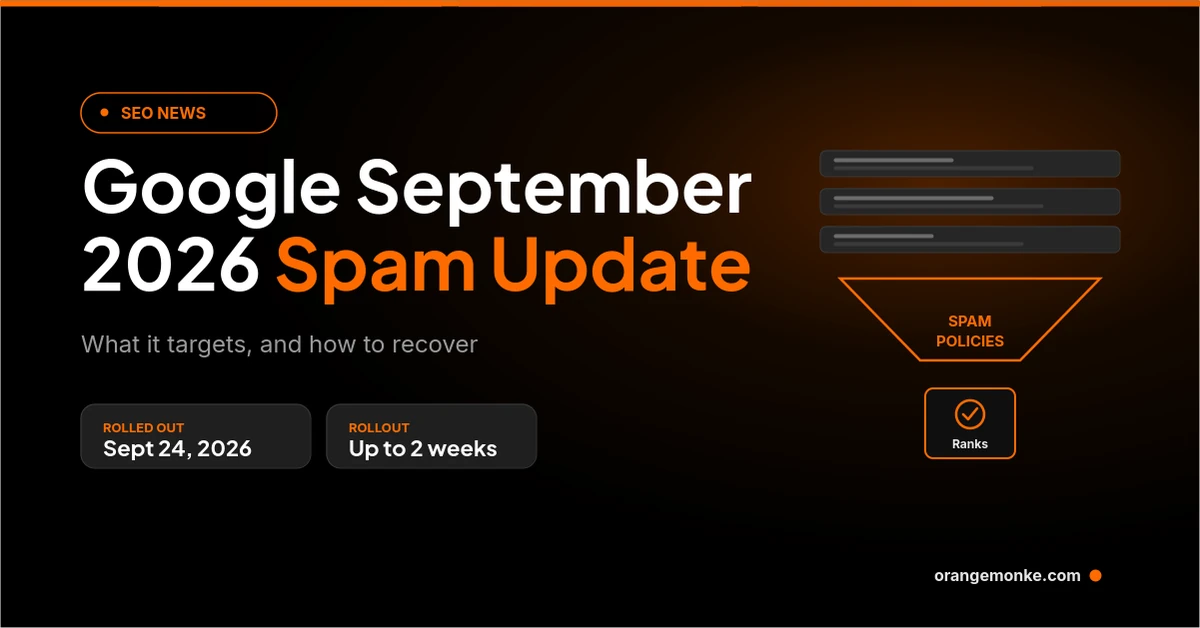
The Google September 2026 Spam Update launched on September 24, 2026 at roughly 9:15 a.m. PDT and targets pages that violate Google's spam policies, not link spam. It is a global rollout across all languages expected to take up to two weeks. Sites hit by it recover by fixing spam-policy violations, though full recovery can take months and no reconsideration request is available because the action is algorithmic.
What Is the Google September 2026 Spam Update?
The September 2026 Spam Update is an algorithmic enforcement of Google's spam policies that rolled out globally on September 24, 2026, and it demotes pages that break those policies rather than punishing links. Google confirmed on its Search Status Dashboard that the update improves how its systems detect content and behavior that violate its published spam policies.
Spam updates are separate from core updates. Where a core update reassesses overall quality and relevance across the whole index, a spam update sharpens Google's ability to catch specific policy violations such as scaled content abuse, expired-domain abuse, and site reputation abuse. If your site follows Google's spam policies, an official spam update should not affect you.
For a plain-language reference on the terms in this post, our SEO glossary breaks down spam updates, core updates, and manual actions side by side.
When Did the September 2026 Spam Update Launch?
The September 2026 Spam Update started rolling out on September 24, 2026 at approximately 9:15 a.m. PDT (12:00 p.m. ET), according to the timestamp Google posted on its Search Status Dashboard. Google said the rollout could take up to two weeks to complete.
Google's Search Liaison and John Mueller both signaled that this rollout may run longer than previous spam updates rather than shorter. That matters for diagnosis: ranking movement during a two-week-plus window is expected and normal, so you should not treat a single day of fluctuation as a confirmed hit until the rollout finishes.
There was notable ranking volatility on September 23 and 24, but Google clarified that the tracker chatter before the official announcement "was not it," meaning the pre-announcement turbulence was unrelated to this specific update.
Is the September Spam Update the Same as a Core Update?
No, the September 2026 Spam Update is not a core update, and confusing the two leads to the wrong recovery plan. A spam update enforces Google's spam policies against clear violations; a core update rebalances how Google weighs quality, relevance, and helpfulness across the entire index.
The difference decides your response. If a spam update hits you, the fix is to identify and remove specific policy violations. If a core update affects you, there is no single violation to fix, so the work is broad, sustained improvement to content quality and usefulness over time.
What Does the September 2026 Spam Update Target?
The September 2026 Spam Update targets pages that violate Google's spam policies, and Google explicitly confirmed it does not target link spam. The enforcement focuses on content and behavior Google has already defined as spam in its published policies.
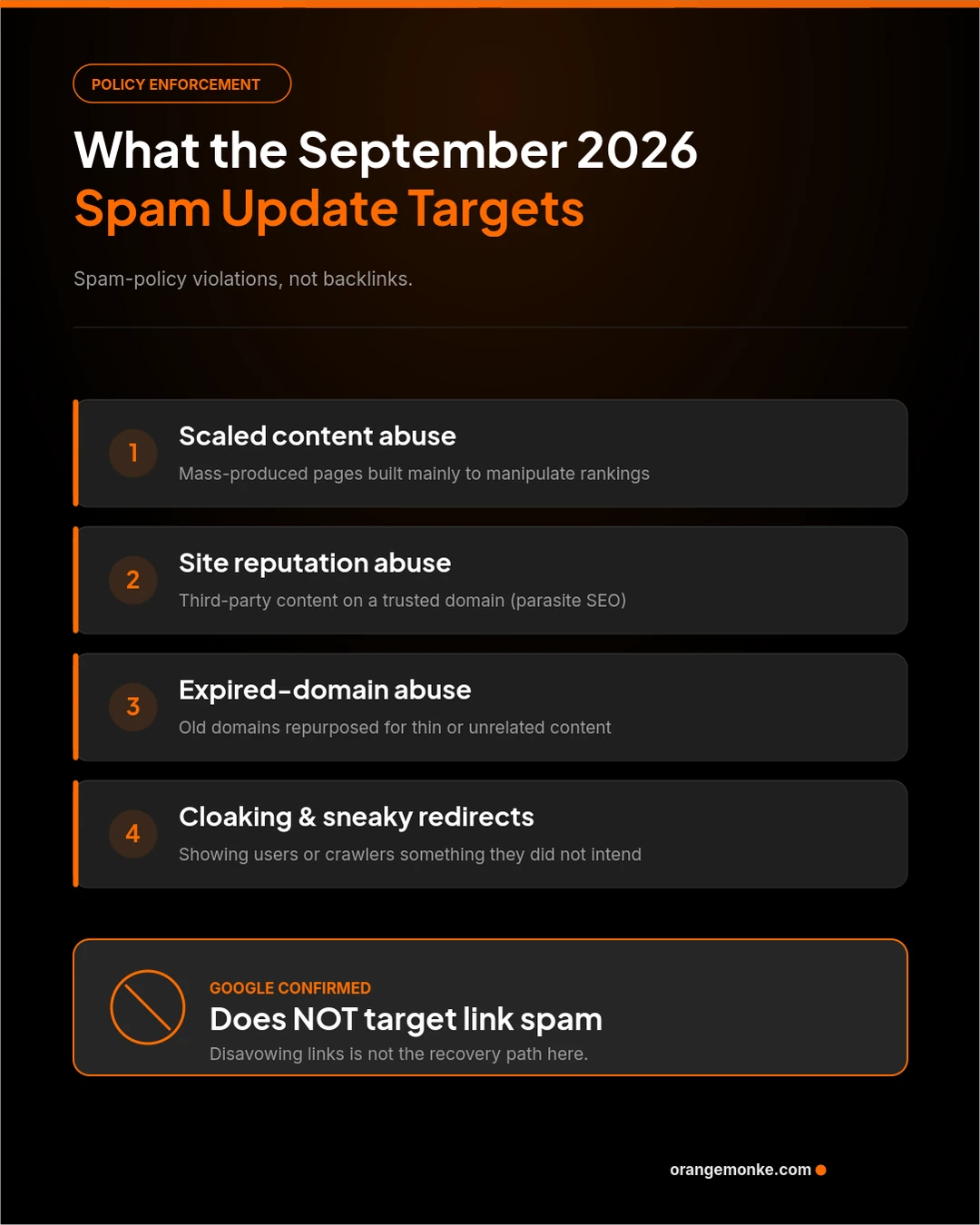
The policy areas most associated with spam-update enforcement include:
- Scaled content abuse: Producing many pages primarily to manipulate rankings, including mass-generated low-value content, whether written by automation, humans, or a combination.
- Site reputation abuse: Publishing third-party content on a trusted domain mainly to exploit that domain's ranking signals, often called "parasite SEO."
- Expired-domain abuse: Buying expired domains and repurposing them to boost thin or unrelated content using the old domain's residual authority.
- Cloaking and sneaky redirects: Showing search engines different content than users see, or redirecting visitors to a page they did not intend to reach.
Because Google stated this update does not address link spam, disavowing links or auditing your backlink profile is not the recovery path here. Building genuinely helpful content the right way, as covered in our beginner's guide to white-hat SEO, is what keeps a site on the safe side of these policies.
Where Does This Fit in Google's 2026 Update Cycle?
The September 2026 Spam Update is the fourth confirmed spam update of the year, following spam updates in March, June, and August, which shows Google is enforcing its spam policies more frequently in 2026. Each rollout has run over multiple days, and this one is expected to run the longest.
| Spam update | Rollout start | Rollout duration |
|---|---|---|
| March 2026 Spam Update | March 2026 | ~19 hours 30 minutes |
| June 2026 Spam Update | June 2026 | ~2 days 1 hour |
| August 2026 Spam Update | August 2026 | ~2 days 16 hours |
| September 2026 Spam Update | September 24, 2026 | Up to 2 weeks |
The pattern is unmistakable: each rollout has taken longer than the one before it, and September is set to be the longest yet.
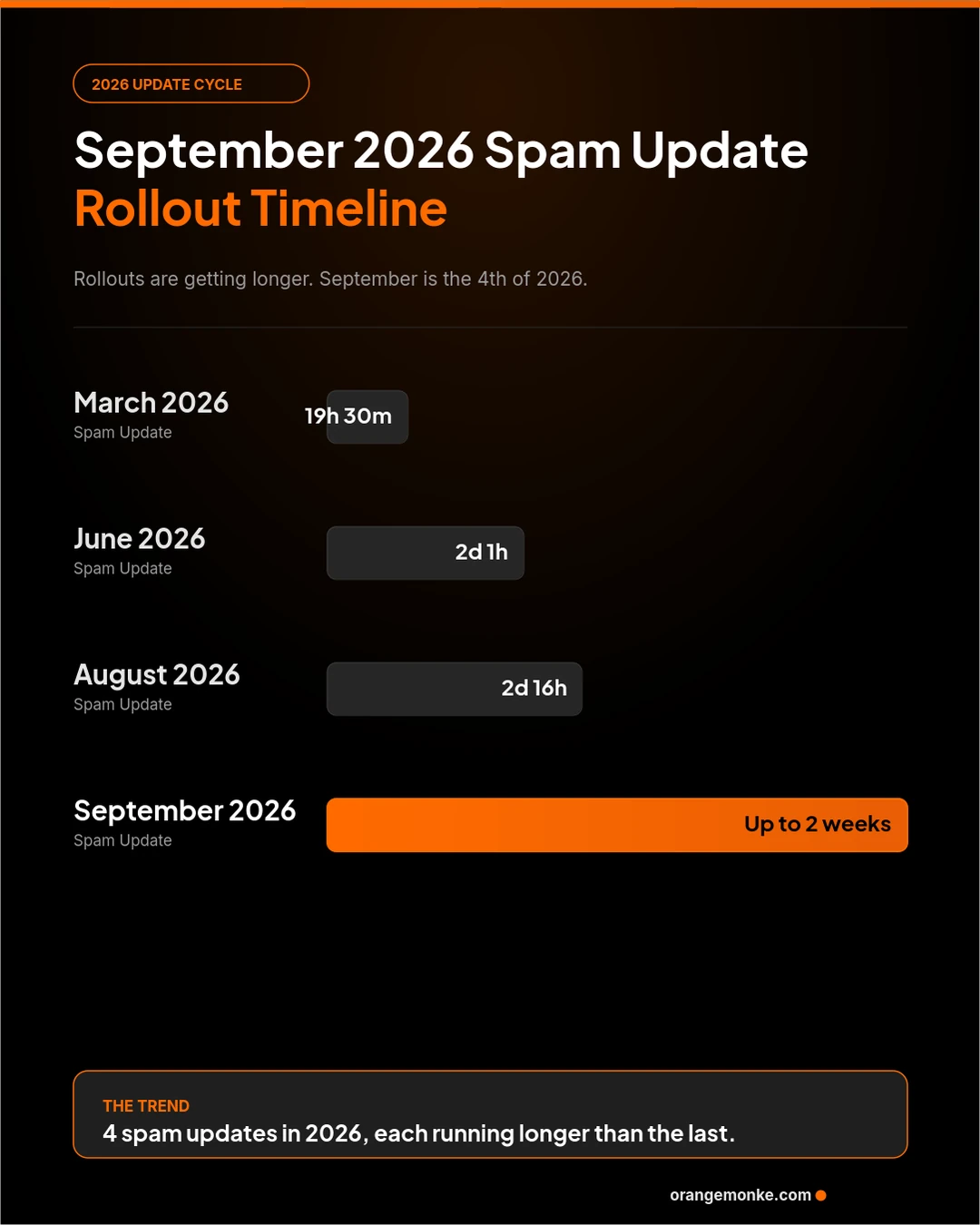
We have covered each of these rollouts in depth as it happened, from the brief March update through the longer June and August ones, and the pattern of lengthening rollouts holds across every one. You will find our full breakdowns of all three linked in the related reading below.
How Do You Know If the September 2026 Spam Update Hit You?
You were likely hit by the September 2026 Spam Update if your organic traffic and rankings dropped sharply starting on or after September 24, 2026 and your site has content that could fall under Google's spam policies. Confirm timing against the rollout window before drawing conclusions.
Work through this quick diagnostic:
- Match the dates: Overlay your Google Analytics and Search Console drop against the September 24 start date. Movement that began clearly before the rollout points elsewhere.
- Wait for the rollout to finish: With a window of up to two weeks, mid-rollout swings can reverse, so a confirmed hit is one that holds after the update completes.
- Audit for policy violations: Honestly review your site for scaled content, parasite pages, or repurposed expired domains. No violations usually means this update is not your cause.
- Rule out other causes: A sudden drop can come from technical errors, manual actions, or a core update, not only spam enforcement.
If the dates do not line up or you find no violations, the cause is probably something else entirely. Our guide on what to do when website traffic drops suddenly walks through the full list of causes and how to isolate each one.
How to Recover From the September 2026 Spam Update
Recovering from the September 2026 Spam Update requires identifying and fixing the specific spam-policy violations on your site, and recovery can take months because the update is algorithmic with no reconsideration request available. There is no shortcut and no form to submit.
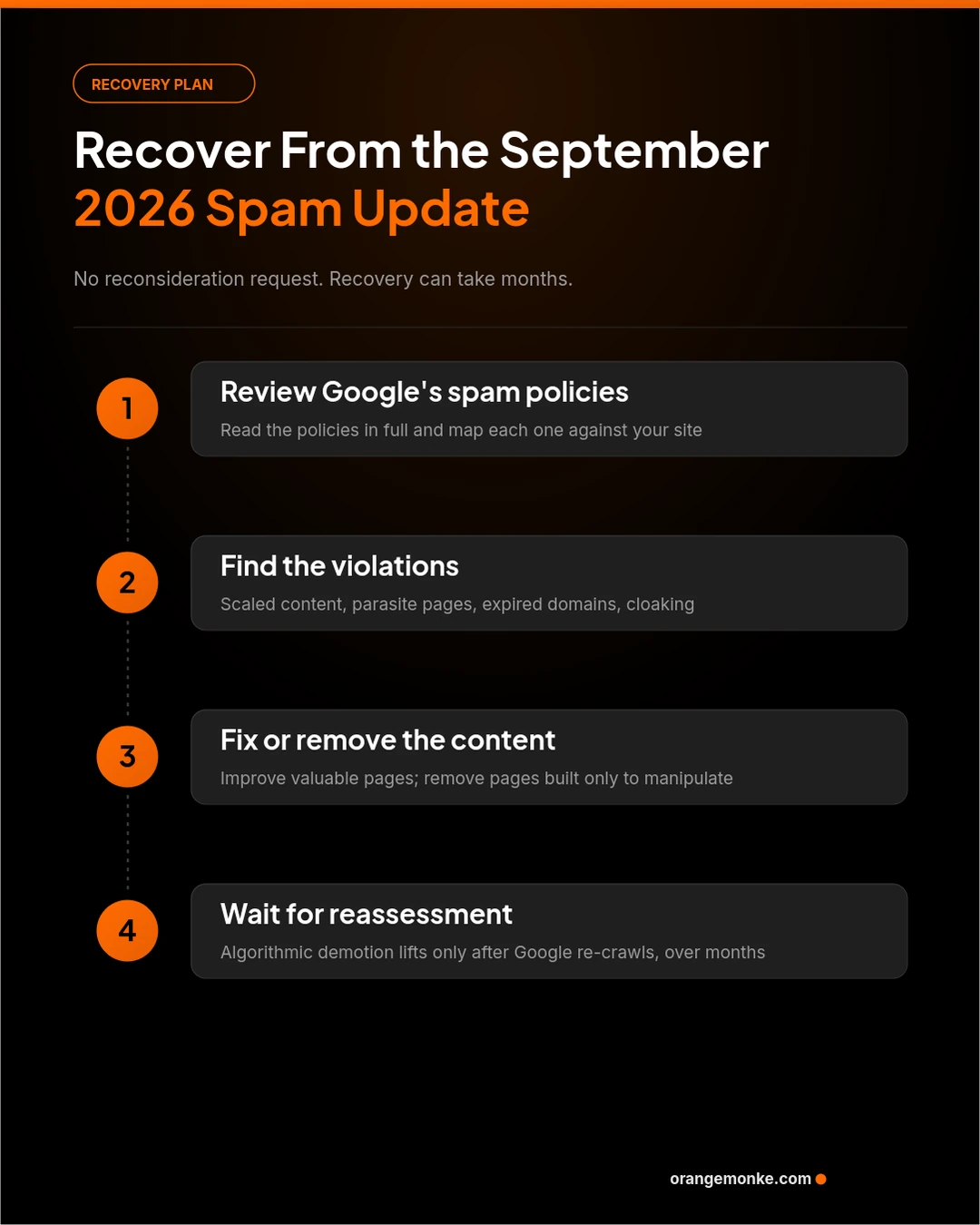
Follow this recovery sequence:
- Review Google's spam policies: Read the current spam policies in full and map each one against your site so you know exactly what you are checking for.
- Find the violations: Look for scaled or mass-produced content, parasite third-party pages, expired-domain repurposing, cloaking, and sneaky redirects.
- Fix or remove the content: Improve genuinely valuable pages, and remove or rebuild pages that exist only to manipulate rankings.
- Wait for the next assessment: Because the demotion is algorithmic, Google's systems must re-crawl and re-evaluate your fixes over time, which is why recovery commonly takes months rather than days.
There is no reconsideration request for an algorithmic spam update, so do not wait on a manual review. The path back is clean content and patience. If you want experienced help auditing and rebuilding, our SEO services team fixes policy violations and restores lost rankings.
What Should You Do During the Rollout?
During the rollout you should hold steady, avoid drastic changes, and wait for the update to finish before judging the impact, because a window of up to two weeks makes mid-rollout data unreliable. Reacting to a single bad day often causes more harm than the update itself.
- Do not panic-edit: Sweeping changes made mid-rollout muddy your ability to attribute cause and effect afterward.
- Keep monitoring: Track Search Console and analytics daily, but wait for the completed rollout before acting.
- Keep publishing quality content: Steady, helpful publishing is the safest posture during any update.
Our guide to getting organic traffic covers the fundamentals that survive every update, from content quality to the technical health that keeps you eligible to rank in the first place.
The Bottom Line on the September 2026 Spam Update
The September 2026 Spam Update rewards sites that follow Google's spam policies and demotes those that do not, and it does not touch link spam, so the winning strategy is clean, genuinely helpful content published the right way. If you were hit, fix the specific violations and give Google's systems time to re-evaluate.
If your rankings dropped and you are not sure why, do not guess. Confirm the timing, audit for real violations, and rule out the other common causes before you commit to a recovery plan. Naming the cause correctly is what turns a scary drop into a fixable problem.
At Orange MonkE, this is the exact process we run for clients after every spam and core update, no panic edits and no guesswork, just a clean audit that names the cause and a recovery plan built around it. If the September 2026 Spam Update hit your site, or you simply want to be sure it did not, our SEO services team will pinpoint what changed and get your rankings climbing again.
Find out what to fix, not just that you dropped.
A free audit pinpoints whether a spam update, a core update, or a technical fault caused your drop, and exactly what to do next.
Explore our SEO services →Frequently Asked Questions
The September 2026 Spam Update targeted pages that violate Google's spam policies, and Google confirmed it did not target link spam.
- Content violations: Scaled content abuse, site reputation abuse (parasite SEO), and expired-domain abuse.
- Deceptive behavior: Cloaking and sneaky redirects that show users or search engines something they did not intend.
- Not links: Backlink audits and disavowals are not the fix for this update.
If your site follows the spam policies, this update should not have affected you.
The September 2026 Spam Update began rolling out on September 24, 2026 at about 9:15 a.m. PDT and is expected to take up to two weeks to complete.
- Start: September 24, 2026, per Google's Search Status Dashboard.
- Duration: Up to two weeks, likely longer than previous spam updates.
Wait for the full rollout before confirming any impact on your site.
No, a spam update is not the same as a core update, and the two require different recovery approaches.
- Spam update: Enforces specific spam-policy violations, so you fix the violations.
- Core update: Rebalances overall quality and relevance, so you improve content broadly.
Matching the right fix to the right update is half the recovery battle.
Recovery from a spam update can take months because the demotion is algorithmic and Google's systems must re-crawl and re-evaluate your fixes over time.
- No quick fix: There is no reconsideration request for algorithmic spam updates.
- Timeline: Expect months, not days, even after violations are fixed.
Fix the violations, then give the algorithm time to reassess.
Google has released four confirmed spam updates in 2026, in March, June, August, and now September, showing tighter and more frequent spam enforcement.
- Getting longer: Each rollout has taken more time, with September expected to run the longest.
- The takeaway: Spam enforcement is now a near-quarterly event, not a rare one.
Building clean is the only strategy that survives every rollout.
If your traffic dropped but you follow Google's spam policies, the September 2026 Spam Update is probably not your cause, so investigate other reasons for the decline.
- Check timing: Compare your drop to the September 24 start date.
- Rule out causes: Technical issues, manual actions, or a core update can all cause sudden drops.
A drop with no policy violations usually points to something technical or a core update instead.