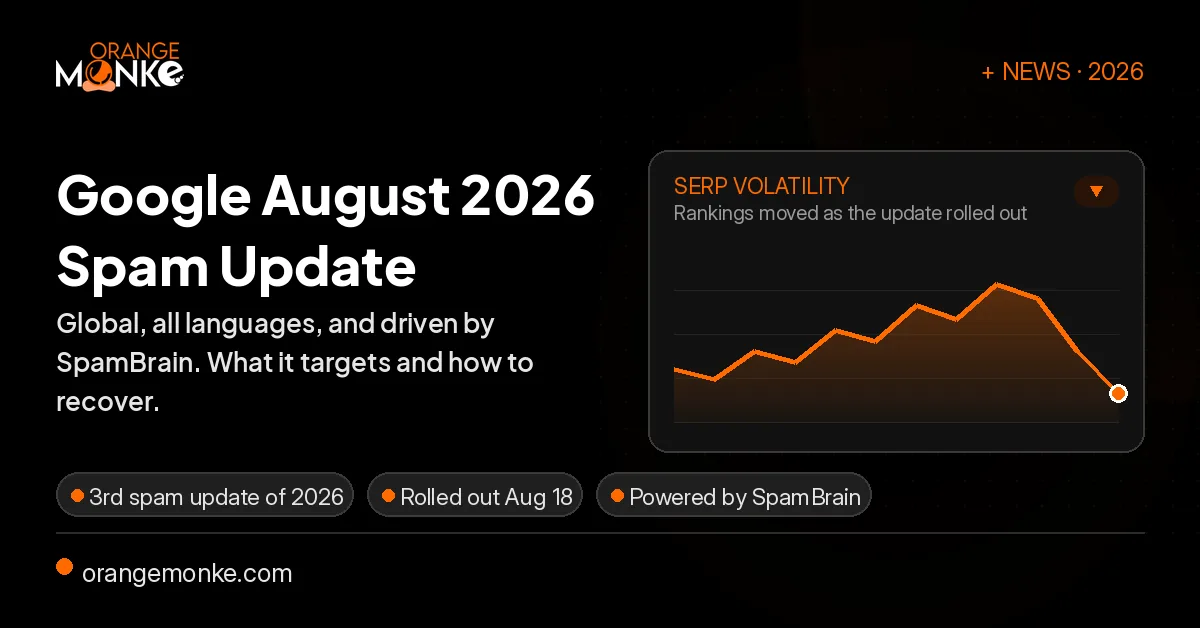
Google finished rolling out the August 2026 spam update on 21 August. It ran for about two days and 16 hours, worldwide and in every language, and it was the third spam update of the year after the March and June ones. Now that the rollout is confirmed complete, your Search Console numbers are finally worth reading. This guide explains what the update looks for, how it decides which sites to hit, and the steps that actually help you recover.
The August 2026 spam update was a routine, worldwide upgrade to SpamBrain, the system Google uses to catch spam. It started on 18 August and Google confirmed it complete on 21 August 2026. It added no new rules. It just enforced the existing spam policies more strictly. Sites built on mass-produced content, thin or doorway pages, old bought domains, or AI content made only to win citations were the most at risk. The rollout is over, so the data is now stable enough to act on, but recovery still takes months rather than days.
What Is the August 2026 Spam Update?
The August 2026 spam update was an upgrade to Google's automatic spam systems, switched on 18 August 2026 and completed on 21 August 2026, running worldwide in every language. Google called it a normal spam update with no new rules. That means it enforces rules that already exist. It does not invent new ones.
A spam update is more focused than a big general update. It improves how Google spots and pushes down pages that break its published spam policies. So a drop caused by a spam update usually points to one clear problem you can find and fix. If you are wondering whether search itself is changing, our take on whether SEO is dead gives the bigger picture.
This was the third named spam update of 2026. It came after a run of spam and core updates this year, including the March 2026 core update, which we cover further below.
When Did the August 2026 Spam Update Roll Out and Finish?
The August 2026 spam update started at 09:27 US Pacific time on 18 August 2026 and Google confirmed it complete on 21 August 2026, a total runtime of about two days and 16 hours. Google logged the start on its Search Status Dashboard and posted a short note a minute later, then marked the rollout finished on its ranking release history page.
Google did not publish a blog post or add any new rule with this update. The existing spam policies page stayed the rulebook throughout. The table below collects every confirmed detail in one place.
| Detail | Information |
|---|---|
| Update name | Google August 2026 spam update |
| Announced | 18 August 2026, 09:27 PDT |
| Completed | 21 August 2026, 01:50 PDT |
| Rollout duration | About two days and 16 hours |
| Scope | Global, all languages and regions |
| Targets | Sites violating Google's general spam policies |
| Does not target | Link spam or the site reputation abuse policy |
| Refreshes | Periodic, Google will refresh the spam update over time |
| Recovery time | Several months, even after fixes |
| Recovery guarantee | Not guaranteed |
The headline is simple: cleaner enforcement of existing rules, aimed at content-level spam, with a recovery path measured in months.
The update also arrived after weeks of choppy search results, with some sites reporting fewer clicks from both Search and Discover. Google's John Mueller has said that earlier volatility was not this update, since Google announces a rollout shortly after it begins rather than days later. Google often follows a spam update with a separate core update, as it did earlier in 2026, so keep an eye out for more announcements.
What Does the August 2026 Spam Update Target?
The August 2026 spam update went after the same old problems: mass-produced content, cloaking, doorway and thin pages, keyword stuffing, old bought domains, scraped content, and AI content built to game rankings. Google did not name any single trick, which is normal. The target is simply the list of rules it already publishes. The graphic below sums them up.
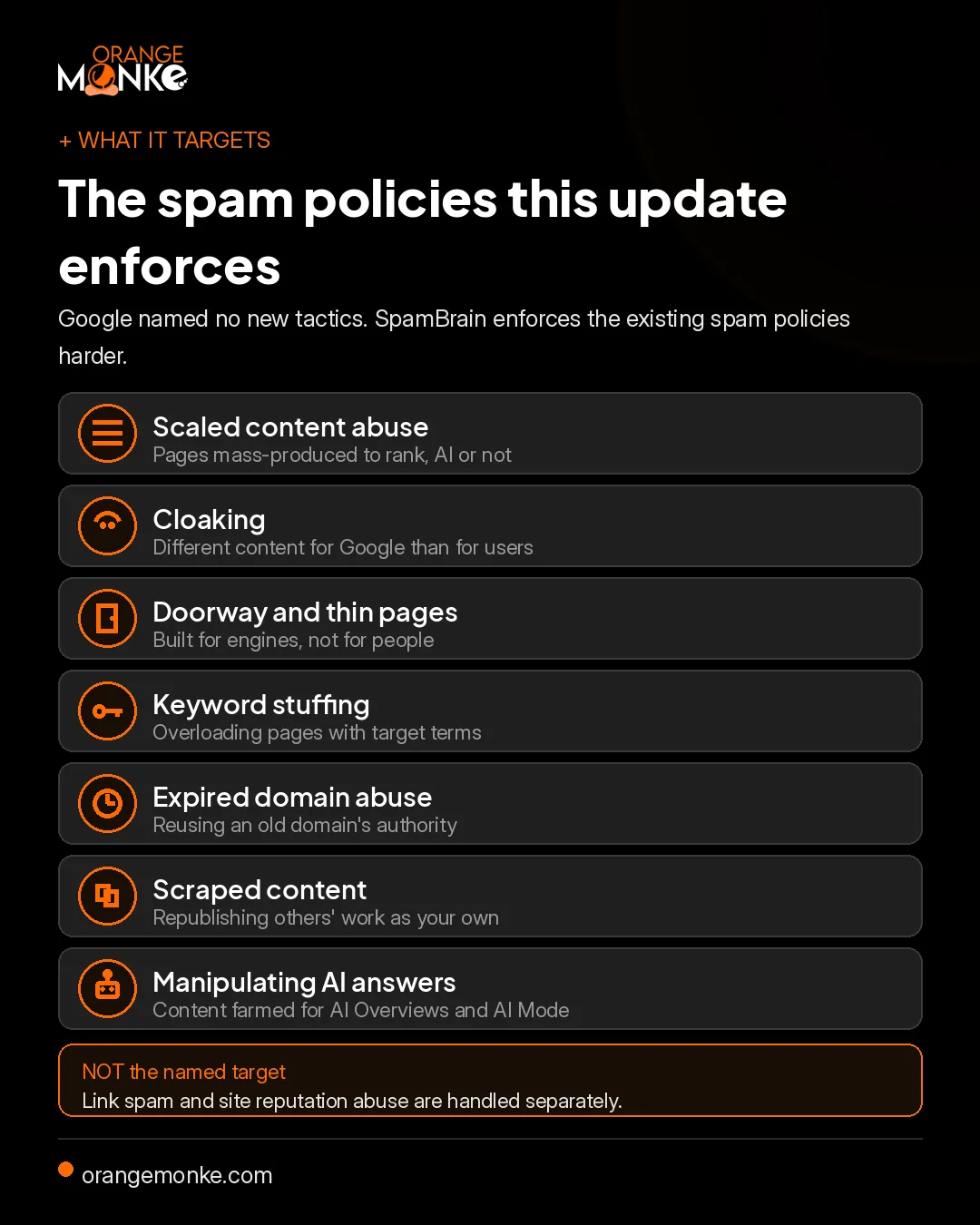
Two things were not the main target this time: link spam and the site reputation abuse rule. Like recent updates, those are handled by other systems, and site reputation abuse is dealt with mostly by hand. This does not make bad links safe. It just means they are not what this update was built to catch.
The AI part is worth a closer look. Google's spam rules now clearly cover content made to trick AI answers. So pages churned out just to get picked up by AI Overviews and AI Mode count as spam, in the same way link farms always did. The place changed, the rule did not. Keeping honest AI SEO on the right side of that line is now everyday work.
What Is SpamBrain and How Does It Work?
SpamBrain is Google's AI system for spotting spam, and a named spam update is usually a fresh round of training for it. Google's spam systems run all the time. When a change is big enough to move rankings, Google announces it as a spam update. The August 2026 update was one of those.
SpamBrain looks at patterns, not single tricks. It does not need to catch your keyword stuffing on its own. It learns what spammy sites look like overall and pushes down pages that match. That is why a site can pass every small check and still get hit if the whole site looks built for search engines, not people.
There is a simple test behind this. Would this page exist if search engines did not? If the honest answer is no, the page is in the danger zone, no matter how tidy it looks. Building pages that pass this test is the base of good SEO.
How Is a Spam Update Different From a Core Update?
A spam update punishes rule-breaking, while a core update rethinks overall quality, and that changes how you find the cause of a drop. With a spam update, a drop usually means Google flagged a rule you broke, so you can hunt it down. With a core update, you can lose rankings without breaking any rule at all.
The fixes are different too. To recover from a spam update, you check your site against the spam rules and clean up the pages that break them. To recover from a core update, you do slower, broader work to make the whole site genuinely better and more useful. You can see how that plays out in our breakdowns of the March core update once it finished and the December 2025 core update, plus what that last one did to real sites.
Are Spam Updates Rolling Out Faster in 2026?
Yes, spam updates are rolling out much faster in 2026. They have gone from about four weeks in August 2025 to under a day for the March 2026 update, with June and August both finishing inside three days. Three spam updates in eight months is a quick pace, and every one of them has cleared in days rather than weeks, as the chart below shows.
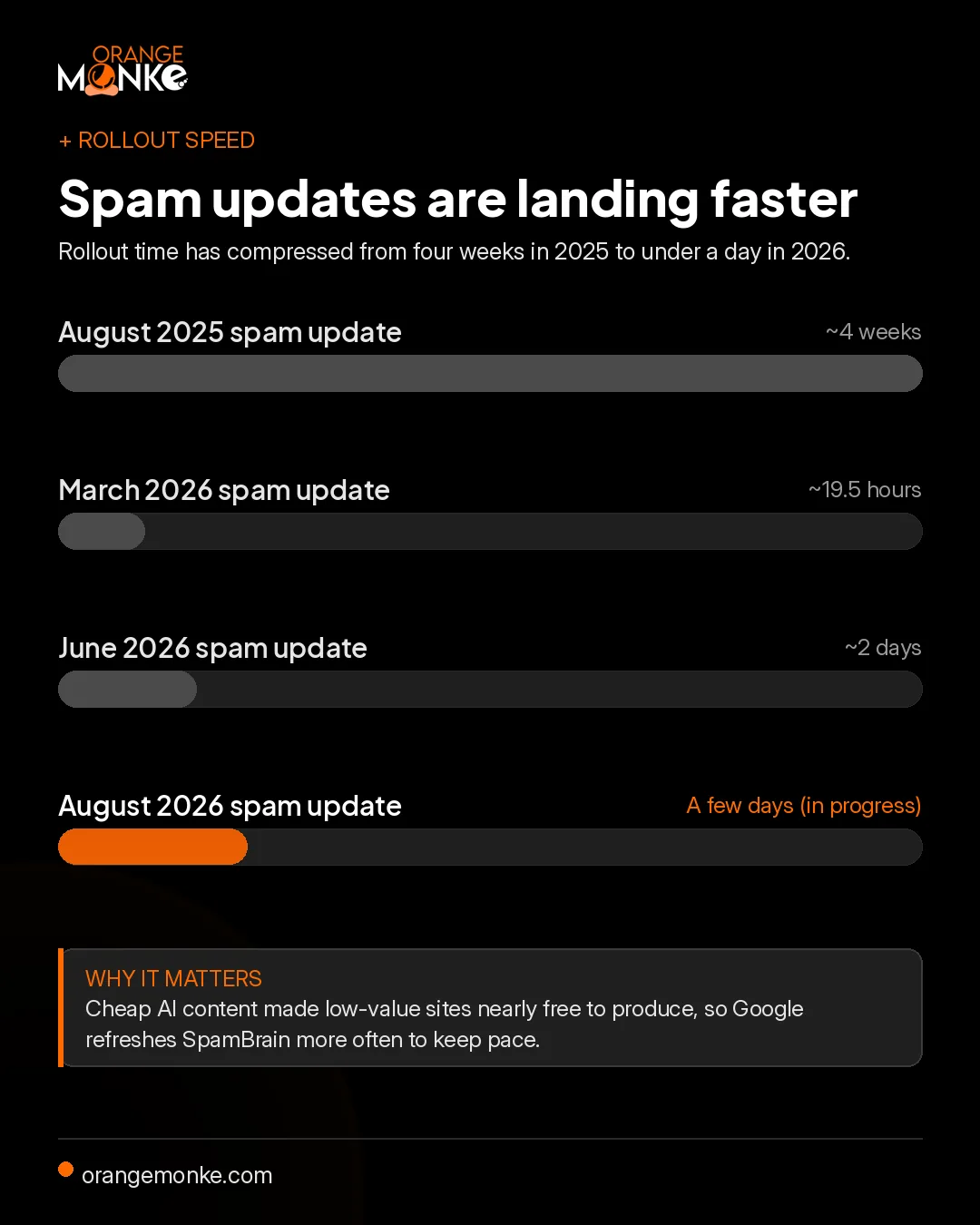
How often they happen matters as much as the speed. Cheap AI writing made low-value sites almost free to build in bulk, so Google now refreshes SpamBrain more often to keep up. Google has also confirmed it will run periodic refreshes of this spam update rather than treating it as a one-off. Expect this pace to continue and the rules to keep spreading into AI answers, which is why keeping up with the biggest SEO trends for 2026 is worth the time.
What Are SEOs Saying About the Update?
Top SEO experts see the August 2026 spam update as another squeeze on mass-produced and AI-farmed content. The early reaction was the usual mix: stay calm, do not make rushed changes, and expect bulk spam to be the real target.
- Glenn Gabe said he hopes the update further cuts down GEO and AEO spam, meaning content made only to get quoted by AI answers, and that he is watching the rollout closely.
- Marie Haynes made a sharper point. SpamBrain is catching more ordinary sites that use pushy tactics, such as pages held up by fake links or content made mostly to rank.
- Barry Schwartz reported that, like recent updates, this one does not target link spam or site reputation abuse, and confirmed the completion time when Google closed the rollout on 21 August.
Tracking tools moved on day one and stayed noisy until the finish. Tools such as AccuRanker, Semrush Sensor, Sistrix, and MozCast showed extra movement as the update began. Webmaster forum reports through the rollout were split, with some sites reporting heavy losses in Search and Discover and others reporting a recovery from earlier false positives. Now that Google has marked the update complete, those readings are worth trusting again.
Does It Target AI Content, GEO, and AEO?
The update targets spammy AI content and AI-citation farming, not sensible use of AI in your work. Google looks at intent and value, not the tool. Content made in bulk just to rank or to farm citations is a problem. AI used to help draft work that a real expert then checks and improves is not.
This is where GEO and AEO get mixed up. Writing content so AI tools can quote it because it is truly the best answer is fine. Making bait just to show up in AI Overviews and AI Mode is the trick the rules name. The good news is that the same clean work that ranks you in normal results also earns AI citations, so you are not running two separate to-do lists.
If AI visibility matters to your business, this balance is exactly what our AI SEO services are built around, and it pairs well with our guide on writing SEO blog posts that rank.
The update is done. Now find out if it hit you, and what to fix first.
We check your site against Google's spam rules, find the pages dragging you down, and build a clear plan to win your visibility back.
Get a free SEO audit →Who Is at Risk From the Update?
Sites running mass-produced, thin, or copy-paste AI content with nothing new added were most at risk from the August 2026 spam update. The risk runs roughly in this order:
- Bulk AI or templated contentLots of pages made mainly to rank, with no real know-how or fresh value on top.
- Auto-built page farmsPages made to cover search terms rather than help people. Done well, keyword-led pages that each answer something real are a different story.
- Old bought domainsBuying a domain with history and reusing it to host weak content that rides the old trust.
- Built or bought linksEven though link spam is not the main target, fake links are still a pattern the systems learn to spot.
- AI-citation farmingContent made only to show up in AI answers rather than to be the best answer.
Some clean sites take a knock too. A few good sites wobble during a rollout and settle once it finishes, which is exactly why rushed changes mid-rollout are a mistake. Spam updates are close to a see-saw: every spot a spam site loses, a good site gains. If you have been doing the honest work, this is the week it pays off.
How Do You Know If It Hit Your Site?
To check if the update hit you, line up your traffic against 18 to 21 August in Google Search Console and look at three reports. A drop that started before 18 August has a different cause, so timing is the first thing to check. With the rollout now complete, the numbers have settled enough to read properly.
- Performance report: look for ranking and click changes that line up with the rollout window, not just one noisy day.
- Pages report: check whether pages are falling out of Google's index, which points to a bigger hit.
- Manual actions: spam updates are automatic, but it takes a second to confirm this box is empty.
Check both Search and Discover while you are there, since some sites saw movement in both. For a fuller picture of your numbers, our guide to Google Analytics website traffic works well alongside Search Console.
How Do You Recover From a Spam Update?
To recover from a Google spam update, check your site against the rules, fix or delete the bad pages, and give the system time to re-check you. There is no shortcut, but there is an order that saves you wasted effort. Because the rollout finished on 21 August, this is now the right moment to start rather than wait.
- Check the timing firstLine your drop up against the 18 to 21 August window. A drop that began earlier is not this update.
- Score your site against the rulesRead Google's spam policies fully and mark yourself honestly against each one.
- Focus where SpamBrain focusesMass-produced content, AI content with no real expertise, fake links, and thin or doorway pages.
- Fix or remove, do not water downImprove pages that can hold real value and delete the ones that cannot. A thousand weak pages hurt more than a hundred good ones help.
- Be patientGoogle says recovery can take many months, because SpamBrain has to re-learn that your site follows the rules, and it happens through periodic refreshes rather than instantly.
- Change the plan, not just the pagesIf the plan was publish in bulk, rank, then make money, the plan itself is the problem.
Reconsideration requests only apply to manual actions. So unless Search Console shows one, there is nothing to file and the system just has to re-check you. A clean-up like this is a normal part of technical SEO services, and it works best with a real content standard behind it.
How Do You Protect Your Site Going Forward?
To protect your site, make spam updates good news for you, with original, expert content and links you would earn anyway. The safe spot is the one where every tightening of SpamBrain moves you up as weaker sites drop. With refreshes now confirmed as periodic, that position matters more than a one-time cleanup.
- Use AI as a helper, not a spam machine. Draft and research with AI, then add real judgement, fact-checking, and fresh insight that a knowledgeable person would sign their name to.
- Earn links you would deserve anyway. Real coverage and real partnerships beat bought links, the approach we teach in our white hat SEO guide.
- Build authority slowly. Going deep on a topic adds up over time, which is the point of a strong content marketing strategy.
- Keep a simple habit. Check Search Console every week and watch a tracking tool during announced rollouts.
If you are starting small, our walkthrough on how to start SEO for a small website sets out the same ideas at the right size.
Conclusion
The August 2026 spam update was a routine, worldwide refresh of SpamBrain, the third this year, aimed at sites that break Google's existing spam rules, and it finished on 21 August after about two days and 16 hours. No new rules, a short rollout, and the usual sorting: sites that make content people actually need have little to fear, while sites built on bulk content, fake links, or AI-citation farming face another round of sharper checks.
With the rollout confirmed complete, your Search Console data is now stable enough to act on. Read the spam rules, find the pages that break them, and fix the plan behind them rather than patching individual pages. If your traffic has moved and you want a clear read on why, Orange MonkE helps businesses recover from updates and build the kind of steady SEO and AI SEO that gets stronger every time Google tightens the rules.
Turn every spam update into your advantage, not your problem.
Our AI SEO service builds content and authority that gets stronger each time Google tightens the rules, and gets cited in AI Overviews.
Talk to an AI SEO strategist →Frequently Asked Questions
The August 2026 spam update finished rolling out on 21 August 2026, three days after Google released it on 18 August.
- Total runtime: about two days and 16 hours, from 09:27 PDT on 18 August to 01:50 PDT on 21 August.
- How it was confirmed: Google filled in the duration on its ranking release history page, which is how it marks a rollout as closed.
- What it means for you: ranking data has settled, so Search Console numbers from after 21 August are now safe to act on.
If your visibility moved during that window, our SEO services start with exactly this kind of diagnosis.
The August 2026 spam update took about two days and 16 hours to roll out, which puts it in line with the two spam updates before it.
- Precedent: the March 2026 update finished in roughly 19 and a half hours and the June 2026 update in about two days.
- The trend: all three 2026 spam updates cleared in under three days, against about four weeks for August 2025.
- Why it matters: shorter rollouts mean less time reading noisy mid-rollout data before you can act.
Now that it is over, keep monitoring performance the way we outline in our guide to organic traffic.
The August 2026 spam update is not a core update, and the difference matters for diagnosis.
- Spam update: targets policy violations and improves how SpamBrain enforces the rules Google already publishes.
- Core update: reassesses overall quality and relevance, so you can lose visibility without breaking any rule.
- Why it matters: a spam-driven drop usually points to a specific policy you can find and fix.
If your visibility moved for broader quality reasons instead, our guide on whether SEO is dead covers where modern ranking signals are heading.
The August 2026 spam update targets manipulative AI content, not the responsible use of AI itself.
- In scope: large volumes of pages produced mainly to rank, whether written by AI, humans, or a mix.
- Also in scope: content farmed purely to earn citations in AI Overviews and AI Mode.
- Out of scope: AI used as a drafting tool on top of genuine expertise and original insight.
Getting that line right is the core of our AI SEO service.
Rankings drop during a spam update when Google classifies something on your site as a spam-policy violation.
- Confirm the timing: overlay your traffic decline against 18 to 21 August, since an earlier drop is a different cause.
- Score against the policies: read Google's spam policies and check your site honestly against each one.
- Look for the usual culprits: scaled content, thin or doorway pages, keyword stuffing, and unnatural links.
A clean technical foundation reduces this risk, which is what our SEO services are built to deliver.
You recover from a Google spam update by fixing the policy violation and giving the automated systems time to re-evaluate you.
- Fix or remove: improve pages that can carry real value and delete the ones that cannot.
- Be patient: Google says recovery can take many months, and it arrives through periodic refreshes of the spam systems.
- Start now: with the rollout complete as of 21 August, there is no longer a reason to hold off on major fixes.
For the underlying content standard, see our guide on writing SEO blog posts that rank.
You do not file a reconsideration request after a spam update unless Search Console shows a manual action.
- Automated by default: spam updates are algorithmic, so there is usually nothing to submit.
- Check the panel: open the manual actions report to confirm it is empty.
- If a manual action exists: fix the issue first, then file the reconsideration request.
Our beginner guide to white hat SEO explains how to stay clear of manual actions in the first place.
The August 2026 spam update can affect Google Discover alongside Search, and several publishers reported Discover and News losses during the rollout.
- Shared signals: Discover leans on the same quality and spam signals as web Search.
- Check both surfaces: review the Discover and Search tabs in Search Console separately.
- Same fix: cleaning up scaled or thin content helps recover on both.
If Discover is a real channel for you, our content marketing strategy guide shows how to earn durable visibility there.
Link spam is not the named target of the August 2026 spam update, though unnatural links can still hurt you through other systems.
- Handled separately: link spam and site reputation abuse run on their own systems, partly through manual actions.
- Still a risk: built or bought link profiles remain a pattern that detection systems flag over time.
- Safer path: earn links you would deserve anyway from real coverage and partnerships.
We build exactly that kind of profile inside our SEO services.