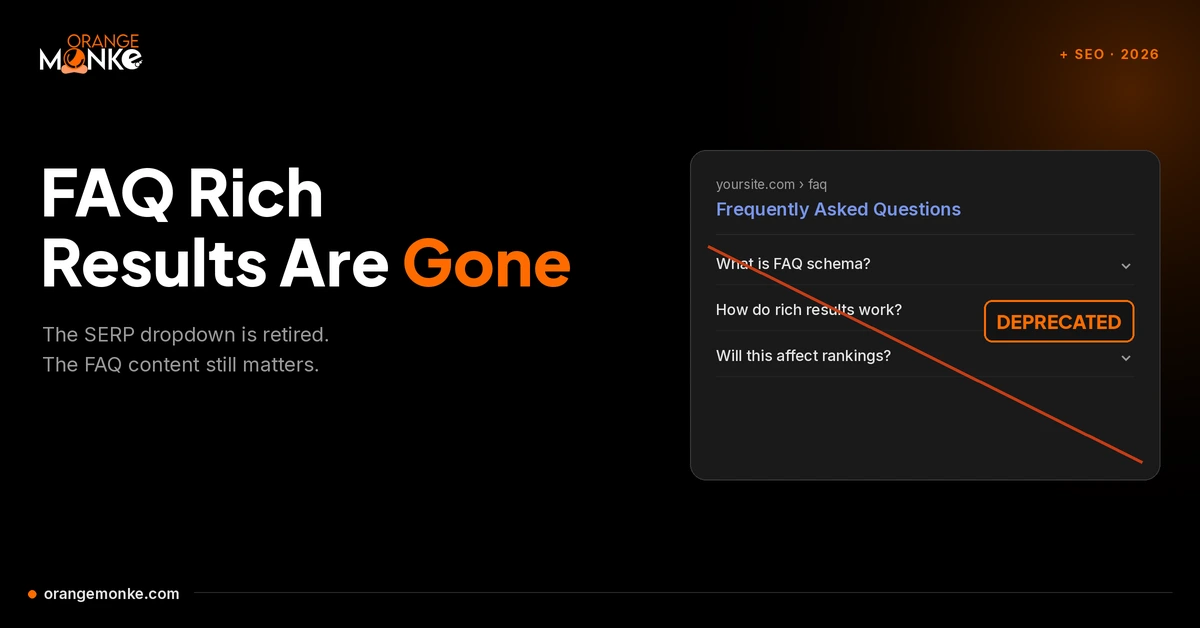
Yes, they stopped showing in Google Search on May 7, 2026.
Is FAQPage schema banned?
No, it is still a valid schema.org type you are allowed to keep.
Who can still get FAQ rich results?
Nobody, because the last exception for government and health sites was removed in May 2026.
Should I remove my FAQ schema?
No. Google says unused structured data causes no problems; only remove it if the FAQ section is gone or was filler.
Does FAQ schema win AI Overview citations?
There is no confirmed evidence that it does, because Google says no special schema is needed for AI Overviews.
When does Search Console stop reporting FAQ data?
The report ends in June 2026 and the API ends in August 2026.
On May 7, 2026, Google quietly added a deprecation note to the top of its FAQ structured data documentation, and that note said FAQ rich results would no longer appear in Google Search. There was no blog post and no announcement, so the only signal was a small label sitting on a developer page. Within a single day, one half of the SEO industry declared that FAQ schema was dead, and the other half declared that it was now more important than ever for AI search. Both of those reactions are wrong, because each one misunderstands what Google actually changed.
Here is the plain version. The rich result, meaning the expandable question-and-answer dropdown under your listing, is now gone for every website. The schema, meaning the FAQPage markup that labels your questions and answers for machines, is still valid code you are allowed to keep. Those two things are not the same, and the gap between them is what decides what you should do this quarter.
The one thing to take away. The FAQ rich result is gone for every website with no exceptions left. The FAQPage markup is still valid and safe to leave in place, but Google has never said it still uses that markup for anything, so do not treat the code as a hidden ranking signal or a shortcut into AI Overviews. The value now lives in the visible question-and-answer content on your page, not in the schema wrapped around it.
This change is not a shock if you were watching in 2023, which is where the story really begins. Below we cover the 2023 origin, the exact 2026 timeline, whether the schema still helps in AI search, what named experts and the Reddit community are actually saying, every common question in one place, and the specific decisions to make before June and August. Current status as of July 2026, two of the three phases have already happened, because rich results stopped on May 7 and the reporting removal was scheduled for June, while the API support is scheduled to end in August 2026. You can use the timeline below as a quick FAQ rich results tracker of what has already changed and what is still coming.
How Google Restricted FAQ Rich Results in 2023
FAQ rich results did not suddenly disappear in 2026, because the real turning point happened three years earlier. In August 2023, Google reduced and limited FAQ rich results so they would only show for well-known, authoritative government and health websites. For every other site on the internet, the expandable dropdown simply stopped appearing. Within weeks, FAQ rich result impressions for ordinary sites collapsed to almost nothing, and pages that had shown those snippets for years lost them overnight.
That 2023 restriction is the part most people forgot. For the vast majority of businesses, FAQ rich results have already been invisible for almost three years. If your reporting still showed FAQ impressions after 2023, then you were most likely one of the few remaining eligible government or health sites, or the numbers were simply residual. By 2025 the feature was already gone for the vast majority of sites, and Google's FAQPage structured data guidelines were updated again in 2026 to confirm that the FAQ rich result had been discontinued.
The reason Google gave was abuse. Through its engineer Ryan Levering, Google explained that FAQ markup had gotten out of control and was making structured data look like a spam vector, in the same category as fake review stars. Marketers had bolted generic FAQ blocks onto almost every page to grab extra space in the results, whether the content deserved it or not, so the 2023 restriction was a cleanup. The May 2026 update simply closes that loop, because the narrow eligibility government and health sites had kept since 2023 is now gone too, confirmed by SERP trackers who watched the last FAQ snippets disappear even from sites like the CDC.
The FAQ Rich Results Deprecation Timeline
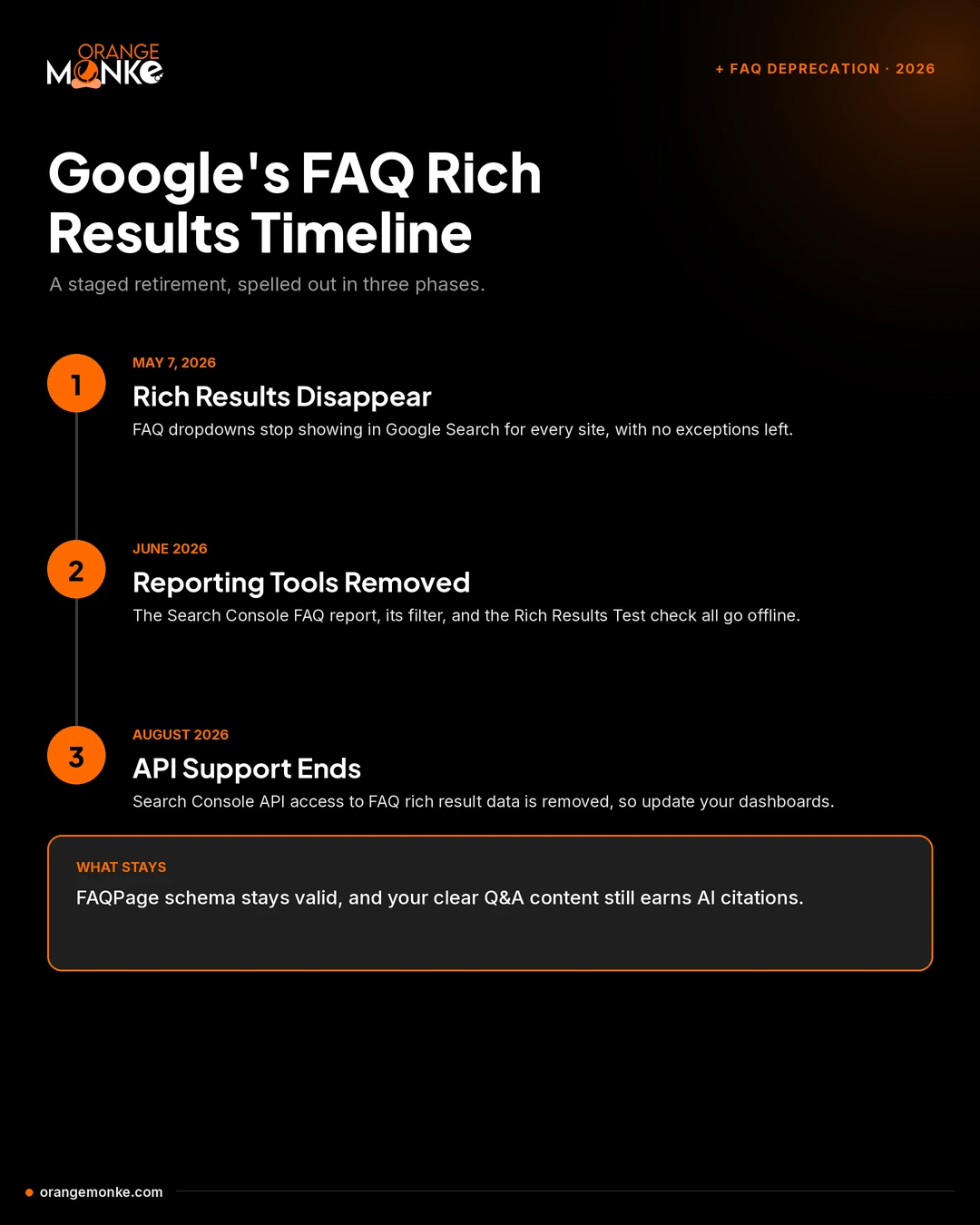
Google is retiring FAQ rich results across three separate stages, and all three were spelled out in that single developer note.
May 7, 2026. FAQ rich results stopped appearing in Google Search.
June 2026. Google removes the Search Console FAQ search-appearance filter, the rich result report, and FAQ support in the Rich Results Test.
August 2026. Google removes Search Console API support for FAQ rich result data, which is the final stage.
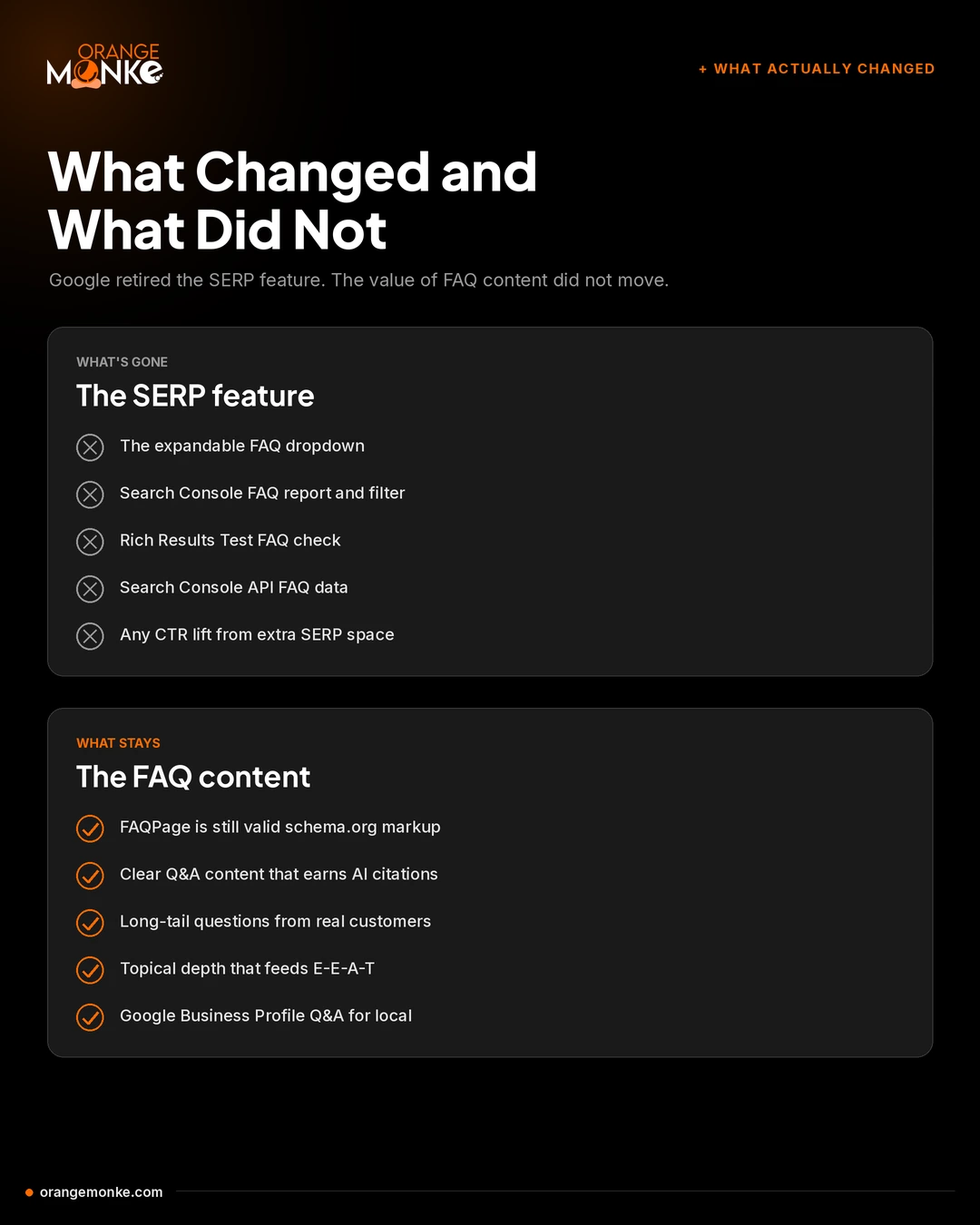
What stays is the important part. FAQPage is still a valid schema.org type, your markup will not throw errors, it will not trigger a manual action, and it will not damage your rankings if you leave it on the page. Only the visible SERP feature ended, and the markup itself was not deprecated.
Google is retiring FAQ rich results in three phases through 2026, but the FAQPage markup stays valid.
FAQ Schema and FAQ Rich Results Are Not the Same Thing
The cleanest way to understand this update is to separate two things that got blurred together for years.
FAQ schema is comprehension. It is markup that tells a search engine, explicitly, that one block of content is a question and another block is its answer, instead of leaving the engine to guess.
FAQ rich results were presentation. They were a display feature that took that markup and rendered an expandable panel under your listing.
Google ended the presentation, but the comprehension layer was not touched. So the honest question is not whether schema is dead, but whether the value you were getting came from the dropdown or from the structure. For most sites the dropdown was already gone in 2023, which means the answer has been sitting in your analytics for almost three years.
The SERP feature is gone, but the value of clear FAQ content did not move.
Does FAQ Schema Help With AI Overviews in 2026?
A lot of readers ask whether FAQ schema is still relevant, or whether FAQ schema still matters in 2026. The honest answer is that there is no confirmed evidence that FAQPage markup itself wins you AI citations. Google's own AI-features guidance states that no special schema is required for Google AI Overviews and AI Mode, and Google never said it still uses FAQ markup as a signal after the deprecation. Pages get cited in AI Overviews all the time with no FAQ schema at all, because what these systems pull from is clean, direct question-and-answer content, whether or not the markup is present.
Be careful with one stat. Several tools claim pages in AI Overviews are "3.2 times more likely" to have FAQ schema. That figure traces to a source page that no longer exists, with no primary study behind it, and Yoast founder Joost de Valk publicly flagged it as the 2019 schema-spam cycle starting over. Treat it as unverified and do not build a strategy on it.
What the credible data does show is more modest and more useful.
The gap between ranking and being cited is widening. An Ahrefs study from early 2026 found only 38% of pages cited in Google AI Overviews also rank in the top 10 of traditional results, down from 76% in mid-2025. Ahrefs itself cautioned that part of that drop reflects better citation detection in its own tools rather than pure behaviour change, so read it as a direction, not a law.
Structure correlates with citations. AirOps found that content with clean heading and question-and-answer structure earns citations at roughly 2.8 times the rate of unstructured prose, though that is a correlation, because well-structured pages tend to be stronger in every other way too. This is also where answer engine optimization overlaps directly with classic SEO.
The takeaway is boring and correct. The thing doing the work in AI search is the clarity of your answers, not the code wrapped around them.
+ AI SEARCH VISIBILITY
Your customers are moving into answers you cannot see
FAQ dropdowns were visible in your dashboard. AI Overviews and ChatGPT citations are not. We map where your brand shows up across AI search, and where it does not.
Since the deprecation note appeared, the same questions keep surfacing across Reddit, LinkedIn, Search Console data, and support threads. Here are the ones dominating the conversation right now, with the short answer to each.
Do I need to rip out my FAQ schema right now?
You do not need to rip out your FAQ schema right now, because Google says unused structured data is harmless, so there is nothing you need to remove today.
Will my rankings or traffic actually drop because of this?
Your rankings and traffic will not drop for most sites because of this change, because the FAQ dropdown was already gone for non-authority sites back in 2023.
Does FAQ schema still get me into AI Overviews and ChatGPT?
FAQ schema does not reliably get you into AI Overviews and ChatGPT, because it is the clear answer on the page that gets cited, not the markup around it.
Is all structured data dying, or just FAQ?
All structured data is not dying, because only FAQ was retired, while Product, Article, Review, Event, and many other types still earn rich results in 2026.
Should I delete the FAQ content too, or only the schema?
You should keep the FAQ content and treat only the schema as optional, because the visible content still helps users and gets cited whenever real people ask those questions.
When do my Search Console FAQ reports and dashboards break?
Your Search Console FAQ reports and dashboards break in stages, because the report and testing tools go in June 2026 and the API stops returning FAQ data in August 2026.
Why did Google do this with no announcement?
Google did this with no announcement because it was a quiet cleanup of a feature that had been mass-abused for extra SERP space since well before 2023.
Should I turn my FAQs into normal question headings instead?
Yes, you should turn your FAQs into normal question headings, because question-style headings with a direct answer underneath work for readers, search engines, and AI systems at the same time.
Do Bing and the other AI engines still read FAQ schema?
Yes, Bing and the other AI engines still read FAQ schema, because Google removing its own rich result is a Google-only decision, not an industry-wide one.
Does any of this affect my Google Business Profile Q&A?
No, none of this affects your Google Business Profile Q&A, because that is a completely separate surface that this update does not touch.
How do I win back the SERP space I just lost?
You win back the SERP space you lost not by getting the dropdown back, but by winning the click with a stronger title tag and by becoming the cited answer in AI search.
What SEO Experts Are Saying
The reaction split along predictable lines, and the most authoritative voices landed in the same place.
John Mueller (Google) said on Bluesky that for most sites this changes nothing, because the feature only ever applied to a tiny set of eligible site types, and markup on an ineligible site was already being ignored. His advice was that there is no need to change anything, but you can remove the markup if you added it only for search.
Glenn Gabe (independent SEO) documented that FAQ snippets are gone even for the government and health sites that had kept them, which closed the door the 2023 restriction left open.
Joost de Valk (founder of Yoast) debunked the 3.2 times figure and went further, filing a proposal at schema.org for a cleaner FAQSection type so honest sites finally have correct markup for an FAQ block on a normal page.
Lily Ray (Amsive) noted on LinkedIn that this fits a pattern she warned about back in 2019, which is that when too many sites lean on the same technique, Google eventually steps in and removes it.
What SEOs Are Saying on Reddit
We went into the SEO subreddits to see what working practitioners are saying, not just the LinkedIn hot takes, and the discussion there is more useful than the headlines. In the r/localseo thread titled "Google officially killed FAQ rich results," the original poster argued that teams should stop building strategies around SERP gimmicks and focus instead on strong brands, clear entities, helpful content, and visibility beyond Google. The most practical reply captured the working consensus in one line.
"You keep the FAQ schema, but strip out the marketing fluff and provide direct, objective data that RAG models can easily pull."u/Particular-Tiger9721, r/localseo
Another commenter made the point that you still satisfy the traditional search algorithms first, and only then optimize for the large language models and the buyer, which is a useful reminder that this is not an either-or choice. Across r/SEO and r/localseo, the same three points kept repeating, and they line up neatly with what Google itself is saying.
The rich result was already dead, so for most sites this barely changes anything on the Google side.
Keep the schema, because it is cheap to maintain and other engines and AI systems still read it.
Weak content cannot be rescued by schema, so the fix is to format your subheadings as real questions and write a clear answer directly underneath each one.
Most of the advice circulating is either too dramatic, telling you to rip it all out today, or too dismissive, telling you nothing changed. Here is the useful middle, as a short checklist.
Leave your existing FAQ schema in place. There is no upside to removing valid FAQPage markup, because Google confirms unused structured data causes no problems, other systems may still parse it, and SearchPilot's controlled test found removing it produced no statistically significant change in traffic. Remove it only if the FAQ section is gone from the page, or if it was thin keyword-stuffed filler.
Stop treating FAQ schema as a tactic. Going forward it is a description of your content, not a lever for traffic, so mark up real question-and-answer content but never add FAQ blocks just to chase a SERP feature that no longer exists.
Audit your FAQ sections for quality. Now that the markup does no cosmetic work, the content stands alone, so check that these are the questions customers actually type, that the answer lands in the first sentence, and that the wording is customer language rather than marketing language.
Update your reporting before August. If your dashboards pull FAQ data from the Search Console API, those calls return empty after August 2026, so export the history you want to keep and fix the reporting flow now.
Work on your Google Business Profile Q&A. This is a separate surface that this update does not touch, it is often filled with wrong user answers, and seeding real questions with owner-verified answers is genuine low-hanging fruit for local businesses.
Why Google Keeps Removing Rich Results
This is not a one-off, because it is part of a clear and repeating pattern. Google removed HowTo rich results from desktop in 2023, pulled seven more structured data types out of search appearance in 2025, and retired FAQ in 2026. Every time, Google removes a SERP feature that gave third-party content extra display space, and every time, the surface that gains that ground is Google's own AI Overview.
The direction is consistent, and it is not hostile to publishers. The teams that do well stop chasing individual SERP features and optimize for the signals that earn citations across every surface, which are clear entity authority, genuinely useful content, real topical coverage, and the E-E-A-T trust signals that come from links and mentions. Those are the same fundamentals that win traditional rankings, so the work did not change, it just stopped being about a single tactic.
The Bottom Line
FAQ rich results were only ever a display feature, and display features come and go. The FAQ content on your pages, meaning the real questions your customers ask and the clear answers you give them, is worth more in 2026 than it was in 2019, because it is exactly what AI search pulls from and what topical authority is built on. Leave your schema in place, cut the filler, and put your effort into becoming the clearest answer in your niche.
Stop building on SERP features Google keeps quietly removing
HowTo in 2023, seven types in 2025, FAQ in 2026. If your strategy leans on display features, the ground keeps moving. We build the entity authority and content depth that ranks and gets cited anywhere.
Every question we saw people asking about this change, in one place, with a straight answer to each.
Yes, FAQ rich results are gone for good as of May 7, 2026, which is the date they stopped appearing in Google Search for every website, including the government and health sites that had kept them since 2023. Google framed this as a permanent change, in the same way it retired HowTo rich results, so planning for a reversal is not realistic. The visible SERP dropdown is finished, and the smarter move is to shift that effort toward your visible content and your AI search visibility.
Yes, FAQPage is still a valid schema.org type, and Google says you do not need to remove it because unused structured data does not cause problems for Search. What ended is the visible rich result, not the markup, so your code will not error, trigger a manual action, or damage your rankings. That said, Google has not confirmed it still uses FAQ markup as a signal, so treat it as safe to keep rather than a hidden ranking benefit, and keep your wider structured data accurate and matched to what is visible on the page.
No, you should not remove FAQ schema in most cases, because Google confirms unused structured data causes no problems and SearchPilot's controlled test found that removing valid FAQ markup produced no measurable change in traffic. There are only two good reasons to remove it: the FAQ section no longer exists on the page, or it was thin, keyword-stuffed filler that a proper technical SEO cleanup would cut anyway. If the content is genuine and visible to users, leave the markup exactly where it is.
No, keeping or removing valid FAQ schema does not hurt your rankings either way, because Google treats unused structured data as harmless and the controlled tests found no meaningful traffic change. If you do notice movement after May 2026, check the usual causes first, such as a core update, seasonality, or shifts in search demand, before blaming the markup. This was a display and reporting change, not a ranking change.
Your click-through rate and traffic should not see a new drop for most websites, because the expandable dropdown was already gone for non-authority sites back in 2023, so the May 2026 change simply removes a feature you most likely lost years ago. The only sites that might see a small change are the government and health domains that kept the feature until now. If your traffic is soft, the bigger opportunity is usually understanding where you show up in AI search, where a growing share of high-intent clicks now begins.
FAQ schema does not have a confirmed role in getting you cited in AI Overviews, ChatGPT, or Perplexity, because Google's own guidance says no special schema is required for Google AI Overviews and AI Mode, and these systems pull from clear question-and-answer content whether or not FAQPage is present. The thing that actually earns citations is a direct, well-structured answer, which is the heart of answer engine optimization. So write for the real question first, and treat schema as optional housekeeping rather than the lever that gets you cited.
Yes, keep the FAQ content whenever it answers real customer questions, because the visible content is what helps users, lowers your support load, and gets pulled into AI answers, while only the markup ever became optional. A strong FAQ block is also one of the most efficient ways to cover long-tail intent, which is why our guide to writing content that ranks recommends it on in-depth pages. Remove the content only if it was generic filler that no real customer would ever ask about.
Yes, you should turn your FAQs into normal question-style headings, because formatting your subheadings as real questions with a clear answer underneath is easy for readers, search engines, and AI systems to follow, and it no longer depends on any rich result. Match the exact phrasing people use, which you can pull from People Also Ask, autocomplete, and a proper read of search intent for the topic. This is the format that can win a featured snippet and an AI citation at the same time.
Google did this as a cleanup of an abused feature, because FAQ markup had been added at scale purely to grab extra SERP space, and a Google engineer described it in 2023 as making structured data look like a spam vector. It follows the same logic as Google's spam updates, which target patterns that get gamed by tooling rather than earned by real content. The lasting lesson is that any tactic used by everyone eventually stops working, so durable results come from genuinely useful pages.
FAQPage is for pages where the site owner gives one official answer to each question, such as a help center article or a policy page, while QAPage is for pages where users submit multiple answers, such as a forum thread or community board. Choosing the wrong type can make search engines and AI crawlers ignore the markup, so use QAPage only when your users write the answers. Whichever you use, the marked-up content must always match what is visible on the page.
Google Search Console removes the FAQ report and Rich Results Test support in June 2026, and it removes the Search Console API support in August 2026. If your dashboards or BigQuery exports pull FAQ rich result data through the API, those calls will start returning empty after August, so export the history you want to keep and update your reporting flow before that date.
No, this change does not affect Google Business Profile Q&A, because that is a separate surface from website FAQ rich results and it still works normally. It is often filled with wrong user-submitted answers, so seeding the real questions your customers ask and adding owner-verified answers through Google Business Profile optimization is genuine low-hanging fruit, especially for local businesses.
Yes, Bing and various AI crawlers such as Perplexity can still parse FAQPage markup, because Google removing its own rich result is a Google decision and not an industry-wide one. What each system then does with that data is not publicly documented, so keep the schema for the engines that may use it, but remember that understanding how AI search retrieves and expands your content matters far more than the markup itself.
Plenty of structured data still earns rich results in 2026, including Product, Article, Review, Event, LocalBusiness, and Organization, so structured data as a category is very much alive and FAQ was simply one retired feature. The safe rule going forward is to use schema that genuinely describes visible content on the page, rather than adding any type just to chase a search feature.
Alex Wilson writes content that ranks and converts. With over a decade of experience creating SEO-optimized articles, guides, and landing pages for Orange MonkE's clients, she specializes in turning complex marketing strategies into clear, actionable content that drives business results. Her approach combines thorough research, strategic keyword targeting, and reader-first writing, ensuring every piece serves both search engines and the humans reading it. Alex writes about technical SEO, structured data, and AI search for Orange MonkE, translating Google and AI-platform changes into what teams should actually do about them.
Follow the expert:
orangemonke.com
🍪
We value your privacy
×
We use cookies to run the site, analyze traffic and improve your experience. You choose what we may use. Read our Privacy Policy.