Jun 16, 2026
  12 Min Read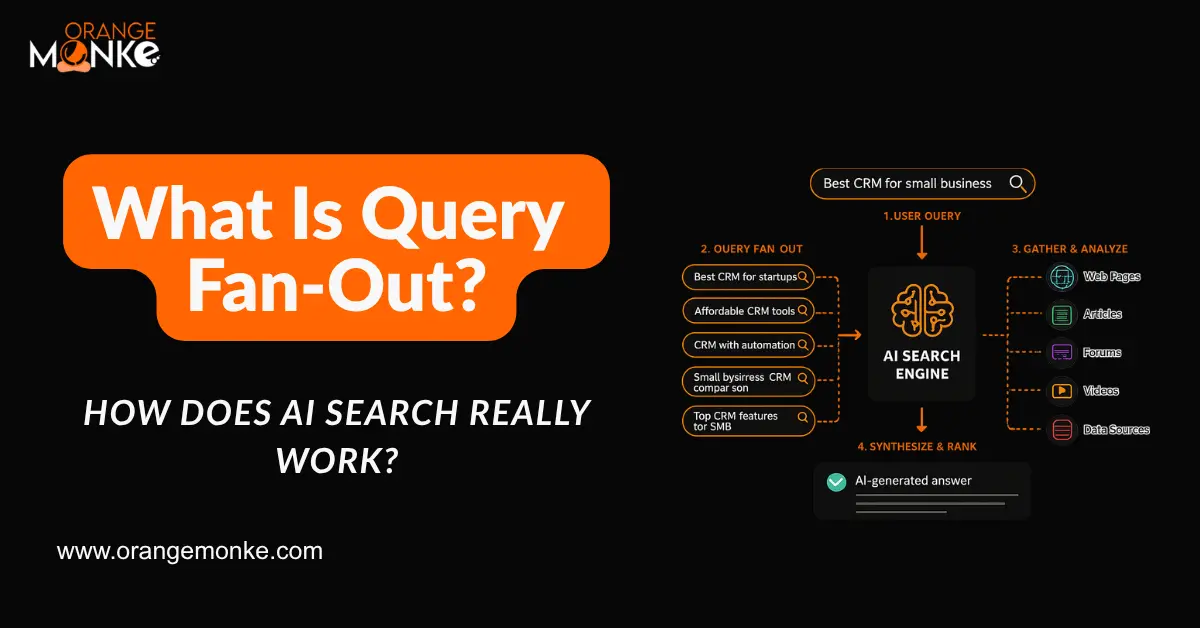
| Quick Answer
Query fan-out is the technique AI search systems use to split a single user query into multiple simultaneous sub-queries, retrieve information from across the web for each one, and merge all results into a single, comprehensive answer. It is the core mechanism behind Google AI Mode, and a key factor in how ChatGPT, Perplexity, and other LLMs decide which sources to cite. |
We are all well aware that search is changing. Instead of matching one query to one web page, AI-powered search engines now break complex questions into multiple sub-queries, analyze information from numerous sources simultaneously, and generate a single synthesized answer. This process, known as query fan-out, sits at the heart of Google AI Mode and influences how platforms like ChatGPT, Gemini, Perplexity, and Copilot retrieve and cite information.
Let’s learn how query fan-out works, why it matters for AI visibility, and the practical steps you can take to increase your chances of being cited in AI-generated responses.
What Is Query Fan-Out?
Query fan-out is a technique used by AI-powered search systems, most notably Google AI Mode, to answer complex user queries more comprehensively than traditional search can manage.
Rather than matching a single user query to a single best-fit web page, query fan-out instructs the AI to decompose the original query into a collection of related sub-queries, execute all of them in parallel, and synthesize the findings into one unified answer.
| “AI Mode isn’t just giving you information — it’s bringing a whole new level of intelligence to search. What makes this possible is something we call our query fan-out technique. Under the hood, Search recognizes when a question needs advanced reasoning. It calls on our custom version of Gemini to break the question into different subtopics, and it issues a multitude of queries simultaneously on your behalf.”
— Elizabeth Reid, Head of Search, Google I/O 2025 |
The term “fan-out” is borrowed from computing and engineering — just as a signal fans out to multiple receivers, a single search query fans out to multiple sub-searches before the results fan back in to a consolidated answer.
How Query Fan-Out Works
Here is exactly what happens from the moment a user types a query into Google AI Mode to the moment they see an answer:
Step 1 — Intent Detection
Google’s system evaluates whether the query is complex enough to warrant fan-out. Simple lookups (e.g., “What is the capital of France?”) may not trigger it. Multi-faceted queries almost always do.
Step 2 — Query Decomposition
A special version of Gemini breaks the original query into subtopics. For instance, “What’s the difference in sleep tracking between a smart ring, smartwatch, and tracking mat?” might be split into eight distinct sub-queries covering each device type, accuracy, battery life, price, and user experience.
Step 3 — Parallel Retrieval
All sub-queries are executed simultaneously against Google’s index, not one after another. This is why AI Mode responses arrive so fast despite effectively running many searches at once.
Step 4 — Content Evaluation & Extraction
Gemini evaluates the retrieved pages for relevance, authority, and accuracy relative to each sub-query. It extracts the most useful chunks of information from each source.
Step 5 — Synthesis
The AI merges all extracted information into one coherent, well-structured answer. Sources that contributed content are cited. The user sees a single response, not a list of links.
Step 6 — Citation Attribution
Each claim in the synthesized answer is attributed to its source page. This is what creates “AI citations” — the linked references you see alongside AI Mode answers.
| Pro tip
When you see “Kicking off 8 searches…” in Google AI Mode before your answer appears, you are watching query fan-out in action. The AI is explicitly showing you the number of sub-queries it is running. |
Key Differences Between Traditional Search and AI Mode Search
Understanding query fan-out requires understanding what it replaced. The difference is fundamental, not cosmetic.
| Factor | Traditional Google Search | Google AI Mode (Query Fan-Out) |
| Query Handling | One query → one results page | One query → many sub-queries → one synthesized answer |
| Result Format | Blue links + snippets | AI-written prose answer with inline citations |
| Source Diversity | One page dominates Position #1 | Multiple pages contribute to one answer |
| Ranking Signals | Keyword relevance, links, E-E-A-T | Topical comprehensiveness, NLP clarity, entity coverage |
| User Behaviour | Users click through multiple sites | Users often read the AI answer and click only for deeper information |
| Click-Through Impact | Clicks drive traffic directly to your page | Citations provide brand visibility even without clicks |
| Complex Queries | May struggle with multi-part questions | Handles multi-faceted queries natively through query fan-out |
One of the most significant consequences of this shift: the sites shown in AI Mode are often different from, or ranked in a different order than, those shown in traditional search results. A brand new site with truly comprehensive topical content can outperform an aged domain if it satisfies more sub-queries.
Why Query Fan-Out Matters for SEO and Marketing
| Metric | Value | Meaning |
| Simultaneous Sub-Queries | 8+ | Google AI Mode can run multiple related searches from a single user prompt. |
| Gen Z AI Search Adoption | ~40% | Approximately 40% of Gen Z users already prefer AI-powered search over traditional search engines. |
| AI Search Tipping Point | 2028 | Projected year when AI search visitors may surpass traditional search visitors, according to Semrush forecasts. |
| AI Citation Placement | #0 | AI-generated citations can appear above organic search results, effectively ranking higher than Position Zero. |
These numbers represent a structural shift in how content is discovered. Here is why it demands attention from every SEO and content marketer today:
1. AI search reduces dependence on keyword rankings
In traditional SEO, you optimized one page for one keyword cluster and fought for position #1. Query fan-out distributes citation opportunities across many sub-topics. A brand that covers a subject broadly has more entry points into AI answers than one that covers a narrow slice perfectly.
2. Brand visibility decouples from click-through rate
When Google AI Mode cites your site, your brand name appears in the synthesized answer — even if the user never clicks. This creates a new form of brand impression that does not exist in traditional search: an AI mention. Over time, repeated mentions train users to associate your brand with authority on a topic.
3. Conversion influence moves earlier in the funnel
AI Mode answers are deeply research-driven. Users trust them to replace the browsing behavior that previously happened across multiple sites. If your brand is cited in the AI answer a buyer reads before making a purchase decision, you have influenced conversion without ever winning the click.
4. Topical authority becomes the primary moat
AI systems evaluate content across multiple sub-queries simultaneously. Websites with deep, interconnected coverage of a subject area are substantially more likely to appear in AI answers than sites with isolated, thin pages on individual keywords.
Common misconceptionMany SEOs assume that AI citations go exclusively to high-DA sites. Research shows this is not true. AI Mode cites sources that best satisfy each sub-query, which means a well-structured article on a newer domain can earn citations that an established competitor misses — as long as it answers the right questions clearly. |
7 Proven Strategies to Optimize for Query Fan-Out
These strategies are not theoretical. They reflect how the AI Mode retrieval system actually evaluates content, based on Google’s public statements, observed citation patterns, and SEO community research.
1. Map Your Topical Territory Before Writing a Single Word
Start with a topic cluster map — a visual representation of your core subject and all the sub-topics an AI might generate during fan-out. This is not keyword research. It is intent architecture.
Ask: “If someone asked an AI about [my topic], what ten to fifteen sub-questions would the AI generate?” Each of those sub-questions is a sub-query in a fan-out. Your goal is to have content that answers every one of them. Use tools like AnswerThePublic, Reddit forums, and Google’s “People Also Ask” boxes to surface real sub-queries.
Identify the questions your audience asks at each stage: awareness (“what is X”), consideration (“X vs Y”), and decision (“best X for [specific use case]”). Each stage produces different sub-queries.
2. Build Comprehensive Topic Clusters, Not Keyword Pages
A topic cluster is a group of interlinked pages that collectively cover every major sub-topic and sub-sub-topic within a core subject. This architecture is uniquely well-suited to query fan-out because different pages in your cluster can each satisfy different sub-queries.
Structure: one pillar page covering the core topic broadly (this page), plus multiple cluster pages going deep on each sub-topic. Interlink them explicitly. When Google AI Mode fans out from a broad query, it can pull your pillar page for the overview sub-query, your product comparison page for the “X vs Y” sub-query, and your use-case page for the “best for [context]” sub-query — all in the same fan-out.
Aim to cover at minimum: definition, how it works, benefits, limitations, comparisons, use cases, examples, optimization strategies, and FAQs. If a competitor has any one of those sections and you do not, you have a gap in your fan-out coverage.
3. Write in NLP-Friendly “Chunks” That AI Can Extract Independently
AI systems do not read your page the way a human does. They identify discrete chunks of information — self-contained passages that answer a specific question — and extract them. Structure your writing to make this extraction easy.
Chunk best practices:
- Open each section with a direct, one-sentence answer to the implied question, then expand. This mirrors the “inverted pyramid” structure that both journalists and NLP systems favour.
- Restate context within each section. A reader who jumps in mid-page (or an AI chunk-extractor) should understand the section without reading what preceded it.
- Provide definitions when introducing any specialist term, even if you think your audience knows it. AI systems search for definitions as sub-queries in their own right.
- Use descriptive H2 and H3 tags phrased as questions or clear declarative statements. “How Query Fan-Out Works” is cleaner for AI retrieval than “The Mechanics.”
- Use tables, bullet lists, and numbered steps for information that is comparative, sequential, or enumerable. These formats are significantly more likely to be extracted as citations than dense prose.
4. Add a Comprehensive FAQ Section (With Schema Markup)
FAQ sections are among the highest-frequency AI citation sources because they are already structured as question-answer pairs — the exact format an AI system needs to satisfy a sub-query.
Identify the real questions your audience asks by reviewing: Google’s “People Also Ask,” your site’s internal search data, sales team FAQs, product review questions on Amazon or G2, and Reddit threads on your topic. Write complete, direct answers to each — not teaser answers that require a click.
Implement FAQPage schema markup on the section (see the source of this page for an example). Schema gives AI systems and Google’s structured data parsers a machine-readable signal about the Q&A structure, making it easier to retrieve and cite.
5. Build E-E-A-T Signals Across Every Page
E-E-A-T (Experience, Expertise, Authoritativeness, Trustworthiness) is Google’s framework for evaluating content quality — and it applies with equal force in AI Mode. AI systems are specifically designed to prefer content from credible, authoritative sources when synthesizing answers.
Practical E-E-A-T checklist:
- Add a named, credentialed author to every article, with an author bio and a link to their professional profile.
- Cite primary sources (research papers, official documentation, statements from named experts) rather than other blogs.
- Include original data, case studies, or firsthand observations that cannot be found anywhere else. “Experience” in E-E-A-T specifically rewards first-person evidence.
- Display publish and last-updated dates prominently. Freshness is a significant ranking signal in AI Mode, especially after the Gemini 3 update.
- Earn backlinks from topically relevant, authoritative domains. Even in AI Mode, links signal trust to the underlying model.
6. Implement Comprehensive Schema Markup
Schema markup provides machine-readable labels that tell AI systems and search engines exactly what type of information appears on your page. It reduces the ambiguity an AI system must resolve when extracting information, which directly increases citation likelihood.
Priority schema types for AI search:
- Article — marks the page as editorial content with publish date, author, and publisher
- FAQPage — labels question-answer pairs for direct extraction
- HowTo — labels step-by-step instructional content
- Product + Offer — labels product details, pricing, and availability for e-commerce pages
- Organization — establishes brand entity identity
- BreadcrumbList — communicates content hierarchy and topic relationship
- Implement schema using JSON-LD (Google’s preferred format) and validate everything with Google’s Rich Results Test before publishing.
7. Monitor, Analyze, and Iterate on AI Citation Patterns
Query fan-out optimization is not a one-time project. AI systems update frequently (as the Gemini 3 example shows), and citation patterns shift accordingly.
To track competitors’ search in AI results, use tools such as Semrush AI Visibility Toolkit, Perplexity citation tracking, and the free Backlinko ChatGPT Query Fan-Out Tool (a Chrome extension) to monitor which sub-queries your content is being cited for and where gaps exist. Compare your citation share against competitors in your category.
When you identify a topic where competitors are cited and you are not, treat that as a content brief: find the specific sub-queries you are missing coverage for and create or update content to fill them. This iterative process is the query fan-out equivalent of traditional link-building — systematic, measurable, and compounding over time.
Query Fan-Out Optimization Checklist
|
Conclusion
Query fan-out represents one of the biggest shifts in search since the introduction of Google’s ranking algorithms. Instead of rewarding a single page for a single keyword, AI search systems evaluate how well your content ecosystem answers dozens of related questions across a topic.
As Google AI Mode, ChatGPT Search, Gemini, and Perplexity continue to evolve, brands that build comprehensive topic clusters, create AI-friendly content structures, and demonstrate genuine expertise will gain a significant advantage.
At Orange MonkE, we help businesses prepare for the future of search through advanced SEO, content strategy, topical authority development, and AI visibility optimization.
Frequently Asked Questions
What is a Query fan-out in simple terms?

Query fan-out is when an AI search tool takes your one question and silently converts it into many related questions, searches for answers to all of them, and gives you one comprehensive summary. Instead of returning ten blue links, the AI does the research itself and writes you a synthesized answer that draws from multiple sources at once.
Is Query fan-out only in Google?
No, while Google popularized the term when announcing AI Mode, the underlying approach — decomposing queries into sub-queries for richer retrieval — is used across AI search tools including ChatGPT (search mode), Perplexity AI, Microsoft Copilot Search, and others. The specific implementation and number of sub-queries differ by platform.
Does Query fan-out replace traditional Google search?
Not immediately, but the trajectory is clear. Google AI Mode is currently available as a separate tab or mode within Google Search. However, Google has signaled that AI-driven answers will increasingly become the default for complex queries, with traditional blue-link results remaining for navigational and simple factual queries. Most industry experts expect AI Mode to become the primary search interface for research-type queries within the next two to three years.
How many sub-queries does Google AI-mode generates?
The number varies by query complexity. Google has publicly demonstrated examples where AI Mode ran 8 simultaneous sub-queries for a single prompt. Following the November 2025 Gemini 3 update, Google stated that AI Mode can now run "even more" searches than before. The exact maximum is not publicly disclosed and likely varies based on the nature of the query.
Will my website lose traffic if AI mode answers questions without users clicking?
For purely informational queries where the AI answer is complete, some click-through traffic loss is likely — though the magnitude is still being measured. However, AI citations create a new form of brand exposure that did not exist in traditional search. Sites cited frequently in AI answers often see increased branded search volume and direct traffic over time, as users develop brand awareness through repeated AI-driven encounters.
Do AI citations appear in Google Search Console?
Google Search Console does not yet have a dedicated report for AI Mode citation appearances. You can infer some AI Mode impact through changes in impression volume and CTR for informational queries, but the clearest picture comes from third-party tools like Semrush's AI Visibility Toolkit.
Is query fan-out optimization same as GEO?
Query fan-out optimization is a subset of Generative Engine Optimization (GEO). GEO is the broader discipline of optimizing content to appear in any AI-generated response across LLMs (ChatGPT, Gemini, Claude, Perplexity, etc.). Query fan-out optimization specifically addresses how to structure content so it can satisfy the multiple sub-queries an AI generates during its retrieval process. The strategies overlap significantly.
Does building topic clusters help with traditional SEO as well as query fan-out?
Yes, topic clusters build topical authority, which is a recognized ranking signal in both traditional Google Search and AI-driven search. A well-structured cluster with a strong pillar page and interlinked cluster pages typically sees improved rankings for long-tail keywords in traditional search while simultaneously increasing AI citation frequency. The two strategies reinforce each other more than they compete.