Jun 10, 2026
  18 Min Read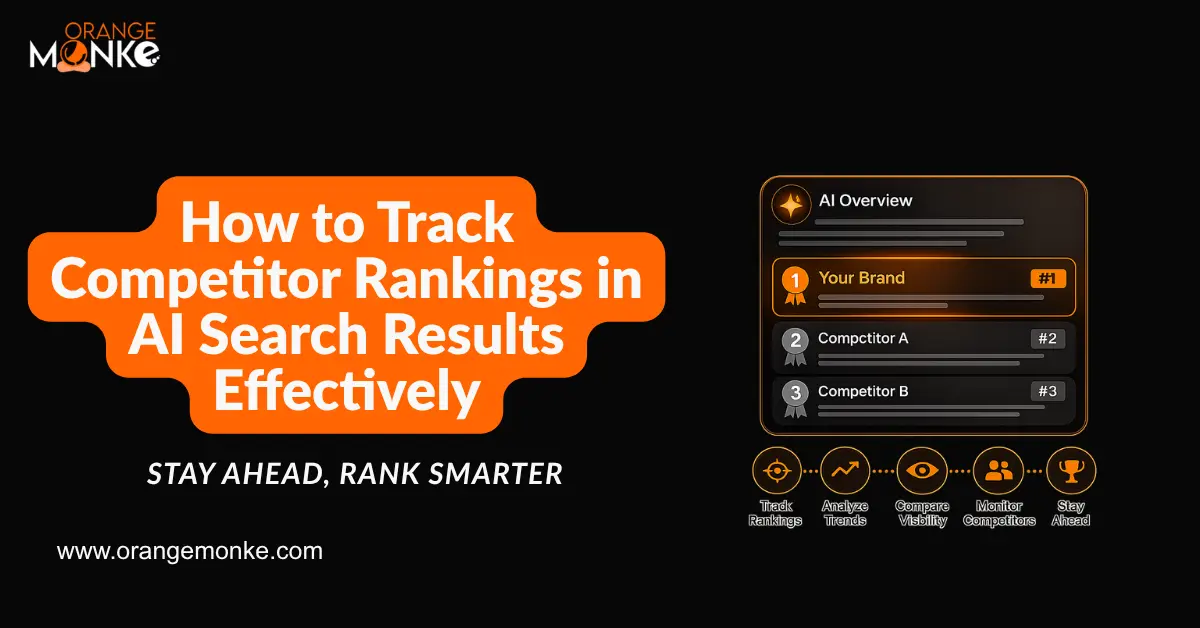
How To Track Competitor Rankings in AI Search Results?To track competitor rankings in AI search results, monitor brand mentions, citations, share of voice, recommendation rank, and prompt coverage across platforms such as ChatGPT, Perplexity, Gemini, Claude, and Google AI Overviews. Use a fixed prompt set and dedicated AI visibility tools to benchmark performance over time. |
Traditional SEO tracking is no longer enough to understand your brand’s online visibility. As AI-powered search engines such as ChatGPT, Perplexity, Gemini, Claude, and Google AI Overviews increasingly influence how buyers research products and services, brands need new ways to measure their presence in AI-generated answers.
Unlike traditional search results, AI platforms do not simply rank websites. Instead, they recommend, summarize, and cite a select group of brands within a single response. This means your competitors may be gaining visibility, trust, and consideration long before users ever visit a website.
In this guide, we’ll explain how to track competitor rankings in AI search results, the metrics that matter most, the tools available in 2026, and the practical steps you can take to monitor and improve your AI search visibility.
Why Tracking AI Search Visibility Matters in 2026
For two decades, the visibility question was simple: Where do we rank on Google? In 2026, that question is no longer complete. Generative AI search engines, ChatGPT, Perplexity, Gemini, Claude, Grok, Google AI Overviews, and Google AI Mode, now sit between your brand and a meaningful share of buyers. They summarise, recommend, and shortlist before a user ever clicks a blue link. If you cannot see how your brand and your competitors are being positioned inside those answers, you are managing visibility with one eye closed.
A few hard numbers from 2026 research help frame the urgency:
- 89% of B2B buyers now rely on generative AI tools such as ChatGPT and Perplexity for vendor research, according to Data-Mania’s 2026 SaaS benchmark report.
- 17.2% is the average brand mention rate across AI answers, per AthenaHQ’s State of AI Search 2026. Leading brands sit far higher; most sit at zero.
- 90% of brands have zero AI search mentions across healthcare, SaaS, and financial services in a 177-brand Search Engine Journal study (May 2026).
- 73% of brands never appear in ChatGPT citations, even those dominating their Google rankings (Onely, Feb 2026).
Gartner projects a 25% decline in traditional search traffic by 2026, with AI-mediated discovery absorbing the difference. - Read those numbers together and one conclusion stands out: most brands are blind to where buyers are now being introduced to their category. Worse, the inverse is also true — your competitors may be capturing AI-referred consideration you can’t see in Google Analytics, because AI answers often satisfy intent without a click and rarely pass identifiable referral data.
Tracking AI search rankings is not a vanity exercise. It is how you discover which buyer questions surface you, which ones surface a competitor, and where the gap between the two is widening. For agencies and marketing leaders, it is also the only way to attribute pipeline influence to GEO (Generative Engine Optimization) work that traditional SEO dashboards completely miss.
How AI Search Tracking Differs from Traditional SEO
Before choosing a tool or building a workflow, it is worth being precise about what is actually different. Traditional SEO rank tracking is built around three assumptions: there is a ranked list of ten blue links, each query returns a roughly stable set of results, and clicks can be attributed to those positions. None of those assumptions hold inside an AI answer.
1. There Are No Rankings, Only Mentions
AI engines do not return a SERP. They return a single synthesized answer that names a small number of brands in line, sometimes with linked citations and sometimes without. The relevant question shifts from “What position are we?” to “Did we get mentioned at all, and how were we positioned versus competitors?”
2. Answers Are Dynamically Assembled
The same prompt can produce different answers across runs and across users. Personalization, retrieval freshness, and the engine’s internal sampling all introduce variance. A one-day snapshot tells you almost nothing — you need rolling 30-day windows and multiple runs per prompt to separate signal from noise.
3. The Source Pool Is Not Google’s Source Pool
This is the single most important shift. Analyses from Ahrefs, Averi, and White hat SEO converge on a striking finding: across 680 million AI citations, only 11% of domains are cited by both ChatGPT and Perplexity, and only around 12% of AI-cited URLs also rank in Google’s top 10. SE Ranking observed similar disconnects for Google AI Mode. Treating “AI search” as one monolithic category — or assuming that strong Google rankings guarantee AI visibility — will quietly destroy your competitor analysis.
4. Citation Logic Is Platform-Specific
Each engine favors different source types. Per 2026 Semrush and Conductor data, Perplexity leans heavily on Reddit, YouTube, and academic domains; ChatGPT favors Wikipedia, established publishers, and brand-owned content; Google AI Overviews lean toward top organic results and structured data; Claude is the most conservative citer. Your competitor analysis must be done per engine, not as a single combined number.
5. Click-Through Doesn’t Reliably Exist
Many AI answers resolve a query without a click. Traditional CTR, sessions, and conversions can’t reliably be tied to AI citations, which is why the industry has settled on prompt-level visibility metrics — citation rate, share of voice, recommendation rank — rather than traffic-based proxies.
| Key Difference in One Line
Traditional SEO tracks position in a list of links. AI search tracking measures presence and positioning inside a synthesized answer, separately for each engine, across a fixed prompt set, over time. |
Core Metrics: What to Measure to Track AI Visibility
Vanity scores like “AI Visibility Index = 73” are useful for dashboards, but they hide the levers. Underneath every credible tracking system are five concrete metrics. Get these right and the dashboards take care of themselves.
| Metric | What It Measures | Formula / How to Calculate |
| Citation Rate | How often your website URL is cited or linked in AI-generated answers for tracked prompts. | (Answers citing your URL ÷ Total tracked answers) × 100 |
| Mention Rate | How often your brand name appears in AI responses, regardless of whether a citation or link is included. | (Answers mentioning your brand ÷ Total tracked answers) × 100 |
| Share of Voice (SoV) | Your brand’s visibility compared to competitors across the same set of prompts. | (Your brand mentions ÷ Total brand mentions across all competitors) × 100 |
| Recommendation Rank | The average position your brand occupies when AI recommends multiple brands, products, or services. Lower values indicate stronger visibility. | Average ranking position across all responses where your brand appears |
| Prompt Coverage | The percentage of tracked prompts for which your brand is mentioned at least once. | (Prompts where your brand appears ÷ Total tracked prompts) × 100 |
| Sentiment | The tone and context AI uses when referring to your brand, such as positive, neutral, or negative descriptions. | Manual review or NLP-based sentiment classification of responses |
| Competitor Citation Share | How your citation frequency compares with competitors cited in the same prompt set. | (Your citations ÷ Total citations across all tracked brands) × 100 |
| Top-3 Recommendation Rate | How often your brand appears within the first three recommendations provided by AI. | (Responses where your brand ranks in Top 3 ÷ Total responses mentioning your brand) × 100 |
| Citation-to-Mention Ratio | Indicates whether AI simply mentions your brand or actively cites your website as a source. | (Total citations ÷ Total brand mentions) × 100 |
| Buyer-Intent Visibility | How often your brand appears for high-intent commercial prompts such as “best,” “top,” “compare,” or “buy” queries. | (Buyer-intent prompts mentioning your brand ÷ Total buyer-intent prompts tracked) × 100 |
The Process of Tracking Competitor Visibility Across AI Search
The process of tracking competitor visibility across AI search breaks into six steps. None of them are technically difficult; the discipline is in running them consistently and keeping the prompt set stable enough to compare results over time.
Step 1: Identify Your Real AI Competitors
Your AI competitors are not always your Google competitors. Open ChatGPT, Perplexity, and Gemini, and ask the questions your buyers actually ask — “best [your category] for [your ICP]”, “alternatives to [your product]”, “[your category] for [use case]”. Note which brands are recommended. You will frequently find one or two names that don’t show up in Ahrefs but dominate the AI answer for your category. Those are the competitors you need to track.
Step 2: Build a Prompt Set (50–100 Queries)
This is the foundation of everything else. A good prompt set is grouped by buyer journey stage and locked once tracking begins. Aim for roughly:
- 15–20 informational prompts — “What is X?”, “How does Y work?”
- 15–20 commercial prompts — “Best [category]”, “Top X for Y”, comparisons
- 10–20 product-specific prompts — “[Brand] vs [Competitor]”, “Alternatives to [Brand]”
- 10–20 transactional / decision prompts — “Pricing of X”, “X for [industry] in [region]”
Pull these prompts from real sources, not your imagination: sales call transcripts, Google Search Console queries, customer interviews, Reddit threads in your niche, and AnswerThePublic exports. The closer the prompts mirror genuine buyer language, the more accurate your tracking will be.
Step 3: Choose Your Tracking Method
You have three realistic options:
- Manual audit: Run prompts by hand across each AI engine and log responses in a spreadsheet. Good for a one-time baseline or quarterly sanity check; impractical at scale.
- Scripted via API: A small Python script that calls the OpenAI, Perplexity, and Gemini APIs on a schedule, stores responses, and runs simple keyword detection for brand mentions. Cheap and customisable, but requires engineering time and doesn’t capture engines like AI Overviews that lack a public API.
- Dedicated AI visibility tracking tool: Profound, Otterly AI, Peec AI, Nightwatch, Scrunch AI, Trakkr, or Rankability. These platforms run scheduled prompts, capture full responses, classify mentions, and produce share-of-voice dashboards.
For most marketing teams, a hybrid works best: a tool for daily/weekly automated tracking, plus a quarterly manual deep-dive on the 20 most strategically important prompts.
Step 4: Run, Capture, and Tag
Whichever method you choose, every captured response should be tagged with: timestamp, engine, prompt ID, brands mentioned, citations (URLs), position of each brand in the answer, and sentiment if you have the bandwidth. Stable schemas make the difference between a useful 90-day trend and a folder of screenshots no one revisits.
Step 5: Benchmark Versus Competitors
Calculate the metrics from the previous section for your brand and for each of your top three to five competitors, per engine. A simple comparison table reveals the strategic picture in seconds: where you lead, where a competitor owns the conversation, and which engine has the biggest visibility gap for you.
Step 6: Loop — Act, Re-measure, Refine
Tracking is not the goal. Action is. Every cycle should feed back into content, PR, and earned-media work: which prompts do you want to win next quarter? Which sources do AI engines pull from for those prompts that you have no presence on? Re-run the prompt set monthly and watch the curve, not the spike.
Platform-by-Platform: Where to Track and What to Expect
Because citation logic varies dramatically across engines, your tracking has to be platform-aware. Here is the practical 2026 lay of the land for the four engines that account for the overwhelming majority of generative search traffic.
ChatGPT (OpenAI)
ChatGPT now processes roughly 2.5 billion prompts per day and serves around 900 million weekly active users (February 2026), making it the single largest AI surface for most businesses. ChatGPT Search favours Wikipedia, established publishers, and clearly structured brand-owned content. Notably, it primarily cites pages ranking at position 21 or lower in Google in roughly 90% of cases — meaning strong Google rankings do not automatically translate. To track ChatGPT, run prompts via the API or use a tool that simulates user browsing rather than relying solely on API output.
Perplexity
Perplexity is a citation-first engine: every claim attributes to a specific source link. It averages around 21.9 citations per response — more than double ChatGPT’s ~10.4 (Discovered Labs, Whitehat SEO, 2026). Its source preferences skew toward Reddit (until the October 2025 Reddit lawsuit), YouTube, and academic / institutional publishers. Tracking Perplexity is the easiest of the major engines because the citations are explicit, but the volatility is also higher.
Google AI Overviews and AI Mode
AI Overviews now appear for the majority of informational and commercial queries in Google Search. Tracking is more nuanced because AI Overviews share the SERP with traditional results. The overlap between top-10 Google rankings and AI Overview citations has collapsed from 75% in mid-2025 to between 17% and 38% by early 2026 (Ahrefs, BrightEdge). Tools like Profound, Semrush AI Visibility, and Nightwatch capture AI Overview citations alongside traditional SERP positions.
Gemini and Claude
Gemini benefits from Google’s index but applies its own selection logic on top. Claude is the most conservative citer of any major engine and tends to give brands the highest owned-source share (Slate HQ, March 2026 — 9.1% owned citation share on Claude versus 6.8% on Perplexity). Both are worth including in any enterprise tracking program; for smaller brands, prioritise ChatGPT, Perplexity, and AI Overviews first.
AI Visibility Tracking Tools Compared
The AI search rank tracking tool landscape has matured fast since 2024. The right choice depends on team size, budget, and whether you need monitoring only or monitoring plus action. The table below summarises the most credible options based on publicly stated capabilities and pricing as of mid-2026 — verify current plans on each vendor’s site before purchasing.
| Tool | Best For | Platforms Covered | Standout Feature |
| Profound | Enterprise brands and large marketing teams | ChatGPT, Perplexity, Google AI Overviews, Gemini, Copilot | Analyzes over 1.5 billion prompts and provides advanced citation intelligence and competitive visibility insights |
| Otterly AI | Small and medium-sized businesses (SMBs) | ChatGPT, Perplexity, Google AI Overviews | Affordable AI search visibility tracking with share-of-voice reporting and prompt monitoring alerts |
| Peec AI | Mid-market and B2B organizations | ChatGPT, Perplexity, Gemini, Claude | Tracks brand visibility and analyzes source usage across a database of more than 30 million sources |
| Nightwatch | Agencies managing SEO and AI visibility together | Google AI Overviews, ChatGPT, Claude, Perplexity | Combines traditional keyword rank tracking with AI search visibility monitoring in a single dashboard |
| Scrunch AI | Regulated industries such as finance and healthcare | ChatGPT, Perplexity, Google AI Overviews, Gemini | Monitors brand sentiment, citation accuracy, and compliance-related risks in AI-generated responses |
| Rankability | Agencies and content teams focused on optimization workflows | ChatGPT, Perplexity, Google AI Overviews, Gemini | Integrates AI visibility tracking with content audits, optimization recommendations, and brief generation |
| LLMrefs | Startups, freelancers, and solo operators | ChatGPT, Perplexity, Gemini | Budget-friendly AI keyword and brand visibility tracking with a low barrier to entry |
| Semrush AI Toolkit | Businesses already using Semrush for SEO | ChatGPT, Perplexity, Gemini, Google AI Overviews | AI visibility tracking and competitor analysis integrated directly into the Semrush ecosystem |
| SpyFu (AI Add-on) | SMBs managing both SEO and PPC campaigns | Search engines and emerging AI search features | Leverages over 20 years of PPC and organic search data alongside newer AI visibility insights |
Ways to Track Brand Mentions in AI Search
Beyond the structured prompt audit, there are several lower-effort ways to track brand mentions in AI search — useful as supplementary signals or as a starting point if you have not yet committed to a tool.
1. Manual Spot Checks
Pick your 10 highest-value buyer prompts and run each across ChatGPT, Perplexity, Gemini, and AI Overviews once a week. Capture the answers as screenshots or text and note brand mentions, citations, and order of appearance. It is slow, but it keeps you close to the actual user experience — something tools sometimes abstract away.
2. Reverse-Engineer Referral Data
While AI answers rarely pass identifiable referral data, some traffic does come through with referrers like chat.openai.com, perplexity.ai, or gemini.google.com. Filter your Google Analytics or server logs for these sources to see which pages are already pulling AI-referred traffic. It is incomplete coverage, but it tells you where you have a foothold.
3. Branded Search Trend Tracking
One of the strongest indirect signals of AI visibility is a lift in branded search demand. When AI engines mention your brand inside a recommendation, a share of those users do a follow-up Google search for your name. Track branded query impressions in Google Search Console month-over-month, especially in correlation with content launches or PR placements.
4. Review Profile and Earned-Media Monitoring
2026 data from Goodie / Adweek shows a striking correlation: brands with no Trustpilot profile have a median AI citation rate of just 1%; brands with even 1–13 reviews jump to 53.5%. Tracking your review counts, third-party mentions, and Reddit / YouTube presence is effectively tracking the inputs to your future AI visibility.
5. Prompt-Level Tool Alerts
If you use an AI visibility tracking tool, configure alerts for two events: (a) a competitor overtakes you on a critical prompt, and (b) your brand appears in a prompt you weren’t previously cited for. The second is often more strategically interesting — it surfaces emerging buyer questions where you can double down with dedicated content.
Dual-Track Visibility Strategies: Google + AI Together
Given that traditional Google rankings and AI citations now overlap by only 11–14%, the strongest 2026 visibility programs are explicitly dual-track: parallel measurement and parallel optimisation for blue-link SERPs and AI answers. A dual-track strategy generally looks like this:
- Shared content foundation: A single pillar page per topic that is structured well enough to serve both Google and AI extraction. Clear H2s as questions, direct answers in the first paragraph below each heading, schema markup, and a visible author byline.
- Parallel KPI dashboards: Traditional KPIs (impressions, clicks, average position) reported alongside AI KPIs (citation rate, share of voice, prompt coverage), per topic cluster.
- Source-pool work that benefits both: Earned media in publications, Reddit and community presence, YouTube depth, and review profiles all lift AI citations and indirectly support Google E-E-A-T signals.
Engine-specific extensions: ChatGPT-specific FAQ depth, Perplexity-specific structured comparisons, AI Overviews-specific featured-snippet formatting. - Unified competitor view: Track the same competitor set in both your traditional rank tracker and your AI visibility tool, so the “real” competitor in each surface is always visible.
Done well, a dual-track program produces compounding gains. The same content investment earns traditional rankings, AI citations, and the branded-search lift that follows AI exposure — without doubling your content team.
AI Visibility Tracking Checklist
Use this as a printable starting point. Each item maps to something covered in this guide.
The 12-Point AI Visibility Tracking Checklist
- You have identified your top 3–5 real AI competitors (not just your Google ones).
- You have a locked prompt set of 50–100 buyer-intent queries, grouped by intent.
- You track at least four AI engines: ChatGPT, Perplexity, Gemini, and AI Overviews.
- You measure citation rate, mention rate, share of voice, and recommendation rank — per engine.
- You run prompts at least monthly; weekly for top buyer queries.
- You log responses with timestamp, engine, prompt ID, brand mentions, and citations.
- You benchmark against the same competitors in your traditional rank tracker.
- You monitor branded search demand in Search Console as an indirect signal.
- You audit your review and earned-media footprint quarterly.
- You have alerts configured for competitor overtakes on priority prompts.
- You feed tracking insights back into a quarterly content and PR roadmap.
- You report AI visibility KPIs to leadership in the same cadence as SEO KPIs.
Common Mistakes to Avoid
The mistakes that quietly destroy AI visibility programs are rarely about choosing the wrong tool. They are about how the work is structured and interpreted.
1. Tracking Only One Engine
Because citation overlap is so low, tracking only ChatGPT (or only AI Overviews) means missing 80–90% of the citation landscape your buyers actually experience. Always cover at least three engines.
2. Changing the Prompt Set Mid-Program
The moment you reword prompts, your trend lines reset. Lock the set for at least a quarter at a time; add new prompts as a separate cohort rather than editing existing ones.
3. Drawing Conclusions from a Single Snapshot
AI answers are volatile. A one-day audit can show wildly different results from a 30-day rolling window. Always average across multiple runs before reporting share of voice.
4. Ignoring Sentiment
Being mentioned is not the same as being recommended. A high mention rate paired with negative or hedged sentiment can be worse than fewer mentions framed positively. Sample sentiment on at least 20% of your tracked answers each cycle.
5. Treating AI Visibility as a Standalone Channel
AI citations are downstream of earned media, owned content depth, structured data, and brand trust. Treating tracking as a goal in itself — without feeding insights back into content, PR, and review strategy — produces dashboards no one acts on.
Conclusion
AI search visibility is quickly becoming as important as traditional search rankings. By tracking metrics such as citation rate, share of voice, recommendation rank, and prompt coverage, businesses can understand how they compare against competitors across platforms like ChatGPT, Perplexity, Gemini, and Google AI Overviews.
The key is to treat AI visibility as an ongoing measurement and optimization process. At OrangeMonkE, we help brands track competitor performance, monitor AI search presence, and build strategies that improve visibility across both traditional search engines and AI-powered discovery platforms.
Frequently Asked Questions
How do I track competitor rankings in AI search results?

You can track competitor rankings in AI search results by building a test list of 50–100 buyer-intent prompts, running them across ChatGPT, Perplexity, Gemini, and Google AI Overviews, and logging how often your brand and each competitor is mentioned or cited. Use an AI visibility tracking tool such as Profound, Otterly, Peec AI, or Nightwatch to automate the process and measure share of voice over time.
What is AI share of voice and how is it calculated?
AI share of voice is the percentage of relevant AI answers in which your brand appears versus all competitor mentions across the same prompt set. The formula is (your brand mentions ÷ total brand mentions for tracked prompts) × 100. It is measured separately for each AI engine because citation pools rarely overlap.
Which tools track AI visibility across ChatGPT and Perplexity?
Popular AI visibility tracking tools include Profound, Otterly AI, Peec AI, Nightwatch, Scrunch AI, LLMrefs, Trakkr, and Rankability. Most run scheduled prompts across ChatGPT, Perplexity, Gemini, Claude, and Google AI Overviews, then report citation rate, mention frequency, and competitor share of voice.
Do Google rankings predict AI search visibility?
Google rankings can not reliably predict AI search visibility. Independent 2026 analyses found that only around 12% of URLs cited by ChatGPT, Perplexity, and Copilot rank in Google’s top 10, and only 11% of domains are cited by both ChatGPT and Perplexity. A brand can dominate Google blue links and be almost invisible inside AI answers.
How often should I track competitor visibility in AI search?
AI citations fluctuate daily, so most teams run prompt audits weekly for key buyer queries and a full competitor benchmark monthly. A 30-day rolling window is more reliable than a one-day snapshot because it reveals stable patterns versus short-term volatility.
What is the difference between AI mentions and AI citations?
A mention is when an AI answer names your brand in the body text without linking to your site. A citation is when the AI engine attributes a claim to your owned URL through a clickable source link. Citations are stronger authority signals because they pass referral traffic and reflect document-level trust.
Can I track AI search rankings manually without a tool?
Yes, you can track AI search rankings manually without a tool. A manual prompt audit involves running a fixed list of 20–50 buyer queries across each AI engine, copying responses into a spreadsheet, and tagging which brands and sources appear. It is time-consuming but works as a starting point or quarterly sanity check alongside automated tools.
Why are my competitors getting cited in ChatGPT but my brand is not?
AI engines pull from a different source pool than Google. Competitors often win citations because they have stronger third-party brand mentions on Reddit, YouTube, review sites, and niche publications. Earned media, review profiles, and clearly structured comparison content correlate with significantly higher AI citation rates.
How long does it take to improve AI visibility once tracking starts?
Most brands see early movement in 60–90 days once they begin acting on tracking insights — particularly on Perplexity and AI Overviews, which refresh sources frequently. ChatGPT tends to lag because of its hybrid training-data plus retrieval architecture, often taking three to six months to reflect changes meaningfully.
Is AI visibility tracking worth it for small businesses?
Yes, tracking AI visibility is worth it, especially for small businesses. AI answers concentrate recommendations on a handful of brands per category, which means a well-positioned small business can be cited alongside large incumbents far more easily than it can rank above them in Google. Starting with a manual audit and a low-cost tool like Otterly or LLMrefs is usually enough to begin.