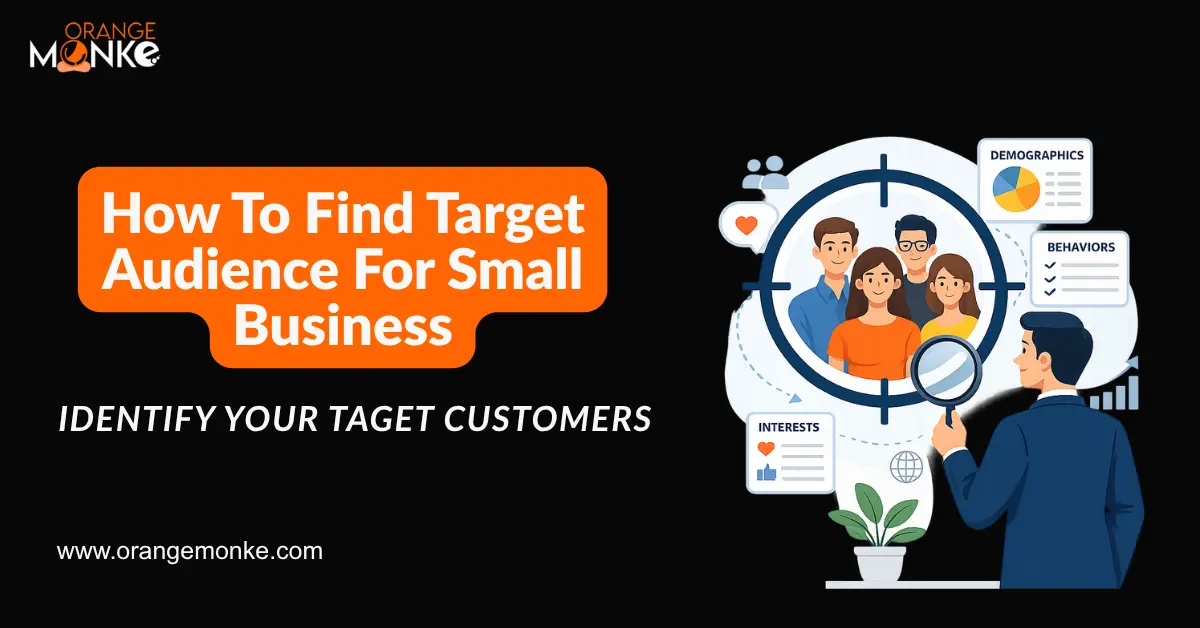
Your target audience is the specific group of people most likely to buy from you, defined by shared demographics, interests, and buying behaviour. Most small business owners can explain their product in seconds but freeze on that one question, and the cost is wasted ad spend, weak messaging, and marketing aimed at the wrong people.
The businesses that grow steadily do not sell to everyone. They pick a specific group with a specific problem and speak directly to them. This guide gives you the framework, the segmentation types, a persona template, real examples, and the 2026 AI-search step most guides miss.
What is a target audience?
A target audience is the specific group of people most likely to buy your product or service, defined by shared characteristics like demographics, interests, and buying behaviour. It is narrower than your whole market and tight enough that you can picture one real person in it.
For small businesses, "people who need accountants" is too broad to act on. A 40-year-old freelance designer in Mumbai earning INR 15 to 25 lakh who hates spreadsheets is a target audience. "Self-employed people" is not. A target audience is sometimes called a customer profile, the shared portrait of who you serve, while a persona names one individual within it.
A target audience is the tightly defined group most likely to buy from you. The tighter the definition, the easier every other marketing decision becomes.
Target audience vs target market vs buyer persona
Target audience, target market, and buyer persona differ by scope. A target market is the full universe of people you could serve, a target audience is the subset you actively focus on, and a buyer persona draws that audience as one named person.
What is the difference between target market and target audience?
The difference between a target market and a target audience is scope. A target market is everyone you could serve; a target audience is the specific slice you spend your marketing on. Confusing the two is one of the most common reasons small business marketing underperforms.
| Term | What it means | Example |
|---|---|---|
| Target market | The full universe of potential customers your business could serve | Small business owners in India who need digital marketing help |
| Target audience | A specific subset of your target market that you actively focus your marketing on | Small business owners in India running ecommerce stores with revenue under INR 2 crore |
| Buyer persona | A named, detailed character representing your target audience as one person | Priya, 34, owns a skincare brand on Shopify, runs Instagram ads, unsure about SEO |
Start with the buyer persona. The market and audience definitions fall into place above it.
Why does defining your target audience matter?
Defining your target audience matters because it turns every marketing decision from a guess into a choice, lifting your messaging, channel fit, and return on ad spend at the same time. Here is what a clear definition buys you.
- Sharper messaging: knowing what your buyer values and fears lets you write copy for their exact problem instead of a bland pitch that lands with no one.
- Better channel fit: once you know who they are, you invest only in the two or three channels that reach them and stop paying for the rest.
- Higher return on ad spend: a tightly defined audience is cheaper to reach and convert, which lifts both return on investment (ROI) and return on ad spend (ROAS).
- Higher conversion rates: messaging built for one specific person converts better than messaging built for everyone.
- Stronger brand loyalty: people stay with brands that clearly understand them, so precision compounds into repeat business.
- Less wasted spend: every rupee or dollar aimed at the wrong person is gone, and audience clarity is the cheapest way to stop that leak.
The 5 ways to segment your target audience
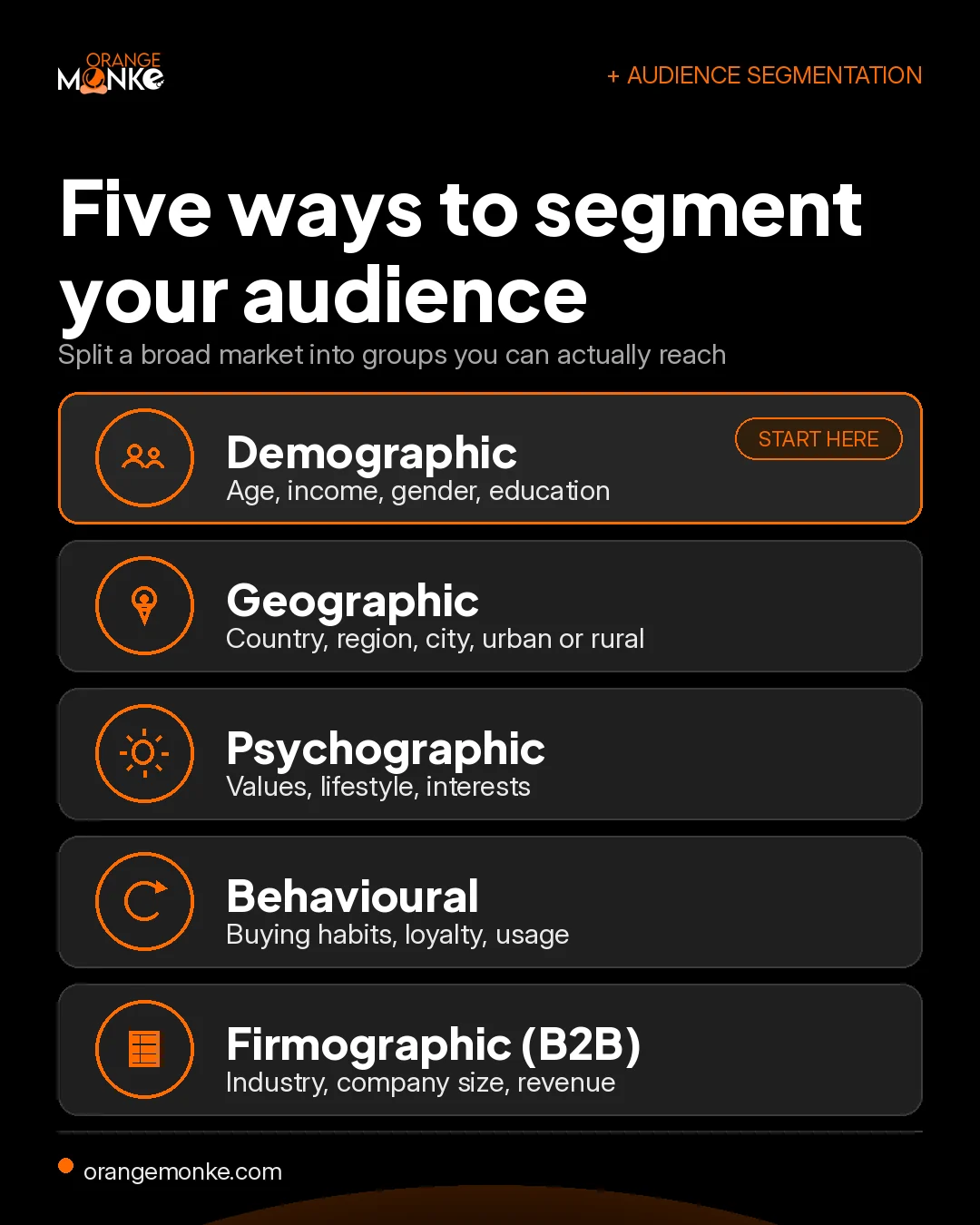
You can segment a target audience five ways: demographic, geographic, psychographic, behavioural, and firmographic. Segmentation, also called customer segmentation, means splitting a broad market into groups you can reach, and most small businesses only need two or three of these to land on a clear audience.
Demographic segmentation
Demographic segmentation splits your market by who people are on paper: age, income, gender, education, and life stage. It is the fastest starting point because you usually have this data already and it maps directly onto ad-platform targeting.
Geographic segmentation
Geographic segmentation splits your market by where people are: country, region, city, or urban versus rural. For any local business it is the primary segment, because your audience is defined first by whether you can reach them. It is also the foundation of strong local SEO.
Psychographic segmentation
Psychographic segmentation splits your market by how people think: their values, lifestyle, interests, and attitudes. This is where a skincare buyer who reads ingredient lists separates from one who buys on price, even at the same age and income.
Behavioural segmentation
Behavioural segmentation splits your market by what people do: buying habits, brand loyalty, usage frequency, and how they interact with you. A first-time buyer and a repeat customer need different messages, and behaviour is what tells them apart.
Firmographic segmentation (B2B)
Firmographic segmentation is the B2B version of demographics, splitting your market by company traits: industry, company size, and revenue. If you sell to businesses rather than consumers, this is usually your primary segment.
These map onto three audience types you will hear named often. A demographic or psychographic audience shares traits like age, income, or values. A funnel-stage audience is grouped by where people sit in the buying journey. A hobby or skill audience shares one interest others do not. Use whichever produces a group you can picture and reach.
How Do You Find Your Target Audience?
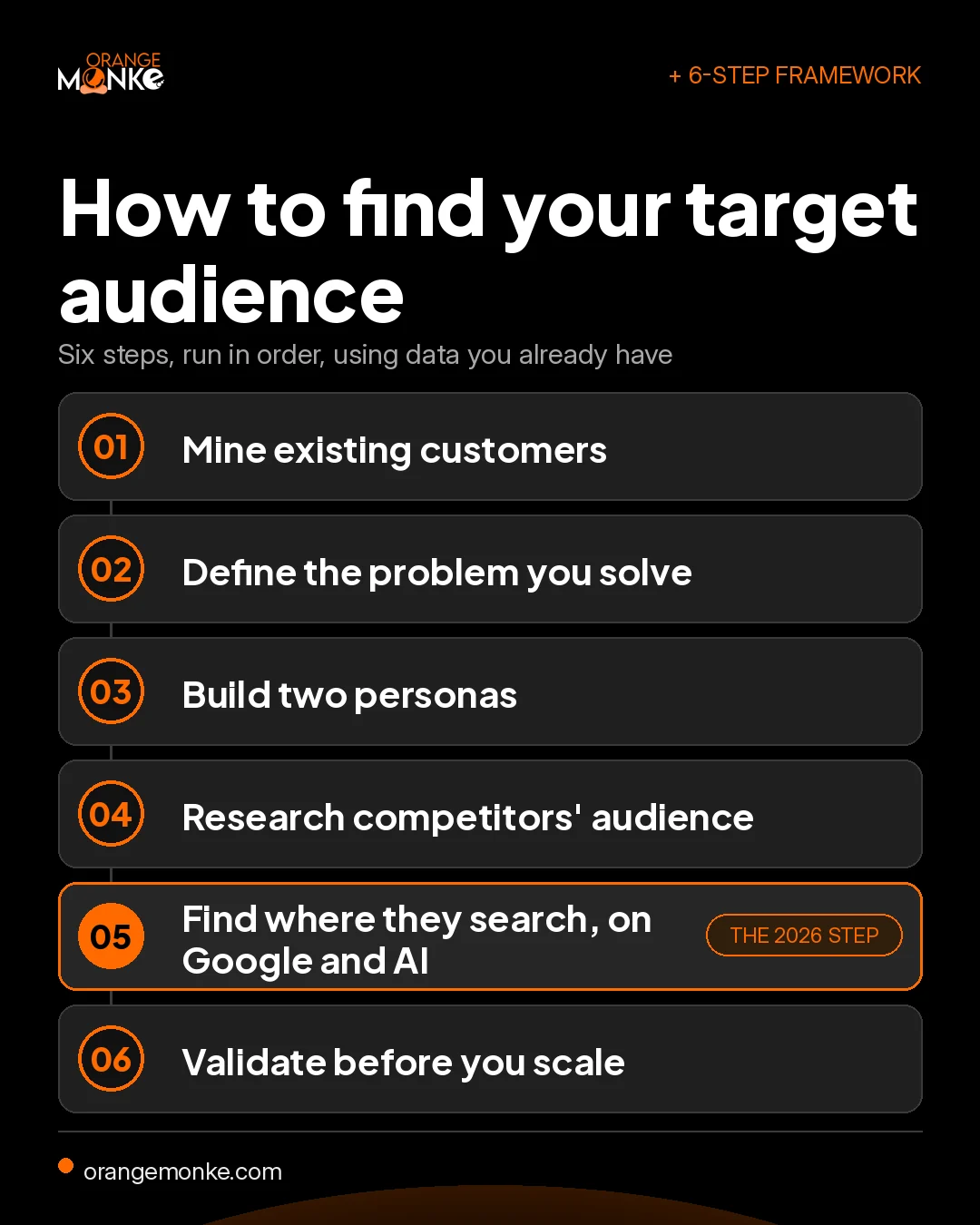
Find your target audience in six steps: mine existing customers, define the problem you solve, build two personas, research competitors, find where they search, and validate. Run them in order using data you already have. Skip a step, and the next one breaks.
Step 1: Mine the customers you already have
Start with the customers you already have, because your data already shows who buys, where, and in what words. Open three sources: your Google Analytics audience report, your CRM or order data, and the last 50 buyer emails or DMs.
In Google Analytics, the reports that matter are Demographics and Geo (who and where), Acquisition (which channels sent them), and Tech and Behaviour (how they browse). If you tag campaigns with UTM parameters, acquisition data shows exactly which content earned your best customers. To go deeper, ask your five best customers how they found you, what convinced them to buy, and what they value most. Those answers become your marketing language.
Next step: write down the top three attributes that repeat across your best customers. They seed Step 3.
Step 2: Define the problem you actually solve
Define the problem you solve, not the product, because your audience is the specific person who has that problem. That person is far narrower and more reachable than everyone who could technically use your product.
A bookkeeping service does not sell bookkeeping. It sells freedom from spreadsheet anxiety for founders who would rather build than reconcile receipts. To pin the problem down, answer four questions: what is the biggest challenge you solve, what frustrates them about current solutions, what have they tried and failed, and what would an ideal outcome look like. Ground every answer in what customers actually say.
Next step: finish this line: "We help [specific person] solve [specific problem] so they can [specific outcome]." If you cannot, your audience is still too broad.
Step 3: Build two personas, not ten
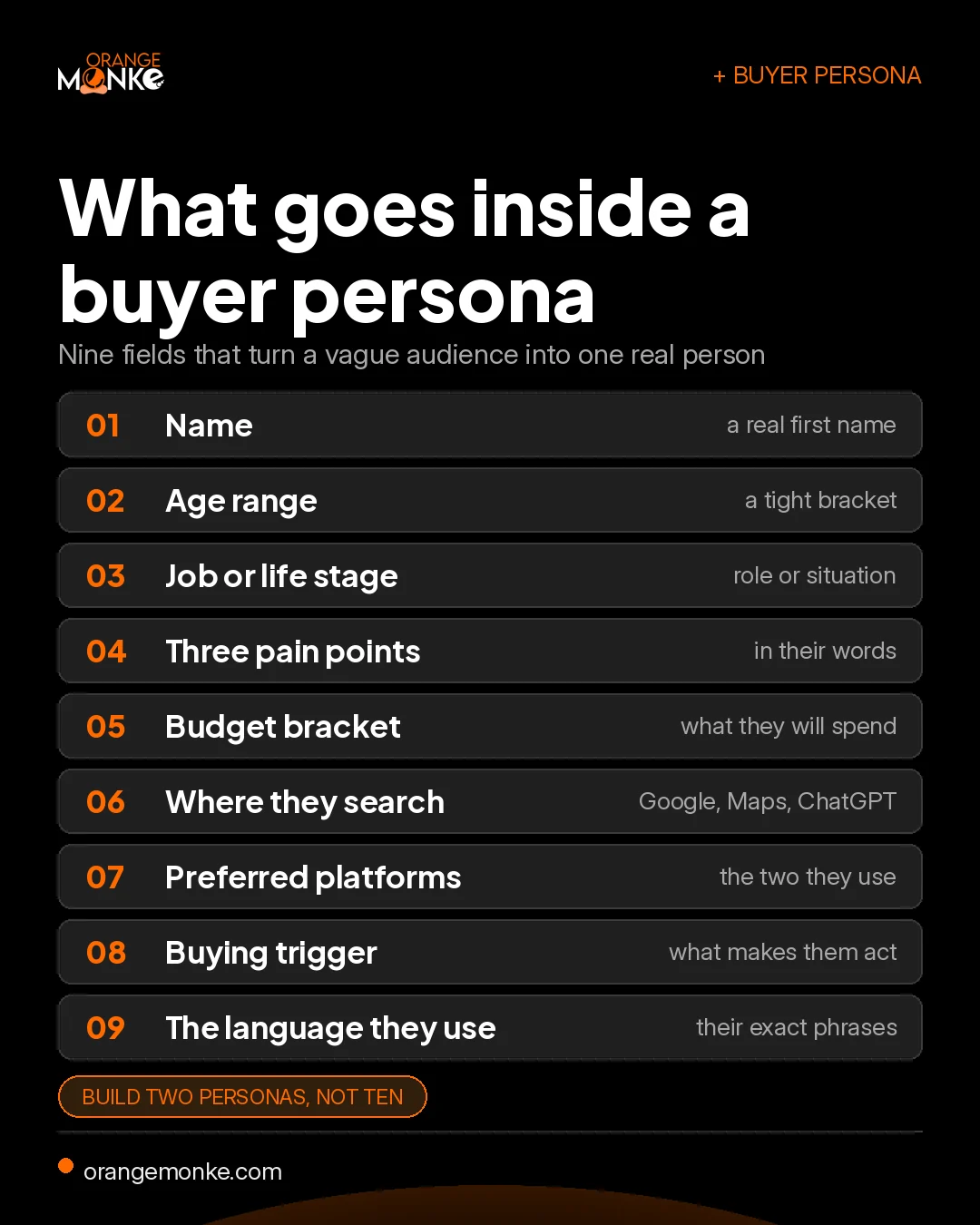
Build two personas, one primary and one secondary, because more personas dilute your marketing instead of sharpening it. Each gets a real name, an age range, a job or life stage, three pain points, a budget bracket, and the platforms they actually use.
Pull these details from Step 1, not from imagination, and use the persona template below for the exact fields. Most small businesses try to build six or seven personas and use none. A local services business may need only one.
Next step: name your two personas, write each on a single page, and pin them where you make marketing decisions.
Step 4: Research your competitors' audience
Research your competitors' audience to find the segment they underserve and the language that already works. This lightweight market research surfaces most of what you need through three free methods, without you spending a rupee to test.
- Meta Ad Library: search a competitor to see every ad they run live, including the audience language and offers they lead with.
- Reviews: read the negative ones especially, because complaints reveal the customers a rival is failing and you could win.
- Social feeds and Facebook Audience Insights: scan who engages and what they ask for, and use Google Trends to confirm demand is rising or steady.
The goal is not to copy a larger competitor. It is to find the opening they leave and define your audience around it, then build the search positioning to own it.
Next step: review your top three competitors' live ads and recent reviews, and note one audience gap you can own.
Step 5: Find where they search, on Google and AI
Find where your audience searches on both Google and AI, because in 2026 they no longer search in one place. Use the Google Search Console queries report for what visitors actually typed, and run your top five buyer questions through ChatGPT, Perplexity, and Gemini to see which sources get cited.
If competitors are cited and you are not, your audience is finding answers without you. Strong keyword research and long-tail keywords help you target both surfaces, and AI Overviews and AI Mode reward clear, citable answers.
Next step: list the top 10 questions your audience asks, then check whether your site shows up on Google, ChatGPT, and Perplexity for each.
Step 6: Validate before you scale
Validate one persona with one cheap test before you scale, because a single post tells you in a week whether the definition is right. Pick one persona, write one social post, ad, or email in their language and their problem, and run it for a week.
Watch the response rate, comments, and replies. If it lands, you have your audience. If it dies, your persona is wrong, not your channel. Validation is the difference between three months of confident growth and twelve months of guessing.
Next step: run one targeted test this week for less than the cost of a team lunch, then adjust the persona from what you learn.
Your target audience persona template
Fill this nine-field persona template for your primary audience, and a second for your secondary only if you truly serve two buyer types. Each field forces a specific decision, and if one is hard to fill, return to Step 1 and read more real customer data before you guess.
You know exactly who your buyer is. Now let's make Google send them to you.
We turn a sharp audience definition into search visibility, so the right people find you instead of your competitors.
Get a free SEO audit →Three small business target audience examples
These three examples show a fully defined small business target audience across local services, B2B SaaS, and DTC ecommerce. Use them as templates for your own persona, not literal copies.
Local services: Maria, 42, homeowner in Austin
- Business type: Independent plumbing company, 4-person team
- Persona name: Maria Hernandez
- Age range: 38 to 55
- Life stage: Homeowner, married with school-age kids, dual-income household earning $90,000 to $140,000
- Pain points: Burst pipe at 9pm with no trusted plumber saved; a cheap quote that doubled on invoice; cannot tell from Google reviews who is actually local
- Where she searches: Google ("plumber near me open now"), Google Maps, neighbourhood Facebook groups, increasingly ChatGPT for non-emergency questions
- What converts her: Visible licence number, response time guarantee, photos of the real team, a Google Business Profile with a 4.8+ rating and recent reviews
Maria does not care about your slogan. She cares whether you answer on a Sunday. A strong Google Business Profile and local SEO presence is what wins her.
B2B SaaS: David, agency operations lead
- Business type: Project management tool for marketing agencies, 15-person company
- Persona name: David Okafor
- Age range: 32 to 45
- Role: Operations Director or Head of Delivery at a 10 to 50 person agency
- Pain points: Spreadsheets breaking at scale; four tools that do not talk to each other; the owner wants "one view of everything" by next quarter
- Where he searches: Google for comparison content, G2 and Capterra for reviews, LinkedIn for peer recommendations, ChatGPT to shortlist tools before demos
- What converts him: A free trial with no credit card, a clear pricing page, one named integration his team already uses, case studies from agencies of similar size
David buys software with his head and his career. The wrong tool reflects badly on him, so make the safe choice obvious.
DTC ecommerce: Priya, 28, professional skincare buyer
- Business type: Independent skincare brand on Shopify, 6-figure annual revenue
- Persona name: Priya Sharma
- Age range: 25 to 34
- Life stage: Working professional in Mumbai, monthly skincare spend INR 2,500 to 6,000
- Pain points: Stopped trusting drugstore brands after sensitivity issues; tired of influencer marketing that ignores Indian skin; reads ingredient lists before buying
- Where she searches: Instagram saves, Reddit (r/IndianSkincareAddicts), YouTube reviews, ChatGPT for ingredient research
- What converts her: Full ingredient transparency, a founder story, before-and-after photos with skin tone diversity, a dermatologist review
Priya does not need another sales pitch. She needs proof, so earn her trust with substance, not discounts. Consistent content that answers her ingredient questions is what pulls her in.
Target audience research in the AI search era
Target audience research in 2026 must cover two search surfaces, Google and AI, because your audience uses both and behaves differently on each. They scan short results on Google and ask full questions on ChatGPT, Perplexity, and Gemini. According to HubSpot's 2026 State of Marketing report, nearly half of consumers now use AI-powered search.
What changes when your audience uses AI search?
When your audience uses AI search, they read one synthesized answer instead of scanning ten results, and they expect you to be cited inside it. The same person uses Google for "what are the options" and ChatGPT for "which one should I pick," so visibility on AI surfaces is now part of being found, not a bonus.
New questions to add to your audience research
Add four AI-specific questions to every persona you build in 2026. The standard fields of age, role, pain points, and channels are no longer enough.
- Which AI tools does your audience use, and for which stage of their buying process?
- What prompts do they type when they look for solutions in your category?
- Which sources do those AI tools currently cite for those prompts, and are you one of them?
- What format does the AI surface for that query: a comparison, a definition, a list, or a recommendation?
Using AI tools for your own audience research
Use ChatGPT and Claude to research your audience cheaply, then validate against real data. Ask them to map common pain points for your customer type, draft persona hypotheses from a description, or summarise what your niche discusses on Reddit and forums. Treat the output as a starting hypothesis, and learn the difference between AEO and SEO so you optimise for both.
Where do you reach your audience once you have defined them?
Reach your audience by matching the channel to the audience type, not to the trend. The same persona behaves differently on Instagram, in a Google result, and inside ChatGPT, so an omnichannel presence on a few right places beats trying to be everywhere at once.
| Audience type | Primary channel | Secondary channel | Content format | Budget tier |
|---|---|---|---|---|
| Local consumer (Maria) | Google Business Profile + Google Maps | Facebook neighbourhood groups | Reviews, response time, photos | Low |
| B2B decision-maker (David) | LinkedIn + comparison content (G2, Capterra) | Email newsletters, podcasts | Case studies, free trials, demo videos | Medium to high |
| DTC consumer (Priya) | Instagram + Reddit communities | Influencer reviews, YouTube | Founder story, ingredient lists, UGC | Medium |
| Professional service buyer | Google search + LinkedIn | Industry newsletters, ChatGPT citations | Long-form blog, original data, FAQs | Low to medium |
Pick the top two channels for your primary persona, dominate them, then expand.
Two reach tactics work for almost every audience. A blog and content marketing strategy puts you in front of people searching for the problem you solve and builds the authority that earns AI citations. Influencer or creator partnerships borrow trust that is already established, which is powerful for DTC and local brands.
Align your team and keep your audience current
Keep your audience useful with two habits: align your whole team on it, and review it at least twice a year. A persona only creates value when marketing, sales, and service all use the same one and it stays current.
Align your team around one persona
Marketing, sales, and customer service should describe your primary buyer identically. When sales pitches one audience and marketing writes for another, your message fractures and conversion drops. Share the persona and make it the reference every customer-facing decision points back to.
Track results and reassess twice a year
Review your audience definition at least twice a year, tracking engagement, conversion rate, and which segments actually buy. Audiences shift, so a persona written 18 months ago is usually fiction today. Update their platforms, pain points, budget, and language as they change, ideally each quarter.
Common mistakes small businesses make with target audience
Five mistakes derail most small business audience work: targeting everyone, guessing instead of using data, copying a bigger competitor, freezing the persona, and skipping AI search. Owners usually skip audience research not because they do not care, but because standard advice is built for enterprise teams with survey budgets.
Mistake 1: Trying to target everyone
Targeting everyone means converting no one. "Our audience is anyone who needs our product" is a wish, not an audience, which is exactly why the marketing reads generic and converts poorly.
Mistake 2: Guessing instead of using the data you already have
Guessing your audience wastes the data already sitting in Google Analytics, your CRM, and your inbox. Twenty minutes inside Google Analytics tells you more about your real audience than any strategy session built on instinct.
Mistake 3: Copying the audience of a much larger competitor
Copying a competitor spending 100x your budget guarantees you lose every fight. Pick a narrower segment they ignore, own it, then expand outward from strength.
Mistake 4: Building the persona once and freezing it
A persona locked in a Google Doc becomes fiction within 18 months. A brand that targeted college students in 2022 may be selling to first-time mothers today without realising it, so calendar a quarterly review.
Mistake 5: Skipping AI search in your audience research
Skipping AI search leaves you with a 2022 picture of a 2026 customer. If your audience uses ChatGPT, Perplexity, or Gemini and your research does not, you are already working from an outdated map. AI search is a discovery channel now, not a future trend.
Conclusion
Finding your target audience is the foundation every other marketing decision rests on, not a one-time step. A clear definition makes your messaging tighter, your channels more efficient, and your budget smaller. The owners who win in 2026 know exactly who they talk to, where that person searches, and what answer they need to hear.
At Orange MonkE, we help small businesses turn audience clarity into search visibility. If you have your persona but no traffic, our SEO services for small business and organic traffic guidance close that gap.
Your audience is searching locally. Are you the one they find?
We get small businesses ranking in Maps, local search, and AI answers, so nearby buyers reach you first.
Talk to a local SEO strategist →Frequently Asked Questions
You can find your target audience for free using the customer data you already own plus a few hours of focused research.
- Open Google Analytics: pull the Demographics, Geo, and Acquisition reports to spot age, location, and channel patterns.
- Read your last 50 emails or DMs: note the exact phrases customers use, and reuse them as marketing copy.
- Audit your top five sales: find what those buyers shared in job, life stage, budget, and urgency.
- Run three free AI prompts: ask ChatGPT for the top pain points of your customer type as a starting hypothesis.
Validate the definition with one targeted social post before spending on ads. For more free tactics, see our guide to getting organic traffic.
The difference between a target audience and a target market is scope, with the market being broad and the audience being the specific slice you focus on.
- Target market: the full universe of people you could serve, defined by broad industry, geography, or demographics.
- Target audience: the specific subset you actively market to, defined by demographics, behaviour, and intent.
- Buyer persona: that audience drawn as one named character to guide content and creative.
Most small businesses stop at the market, but revenue moves at the persona level. A clear audience also sharpens your content marketing strategy.
The five types of market segmentation are demographic, geographic, psychographic, behavioural, and firmographic.
- Demographic: age, income, gender, and education.
- Geographic: country, region, or city, which drives local SEO.
- Psychographic: values, lifestyle, and interests.
- Behavioural: buying habits, loyalty, and usage.
- Firmographic: the B2B version, split by industry, company size, and revenue.
Most small businesses only need two or three of these to define a clear audience.
You identify your target audience's pain points by asking four questions grounded in real customer data, not assumption.
- The core challenge: what is the biggest problem you solve for them?
- Current frustration: what annoys them most about the solutions they use now?
- Past failures: what have they already tried and failed to fix it?
- Ideal outcome: what would a perfect result look like?
Pull the answers from reviews, support tickets, and sales calls, then turn them into copy with strong content writing.
AI search changes target audience research by adding a second discovery surface that behaves differently from Google.
- Behaviour shift: a Google user scans ten results, while an AI user reads one synthesized answer and clicks only if it is incomplete.
- Citation matters: being quoted inside an AI answer is now part of being found, not just ranking below it.
- New persona fields: record which AI tools they use, what prompts they type, and which sources those tools cite.
According to HubSpot's 2026 State of Marketing report, nearly half of consumers now use AI-powered search. Learn how to appear in AI Overviews and AI Mode.
The tools to find your target audience fall into three groups, and most are free.
- Your own data: Google Analytics, your CRM, and Google Search Console.
- Competitor research: the Meta Ad Library, Facebook Audience Insights, and Google Trends.
- Prompt research: ChatGPT, Perplexity, and Gemini to see what your audience asks and who gets cited.
Start with the data you already own before paying for anything, and pair it with solid keyword research.
A small business should define one primary target audience and at most one secondary, not five or ten.
- One primary persona: drives 70 to 80 percent of your homepage, ad copy, and sales decisions.
- One optional secondary: only if you genuinely serve two buyer types, like freelancers and agencies.
- Local services: usually need only one persona.
More personas dilute your marketing rather than improve it. See how to build an audience before you launch.
You should update your target audience at least twice a year, and ideally every quarter.
- What to review: their platforms, pain points, budget, and the language they use.
- Why it matters: a persona written 18 months ago is usually fiction as markets and behaviour shift.
- How to check: confirm your campaigns still match the people actually buying.
Treat it as a recurring calendar task, and track movement with your search positioning over time.