Google rolled out the June 2026 spam update from 24 June to 26 June 2026, and it targets sites that break Google's spam policies. It applies globally and to all languages. This is the second spam update of 2026, and Google confirmed it as a normal spam update with no new policies attached. If your traffic moved that week, this guide covers the full details and impact of the June 2026 spam update, how to confirm it caused the change, and what recovery actually involves.
The June 2026 spam update refines SpamBrain to demote pages that violate Google's content-level spam policies, and it rewards the cleaner results that rise in their place. It ran for roughly two days, does not target link spam or the site reputation abuse policy, and recovery is a content job that takes months of sustained compliance, not a quick reversal.
What Is the June 2026 Spam Update?
The June 2026 spam update is an improvement to the automated systems Google uses to detect search spam, including SpamBrain, its AI-based spam-prevention system. It demotes pages that violate Google's spam policies and rewards the cleaner results that move up in their place. It is not a link spam update, and Google has confirmed it does not target the site reputation abuse policy.
SpamBrain has powered every confirmed Google spam update since 2022, so this release tightens enforcement of rules that already exist rather than inventing new ones. A spam update is not the same instrument as a core update, and the two call for different fixes, which the comparison later in this guide makes concrete.
Here are the confirmed facts:
| Detail | Information |
|---|---|
| Update name | Google June 2026 spam update |
| Announced | 24 June 2026, 09:00 PDT |
| Completed | 26 June 2026 |
| Rollout duration | About two days |
| Scope | Global, all languages and regions |
| Targets | Sites violating Google's general spam policies |
| Does not target | Link spam or the site reputation abuse policy |
| Recovery time | Several months, even after fixes |
| Recovery guarantee | Not guaranteed |
The headline is simple: cleaner enforcement of existing rules, aimed at content-level spam, with a recovery path measured in months.
When Did the June 2026 Spam Update Roll Out and Finish?
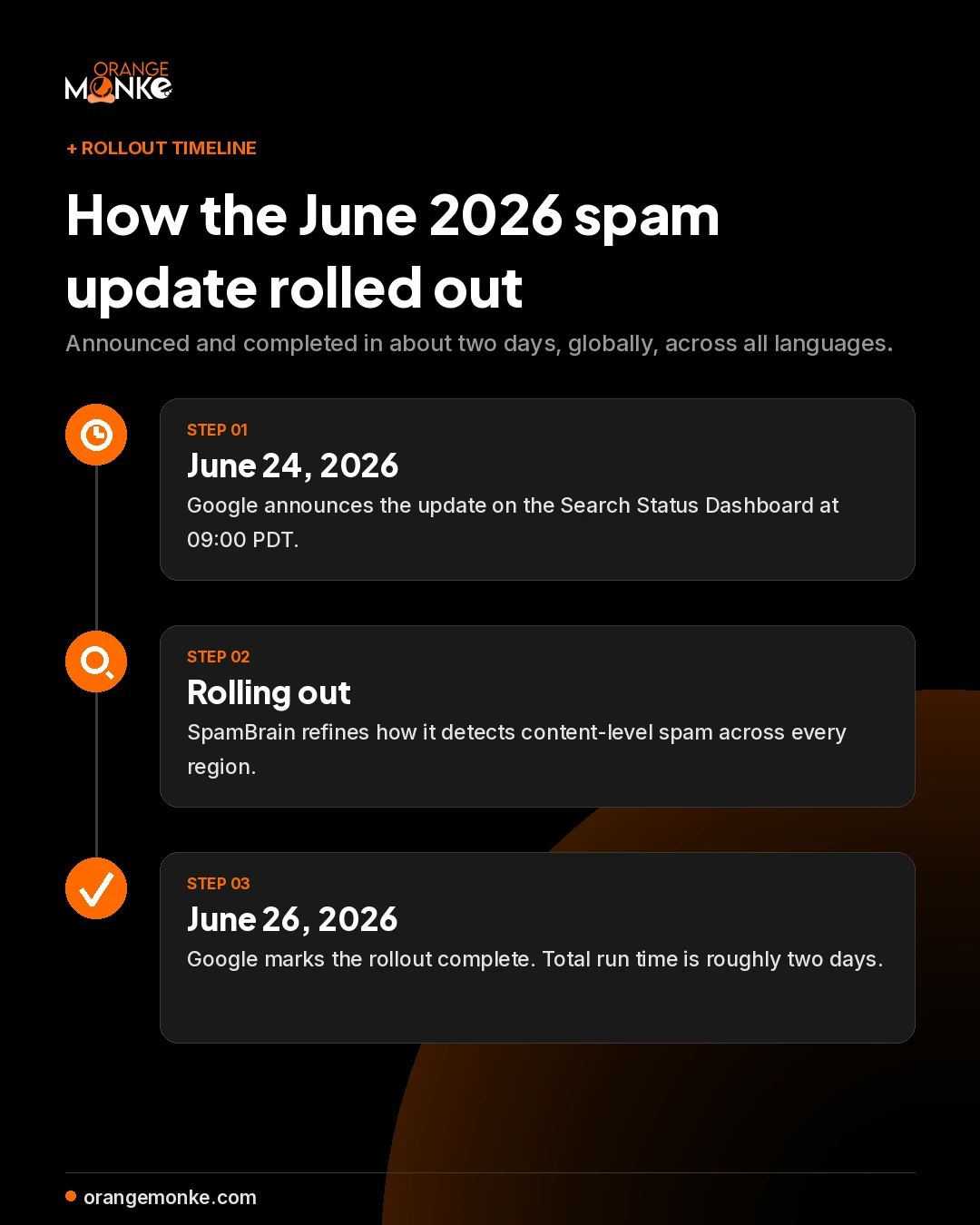
Google announced the June 2026 spam update on the Search Status Dashboard on 24 June 2026 and marked it complete on 26 June, about two days end to end. The dashboard logged the start at 09:00 PDT, and it is the single official source of truth for start and end times, so it is where you confirm a rollout is finished before you judge its impact.
That two-day window matters for diagnosis. A traffic change that begins inside 24 to 26 June and spans many pages lines up with this update, while a change that starts before the 24th points to a different cause, most likely the earlier May 2026 core update. Annotate the window in your analytics so the before-and-after is unambiguous.
Industry trackers noted the release felt broader than a typical spam update despite the short window. Search Engine Roundtable reported chatter suggesting it was more widespread than usual, a reminder that rollout length says little about severity, a point the history section below makes plain.
The official record sits on the Google Search Status Dashboard, part of Google Search Central, with independent confirmation from Search Engine Land and Search Engine Journal. Always confirm the dates on the dashboard before you act.
What Did Google Change Alongside the Update?
The June 2026 spam update shipped with no new policy, but it follows two recent expansions to what counts as spam: back-button hijacking and AI answer manipulation. Understanding that context explains why enforcement keeps tightening even when a release is labelled normal.
Two policy moves set the stage for this update:
- Back-button hijacking policy. Google published this policy in April 2026 and began enforcing it on 15 June 2026, nine days before the spam update went live.
- AI answer manipulation. In May 2026, Google expanded its spam policies to state that attempting to manipulate AI responses in Google Search counts as spam.
The practical takeaway is that Google's spam systems now police the full answer layer of search, including AI Overviews and AI Mode, not just the traditional list of blue links. Tactics that felt safe eighteen months ago, particularly mass-produced pages and AI answer manipulation, now sit squarely inside policy scope.
What Does the June 2026 Spam Update Target?
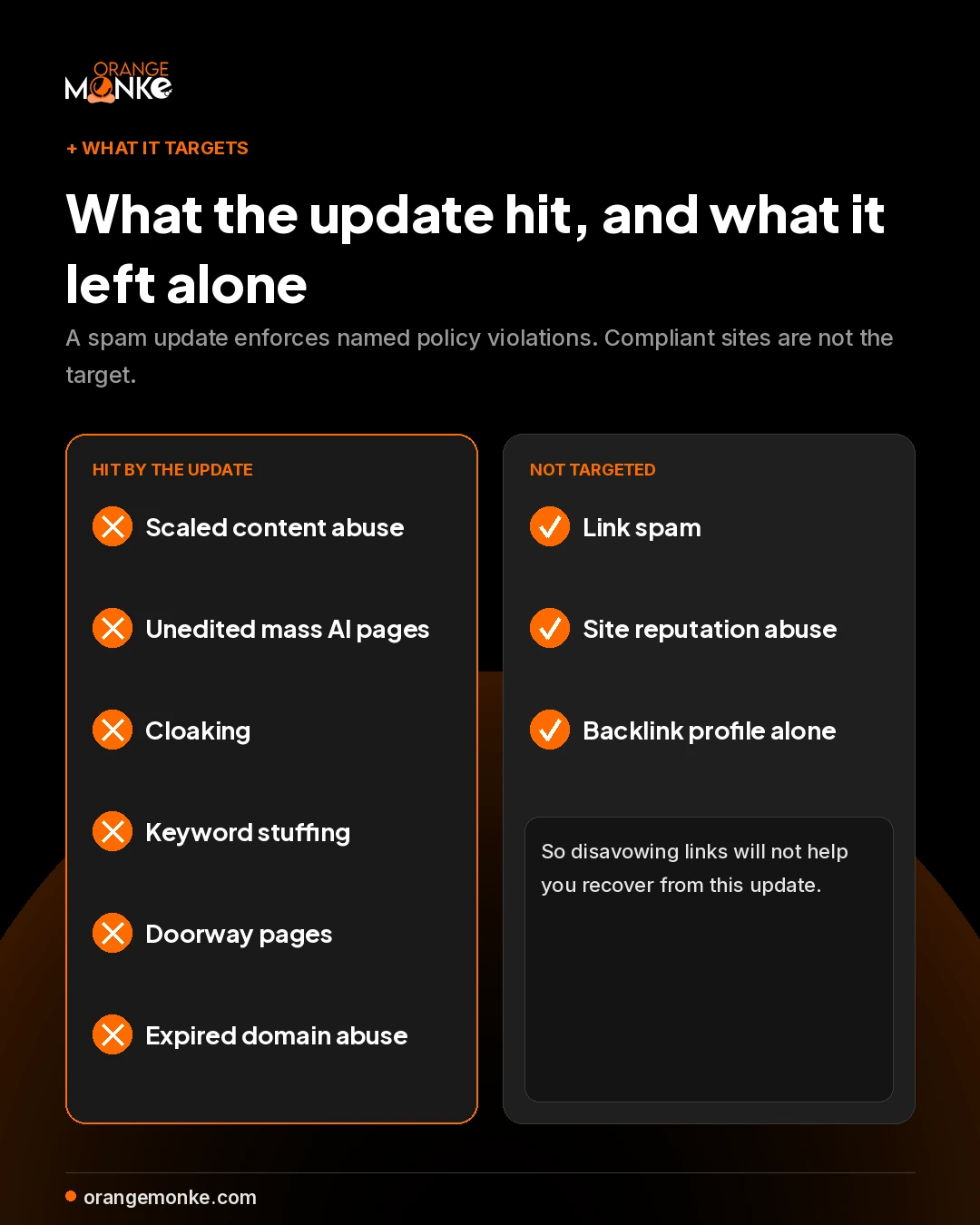
The June 2026 spam update targets pages that use manipulative techniques to game search rankings, as defined in Google's spam policies, and it excludes link spam and site reputation abuse. It does not penalise sites at random. If your content follows the policies, this update should leave you alone. The sites that drop are the ones relying on tactics Google's documentation already names as violations.
The most common triggers in a general spam update are:
- Scaled content abuse. Producing large volumes of low-value pages, often AI-generated, mainly to rank rather than to help readers. This is the violation Google has pushed hardest on since 2024.
- Cloaking. Showing search engines one version of a page and users another.
- Keyword stuffing. Forcing exact-match keywords into headings, body text, or anchors in a way that reads unnaturally.
- Hidden text and sneaky redirects. Content users cannot see, or redirects that send them somewhere other than the indexed page.
- Expired domain abuse. Buying an aged domain to inherit its authority for unrelated, low-value content.
- Doorway pages. Thin pages built to funnel users toward a single destination with no standalone value.
This update excludes link spam, so you cannot blame a sudden drop on your backlink profile alone. Disavowing links will not help recovery from the June 2026 spam update. The work belongs on-page and on content quality.
Does the June 2026 Spam Update Target AI Content?
No, the June 2026 spam update does not target AI content for being AI-made; it targets scaled content abuse, which is often, but not always, AI-generated. Google evaluates the usefulness of a page, not the tool used to write it. AI-assisted content that is edited, accurate, and genuinely helpful stays within policy.
The line Google draws is about value at scale, not authorship:
- Within policy. AI used for research, drafting, or efficiency, then edited into accurate, original, people-first pages.
- Outside policy. Unedited, mass-produced pages published in volume mainly to rank, which is the definition of scaled content abuse.
So earning AI citations works the same way as ranking on Google: answer the question clearly in your visible copy, then prove expertise. That is exactly what a modern content strategy is built to do, and it is the foundation of AI SEO that survives every crackdown.
How Do I Know if the June 2026 Spam Update Hit My Site?
Check whether your traffic or rankings dropped on or after 24 June 2026, then confirm the change is sitewide rather than limited to one page. Google Search Console is the only data source that tells you this reliably. A drop that lines up with the rollout, spans multiple pages, and traces back to a spam policy issue is a strong signal the update is the cause.
Work through these checks in order, and treat the table as your audit worksheet:
| Area to review | What to check | Why it matters |
|---|---|---|
| Match the date | In GSC Performance, set the range around 24 to 26 June and look for a clear step-down in clicks and impressions. | A drop that starts before the 24th is not this update. Compare in Search Console and analytics. |
| Rule out the core update | See whether the decline began in May and continued. | An earlier start points to the May 2026 core update, a different problem with a different fix. |
| Check the spread | In the Pages report, see whether the decline hits many URLs or just a few. | Spam updates usually affect a site broadly. A single dropped ranking position is rarely this. |
| Review Manual Actions | Open the Manual Actions report. | Spam updates are algorithmic, so this is normally clear. Confirming it rules out a separate manual penalty. |
| Audit thin and technical issues | Read your lowest-quality pages against the spam policies, and check crawl errors, broken links, speed, and indexing. | Thin, duplicate, or templated pages are the usual triggers, and technical faults can amplify a drop. |
If the timing does not match the rollout, the cause is something else. Do not start a spam recovery for a problem you have not confirmed.
Comparing your own decline against competitor visibility over the same dates also helps separate a site-specific demotion from a niche-wide shift.
Spam Update vs Core Update: What Is the Difference?
A spam update targets specific policy violations, while a core update reassesses overall content quality across the web, so the two call for completely different fixes. Diagnosing which one moved your rankings is the first step, because a recovery plan built for the wrong update wastes months.
A spam update improves the systems that detect named violations such as cloaking, scaled content abuse, and keyword stuffing, so recovery means finding and fixing the specific breach. A core update has no single violation to fix. It is a broad recalibration of how Google weighs relevance, depth, and trust, so recovery means raising the genuine quality of the site over time.
| Spam update | Core update | |
|---|---|---|
| What it judges | Specific policy violations | Overall content quality and relevance |
| Typical fix | Remove or correct the violation | Improve depth, trust, and usefulness sitewide |
| Recovery speed | Months, after systems reassess | Often the next core update |
The June 2026 update is a spam update, so your diagnosis should focus on policy compliance, not a general quality overhaul.
If your drop predates 24 June 2026 and traces to the May 2026 core update instead, the table above points you to the right response.
A Short History of Google Spam Updates (2025 to 2026)
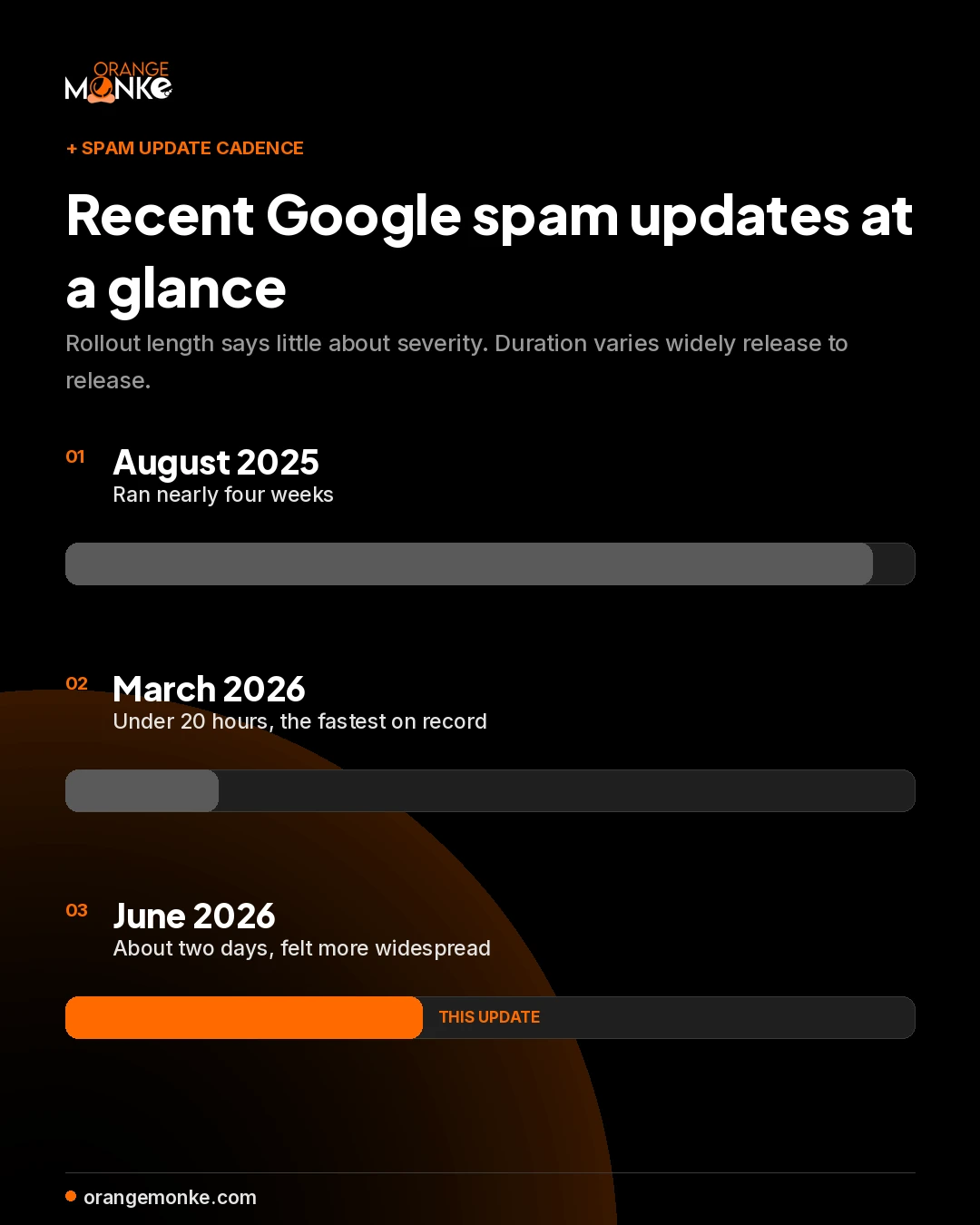
Google typically releases one to three spam updates a year, and June 2026 is the second confirmed spam update of the year, following March 2026 and August 2025. Seeing the cadence helps you read volatility correctly and avoid blaming the wrong update.
| Update | Rollout length | Notes |
|---|---|---|
| August 2025 spam update | About 27 days (26 Aug to 22 Sep) | A long, drawn-out rollout |
| March 2026 spam update | Under 20 hours | The fastest confirmed spam rollout on record |
| June 2026 spam update | About two days (24 to 26 Jun) | Short window, but reported as more widespread |
Rollout duration tells you almost nothing about severity. A one-day update can bite harder than a four-week one.
Between named updates, Google also runs periodic refreshes, so its spam systems reassess far more often than the announcements suggest. A confirmed window is a diagnostic anchor, but a traffic move outside any announced rollout can still trace to a quiet refresh.
Why Is the June 2026 Spam Update Good News for Clean Sites?
Every spam site Google demotes creates ranking room for a compliant business to move up, so a spam update is an opportunity for sites that earned their visibility honestly. When SpamBrain neutralises rankings built on scaled content or cloaking, the sites that earned their positions inherit that visibility without changing a thing.
Compliance is not just risk avoidance. It is a competitive position that pays out every time Google's detection improves, and detection is improving on a faster cadence than ever. The window between deploying a manipulative tactic and getting caught keeps shrinking, which means growth built to fool an algorithm sits on ground Google re-inspects every few months.
Honest organic growth behaves differently. Content that answers real questions earns rankings, AI citations, backlinks, and returning visitors, and each signal reinforces the others. Organic search also compounds in a way paid channels cannot, so a page published once can generate qualified leads for years. That is the whole case for building durable organic traffic on genuine E-E-A-T rather than shortcuts.
Not sure whether it was spam, core, or something technical? We will tell you exactly.
We separate spam-update damage from core-update and technical issues, name the policy you breached, and hand you a recovery plan that lasts.
Get a free SEO audit →How Do You Recover From the June 2026 Spam Update?
Recovery means finding the spam policy violation on your site, fixing or removing it, then waiting for Google's systems to reassess and confirm compliance. There is no button to request reinstatement for an algorithmic spam demotion. You make genuine changes, then Google's automated systems confirm compliance over a period of months, and Google has been clear that recovery is not guaranteed even after you fix the problem.
Work through recovery in this order:
- Confirm the diagnosis firstDo not start until you have matched the drop to the rollout date and identified at least one likely violation. Fixing the wrong thing costs time you cannot recover.
- Audit your weakest pagesList your thinnest, most templated, or most keyword-heavy URLs. Read each one honestly against Google's spam policies. Scaled, low-value content is the most common trigger, so be strict with AI-generated pages that add nothing.
- Fix or remove, do not disguiseRewrite pages to serve readers, or remove them outright. Consolidate duplicates. Strip hidden text, cloaking, and sneaky redirects. Changing only the publish date will not work and can make things worse.
- Strengthen what remainsImprove what remains, because helpful E-E-A-T content signals work sitewide, and weak pages drag down strong ones. Pruning genuinely poor content can lift the pages you keep.
- Document every changeRecord what you altered and when, so you can correlate any recovery with the next spam update refresh, and be prepared for the next storm of updates.
- Then waitGoogle refreshes spam systems periodically. Improvements are recognised over months, not days. Resist the urge to keep changing things in a panic.
The honest position is that quick reversals are rare. Sites that recover are the ones that made real, lasting changes to content and structure, the kind our content team and SEO service are built to deliver, not the ones that looked for a shortcut.
How Long Does Recovery Take?
Recovery from the June 2026 spam update typically takes months, not days or weeks, and Google does not guarantee it even after you fix the problem. Visibility returns only once Google's systems recrawl your site, register the changes, and confirm sustained compliance, which is a slow, automated process you cannot speed up by asking.
Two factors control how long it takes:
- Depth of the fix. A thorough cleanup recovers faster than a half measure. Patching one page while leaving the wider violation in place resets the clock, because the systems keep detecting the pattern.
- Google's refresh schedule. Spam systems reassess periodically, not continuously. A site cleaned up properly in late June 2026 may not see meaningful movement until a later refresh lands.
Set expectations accordingly and treat recovery as a quarter-by-quarter effort rather than a quick rebound. Keep publishing genuinely useful content while you wait, and measure progress in the Search Console Performance report, alongside your analytics, instead of refreshing rankings daily. If you have made real, substantive changes and still see nothing after several months and a confirmed refresh, the cleanup almost certainly did not go deep enough.
Where Does This Fit in Your Wider SEO Strategy?
SEO is one instrument in a system that also includes paid media, email, social, and brand, and organic search feeds every one of them. Organic content fuels your email programme, informs your paid keyword strategy, and increasingly decides whether AI engines cite your brand at all. Treating search as a place to cut corners weakens every channel that depends on the content search produces.
That is why the June 2026 spam update did not punish businesses for doing SEO. It punished businesses for doing it badly, or for handing the channel to vendors who chased shortcuts. The durable play is to build content that both traditional search and AI engines can extract and cite, then let it power the rest of the mix, from SEO and PPC working together to social and AI search. Google's own AI Optimization Guide, published 15 May 2026, makes the point directly: optimising for generative AI search is still SEO.
Conclusion
The June 2026 spam update rewards the same thing every recent Google update has rewarded: genuine, policy-compliant content built for readers rather than rankings. Recovery is set by how honestly you audit and how thoroughly you fix, not by a permanent penalty. Sites that treat the cleanup as real editorial work, not a date-stamp refresh, are the ones that hold their position through the next update cycle.
This is where Orange MonkE helps. We diagnose exactly which spam policy a site has breached, separate spam-update damage from core-update and technical issues, and rebuild content and structure for durable visibility across Google and AI search. If your rankings have slipped and you want a clear answer on why, plus a recovery plan that lasts, our SEO services are built for exactly that.
Want to show up in AI Overviews and ChatGPT, not just blue links?
Spam updates now police the AI answer layer too. Our AI SEO service makes your pages the answer AI engines quote, where your buyers now search.
Talk to an AI SEO strategist →Frequently Asked Questions
Google does not notify you when an algorithmic spam update affects your site; the demotion happens silently through SpamBrain.
- Algorithmic spam update: applied automatically, with no notice anywhere in Search Console. Rankings simply drop across many pages around the rollout date.
- Manual action: applied by a human reviewer and the only type that triggers a notice, listed under Security and Manual Actions.
- Your real signal: a sustained fall in clicks that begins on or just after 24 June 2026, spread across multiple URLs.
A clean Manual Actions report does not mean you were spared, so match your clicks against the rollout window and any confirmed drop in search position instead of waiting for a warning.
You can fully recover from content-based spam violations, but link-based losses are usually capped.
- Content violations: recovery is realistic once you remove or genuinely fix the offending pages and Google recrawls and reassesses.
- Link spam: once Google discounts spammy links, the ranking benefit they carried is permanently lost, even after cleanup.
- This update: it does not target link spam, so for most sites hit this round the path back runs through content quality.
That is good news, because content problems are the recoverable kind. Audit honestly, fix properly with strong content work, and your ceiling is set by the quality of your work.
Recovery from the June 2026 spam update typically takes several months, even when your fixes are fast and thorough.
- Reassessment, not reaction: Google's systems must recrawl your pages and confirm sustained compliance before visibility returns.
- Refresh schedule: spam systems reassess periodically, so meaningful movement often waits for a later refresh.
- Your job meanwhile: keep publishing useful content and measure progress in Search Console, not daily rankings.
Treat it as a quarter-by-quarter effort. A structured SEO recovery programme keeps the work disciplined instead of reactive.
Google typically releases one to three spam updates per year, and June 2026 is the second confirmed spam update of the year.
- 2025: the August 2025 spam update ran about 27 days, from 26 August to 22 September.
- 2026: the March 2026 update completed in under 20 hours, the fastest on record, and June followed on 24 June.
- Between updates: Google also runs periodic refreshes, so its systems reassess more often than the announcements suggest.
A confirmed window is a diagnostic anchor, but a move outside any announced rollout can still trace to a quiet refresh or a separate core update.
Wait until the rollout finishes before judging the impact, but you can safely begin auditing straight away.
- Hold your conclusions: rankings can rise and fall daily until the update settles, so a mid-rollout drop is not yet a verdict.
- Start the audit now: reviewing pages against the spam policies is harmless to begin immediately and saves time later.
- Confirm on the dashboard: Google marks the Search Status Dashboard complete when the rollout ends, and that is the moment to act.
Sweeping changes made during an active rollout can muddy the picture, so track the trend in Search Console and analytics before you act.
SpamBrain is Google's AI-based spam-prevention system, and it has powered every confirmed Google spam update since 2022.
- What it does: identifies patterns tied to policy violations and neutralises the ranking signals those tactics generated.
- Why recovery is slow: because it neutralises rather than warns, manipulated rankings rarely return even after the content is removed.
- What it means for you: the durable move is content that never relied on manipulation in the first place.
Building that kind of resilient, citable content is the core of modern AI SEO.
AI-generated content is not penalised for being AI-made; it is penalised only when it qualifies as scaled content abuse.
- Within policy: AI-assisted content that is edited, accurate, original, and genuinely helpful.
- Outside policy: unedited, mass-produced pages published in volume mainly to rank.
- The test: Google evaluates usefulness and expertise, not the tool used to write the page.
A disciplined content strategy keeps AI on the right side of that line.
Google confirmed the June 2026 spam update on the Google Search Status Dashboard, which logged the 24 June start and the 26 June completion.
- Official source: the Search Status Dashboard is where Google posts start and end times for every confirmed update.
- Independent confirmation: SEO press including Search Engine Land and Search Engine Roundtable reported the same window.
- Why it matters: confirm the dates there before you diagnose, so you do not blame the wrong update.
If your decline predates that window, check whether the May 2026 core update is the real cause.