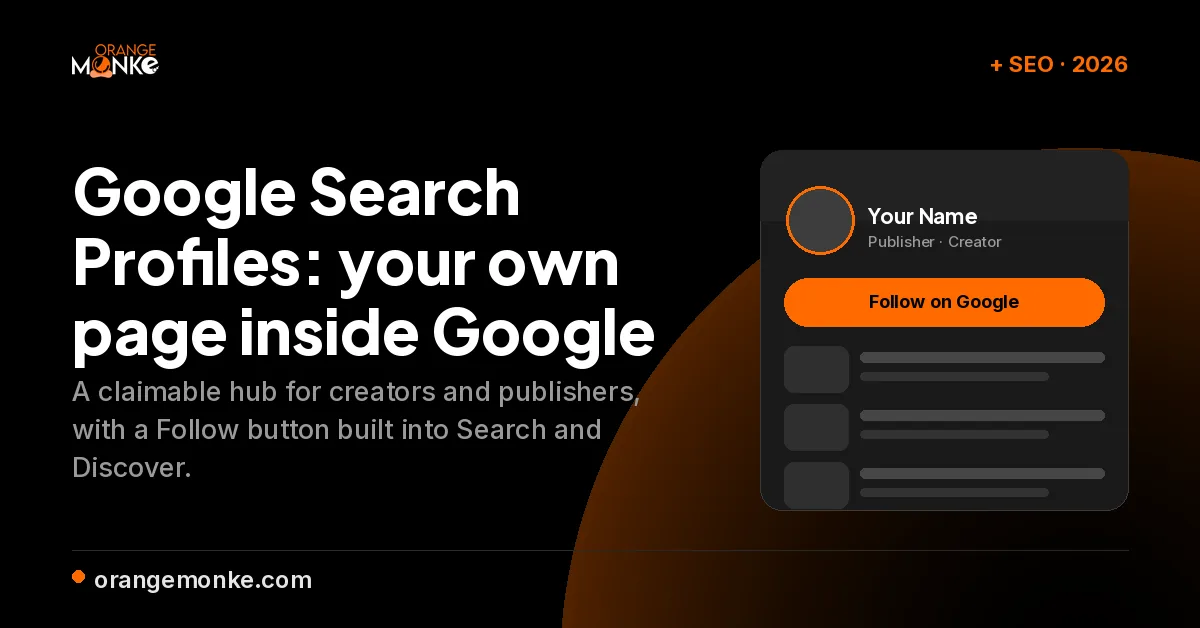
Google Search Profiles launched on 4 June 2026 as Google's answer to a decade of one-way traffic: publish, get ranked, lose the click. Announced by Google Search product manager Ibrahim Badr, they give creators and publishers a claimable page and, for the first time, a Follow button that lives inside Google itself.
The launch landed as AI Overviews were absorbing clicks that used to reach websites. Rather than watch publishers drift away, Google gave them a direct, follow-based relationship inside its own app, one that does not depend on ranking first for a query.
- A claimable page that pulls your articles, videos, and social posts into one place on Google.
- A Follow button that feeds your latest content into your followers' Google Discover feed.
- An easier route to a Knowledge Panel, which used to require a separate, opaque verification process.
It hands creators a piece of owned real estate inside Search, so audiences can find and follow them without depending on any single social platform's algorithm.
Google Search Profiles are the biggest shift in how Google treats creators in years, and most people still are not sure what they are or whether they qualify. This guide breaks down what a Search profile is, how it differs from a Google Business Profile, who can claim one, how to claim it, and what to do if you are not eligible yet.
A Google Search Profile is a free, Google-hosted page that consolidates your content across platforms and lets people follow you directly on Google.
- Who it is for: creators, publishers, and brands, not local businesses.
- Eligibility: 100,000+ followers on YouTube, Instagram or X, or 300,000+ on TikTok, on one platform.
- Where it shows: your Knowledge Panel, Google Discover, and a direct profile URL, on mobile.
- Availability: United States only at launch, with a global rollout planned.
- The catch: it does not boost rankings; the payoff is Discover distribution and an easier Knowledge Panel.
What Is a Google Search Profile?
A Google Search Profile is a shareable, Google-hosted page that gathers a creator's or publisher's content from across platforms into one searchable hub inside Google. Think of it as a verified profile that lives on Google rather than on any one social network, connected to your website and social accounts but owned by neither.
Google describes it as a dedicated space to highlight content across platforms and help audiences find accurate, up-to-date information about sources on Search. In plain terms, it is Google's answer to the "link in bio" page, built directly into the results people already see. It is not a passive, Google-generated box: it is a space you claim and manage, with a built-in follow button.
Each profile can be customised with:
- Avatar and header image that establish your visual identity on Google.
- Bio and website link so visitors understand who you are and where to go next.
- Linked social and video accounts across YouTube, Instagram, X, and TikTok.
- Pinned content, including featured work, merchandise, or a launch you want front and centre.
- A "Follow on Google" button that lets people subscribe to you inside Google.
New content from your linked platforms typically appears on the profile within 24 hours of publishing, so the page stays current without manual updating.
Search Profile vs Business Profile
A Google Search Profile is for creators and publishers who want to consolidate content and grow followers, while a Google Business Profile is for local businesses that want to appear on Maps and in local search. They share a word and nothing else, and people searching "google business profile search" or "google search business profile" are usually looking for one when they mean the other.
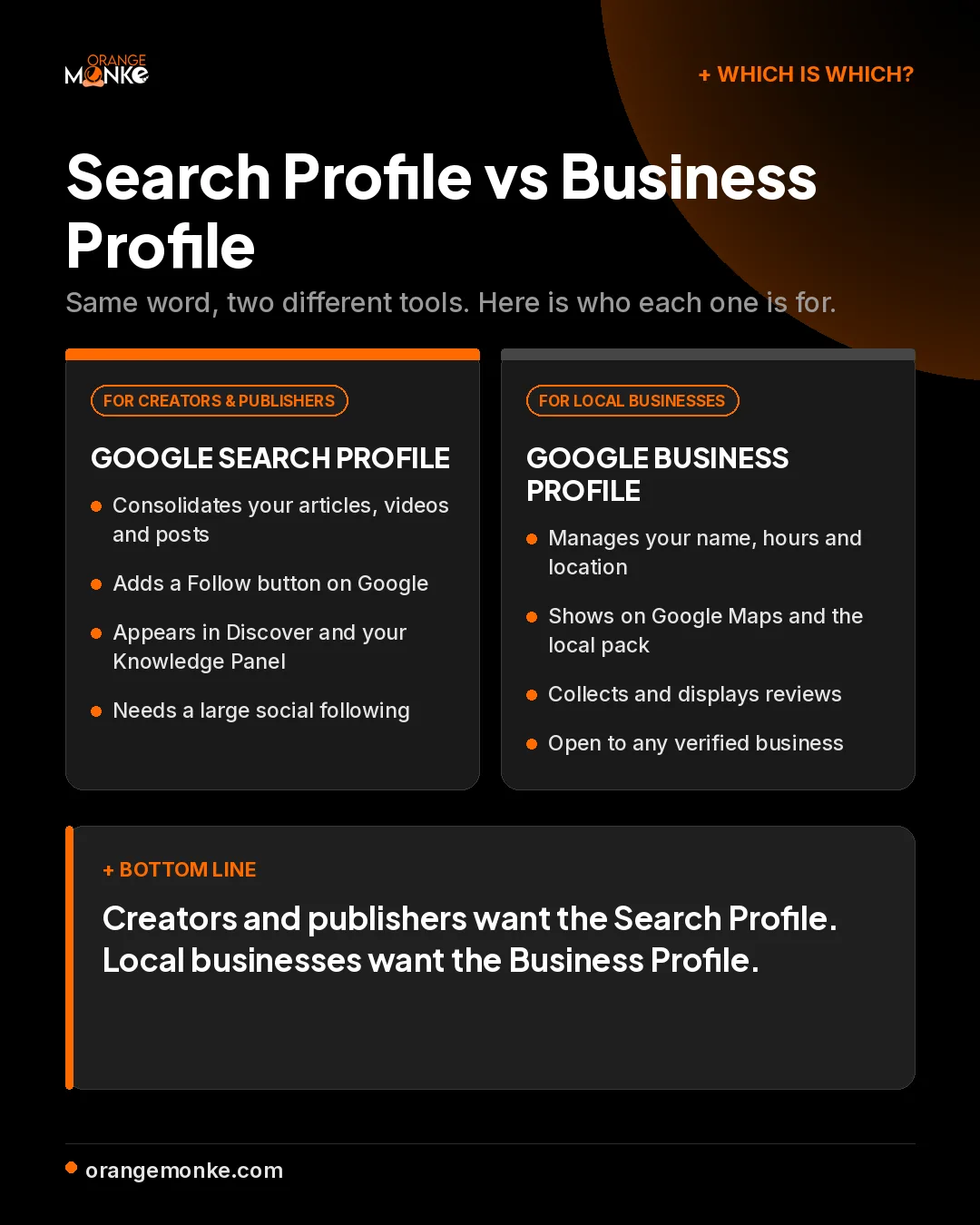
Here is the distinction in practice. If you run a plumbing company in Dubai, you want a well-optimised local listing, which is where Google Business Profile optimisation comes in. If you are a publisher or creator with a six-figure following, you want a Search profile. The two do genuinely different jobs, and what a Business Profile does for a local shopfront has nothing to do with what a Search profile does for a creator.
Where Do Search Profiles Appear?
Google Search Profiles surface in three distinct places on mobile: the Knowledge Panel, Google Discover, and a direct profile URL. Each route reaches a different slice of your audience, which is what makes the profile more than a static bio page.
- In your Knowledge Panel. When someone searches your name or brand, a "View Search Profile" link appears at the bottom of your Knowledge Panel.
- In Google Discover. When your content shows up in a user's Google Discover feed, they can tap your name in the content header to reach your profile and follow you.
- Via a direct URL. Every profile gets a shareable link in the format profile.google.com/@handle that you can drop into bios, newsletters, and email signatures.
The Discover route matters most, because that is where a follow turns into repeat distribution. That shareable URL is more powerful than it looks: it lets you send your existing email list and social audiences to a Google-owned page where they can follow you, turning one-time readers into a recurring Discover audience.
Who Qualifies for a Google Search Profile?
Google Search Profile eligibility currently requires a sizable following on at least one major platform: 100,000 followers on YouTube, Instagram, or X, or 300,000 on TikTok. You only need to clear the bar on a single platform, so strength on YouTube covers you even if your Instagram is small.
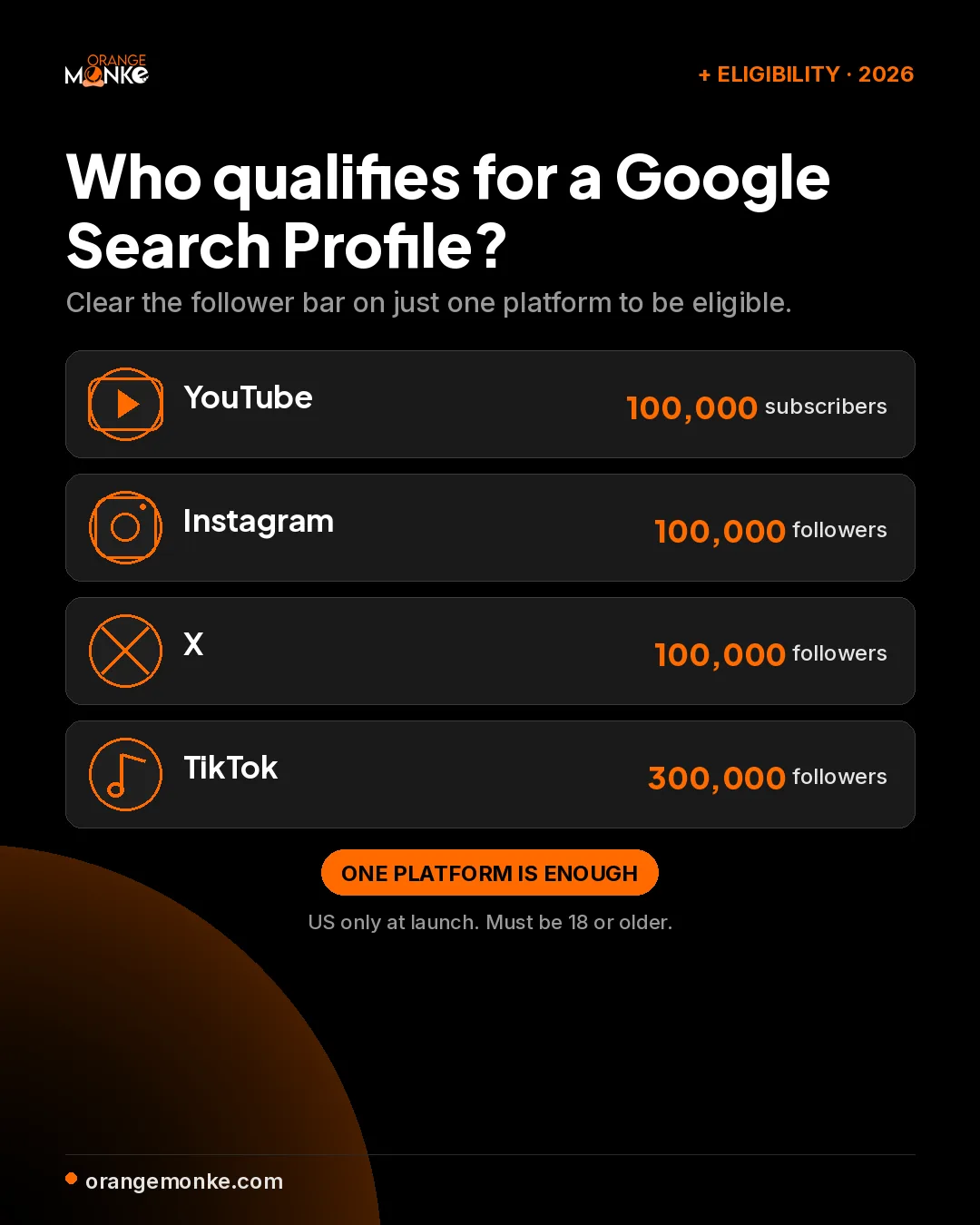
Two further requirements apply. You must be at least 18 years old, though an adult can create and manage a profile on behalf of a minor, and your content must comply with Google's community guidelines for user-generated content. If you are close on one channel, focusing your effort to grow your YouTube following or to grow your following across platforms is the fastest route in.
One caveat worth knowing: the gatekeeping has not been perfectly consistent. Some profiles created during the beta appear to remain live below the stated thresholds. Do not count on that loophole; the numbers above are what the claim flow checks.
How Do You Claim a Google Search Profile?
You claim a Google Search Profile at profile.google.com/claim by signing in with your creator Google Account and connecting a qualifying social platform. The process takes minutes, and in many cases Google has already generated an unclaimed profile for you based on your existing online presence.
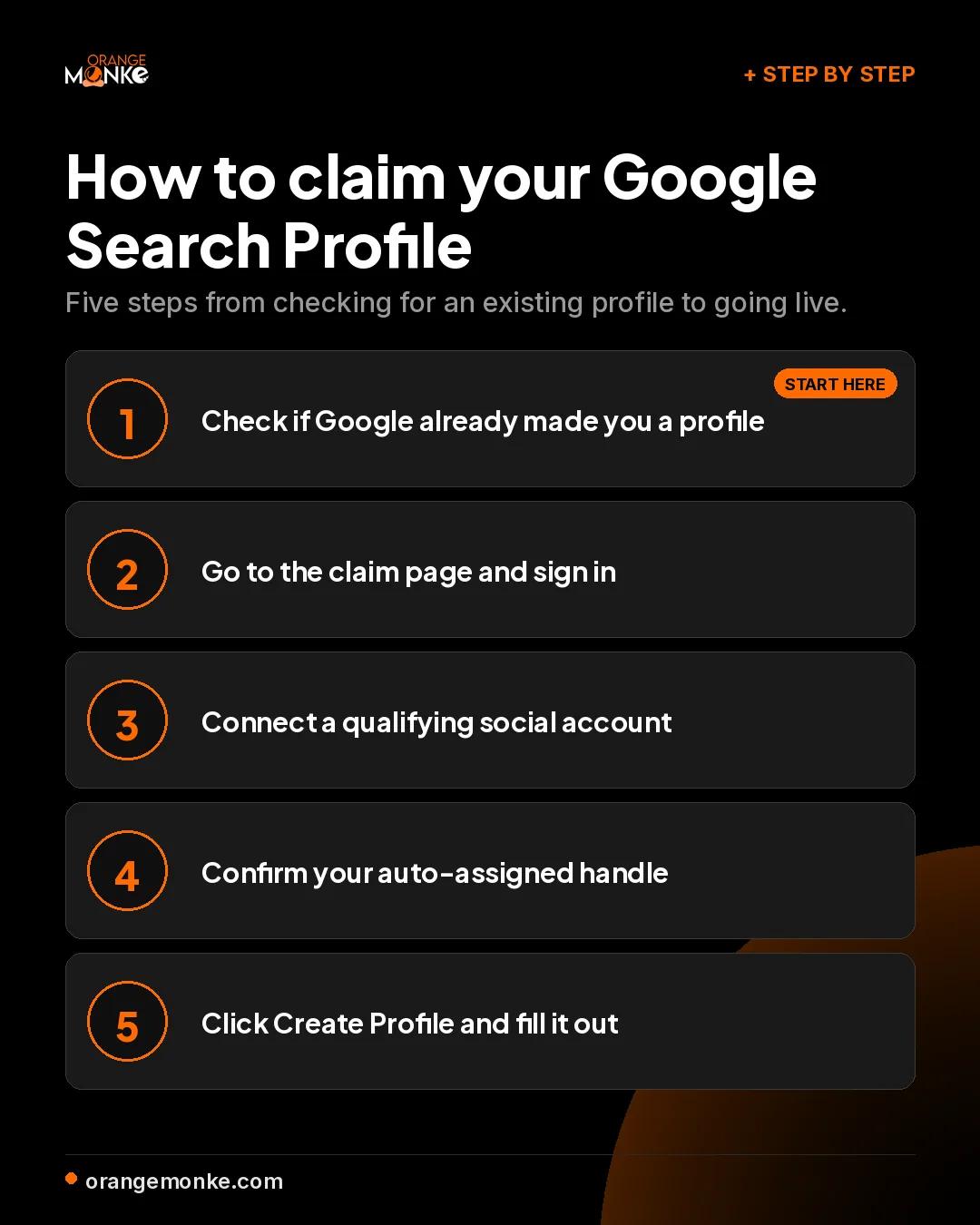
- Check whether a profile already existsSearch your name or handle on Google, or visit profile.google.com while signed in. If you already have a Knowledge Panel, there is a good chance a profile is waiting. It is worth reviewing what already appears when you search your name before you start.
- Go to the claim pageOpen profile.google.com/claim and sign in with the Google Account tied to your creator work. If you have a YouTube channel, use that same account.
- Connect a qualifying accountLink at least one platform that meets the follower threshold. Google will flag any existing unclaimed profile attached to that account.
- Set your handleYour handle is assigned automatically from your most-followed linked account. If that handle is taken, Google uses the next most-followed platform's handle.
- Create the profileClick Create Profile, then add more links, refine your bio, and manage your content.
One thing to expect: edits to your name, links, or bio go into a "Pending" status until Google reviews them, which keeps the factual information on your profile accurate. You can also start through Google for Creators at creators.google/profile.
The Knowledge Panel Connection
Claiming a Search profile can trigger the creation of a Google Knowledge Panel, or automatically upgrade one you already have. This is the single most valuable side effect for brands, because Knowledge Panels have historically been hard for creators to earn.
A Knowledge Panel is the information box that appears in Search for notable people, brands, and entities, and it is one of the most visible trust signals Google offers. Previously, getting one meant navigating a separate and often opaque verification process. Claiming a qualifying Search profile now gives you a clearer, more direct route. If you already have a panel, claiming your profile enriches it with your updated avatar, latest content, and a direct link to your page. The stronger your entity and E-E-A-T signals, the more reliably Google can build that panel in the first place.
Search Profile vs Knowledge Panel: what's the difference?
These two features are linked but do different jobs, and the distinction matters when you plan your Google presence.
| Aspect | Knowledge Panel | Search Profile |
|---|---|---|
| What it is | An information box Google generates about a notable entity | A creator-managed showcase of your content with a follow button |
| Who controls it | Google generates it; verified owners can suggest edits | The creator, publisher, or brand claims and manages it |
| Main purpose | Provide quick facts about an entity | Help audiences discover, follow, and engage with your content |
| Relationship | Can link out to a Search profile | Claiming a profile can create or enhance a Knowledge Panel |
Think of the Knowledge Panel as Google's summary of who you are, and the Search profile as your storefront, the place where you actively convert searchers into followers.
Do Google Search Profiles Help Your SEO or Rankings?
No, a Google Search Profile does not directly improve how your content ranks in Google Search, and Google is explicit about this. The profile is an audience-building and distribution tool, not a ranking shortcut, so anyone hoping it will lift their blog posts up the results will be disappointed.
The visibility payoff lives in Google Discover, not in blue-link rankings. When someone follows your profile, your content becomes more likely to appear in their Discover feed, which is where the real traffic upside sits. Keep your ranking work where it already is: the fundamentals still do the ranking work, and the technical foundations behind them do not change. If you want to compound the effect, pair the profile with AI SEO and technical SEO so you are visible across Search, Discover, and AI answers at once.
A Search profile is a distribution and following tool, not a ranking hack. Its payoff shows up as Discover impressions and follower growth, not as a jump in keyword positions. Set expectations accordingly.
What Are the Benefits of a Google Search Profile?
A Google Search Profile gives creators unified visibility, a followed Discover audience, an easier Knowledge Panel, a URL they control, and early access to built-in analytics. Together they turn a scattered online presence into one Google-native home.
- Unified cross-platform visibility. Your videos, posts, and articles sit in one view instead of scattered across the web.
- Stronger Discover presence. The "Follow on Google" button builds an audience independent of algorithm-driven social feeds.
- Knowledge Panel enhancement. A claimed profile can create or upgrade one of Search's most trusted signals.
- A direct URL you control. Your profile.google.com/@handle link works anywhere you point an audience.
- Built-in analytics, in beta. Google is testing an Insights section showing top posts by clicks, total impressions, clicks from Google, and top countries.
- Multiple identities, one account. Run a blog, a podcast, and a business? You can hold separate profiles for each.
For the first time, you can build a subscriber base inside Google's own ecosystem rather than renting an audience from a third-party platform. That is why early movers gain an edge: eligibility is gated behind high thresholds today, so the creators who claim and optimise now establish their following before the field gets crowded.
Claiming the profile is easy. Earning the visibility around it is the real work.
We build the entity signals, technical SEO and content that make Google trust you across Search, Discover and AI answers.
Get a free SEO audit →How Do You Optimise Your Google Search Profile?
You optimise a Google Search Profile by completing every field, linking all qualifying platforms, staying active, and promoting your profile URL so people actually follow you. A complete, active profile will always outperform a bare one.
- Complete every field. A filled-out bio, avatar, header image, and full set of platform links make your profile look credible and worth following.
- Link all qualifying platforms. The more active feeds you connect, the fresher the content your profile shows.
- Stay active. Your profile is only as compelling as the content flowing into it.
- Promote the URL. Add it to your newsletter, link-in-bio, and website so existing fans can follow you on Google.
- Pair it with Discover-friendly content. Strong, accurate headlines and high-quality images give your posts the best chance of surfacing, which is exactly what good Discover-friendly content is built for.
Next step: fill the profile out completely on day one, then treat it like any other owned channel you keep warm.
What If You Are Not Eligible Yet?
If you are outside the United States or under the follower bar, you cannot claim a Search profile yet, but you can prepare now so you qualify the moment access opens. The claim flow is US only at launch, so creators in the UAE, India, the UK, Canada, and Australia see a "This feature isn't available in your region yet" message.
Google has confirmed a global expansion but given no dates, which follows its usual pattern of staged, US-first rollouts. There is one useful nuance: you can often view the profile Google has already generated for you, even though you cannot fully claim it. That preview shows what Google believes about you as an entity, so you can spot errors early. One catch reported by SEOs testing this: an unclaimed profile carries a noindex tag, so nobody finds it through Search until you claim it and the flow reaches your country.
Here is what actually moves the needle now, whether you are region-locked or still growing:
- Build toward the thresholds. Grow the platform closest to the bar so you qualify the day the flow opens.
- Lock in your entity signals. Keep your website, bios, and social accounts consistent and clearly attributed, since these are the signals Google uses to build a Knowledge Panel automatically.
- Invest in Discover now. Discover is already live in India and the UAE, so the channel the profile feeds into is available to you today.
- Nail the basics. Crawlability, indexing, and helpful content are the backbone of visibility; if you are starting out, nail your SEO fundamentals first.
If you operate in the UAE or India and cannot claim yet, getting these foundations right early means you claim your preferred handle before someone else does. An SEO consultant to prep now can get your entity and Discover signals in order ahead of the rollout.
Why Did Google Launch Search Profiles Now?
Google launched Search profiles as a response to publisher and creator frustration over falling referral traffic in the AI era. The feature gives creators a direct follow relationship inside Google at exactly the moment AI Overviews are absorbing clicks that used to reach websites.
The timing is not subtle. Industry coverage of the launch tied it to reports that AI Overviews have sharply reduced organic click-through rates since mid-2024, with one widely cited figure putting the drop at around 61% on AI Overview queries. Whatever the exact number, the direction is clear: fewer clicks are reaching publishers, and Google needs to keep creators invested in its ecosystem. This is the same pressure that makes AI search optimisation matter more each quarter, and why publishers keep asking whether referral traffic from Search can hold up.
Search profiles are the latest layer in a year of publisher tooling, alongside Follow buttons for websites on Discover, a global Preferred Sources rollout, and an early-2026 Discover core update. Read together, they show Google building a follow-based distribution system that keeps audiences, and creators, inside the Google app.
Common Google Search Profile Problems and Fixes
Most Google Search Profile problems come down to region locks, common names, pending edits, or handle conflicts, and each has a straightforward fix. Knowing them in advance saves the frustration of a profile that seems broken when it is simply behaving as designed.
- Profile not showing in Search? If your name is shared by many people, search your unique handle (for example @username) instead, since Google shows profiles mainly when users are clearly looking for you. If it is your website rather than your profile that is missing, that is a different issue covered in our guide to a site not showing on Google.
- Stuck on "not available in your region yet"? You are outside the US launch. You can still preview an auto-generated profile, but full claiming waits for the regional rollout.
- Edits stuck on "Pending"? Changes to your name, links, or bio are held for Google's review to protect factual accuracy. This is normal; give it time.
- Your preferred handle is taken? Handles derive from your most-followed linked account, so growing and linking your strongest account gives you the best handle.
Conclusion
Google Search Profiles mark a real shift in how Google treats the people who make the content it depends on. For eligible creators, those with 100,000+ followers on YouTube, Instagram, or X, or 300,000+ on TikTok, claiming one is a low-effort win: a better Knowledge Panel, a new Discover audience channel, and a single hub for everything they publish.
For everyone else, the move is to prepare. Grow toward the thresholds, keep your entity signals clean, and build your Discover strategy now so you are ready the moment the feature reaches your region. The first practical step costs nothing: search your name on Google, or head to profile.google.com, and see whether a profile is already waiting. At Orange MonkE, we help brands and creators win visibility across every Google surface and turn search presence into lasting growth.
Outside the US or under the follower bar? Let's get you ready before the rollout.
We grow your platform presence, tidy your entity signals and build the Discover-ready content that qualifies you fast.
Talk to an SEO strategist →Frequently Asked Questions
A Google Search Profile is not the same as a Google Business Profile: one is a content hub for creators and publishers, the other is a local listing for businesses on Maps.
- Search Profile: consolidates your articles, videos, and posts and lets people follow you on Google.
- Business Profile: manages your name, hours, location, and reviews for Maps and the local pack.
- Who needs which: creators and publishers want the Search Profile; local businesses want the Business Profile.
- They can coexist: a personal brand that is also a local business can hold both.
If you run a location-based business, start with the photos on your Business Profile.
You do not need an existing Knowledge Panel to claim a Search Profile, and claiming one can actually create or upgrade a panel for you.
- No prerequisite: eligibility depends on follower thresholds, not on already having a panel.
- It can trigger a panel: claiming a qualifying profile may generate a new Knowledge Panel.
- It enhances an existing panel: an existing panel gains your avatar, latest content, and a profile link.
The stronger your entity footprint, the better this works, which is why entity and E-E-A-T signals matter before you claim.
A Google Search Profile does not improve how your content ranks in Google Search; Google states this plainly.
- No ranking effect: the profile is not a ranking factor for blue-link results.
- Discover is the payoff: followers are more likely to see your content in their Discover feed.
- Entity benefit: the Knowledge Panel boost strengthens brand authority indirectly.
Keep your ranking work in the fundamentals covered in our guide to search engine positioning.
Brands and publishers can claim a Google Search Profile, not just individual creators, as long as they meet the follower thresholds.
- Brand-eligible: Google built the feature for creators, publishers, and brands alike.
- Threshold applies: the account still needs 100,000+ (or 300,000 on TikTok) on one platform.
- Often pre-generated: many established brands already have an unclaimed profile waiting.
A profile is only as strong as the work behind it, so pair it with a real content marketing strategy.
Google approves the initial claim in minutes, but later edits to your name, links, or bio sit in a "Pending" review first.
- Claiming is fast: creating the profile itself takes only a few minutes.
- Edits are reviewed: factual changes stay "Pending" until Google checks them.
- Content syncs quickly: new posts from linked platforms usually appear within 24 hours.
If you are still building the presence Google needs to recognise you, start with a solid presence on Google Search.
A Google Search Profile is not yet available in India or the UAE, since the feature launched in the United States first.
- US only at launch: other regions see a "not available in your region yet" message.
- Global expansion planned: Google has confirmed a wider rollout but given no dates.
- You can still prep: grow toward the thresholds and tidy your entity signals now.
Our Delhi team can get your Discover and entity foundations ready before the rollout reaches you.
You can hold more than one Google Search Profile if you manage several identities, such as a personal brand, a podcast, and a business.
- One per identity: create a separate profile for each brand, ideally on a separate Google Account.
- Shared accounts allowed: the same social account can link to more than one profile.
- Threshold still applies: each profile needs a qualifying linked account.
Juggling multiple brands is easier with the right stack, like these tools for content creators.