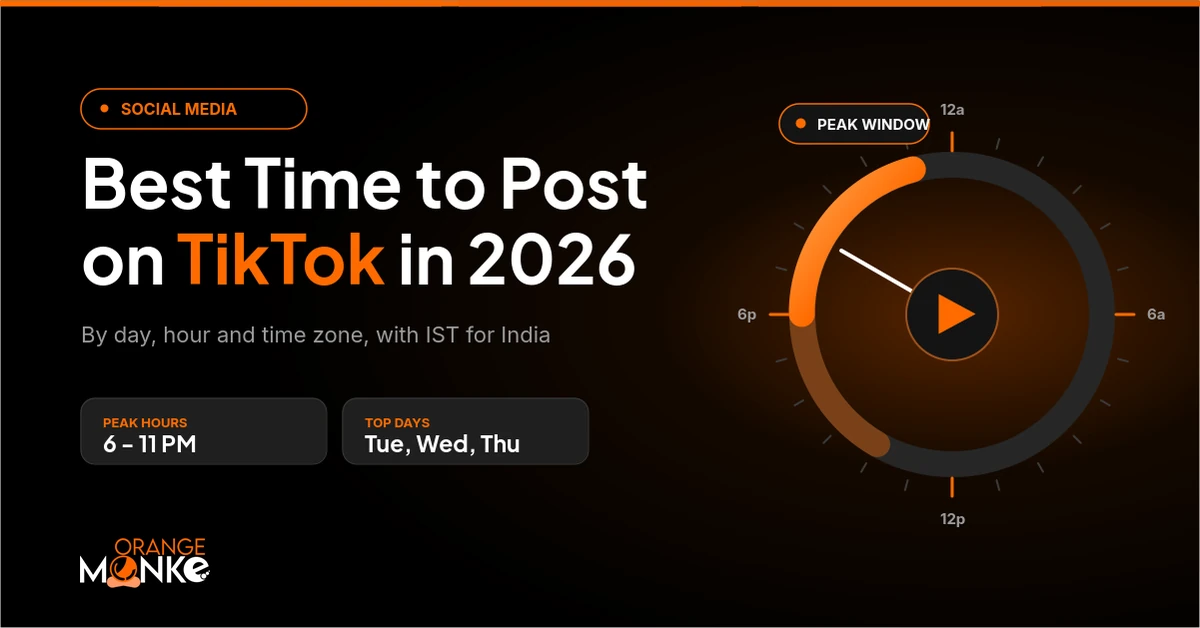
The best time to post on TikTok in 2026 is late afternoon to evening, roughly 2 p.m. to 11 p.m. local time, with Tuesday to Thursday afternoons and weekend mornings standing out. Treat these as starting points, then confirm them with TikTok Studio's "Most active times" report.
The best time to post on TikTok is when your followers are online and ready to watch, because the first hour after posting shapes how far a video travels. Timing will not rescue a weak video, but it gives a strong one a fair start.
Most advice online hands you one "magic hour" and stops there. The problem is that posting-time studies do not agree with each other, and none of them was built on your audience. In this guide, we combine what the largest 2026 datasets agree on, explain where they split, convert the times for Indian and global audiences, and give you a simple 4-week method to find the slots that work for your own account. It is the same evidence-first approach we bring to every channel in our wider work on social media marketing.
What Are TikTok's Peak Times and Days at a Glance?
TikTok engagement is strongest in the evening and on midweek afternoons, while the best single day depends on who your audience is. Here is the short version before the detail.
- Top days: Tuesday, Wednesday and Thursday are the most reliable. Saturday and Sunday perform well for entertainment and lifestyle accounts but poorly for B2B and professional content.
- Peak hours: 6 p.m. to 11 p.m. on most days, with a second strong window from 2 p.m. to 6 p.m. midweek.
- Times to avoid: Late night to early morning (roughly 1 a.m. to 5 a.m.), when few people are awake to give a video its first views.
- Posting strategy: Publish 30 minutes to 2 hours before your followers' peak, so the video is already waiting when they open the app.
- For India: These are local clock times, so an Indian audience can use them as IST.
Why Does Posting Time Matter on TikTok?
Posting time matters on TikTok because the algorithm tests every new video on a small group of viewers first, and those early reactions decide whether it reaches a wider audience. If your followers are asleep, that first test runs on fewer people.
TikTok has explained publicly that its For You feed ranks videos using how people interact with them (watch time, likes, shares, comments and follows), details about the video itself (captions, sounds and hashtags), and, with less weight, device and account settings such as language and country. Posting time touches only the first part of that list: it controls how many people are online to give your video its first watches. Everything after that depends on the video. If you have ever studied how a recommendation feed decides what to surface, you will recognise the pattern from our breakdown of the Instagram algorithm, which rewards early engagement in much the same way.
What Happens in the First Hour After You Post?
The first hour after you post is when TikTok shows your video to its first test audience, and strong watch time and shares in that window push it to more feeds. Weak early signals usually mean the video stops spreading. Three things decide how that hour goes:
- How many followers are online. This is the only part the clock controls.
- How long they watch. Completion and rewatches tell TikTok the video holds attention.
- What they do next. Shares, saves, comments and follows show the video is worth more than a scroll.
Why Do TikTok Posting-Time Studies Disagree?
TikTok posting-time studies disagree because each one analyses a different set of accounts, uses a different engagement metric and treats time zones differently. No single chart can describe every audience.
We reviewed the largest 2026 datasets, which together cover millions of posts and billions of engagements. One names Saturday as the best day; another tells brands to avoid weekends entirely. The gap comes from four places:
- Whose accounts were measured. Datasets built from creators and small businesses behave differently from datasets built from large brand accounts.
- What counts as success. Median engagement rate per post rewards small accounts that punch above their weight. Total engagement rewards times when big accounts post.
- How time zones are handled. Some studies report every slot in the viewer's local time; others normalise times across regions.
- What kind of content was posted. Entertainment, education and product videos are watched at different moments of the day.
The practical lesson: trust the times where the studies overlap, and treat the rest as hypotheses to test on your own account.
When Is the Best Time to Post on TikTok by Day of the Week?
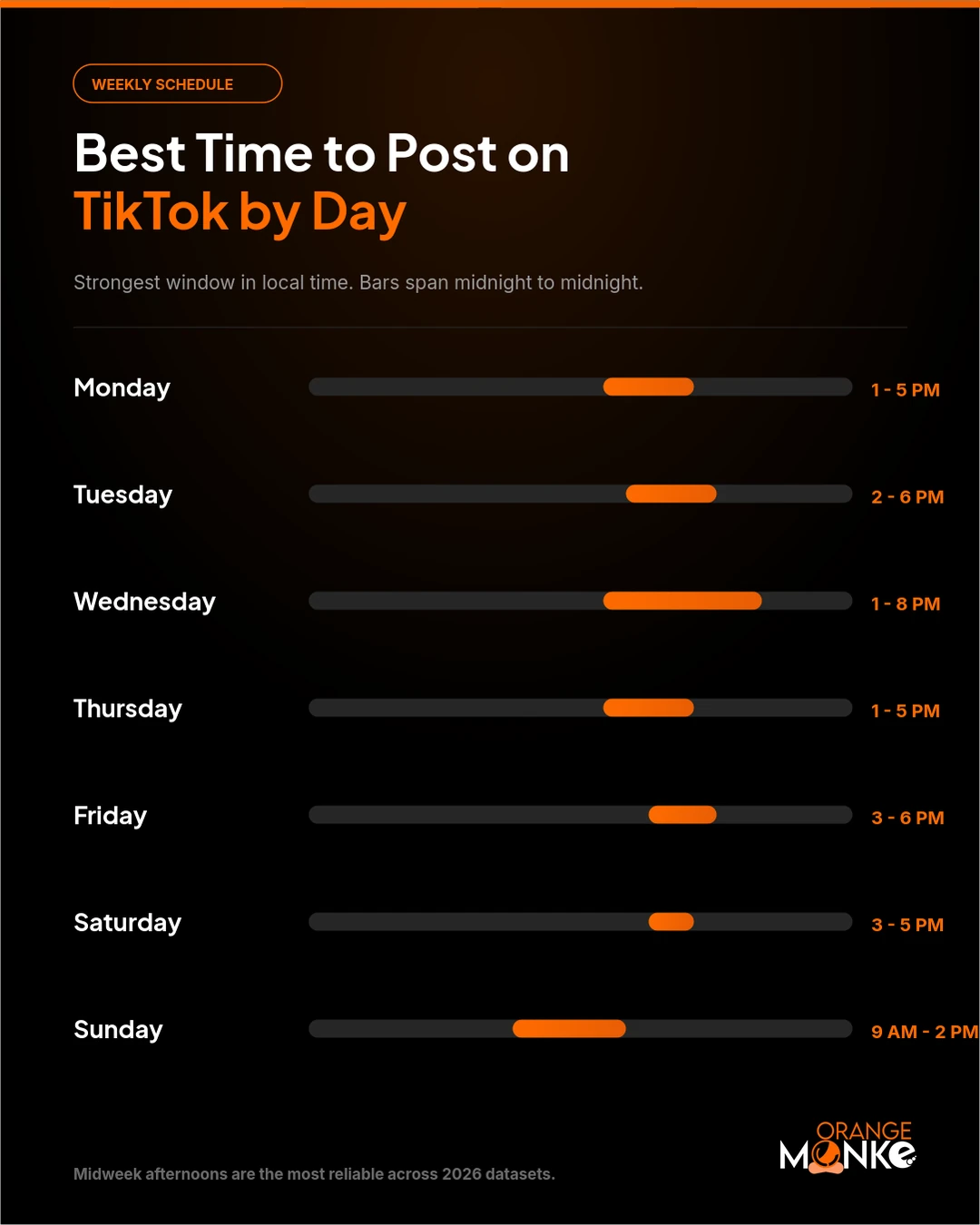
The best time to post on TikTok changes by day: weekday afternoons from 1 p.m. to 6 p.m. are the most dependable, while weekends reward mornings and early evenings. The table combines where the major 2026 studies overlap with slots worth testing.
| Day | Strongest window (local time) | Also worth testing | Evidence |
|---|---|---|---|
| Monday | 1 p.m. to 5 p.m. | 10 a.m. to 11 a.m. | Strong |
| Tuesday | 2 p.m. to 6 p.m. | 6 a.m. to 7 a.m., 10 p.m. | Strong |
| Wednesday | 1 p.m. to 8 p.m. | 9 p.m. to 10 p.m. | Strong |
| Thursday | 1 p.m. to 5 p.m. | 10 a.m., 10 p.m. | Strong |
| Friday | 3 p.m. to 6 p.m. | 8 p.m. to 10 p.m. | Moderate |
| Saturday | 3 p.m. to 5 p.m. | 11 a.m. | Mixed |
| Sunday | 9 a.m. to 2 p.m. | 5 p.m. to 6 p.m. | Mixed |
"Mixed" means one large dataset rates the day highly and another rates it poorly, so test it before relying on it.
What Is the Best Time to Post on TikTok on Monday?
The best time to post on TikTok on Monday is between 1 p.m. and 5 p.m., when people take a break after the busy start to the working week. A late-morning slot around 10 a.m. is a useful second test.
What Is the Best Time to Post on TikTok on Tuesday?
The best time to post on TikTok on Tuesday is between 2 p.m. and 6 p.m., one of the most consistent peak windows of the week. Tuesday also has an early-morning pocket around 6 a.m., which suits commuters and educational content.
What Is the Best Time to Post on TikTok on Wednesday?
The best time to post on TikTok on Wednesday is between 1 p.m. and 8 p.m., the widest peak window of any day. Midweek fatigue keeps people scrolling from lunch well into the evening, so Wednesday is forgiving if your schedule is tight.
What Is the Best Time to Post on TikTok on Thursday?
The best time to post on TikTok on Thursday is between 1 p.m. and 5 p.m., where most studies overlap, making early Thursday afternoon one of the safest slots to test. A 10 p.m. post can also work for night-time scrollers.
What Is the Best Time to Post on TikTok on Friday?
The best time to post on TikTok on Friday is between 3 p.m. and 6 p.m., just before people log off for the weekend. Evening slots from 8 p.m. to 10 p.m. suit entertainment and lifestyle accounts.
What Is the Best Time to Post on TikTok on Saturday?
The best time to post on TikTok on Saturday is between 3 p.m. and 5 p.m., though the evidence is split, with some datasets ranking Saturday first and others last. It tends to work for entertainment, food and lifestyle content and poorly for B2B.
What Is the Best Time to Post on TikTok on Sunday?
The best time to post on TikTok on Sunday is between 9 a.m. and 2 p.m., when people scroll over a slow morning and lunch. Sunday is the most disputed day in the data, so compare it against a weekday slot before committing.
What Is the Best Day to Post on TikTok?
The best day to post on TikTok for most accounts is Tuesday, Wednesday or Thursday, because midweek afternoons perform well across almost every dataset. Weekends split opinion. Use your audience to break the tie:
- Professional or B2B audience: stick to Tuesday to Thursday afternoons.
- Entertainment, food, fashion or lifestyle audience: test Saturday afternoon and Sunday morning against a midweek slot.
- Students: test weekday late afternoons, after school or college hours.
The worst day to post on TikTok is the one your own analytics show the fewest followers online, which for many brand accounts turns out to be Sunday.
What Is the Best Time to Post on TikTok Today?
The best time to post on TikTok today is the strongest window for today's day in the table above, published 30 minutes to 2 hours before your followers' peak. Check TikTok Studio first, because this week's audience may differ from last week's. A 2-minute routine for any day:
- Open TikTok Studio and check "Most active times" for today.
- Pick the slot in the table closest to that peak.
- Schedule the video to go live shortly before it.
- Stay available for the first hour to reply to comments.
What Is the Peak Hour on TikTok?
The peak hours on TikTok are 6 p.m. to 11 p.m. on most days, when people have finished work or school and have time for sound-on video. Midweek, a second peak runs from 2 p.m. to 6 p.m.
Short-form video needs full attention and usually sound, unlike a text post you can skim in a meeting. That is why engagement climbs after lunch, rises through the commute and peaks while people unwind at home.
What Is the Golden Hour to Post on TikTok?
The golden hour on TikTok is the first 60 minutes after you post, when early watch time, shares and comments decide how widely the video is recommended. Posting just before your followers' peak puts the most people in that window.
Is It Better to Post on TikTok at Night or in the Morning?
Posting on TikTok at night is usually better for entertainment and lifestyle content, because evening hours carry the highest engagement on most days. Mornings between 6 a.m. and 10 a.m. can work for educational, news and professional content, when people are in a learning frame of mind.
When Is the Best Time to Post on TikTok by Industry?
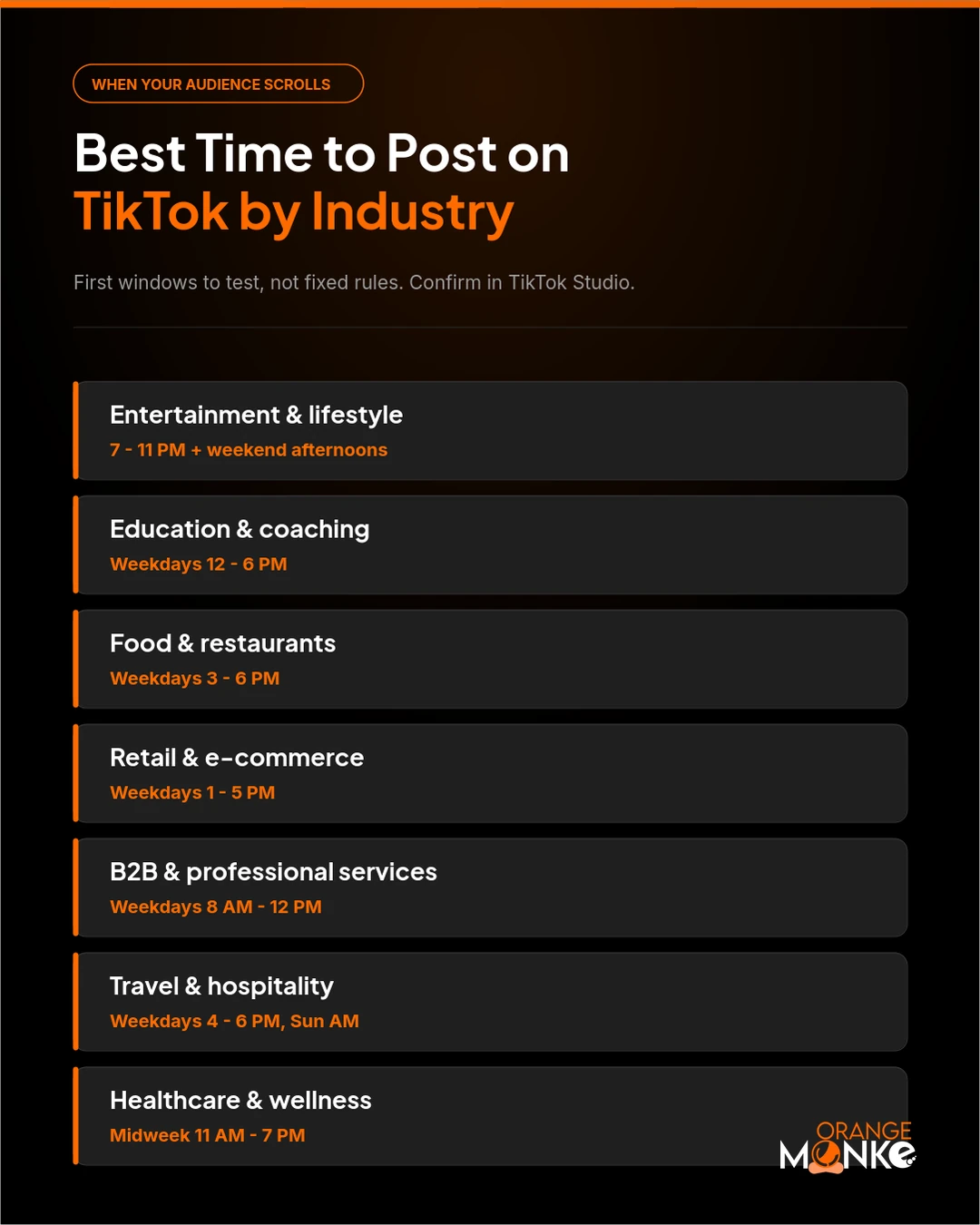
The best time to post on TikTok by industry depends on when your customers scroll, because each audience fits TikTok around its own daily routine. Use these windows as your first tests, not fixed rules.
| Content or industry | Start testing | Why this window |
|---|---|---|
| Entertainment, comedy, lifestyle | 7 p.m. to 11 p.m., plus weekend afternoons | Viewers are relaxing and scrolling for fun |
| Education and coaching | Weekdays 12 p.m. to 6 p.m. | Students and learners scroll between classes and after study |
| Food and restaurants | Weekdays 3 p.m. to 6 p.m. | People plan evening meals in the late afternoon |
| Retail and e-commerce | Weekdays 1 p.m. to 5 p.m. | Browsing peaks in the mid-afternoon slump |
| B2B, SaaS and professional services | Weekdays 8 a.m. to 12 p.m. | Buyers research while they are working |
| Travel and hospitality | Weekdays 4 p.m. to 6 p.m., Sunday late morning | Trip planning happens after work and on slow weekends |
| Healthcare and wellness | Midweek 11 a.m. to 7 p.m. | Self-care browsing rises in the middle of the week |
If you run paid campaigns alongside organic, the same audience rhythms shape ad delivery, something our Facebook Ads benchmarks break down by industry in detail.
When Is the Best Time to Post on TikTok in India (IST)?
The best time to post on TikTok for an Indian audience is the same clock time in IST, because posting-time studies report times in the viewer's local time. So a 7 p.m. evening slot means 7 p.m. IST for followers in India.
Expect a similar daily rhythm from Indian audiences: a lunch-break scroll, a strong late-afternoon rise, and the busiest window after dinner, roughly 7 p.m. to 11 p.m. IST. Check "Most active times" to confirm, since audiences in different cities keep slightly different hours.
How Do You Post From India for a US Audience?
To post from India for a US East Coast audience, add 9 hours 30 minutes to US Eastern time until 1 November 2026, then 10 hours 30 minutes after US daylight saving ends. Many US evening peaks fall in the early hours in India, so schedule posts instead of staying up.
| US Eastern time | IST until 31 Oct 2026 | IST from 1 Nov 2026 |
|---|---|---|
| 9 a.m. | 6:30 p.m., same day | 7:30 p.m., same day |
| 1 p.m. | 10:30 p.m., same day | 11:30 p.m., same day |
| 2 p.m. | 11:30 p.m., same day | 12:30 a.m., next day |
| 6 p.m. | 3:30 a.m., next day | 4:30 a.m., next day |
| 8 p.m. | 5:30 a.m., next day | 6:30 a.m., next day |
For a US West Coast audience, add another 3 hours to each IST time above.
What About UK, UAE, Europe and Australia Audiences?
To reach an audience outside India, take the peak time in their local clock and convert it into IST, then recheck whenever daylight saving changes.
- UAE: IST is 1 hour 30 minutes ahead all year, so a 7 p.m. Dubai slot is 8:30 p.m. IST.
- UK: IST is 4 hours 30 minutes ahead until the UK clocks change on 25 October 2026, then 5 hours 30 minutes ahead.
- Central Europe: IST is 3 hours 30 minutes ahead until 25 October 2026, then 4 hours 30 minutes ahead.
- Australia (Sydney): Sydney is 5 hours 30 minutes ahead of IST during its daylight saving, from early October to early April, so a 7 p.m. Sydney slot is 1:30 p.m. IST.
How Do You Find Your Own Best Time to Post on TikTok?
You find your own best time to post on TikTok by reading "Most active times" in TikTok Studio, posting just before those peaks, and comparing results over four weeks. Industry studies are averages; your followers are the only audience that counts.
Where Do You See When Your TikTok Followers Are Most Active?
You see when your followers are most active in TikTok Studio, under Analytics, in the Followers tab's "Most active times" chart. It shows activity by hour and by day for the past week.
- In the app: open your profile, tap TikTok Studio, tap Analytics, then View all, and open the Followers tab.
- On desktop: business accounts can open Business Suite on tiktok.com, then Analytics, then Followers.
- Then: scroll to "Most active times" and note the busiest hour for each day.
How Do You Test TikTok Posting Times?
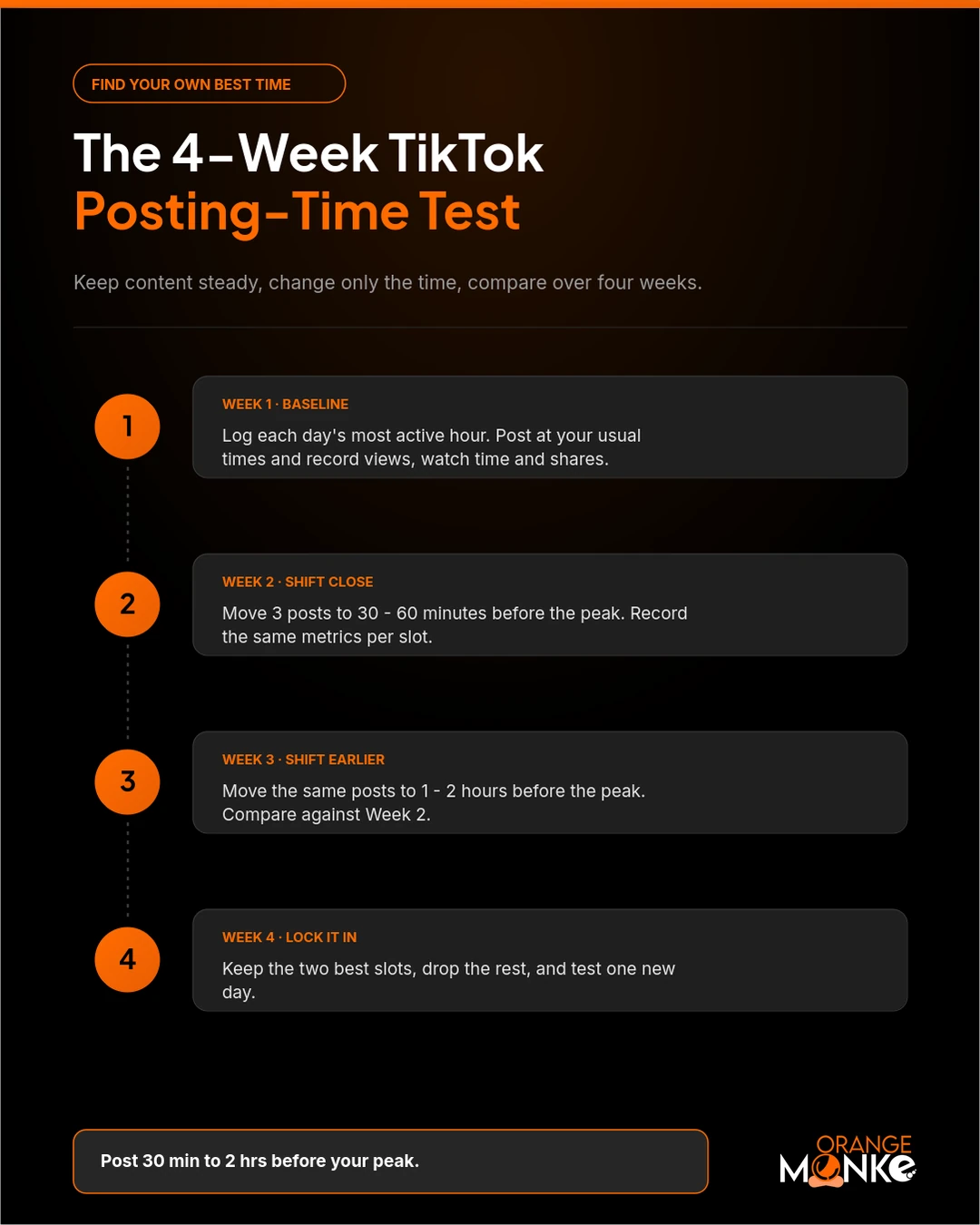
You test TikTok posting times by keeping content quality steady and changing only the time, then comparing each slot over at least two weeks. One post per slot is not enough data.
| Week | What to do | What to record |
|---|---|---|
| Week 1 | Log your followers' most active hour for each day. Post at your usual times. | Your baseline views, watch time and shares |
| Week 2 | Move 3 posts to 30 to 60 minutes before the peak. | The same metrics, per slot |
| Week 3 | Move the same posts to 1 to 2 hours before the peak. | The same metrics, per slot |
| Week 4 | Keep the two best slots and test one new day. | Which slots beat your baseline |
Track these numbers for every post:
- Views in the first hour and after 24 hours
- Average watch time and completion rate
- Shares and saves, the strongest signs of value
- Comments and your reply rate
- New followers from the video
Keep the slots that beat your baseline, drop the rest, and add one new slot to test each month. Audiences shift with seasons, exams, festivals and holidays.
Views, Virality and How Often to Post
Does Posting Time Matter if Your TikTok Videos Get No Views?
Posting time rarely explains a TikTok video with almost no views; weak hooks, low watch time or content that does not match your audience are far more common causes. Fix the video first, then fine-tune the clock.
Marketers in online communities increasingly say that a universal "best time" no longer exists, and that what happens after you post matters more than the hour. We agree with half of that: timing is a multiplier, not a foundation. Before you change your schedule, check:
- The hook: does the first second give viewers a reason to stay?
- Watch time: do most viewers leave within three seconds?
- Relevance: does the video match what your followers followed you for?
- Sound and captions: can the video be understood with and without sound?
Posting at the right time but still stuck on low views? Orange MonkE's social media marketing team audits your content and your schedule together, so you fix the real bottleneck instead of guessing at the clock.
What Time Do TikTok Videos Go Viral?
No posting time guarantees a viral TikTok video, but posting when your audience is active gives it the early watch time and shares that trigger wider distribution. Virality comes from the content; timing only gives it a head start.
Videos that break out usually share three traits: a hook in the opening second, a reason to watch to the end, and a reason to share. Post them in your strongest evening or midweek slot, then stay online to reply to early comments. The same distribution logic applies well beyond TikTok, as our guide to driving traffic to your website shows across channels.
What Is the 3-Second Rule on TikTok?
The 3-second rule on TikTok is a creator guideline that you must hook viewers within the first three seconds or they scroll away. Open with the result, a bold claim, a question or movement, never a logo or a slow introduction.
How Many Views in the First Hour Is Good on TikTok?
A good first-hour view count on TikTok is one that beats your own account's usual first-hour average, because no fixed benchmark fits every account size. 300 views in an hour is a strong start for a new account and a slow one for an account with 500,000 followers. To lift your first-hour views:
- Post 30 minutes to 2 hours before your followers' peak so the video is ready when they arrive.
- Put the payoff in the first second, on screen and in the caption.
- Use a trending sound only when it fits the video.
- Reply to every comment in the first hour to keep the conversation growing.
- Post on a consistent schedule so followers learn when to expect you.
How Often Should You Post on TikTok?
You should post on TikTok as often as you can maintain quality, because a steady schedule beats occasional bursts of daily posting. More posts also mean more data for finding your best times. A realistic starting point for most businesses is three videos a week on fixed days and times. Hold it for a month, then add a fourth only if the quality holds.
What Is the Best Time to Go Live on TikTok?
The best time to go live on TikTok is during your followers' single most active hour, because LIVE viewers must be online to watch in real time. Unlike a regular video, a LIVE gets almost no second chance to find viewers later. Announce each LIVE with a short video 1 to 2 hours before, and keep the same weekly slot so regular viewers can plan around it.
Conclusion: Let Your Own Audience Set the Clock
The best time to post on TikTok is the slot your own followers are online for, proven over several weeks of testing, not a single hour from a chart. Start with midweek afternoons and evenings, post shortly before your audience peaks, and let TikTok Studio decide every change.
At Orange MonkE, we treat timing as the multiplier it is: we pair the right schedule with hooks, formats and sounds that actually earn the first hour. If you would rather have specialists plan your TikTok content and schedule, our social media marketing services team can build, test and run it for you.
Stop guessing the clock, start growing on TikTok.
We plan, schedule and test your TikTok content around your real audience peaks, so every video gets its best shot at the first hour.
Explore social media marketing →Frequently Asked Questions
The best time to post on TikTok is late afternoon to evening, roughly 2 p.m. to 11 p.m. local time, with Tuesday to Thursday afternoons the most reliable across almost every 2026 dataset.
- Most reliable: midweek afternoons, 1 p.m. to 6 p.m.
- Strongest evenings: 6 p.m. to 11 p.m. on most days.
- Confirm it: check "Most active times" in TikTok Studio before fixing a schedule.
Treat the ranges as a starting point, then let your own analytics narrow them down.
The peak hours for TikTok run from 6 p.m. to 11 p.m. on most days, when people have finished work or school and have time for sound-on video.
- Second peak: midweek, between 2 p.m. and 6 p.m.
- Why evenings win: short-form video needs attention and sound, which people have after hours.
Post 30 minutes to 2 hours before the peak so the video is waiting when the audience arrives.
The golden hour on TikTok is the first 60 minutes after posting, when early watch time, shares and comments decide how far a video spreads.
- Why it matters: TikTok tests the video on a small group first, and strong signals push it wider.
- How to win it: post just before your followers' peak and reply to comments quickly.
Being present and responsive in that first hour is as important as the hour you chose.
Posting on TikTok at night usually performs better for entertainment and lifestyle content, because evenings carry the most engagement on most days.
- Nights: best for entertainment, comedy and lifestyle.
- Mornings (6 a.m. to 10 a.m.): suit educational, news and professional content.
Test both against your own audience before committing to one.
The best day to post on TikTok for most accounts is Tuesday, Wednesday or Thursday, as midweek afternoons perform well in almost every dataset.
- B2B and professional: stick to Tuesday to Thursday.
- Entertainment and lifestyle: test Saturday afternoon and Sunday morning too.
Weekends can work for some niches but should be tested before you rely on them.
The 3-second rule on TikTok is a creator guideline to hook viewers within the first three seconds before they scroll away.
- Open with: the result, a bold claim, a question or movement.
- Avoid: a logo, intro card or slow build at the start.
Winning the first three seconds is what makes the golden hour pay off.
1,000 views in 1 hour on TikTok is good if it beats your account's usual first-hour average, because no fixed benchmark fits every account size.
- Small accounts: 1,000 first-hour views is a strong start.
- Large accounts: judge it against your own recent videos, not a universal number.
Compare every post to your own baseline rather than to someone else's.
Your TikTok posting time should follow your audience's time zone, not your own, because engagement depends on when viewers are awake and scrolling.
- Post at: your audience's local peak hours.
- Use scheduling: when that peak falls at night or early morning where you live.
For a cross-border audience, convert their peak into your local clock and schedule around it.
The best time to post on TikTok in India follows the same local windows in IST, especially 7 p.m. to 11 p.m., because studies report times in the viewer's local time.
- Daily rhythm: a lunch scroll, a late-afternoon rise, and a post-dinner peak.
- Posting for US viewers: add 9 hours 30 minutes to US Eastern time until 1 November 2026.
Confirm your exact peak in TikTok Studio, since cities keep slightly different hours.