Instagram has quietly changed a lot recently, but most creators are still using the old playbook. Here is what is actually different right now, confirmed by Instagram's own leadership, and exactly what to do about it.
Most Instagram algorithm guides are recycled content with a fresh headline. They tell you to "post consistently," "use hashtags wisely," and "engage with your community", advice so vague it applies to every platform, every year, and helps no one.
This isn't that. Everything in this post maps to confirmed changes from Instagram's own announcements, Adam Mosseri's public updates, and what is measurably working for creators and brands right now in 2026.
The Instagram algorithm in 2026 rewards intent, not vanity. Watch time, DM shares and saves decide how far your content travels, while likes are now the weakest signal. There is no single algorithm: Feed, Reels, Stories and Explore each rank content their own way. Grow by picking a clear niche, winning the first three seconds, and making content people save or send to a friend.
The Biggest Instagram Algorithm Changes in 2026
The biggest Instagram algorithm changes in 2026 are user-curated recommendations through "Your Algorithm", an audition system that tests new posts on non-followers first, stronger relationship-based ranking, and Views replacing likes as the headline metric. These aren't subtle tweaks: each one changes how content gets discovered, so strategies that worked before may now be working against you.
"Your Algorithm" lets users curate their own recommendations
It was launched in December 2025 but went fully live globally as of early 2026. This is the most significant structural shift Instagram has made to Reels recommendations in years. "Your Algorithm" gives every Instagram user a personal dashboard, visible in Settings then Content Preferences, showing the topics Instagram believes they care about. Users can add topics they want more of and actively remove categories they don't.
"We use AI to summarise your interests based on your activity. And if we get it wrong, you can remove those interests from your algorithm."
Tessa Lyons, Instagram VP of Product, December 2025The implication for creators is profound. The algorithm used to work entirely on inferred behavior, what you watched, scrolled past, and liked. Now users are actively telling Instagram what they want to see. If your content doesn't fit a clear, recognizable topic, it becomes invisible the moment someone removes a loosely related category from their preferences. Niche clarity is now a survival requirement, not a growth strategy.
Tighten your topic focus immediately. If your account posts on unrelated topics, users can now surgically remove your content category from their feeds. Pick one or two tightly related themes and build around them consistently. Mixed-niche accounts face the steepest reach drop under this update. If you are rebuilding your niche focus, understanding how to build a social media brand from scratch gives you a clear framework to establish your identity before the algorithm categorizes you incorrectly.
The "audition system" decides how new content gets its first audience
Adam Mosseri confirmed that Instagram now uses what he describes as an "audition system" for public content. When you post, Instagram first shows it to a small test group of non-followers. If that group engages well, it gets pushed to progressively larger audiences. If early viewers scroll away immediately, the content gets throttled before it can even reach your own followers.
This is why your hook, the first two to three seconds are now determines whether your content gets seen at all, not just how far it travels.
Relationship-based ranking got stronger in March 2026
Instagram strengthened the weight it gives to accounts users interact with regularly through DMs, comments, and Story replies. Accounts you have genuine, two-way conversations with are now ranked higher in your Feed and pushed to the front of your Stories tray. For creators, this means building real conversations with your audience isn't just community management, it is a direct algorithmic advantage.
AI-powered content recognition is now much deeper
Instagram's ability to understand what your content is actually about improved substantially. The updated AI analyzes visuals, on-screen text, voiceover audio, and video clips, not just hashtags and captions, to categorize content and match it to the right users. Keyword-stuffed captions won't carry your content if the actual content doesn't match the declared topic. This shift mirrors what is happening across all major platforms, and understanding why AI search optimization matters more helps creators and brands adapt their content strategy beyond just Instagram.
Cross-platform signals mean the Meta ecosystem now counts
Instagram now factors in engagement signals from across Meta's platforms, not just behavior within Instagram. An active, engaged presence across the Meta ecosystem can contribute positively to how your Instagram content is ranked and recommended.
Views replace likes as the primary metric
Instagram officially moved to Views as the headline metric across all content formats. A View is counted every time a post appears on screen, including repeat views. This reframes the entire optimization target: the goal is no longer to accumulate reactions, it is to create content people return to.
Longer Reels exist, but the reach ceiling is still 3 minutes
Instagram raised the technical Reel ceiling to 20 minutes, but its recommendation system still stops pushing Reels longer than 3 minutes to non-followers, so 3 minutes is the practical limit for reach. Longer storytelling content, tutorials, and behind-the-scenes series mainly land with the followers you already have, provided they hold attention throughout. Treat the extended length as a tool for warm audiences, not a shortcut to new reach.
In-Reel linking arrived through Instagram Edits
Instagram's standalone editing app, Edits, added the ability to place clickable links inside a Reel, pointing to another profile or another Reel. For brands, this turns a single Reel into the start of a content journey: a multi-part series can send viewers straight to the next episode, and a collaboration can link directly to a partner's account. It is a distribution tool most creators still aren't using.
User feedback surveys now shape recommendations
Alongside "Your Algorithm," Instagram asks users direct questions such as whether they enjoyed a Reel or found it relevant, and feeds those answers straight into the recommendation engine. The practical takeaway is simple: deliver exactly what your hook promises. If your opening line sets up five tips, give five tips. Viewers who feel misled mark the content as irrelevant, which suppresses your future reach.
Teen Accounts changed who can see some content
Instagram's Teen Accounts place younger users into more protective default settings, which limits the kinds of content recommended to them. If your audience skews young, review your content against those safety settings, because material that sits outside them simply won't be surfaced to that segment.
How the Instagram Algorithm Works in 2026
There is no single Instagram algorithm. There are several AI ranking systems, each tuned for a different part of the app, so how does the Instagram algorithm work in 2026? Content is scored separately for Feed, Reels, Stories, Explore and Search, and the same post can perform completely differently across them. Understanding how each one works lets you build content that is actually designed for the surface you are targeting.
Instagram Feed algorithm
Your Home feed blends posts from people you follow with recommended content from accounts you don't. The Instagram feed algorithm orders posts by predicting how likely you are to spend ten or more seconds on a post, comment on it, or reshare it via DM.
It tracks negative signals too, rapid scrolls, "Not Interested" taps, and immediate bounces. Content that gets repeatedly skipped is downranked quickly. The system also limits back-to-back posts from the same creator, so even the best accounts don't dominate your entire feed at once. You can see Meta's own breakdown of these Feed signals in the Meta Transparency Center.
Instagram Reels algorithm
Reels is Instagram's primary discovery engine right now. The Instagram Reels algorithm predicts your likelihood to watch a Reel to completion, rewatch it, share it via DM, and follow the creator after watching.
The first two to three seconds determine whether your Reel gets pushed to a broader audience or quietly throttled. Under the audition system, early performance with non-followers is what unlocks wider reach, not your follower count.
Instagram Stories algorithm
Stories only surface content from accounts you follow, so the Instagram Stories algorithm focuses entirely on closeness. Whose Stories you consistently watch, reply to, or react to get pushed to the front of your tray.
DM frequency is also a signal; if you message regularly, you are treated as their "inner circle" and prioritized. Posting Stories consistently keeps you visible to your warmest audience, regardless of how Feed posts perform. If you are new to Instagram Stories, finding answers to common questions like whether Instagram notifies screenshots of stories helps you engage more confidently with the format.
Instagram Explore algorithm
Explore is where you reach people who have never heard of you. The Instagram Explore algorithm has the highest number of ranking signals of any surface. The three that carry the most weight: whether viewers watch your video to at least 95% completion, whether they linger on an image for five or more seconds, and whether they follow you after viewing. Meta documents the full set of Explore signals in its Transparency Center.
First-impression quality is everything here. Explore rewards content that earns an immediate, undivided reaction from cold audiences.
Instagram Search algorithm
Instagram Search is increasingly working like a content-first search engine. It analyzes voiceover audio, text within visuals, captions, and keywords, not just account names and hashtags.
Treat captions and voiceovers the way you would approach on-page SEO copy: clear, natural language that reflects what your target viewer would actually type into search.
Instagram Ranking Signals 2026
The Instagram ranking signals that matter most in 2026 are watch time, DM shares, saves and meaningful comments, with likes now the weakest of the group. Adam Mosseri, the head of Instagram, has confirmed the top signals directly. Here is how they stack up and what has shifted compared to what used to drive reach.
Watch time
How long people watch and whether they rewatch. Completion rate is the single most powerful signal for Reels reach. Getting past the 3-second mark is the first critical threshold.
DM shares, or sends per reach
Private sharing signals genuine value. An estimated 694,000 Reels are shared via DM every minute, so track "Sends" in your Insights, not just likes.
Saves
A save tells Instagram this content is worth returning to. Educational, reference, and practical posts earn saves. They carry far more weight than likes.
Meaningful comments
Comment depth matters more than count. Thread conversations and detailed reactions signal real engagement. Short filler comments carry minimal algorithmic weight.
Originality
The algorithm actively favors fresh, platform-native content over reposted or watermarked material. Recycled content may be replaced by the original source in recommendations.
Likes
Still counted, but now the weakest major engagement signal. Building your strategy entirely around likes no longer moves the needle on reach.
The catch is that these Instagram algorithm ranking factors carry different weight on each surface. A signal that drives Reels reach may barely register in Stories. The matrix below shows where each one matters most.
| Ranking signal | Feed | Reels | Stories | Explore |
|---|---|---|---|---|
| Watch time | Medium | Highest | Low | High |
| DM shares (sends) | High | Highest | Medium | Highest |
| Saves | Medium | High | Low | Highest |
| Comment depth | High | Medium | Low | Medium |
| Completion rate | n/a | Highest | n/a | High |
| Recency | High | Medium | Highest | Low |
| Relationship signals | Highest | Low | Highest | n/a |
| Likes | Low | Low | Low | Low |
Read down the Reels column and you have your discovery checklist: win watch time and completion, earn sends, and treat likes as a bonus, not a target. Signal weighting is drawn from Adam Mosseri's public statements and Meta's ranking documentation.
The most important signals now are watch time, shares, and saves, which show that people actually care about your content. Instagram is no longer just counting likes, it is measuring real intent. If your content doesn't make someone think "I should send this to someone" or "I want to save this for later," it will be much harder to grow organically.
Instagram Reels algorithm ranking signals
The Instagram Reels algorithm rewards one thing above all: watch time. It predicts how likely you are to watch a Reel to the end, rewatch it, send it to a friend, and follow the creator, then pushes the Reels that clear those bars out to non-followers. Three thresholds decide whether a Reel travels or stalls.
- The first 3 secondsIf early viewers drop off before the three-second mark, the audition system throttles the Reel before it reaches your own followers. Aim to hold at least half of viewers past that point.
- The first 30 to 60 minutesEarly engagement velocity in this window tells Instagram whether to widen distribution to non-followers. A strong start compounds; a flat start caps the Reel.
- Completion rateA Reel that most people finish, or rewatch, is the clearest quality signal for Explore and the Reels tab. This is why a short Reel with high completion beats a long one people abandon.
How long should Instagram Reels be in 2026?
Instagram Reels can technically run up to 20 minutes, but reach and completion favour short. Because the recommendation system stops pushing Reels past 3 minutes to non-followers, match length to the job the Reel needs to do rather than chasing a maximum.
| Goal | Length | Why it works |
|---|---|---|
| Reach and discovery | 7 to 30 seconds | Highest completion rate, the strongest discovery signal |
| Tutorials and storytelling | 30 to 90 seconds | Enough depth while retention stays high |
| In-depth education | 1 to 3 minutes | The upper edge that still reaches non-followers |
| Warm-audience content | Over 3 minutes | Mostly served to existing followers, not recommended out |
Start short, watch your completion rate in Insights, and only extend length when the data says your audience is staying to the end.
Test with Trial Reels before you go broad
Trial Reels show a Reel only to non-followers first, so you can read its performance with a cold audience before risking it with your own. Use it to compare hooks, formats and topics with no downside to your existing engagement rate, then publish the winner widely.
Why Your Instagram Reach Is Dropping
Your Instagram reach is usually dropping because of reduced distribution, not a broken account. Instagram quietly limits how far certain content and accounts travel, and it rarely says so directly. The good news is that most causes are self-inflicted and reversible, and the graphic below maps the most common ones to their fix.
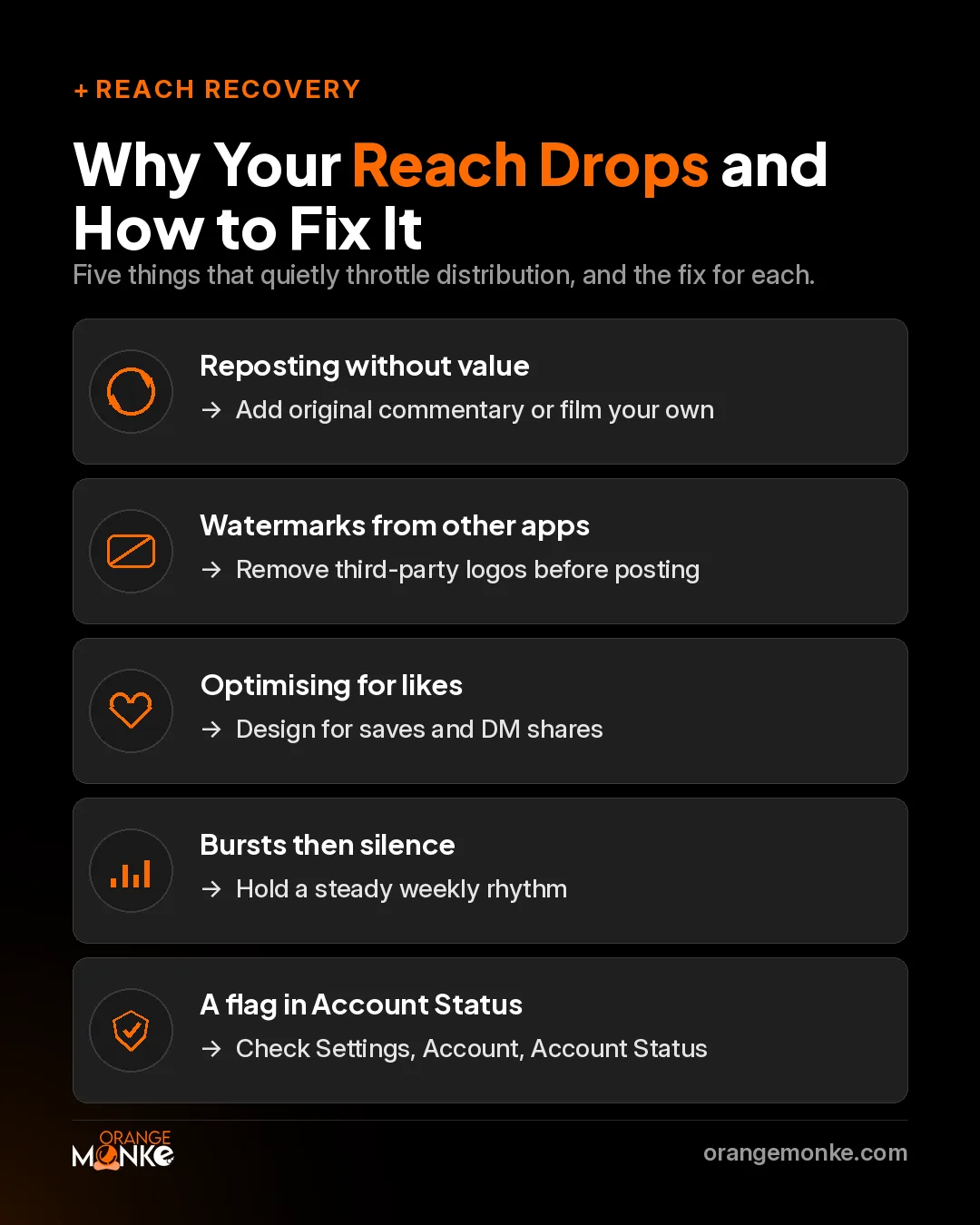
Reduced distribution, not "shadowban"
Instagram does not use the term shadowban, but it does apply reduced distribution and recommendation limits to accounts that break Community Guidelines, use flagged hashtags, or rely on unofficial third-party tools. The effect is the same: your content stops reaching non-followers across every surface, not just one post.
Recovery usually means stopping the flagged behaviour, posting original content consistently, and waiting roughly one to two weeks for limits to lift. The behaviours below are the ones that trigger reduced distribution most often, so work through them before you blame the algorithm.
These aren't theoretical risks, they are behaviors the algorithm is measurably penalizing in the current version of Instagram.
Mistake 1: Reposting without adding original value
Instagram actively penalizes content reshared without a meaningful original contribution. When you repost someone else's Reel or meme without transformation, the algorithm may serve the original creator's version in recommendations instead of yours. Always add commentary, context, a reaction, or a new framing that makes your version genuinely different.
Mistake 2: Cross-posting with watermarks from other platforms
Instagram's AI detects watermarks from other platforms and demotes watermarked content in recommendations. If you repurpose content from elsewhere, remove any third-party branding before uploading to Instagram. This applies to any logo or platform indicator visible in the frame.
Mistake 3: Optimizing for likes over saves and DM shares
Likes are the weakest signal in the current ranking hierarchy. Content designed primarily to look appealing, without giving people a reason to save it or share it privately, is being left behind by accounts creating genuinely useful material. Check your Insights: track sends per reach and saves per reach, not like totals.
Mistake 4: Inconsistent posting with long gaps
A burst of posts one week, followed by silence, works against you. The algorithm favors accounts that show up reliably. Three to five quality Feed posts per week with daily Stories is a sustainable rhythm that keeps all algorithmic signals active without sacrificing content quality.
Mistake 5: Not checking your Account Status
A flag or content restriction in your Account Status suppresses reach across every surface, not just the individual post. Check Settings, then Account, then Account Status regularly. Any recommendation restrictions there will undermine every other strategy in this guide until they are resolved.
Mistake 6: Posting AI-generated content without a human layer
As Mosseri noted in his end-of-year message, perfectly polished AI content is becoming cheap and abundant. Instagram is actively exploring AI content labeling, and user trust is shifting toward authenticity signals. AI-assisted content with a visible human perspective and voice performs well. Pure AI generation with no personal layer is increasingly easy for audiences and the algorithm to pass over. Professional content writing services ensure your content retains a genuine human voice and perspective, exactly what both Instagram's algorithm and your audience are rewarding in 2026.
Your content is good. Your distribution isn't.
We build Instagram content strategies aligned with the 2026 algorithm, so watch time, saves and shares actually turn into reach.
Get a free social media audit →12 Instagram Growth Tips for 2026
Each tip below is directly tied to a confirmed ranking signal or platform update. Not general best practices, specific responses to how the algorithm actually works right now.
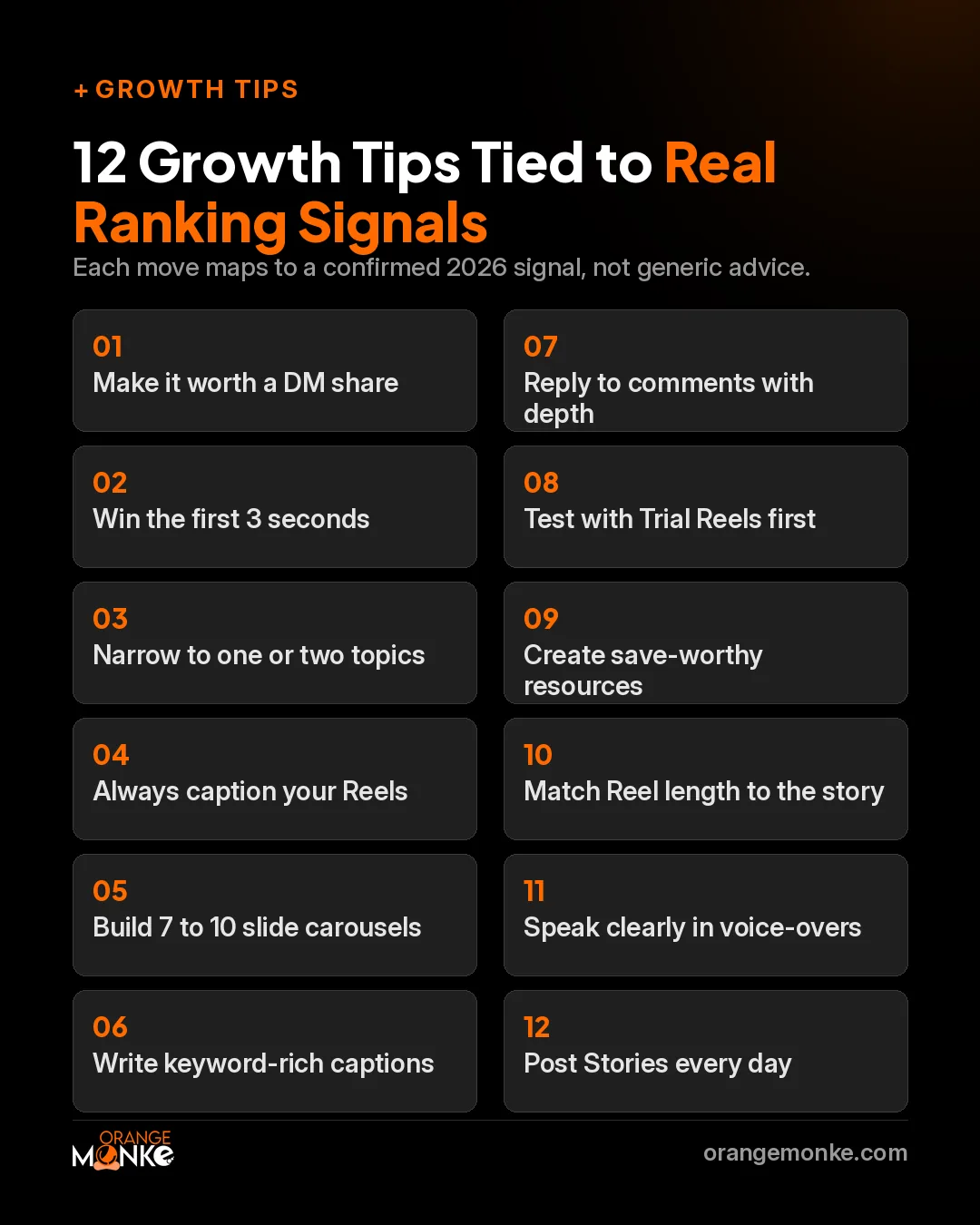
Design every post to be worth sharing via DM
DM shares are among Instagram's highest-weighted signals. Before posting, ask: "Would someone send this to a specific friend who needs to see it?" Relatable situations, genuinely useful tips, and surprising information that feels personal are what earn private shares. Looking at recent innovative marketing campaigns can spark ideas for content that naturally earns DM shares by connecting with audiences on a deeper emotional level. A direct CTA, "Send this to someone who needs this," works better than you would expect.
Win the first 3 seconds or lose the algorithm
Under the audition system, early viewer drop-off throttles your content before it reaches your own followers. Lead with the most compelling or surprising element immediately. Context, backstory, and setups come after you have earned the watch, not before. Getting at least 50% of viewers past the 3-second mark is the first benchmark to aim for.
Narrow to one or two closely related topics
With "Your Algorithm" letting users actively remove topic categories from their feed, multi-niche accounts are at significant risk. The algorithm needs to clearly categorize you to recommend you. Define your lane tightly, not just for algorithmic reach, but because it makes every other signal easier to earn when your audience knows exactly what to expect from you.
Always add captions to Reels
Most people watch with sound off. Captions also help Instagram's AI categorize your content correctly for recommendation matching. Adam Mosseri has publicly listed captions as a Reels ranking factor. It is one of the easiest improvements available, no extra content creation required.
Build carousels with 7 to 10 slides, not 3
When someone doesn't swipe through your entire carousel, Instagram reshows the post later with the unseen slides. More slides create more re-engagement opportunities from a single post. Carousel posts are currently achieving some of the highest engagement rates on the platform, use the format fully.
Write keyword-rich captions
Instagram Search now reads caption language the way a search engine reads page copy. Write naturally but include the actual words your target viewer would search. Hashtags now function as topic signals for the AI, not discovery channels, three to five specific, relevant ones is enough. More doesn't help.
Reply to comments with depth, not emojis
Instagram measures conversation depth, not just comment count. When someone leaves a thoughtful comment, reply with a follow-up question or a genuine observation. A thread of five real exchanges signals more meaningful engagement than fifty single-word replies or emoji responses.
Use Trial Reels to test content before going broad
Trial Reels shows your content exclusively to non-followers first. If it performs well with a cold audience, that is your green light to post it widely. Use it to A/B test hooks, formats, and topics with no risk to your existing follower engagement stats.
Build content that earns saves
Saves come from content people intend to return to, checklists, how-to guides, frameworks, and reference material. If your niche is educational or practical, packaging information as a resource rather than a tip significantly lifts this signal. Track saves per reach in your Insights, not raw save counts.
Match Reels' length to your content's natural depth
A Reel with a high completion rate at 60 seconds outperforms a five-minute video people abandon halfway. But if your content genuinely warrants depth, tutorials, mini-docs, behind-the-scenes, the extended Reels format is a real opportunity on a surface most creators still aren't competing for with long form.
Speak clearly in voice-overs
Instagram's AI listens to your audio and reads voiceover content to categorize Reels for recommendation. Clear speech with relevant, natural keywords helps surface your content in Explore and Search. As AI translation expands into more languages, clear audio also means your content automatically reaches global audiences.
Post Stories daily
Stories keep you visible and front-of-tray for your most engaged followers, independent of Feed or Reels performance. Regular Story viewers are your highest-intent audience segment. Maintaining that relationship daily through Stories keeps your warm audience primed for your next bigger post.
Instagram Algorithm for Creators and Businesses
The Instagram algorithm uses the same signals for everyone, but the smartest focus differs by account type. The Instagram algorithm for creators rewards a different emphasis than the Instagram algorithm for businesses or public figures, so pick the priorities that fit your goal rather than chasing every signal at once.
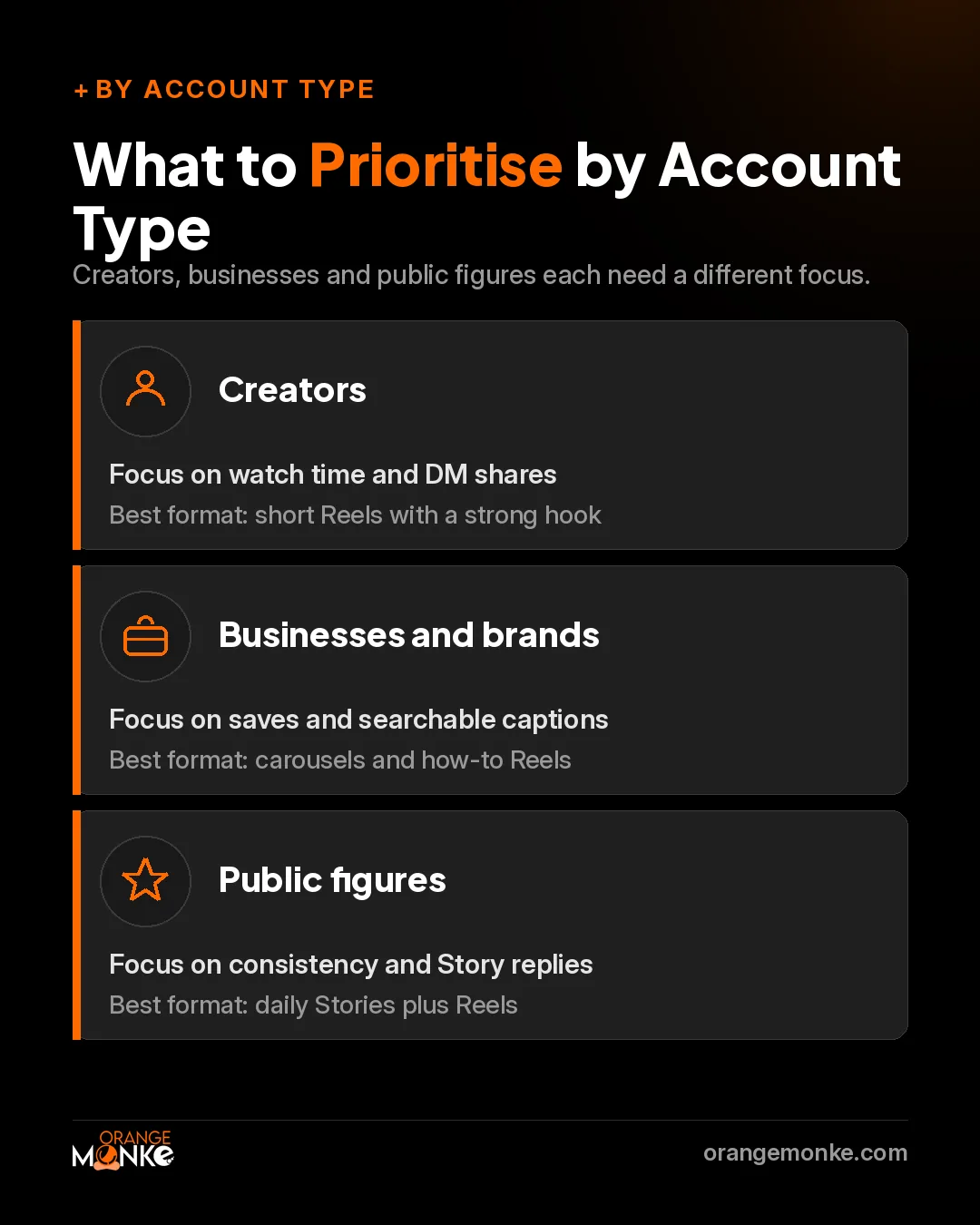
| Account type | Prioritise | Best format |
|---|---|---|
| Creators | Watch time and DM shares | Short Reels with a strong hook |
| Businesses and brands | Saves and searchable captions | Carousels and how-to Reels |
| Public figures | Consistency and Story replies | Daily Stories plus Reels |
Same algorithm, different lever. Creators grow on discovery signals, businesses on saveable utility, public figures on relationship depth.
Creators should treat every Reel as a reach experiment, leading with the hook and designing for the send. Businesses and brands win by packaging expertise into saveable resources, checklists, comparisons and how-to carousels, with captions written the way a buyer would search. Public figures grow fastest on relationship signals, so daily Stories and genuine replies matter more than polished Feed posts.
Instagram SEO and Searchable Captions
Instagram SEO is the practice of writing captions, on-screen text and voiceovers so Instagram Search and its AI can understand and surface your content. Because Search now reads the words inside your content, not just your handle, treating each post like a small piece of on-page SEO is one of the highest-leverage habits in 2026.
- Write captions in natural language. Include the exact phrases your target viewer would type, worked into real sentences rather than a keyword list.
- Put keywords on screen and in the voiceover. The AI reads text in the frame and transcribes your audio, so say and show the topic clearly in the first few seconds.
- Use hashtags as topic labels, not discovery. Three to five specific, relevant hashtags help categorise the post. Stacking thirty does nothing for reach.
- Match the content to the claim. If your caption says one thing and the video shows another, deeper content recognition will ignore the caption and miscategorise the post.
Done consistently, this improves your discoverability, visibility and content ranking inside Instagram, and it feeds the same clarity that AI search rewards everywhere else.
The Best Posting Strategy for 2026
The best posting strategy for Instagram in 2026 is consistency over volume. A steady rhythm keeps every algorithmic signal active, while bursts followed by silence work against you. Three to five quality Feed posts a week, with daily Stories, is a sustainable baseline for most accounts.
- Frequency: three to five Feed posts a week, plus daily Stories, beats a daily grind of low-effort posts.
- Best time to post: there is no universal slot. Open Instagram Insights, find your audience's most active hours, and publish inside that window so your first-hour engagement lands.
- Format mix: lead with Reels for reach, use carousels for saves and depth, and use Stories to hold the relationship with your warmest followers.
Consistency also protects you from the reach drops covered earlier. An account that shows up reliably gives the algorithm a stable signal to trust, which matters more than any single viral post.
The Bottom Line
In 2026, Instagram isn't rewarding likes, it is rewarding intent. If your content isn't worth a save, share, or rewatch, growth becomes difficult.
The accounts winning today are simple: clear niche, share-worthy content, consistency. No hacks, just alignment with what people actually value.
"The content that will cut through is more human, more raw, and more real."
Adam Mosseri, Head of InstagramThis is where most brands struggle, and where Orange MonkE's social media marketing services help by building content strategies that are aligned with the algorithm and designed for real growth. The opportunity right now is huge for creators who adapt early and focus on depth over volume. Those who understand intent today will dominate reach tomorrow.
Want reach built on how the algorithm actually ranks?
Our social media team turns watch time, saves and shares into real growth, with content and strategy tuned to the 2026 Instagram algorithm.
Talk to a social media strategist →Frequently Asked Questions
The Instagram algorithm works as several separate ranking systems in 2026, one each for Feed, Reels, Stories and Explore, that predict how likely you are to watch, save, share or comment on a post.
There is no single feed algorithm. The same post can perform very differently on each surface, but across all of them the strongest signals are watch time, DM shares and saves, so content that holds attention and prompts action reaches the most people.
The top Instagram ranking signals in 2026 are watch time, DM shares, saves and meaningful comments, with likes now the weakest of the major signals.
- Watch time and completion: the single biggest driver of Reels reach.
- DM shares (sends per reach): private shares signal genuine value.
- Saves: mark content people intend to return to.
- Meaningful comments: conversation depth counts far more than volume.
Instagram weights these differently on each surface, but content people watch to the end and send to a friend consistently travels furthest.
Your Instagram reach is usually dropping because of reduced distribution, not a broken account, and the cause is almost always one of five fixable behaviours.
- Reposting without value: add original commentary or film your own version.
- Watermarks from other apps: remove third-party logos before uploading.
- Optimising for likes: design for saves and DM shares instead.
- Inconsistent posting: hold a steady weekly rhythm.
- A flag in Account Status: check Settings, Account, Account Status.
Fix the behaviour, post original content consistently, and reach typically recovers within one to two weeks.
Instagram does not use the term shadowban, but it does apply reduced distribution and recommendation limits to accounts that break Community Guidelines, use flagged hashtags, or rely on unofficial third-party tools.
The effect is the same as a shadowban: your posts stop reaching non-followers. Check Settings, then Account, then Account Status to see if you are affected, and limits usually lift within one to two weeks once the flagged behaviour stops.
You rank on Instagram Explore by earning fast, strong engagement from your own followers first, which prompts Instagram to test the post with a small cold audience.
If that Explore audience also watches to around 95% completion, saves the post and follows you, distribution widens. Original, platform-native content with a high completion rate is the main driver.
Instagram Reels should be 7 to 30 seconds for reach in 2026, because the algorithm stops recommending Reels longer than 3 minutes to non-followers even though the technical ceiling is 20 minutes.
Keep most Reels short, where completion rates are highest, and only extend length when your Insights show viewers staying to the end.
Hashtags still work on Instagram in 2026 as topic labels, not as discovery channels, so three to five specific, relevant tags help Instagram categorise a post.
Keyword-rich captions, clear on-screen text and voiceovers now drive far more reach than stacking thirty hashtags, which does nothing for distribution.
You should post three to five quality Feed posts a week plus daily Stories, because consistency keeps every ranking signal active better than high volume does.
The algorithm prioritises meaningful engagement, so a few valuable posts outperform a daily grind of low-effort ones.
Your Algorithm is an Instagram feature, launched in December 2025, that shows users the topics Instagram links to their interests and lets them add topics they want or remove ones they don't.
For creators it makes niche clarity essential: if your content doesn't fit a recognisable topic, users can filter your category out and your reach falls.
No, the Instagram Story viewer order is not a ranking of who views your profile most or who has a crush on you. Instagram orders the list mainly by who engages with and visits your profile most often, combined with recency, not by any secret admirer metric.
On Stories with only a handful of views that engagement signal dominates the order; on Stories with many views the order trends closer to random, so it is not a reliable clue about who is watching you.
You can reset your Instagram algorithm through Content Preferences, which clears past behaviour signals, but this only changes what you see as a user.
It does not lift a reach drop on your own posts. To fix your content's distribution, focus on the ranking signals above and clear any flag in Account Status instead.