The most innovative marketing campaigns of 2025 and 2026 won attention by engineering participation, cultural timing, and AI-assisted creativity, not by spending more. Audiences scroll faster than ever, attention spans keep shrinking, and “good enough” campaigns disappear into the feed.
The brands that won did something different. They didn’t just promote products, they created moments, sparked conversations, and became part of culture. From AI-powered creativity and chaos marketing to purpose-driven storytelling and experiential drops, the best work demanded bravery, relevance, and authenticity.
In this guide we break down 30 recent innovative marketing campaigns from 2025 and 2026, what made each one work, the psychological trigger behind it, and a step-by-step playbook to build your own. Consider it an inspiration board and a strategy guide rolled into one.
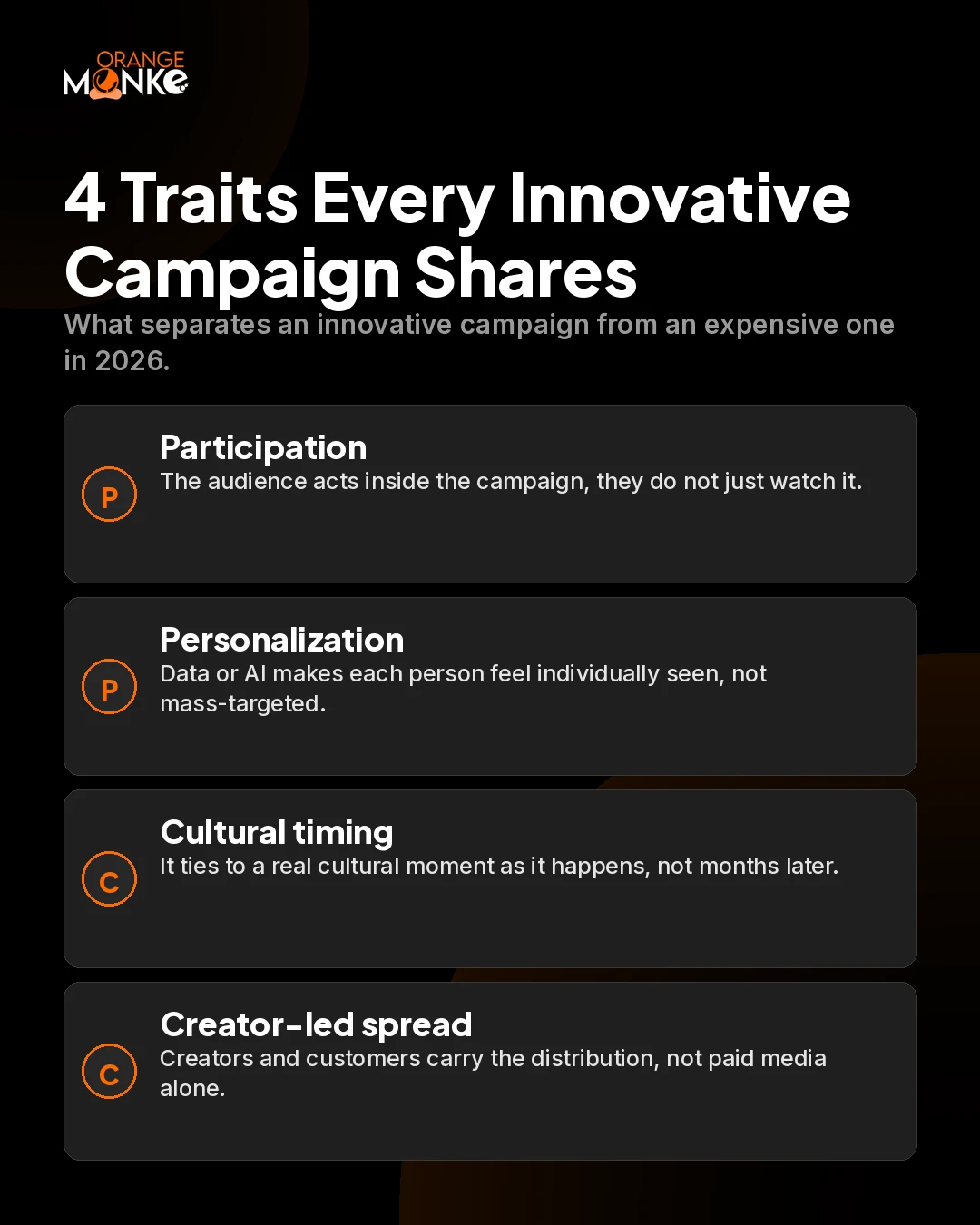
The best recent campaigns share four traits: they make participation easy, personalize at scale, ride cultural timing, and are built for creators to distribute. Budget scales a working idea, it never rescues a weak one. Below: 30 examples (2025–2026), a comparison table, the 7 triggers behind virality, and a 6-step build playbook.
What Makes a Marketing Campaign Innovative in 2026?
A marketing campaign is innovative in 2026 when it changes how the audience participates or how the brand behaves, not just how the ad looks. An innovative campaign is not the one with the biggest production budget or the most celebrities. It is the one that puts the audience inside the campaign, uses data or AI to make people feel individually seen, ties to a cultural moment in real time, and lets creators and customers carry the distribution.
That is the line between innovative and merely creative. A creative campaign is a fresh execution of a familiar format. An innovative campaign introduces a new mechanic, a new behavior, or a new relationship with the audience. The best audience-first marketing does both.
Why Is Traditional Marketing Losing Its Grip?
Traditional marketing is losing ground because attention is fragmented, ad fatigue is real, and trust has shifted from brands to peers. Banner ads, generic email blasts, and interruption-style advertising increasingly read as noise, repetition without relevance that audiences have learned to skip.
What replaced it is entertainment-first marketing built on identity, humor, community, and the timely use of AI. Modern campaigns turn the audience into a co-creator instead of a passive viewer, and they lead with a single sharp psychological trigger rather than a list of product features.
30 Recent Innovative Marketing Campaign Examples (2025–2026)
These 30 campaigns from 2025 and 2026 show innovation in practice, each tagged with its core tactic and the psychological trigger that made it spread. Campaigns 1 to 25 defined 2025; campaigns 26 to 30 are the standout moments from the first half of 2026. Read them as a pattern library: the mechanic matters more than the brand behind it.
1. Chili’s — Turning a Restaurant Brand into a Cultural Personality
Chili’s quietly became one of the most talked-about brands of 2025 by abandoning traditional restaurant marketing altogether. Instead of focusing on menu items or discounts, the brand leaned into internet humor, nostalgia, and cultural relevance.
Chili’s content felt less like advertising and more like something you’d stumble upon organically on social media — witty, self-aware, and intentionally unserious.
Source: Storychief
Why it worked
- Chili’s understood that attention today is earned through entertainment, not promotion
- Nostalgia created emotional comfort during economic uncertainty
- The brand spoke with internet culture, not at it
2026 insight. Brands that behave like cultural participants, not advertisers, will consistently outperform those still relying on traditional promotional messaging.
2. Dove — #ShareTheFirst and the Power of Vulnerability
Dove’s #ShareTheFirst campaign asked people to post the first photo they took, instead of the perfectly curated final version. This simple idea tapped into a deep emotional truth: perfection is exhausting.
The campaign spread organically as creators, influencers, and everyday users shared unfiltered images and personal stories.
► Watch: Dove — #ShareTheFirst and the Power of Vulnerability campaignSource: Dove
Why it worked
- Perfectly aligned with Dove’s long-standing Real Beauty platform
- Encouraged participation rather than passive consumption
- Made vulnerability feel empowering, not embarrassing
2026 insight. The future of brand trust lies in campaigns that celebrate imperfection and allow audiences to show up as they are.
3. American Eagle — “Sydney Sweeney Has Great Jeans”
American Eagle’s 2025 campaign starring Sydney Sweeney dominated social feeds and sparked widespread conversation, including controversy. But that controversy only amplified reach and awareness.
The campaign leaned into confidence, desirability, and meme-ability while keeping the product front and center.
► Watch: American Eagle — campaignSource: American Eagle
Why it worked
- Celebrity relevance created instant attention
- Controversy fueled organic discussion and shares
- Strong product-category association drove conversion
2026 insight. Bold creative can deliver massive upside, but brands must be prepared with sentiment monitoring and rapid response strategies.
4. Coca-Cola — Share a Coke (Gen Z Relaunch)
Coca-Cola revived its iconic “Share a Coke” campaign with a modern twist: QR codes, digital personalization, and social-first storytelling designed for Gen Z.
By combining nostalgia with technology, Coca-Cola bridged generations without alienating younger audiences.
► Watch: Coca-Cola — Share a Coke (Gen Z Relaunch) campaignSource: Coca-Cola
Why it worked
- Emotional memory triggered through personalization
- Seamless offline-to-online experience
- Encouraged sharing, creation, and participation
2026 insight. The smartest innovation often comes from reimagining what already works, not starting from scratch.
5. ChatGPT (OpenAI) — Making AI Feel Human
Instead of marketing ChatGPT as advanced technology, OpenAI focused on everyday use cases: writing emails, planning trips, brainstorming ideas. AI wasn’t portrayed as futuristic, it was portrayed as helpful.
► Watch: ChatGPT (OpenAI) — Making AI Feel Human campaignSource: ChatGPT
Why it worked
- Reduced fear and intimidation around AI
- Focused on outcomes, not features
- Showed AI fitting naturally into daily life
2026 insight. Complex products must be marketed through human benefit, not technical superiority.
6. Barbie — Type 1 Diabetes Doll
Barbie released a Type 1 Diabetes doll as part of Mattel’s commitment to representation and inclusivity. The doll included realistic features like an insulin pump and accessories, aiming to educate children and normalize conversations around chronic conditions.
The campaign was supported with educational social media content, influencer stories, and collaborations with healthcare advocates, creating awareness while emphasizing empathy and understanding.
► Watch: Barbie — Type 1 Diabetes Doll campaignSource: NBC News, Barbie
Why it worked
- Genuine inclusion rooted in real experiences
- Strong emotional connection with families
- Earned widespread positive media coverage
2026 insight. Representation must be intentional, informed, and collaborative, not performative.
7. Liquid Death x Ozzy Osbourne — Shock That Made Sense
Liquid Death sold cans containing Ozzy Osbourne’s DNA, an absurd idea that instantly went viral. But the brilliance lay in brand alignment: it felt exactly like something Liquid Death would do.
► Watch: Liquid Death campaignSource: Liquid Death
Why it worked
- Shock value aligned with brand voice
- Scarcity created urgency
- Earned media far exceeded paid reach
2026 insight. Shock marketing only works when it reinforces, not distracts from, brand identity.
8. IKEA — “Where Life Happens”
IKEA focused its storytelling on life moments, moving out, breakups, growing families, positioning furniture as a quiet witness to real life.
► Watch: IKEA — campaignSource: IKEA
Why it worked
- Universally relatable narratives
- Emotionally driven brand recall
- Elevated IKEA beyond product messaging
2026 insight. People remember how brands make them feel, not what they sell.
9. Gap — “Better in Denim”: Reclaiming Cultural Relevance Through Movement
After years of struggling with brand perception, Gap’s “Better in Denim” campaign marked a cultural reset. Instead of positioning denim as a wardrobe essential, Gap reframed it as a creative expression tied to movement, music, and identity.
The campaign featured diverse Gen Z creators, dancers, and musicians wearing Gap denim in fluid, energetic performances designed for TikTok, Instagram Reels, and Shorts. The visuals felt raw, kinetic, and modern, a sharp contrast to Gap’s traditionally safe advertising style.
► Watch: Gap — campaignSource: Gap
Why it worked
- It embedded itself inside youth culture
- Denim wasn’t the hero; self-expression was
- By collaborating with creators who already had cultural credibility, Gap borrowed trust rather than trying to manufacture coolness
2026 insight. Legacy brands don’t need to reinvent themselves, they need to re-enter culture with humility. Partner with creators who already speak the language of your audience, and let the product support the story rather than dominate it.
10. Nike — “Whatever They Say You Can’t Do, So Do It” (2025 Super Bowl)
Nike’s Super Bowl ad celebrated women in sports, focusing on overcoming doubt and societal limits. Featuring elite athletes and everyday women, it highlighted resilience, confidence, and empowerment, not products.
► Watch: Nike — campaignSource: Nike
Why it worked
- Emotional storytelling over product features
- Cultural relevance with rising women’s sports visibility
- Star power plus authentic everyday representation
- Sparked conversations and social sharing
2026 insight. Marketing wins when it shapes conversations people care about. Lead with narrative and purpose, not just products.
11. Spotify — “Daylist”: Turning Mood Into a Daily Ritual
Spotify’s “Daylist” evolved from a feature into a cultural phenomenon. By updating playlists dynamically based on time of day, behavior, and mood, Spotify turned listening into a living, shareable experience.
People began sharing screenshots of their “current mood playlist” on social media, turning Spotify into a self-expression tool.
Source: Spotify
Why it worked
- Spotify didn’t market, it designed virality
- People shared Daylists because it felt personal, funny, and relatable. This was personalization at scale without feeling invasive
2026 insight. The strongest marketing will be product-led. If your product creates emotional identity, users will do the distribution for you.
12. Apple — “Shot on iPhone”: Real Stories, Real People
Apple further stripped away polish from its iconic “Shot on iPhone” platform. Instead of cinematic visuals, Apple showcased raw, emotional moments captured by everyday users, protests, family moments, quiet creativity.
The campaign felt less like advertising and more like documentation of humanity.
► Watch: Apple — campaignSource: Apple
Why it worked
- Apple leaned into social proof, letting users demonstrate product capability organically
- Trust increased because Apple wasn’t telling people the iPhone was great, people were showing it
2026 insight. User validation is more powerful than brand storytelling. Build platforms that allow customers to prove your value for you.
13. LEGO — “Never Stop Playing”: Redefining Creativity for Adults
LEGO challenged the idea that play is childish. Their 2025 campaign highlighted adults using LEGO as a creative outlet for stress relief, mental health, and expression.
The visuals were calm, intentional, and introspective, a departure from high-energy toy advertising.
► Watch: LEGO — campaignSource: LEGO
Why it worked
- LEGO didn’t sell toys; it sold permission. Permission for adults to slow down, create, and reconnect with curiosity
- This reframing expanded LEGO’s audience without alienating its core base
2026 insight. Category expansion doesn’t require new products, it requires new meaning.
14. Duolingo — Full Commitment to Chaos Marketing
Duolingo’s social strategy leaned unapologetically into absurdity. The brand mascot became a chaotic, self-aware internet character participating in trends, jokes, and memes, often unrelated to language learning.
Source: Duolingo
Why it worked
- Duolingo understood platform culture better than most brands. Instead of resisting chaos, it embraced it, consistently
- The audience didn’t feel marketed to; they felt entertained
2026 insight. Consistency beats cleverness. If you choose a tone, commit fully, half-measures kill authenticity.
15. GoDaddy — “Act Like You Know”
GoDaddy’s campaign “Act Like You Know” aimed to empower small business owners and entrepreneurs to confidently own their online presence. The campaign used bold, humorous, and motivational messaging, showing people taking control of domains, websites, and branding with a “know-how” attitude.
Social media content, influencer partnerships, and short-form video clips amplified the message and encouraged business owners to share their own stories.
► Watch: GoDaddy — campaignSource: GoDaddy
Why it worked
- Empowered audiences with confidence and actionable advice
- Combined humor with practical business guidance
- Designed for shareable social content that encouraged user participation
2026 insight. Campaigns targeting entrepreneurs must blend education, empowerment, and entertainment. Providing value while encouraging self-expression will drive engagement and brand advocacy.
16. WWF Denmark — “The Hidden Cost”
WWF Denmark launched “The Hidden Cost” to reveal the environmental impact of everyday consumer products. Using striking AI-generated visuals, the campaign connected daily items, like coffee, chocolate, and cosmetics, to the destruction of habitats and endangered species.
Social media sharing, visually compelling storytelling, and discussion around AI-created art drove engagement and awareness.
Source: famouscampaigns
Why it worked
- Turned abstract environmental issues into tangible, relatable visuals
- Leveraged AI for creative, shareable content
- Sparked social conversations and advocacy
2026 insight. Purpose-driven campaigns must visualize impact and make abstract issues tangible. Emerging technology can amplify storytelling, but emotional resonance remains the key to engagement.
17. State Farm — “Trainer”
State Farm’s 2025 campaign “Trainer” focused on insurance in a humorous, relatable way. The ad featured a personal trainer who unexpectedly helps clients navigate everyday life mishaps, blending real-life situations with light-hearted insurance messaging. The campaign ran across TV, digital, and social platforms, with short clips optimized for sharing and engagement.
► Watch: State Farm — campaignSource: State Farm
Why it worked
- Made insurance relatable through humor and storytelling
- Showcased real-life scenarios people could identify with
- Designed for cross-platform sharing, boosting reach and engagement
2026 insight. Traditionally “boring” industries must use storytelling and humor to humanize their brand, creating shareable, relatable content that resonates across platforms.
18. Uber Eats x Jude Law — “Rom-Com Cliché”
Uber Eats partnered with Jude Law for the playful campaign “Rom-Com Cliché”, turning classic romantic comedy tropes into humorous food delivery scenarios.
The campaign featured short, witty videos where Uber Eats delivered meals in cinematic, exaggerated rom-com moments, like surprise dinners, mistaken orders, and dramatic encounters, creating shareable content across social media and streaming platforms.
► Watch: Uber Eats campaignSource: Uber Eats
Why it worked
- Leveraged humor and familiar pop-culture tropes for instant relatability
- Star power (Jude Law) increased credibility and attention
- Designed for viral sharing through short, entertaining clips
2026 insight. Brands can amplify engagement by blending storytelling with cultural references. Humor, nostalgia, and recognizable formats will make campaigns shareable and memorable, while celebrity partnerships can boost initial reach.
19. FILA x Almost Gods — AI-Generated Campaign
FILA collaborated with creative studio Almost Gods to launch a campaign entirely generated with AI, from visuals to storytelling. The campaign showcased FILA sneakers in surreal, imaginative settings that would be impossible to produce in traditional shoots.
By combining fashion with futuristic AI aesthetics, the campaign captured attention on Instagram, TikTok, and fashion blogs, sparking conversation about creativity and technology.
► Watch: FILA campaignSource: FILA
Why it worked
- Pushed boundaries of fashion advertising with visually stunning AI-generated content
- Created buzz around innovation and tech in branding
- Designed for social sharing and viral discussion
2026 insight. AI can amplify creativity and scale content production, but campaigns must balance novelty with brand identity. Surreal or experimental content works best when it’s shareable and culturally resonant.
20. Dyson — “Dyson Airbrow” April Fools Prank
Dyson launched the “Dyson Airbrow”, a playful April Fools’ campaign claiming to have invented a device that styles your eyebrows with airflow technology.
The campaign featured a sleek product mock-up, humorous videos, and social media teasers, engaging audiences with Dyson’s signature innovation credibility while showcasing a fun, unexpected side of the brand.
► Watch: Dyson — campaignSource: Dyson
Why it worked
- Captured attention through humor and surprise
- Aligned with Dyson’s tech-forward brand identity, making the prank believable
- Designed for social sharing, sparking conversations and media coverage
2026 insight. Leveraging brand credibility while adding humor increases engagement and shareability without diluting brand value.
21. Airbnb — “Icons” Experience Drop
Airbnb launched “Icons,” allowing users to stay in locations inspired by pop culture, from movie homes to fictional worlds. The campaign blurred the line between entertainment and hospitality.
Social media buzz, influencer walkthroughs, and limited availability created urgency and virality.
► Watch: Airbnb — campaignSource: Airbnb
Why it worked
- Turned booking into an experience
- Fused fandom with travel
- Designed for social sharing
2026 insight. Experiential marketing must be share-first and story-driven, not just experiential.
22. Patagonia — “Repair Is Revolutionary”
Patagonia doubled down on sustainability by actively discouraging overconsumption. The brand promoted repair guides, reuse stories, and second-life product journeys.
Instead of pushing sales, Patagonia focused on long-term trust and environmental responsibility.
► Watch: Patagonia — campaignSource: Patagonia
Why it worked
- Radical honesty stood out
- Values matched actions
- Built deep brand loyalty
2026 insight. Purpose marketing only works when profits don’t overpower principles.
23. Frankies Bikinis — Influencer Collaboration & Aesthetic Narrative
Frankies Bikinis amplified its brand presence through influencer collaborations that highlighted both product and lifestyle. The campaign leaned heavily on aesthetic storytelling, using Instagram and TikTok creators to showcase the swimsuits in aspirational beach and poolside settings.
By blending curated visuals with relatable micro-narratives, Frankies Bikinis created an emotional connection with audiences while emphasizing style, confidence, and summer vibes.
► Watch: Frankies Bikinis — Influencer Collaboration campaignSource: Frankies Bikinis
Why it worked
- Leveraged influencers to build credibility and social proof
- Combined visual aesthetics with lifestyle storytelling, making posts aspirational yet relatable
- Designed for organic social sharing, encouraging engagement through tagged content and reels
2026 insight. Lifestyle and fashion brands must blend influencer authenticity with strong visual narratives. Marketing should focus on creating shareable, story-driven content that inspires aspiration while feeling genuine, ensuring both reach and engagement.
24. Astronomer x Gwyneth Paltrow — Starry Lifestyle Collaboration
Astronomer partnered with Gwyneth Paltrow for a lifestyle-meets-astrology campaign. The collaboration offered curated celestial experiences, from personalized star charts to immersive cosmic-themed products, blending luxury lifestyle with astrology. Gwyneth’s involvement lent credibility, lifestyle appeal, and storytelling power, while social media activations and influencer content amplified awareness.
► Watch: Astronomer campaignSource: The Independent
Why it worked
- Combined celebrity influence with aspirational lifestyle and astrology trends
- Created personalized, experiential products that felt exclusive
- Designed for shareable social content, sparking curiosity and engagement
2026 insight. Celebrity-brand collaborations work best when they merge authenticity, lifestyle aspiration, and shareable experiences. Personalization and exclusivity drive engagement and cultural relevance.
25. Naukri.com — “Kab Tak Latke Rahoge?”
Naukri.com launched a smart OOH campaign (Out of Home advertising) inside Mumbai and Delhi Metro coaches, using mirror installations with the message “Kab tak latke rahoge?” to prompt commuters to reflect on career stagnation and consider new job opportunities.
Source: marketingmind.in
Why it worked
- Used contextual placement during daily commutes for instant relevance
- Encouraged self-reflection by literally putting commuters face-to-face with the message
- Sparked organic social sharing through relatable, witty storytelling
2026 insight. Context-driven campaigns that tap into everyday moments and personal reflection create stronger recall, engagement, and shareability, without relying on celebrity power.
The 2026 additions. The first half of 2026 pushed a clear shift: less glossy film, more physical products, unlikely partnerships, and work that proves it is real in an AI-saturated feed.
26. Heinz — The Ketchup-Friendly Fry Box
Heinz and agency Rethink redesigned the fast-food fry box for the first time in around 75 years, adding a built-in section that actually holds ketchup. The product itself became the campaign: a small, physical fix to a problem everyone had quietly lived with.
The redesign travelled on social precisely because it needed no explanation, one photo of the box made the idea land instantly.
Source: Famous Campaigns
Why it worked
- Turned a distinctive brand asset Heinz already owned into the whole idea, with almost no media spend
- Solved a real, relatable friction, which made people want to share it
- The physical object was the message, so it worked as its own out-of-home moment
2026 insight. The cheapest innovation is often a better version of something you already own. Fix a real friction in public and the object does the marketing for you.
27. Absolut x Tabasco — “Absolut Tabasco”
Absolut Vodka and Tabasco paired two famous, instantly recognisable products into a single limited-edition spirit, amplified through a campaign film and out-of-home. The partnership felt overdue rather than random, two icons people already associated with a Bloody Mary.
The collaboration earned attention because the pairing itself was the story, before a single feature was explained.
Source: Famous Campaigns
Why it worked
- Two distinctive brand assets combined into one unmistakable idea
- The unlikely-but-logical pairing generated curiosity and earned media
- Limited-edition framing added scarcity and a reason to act
2026 insight. The strongest collaborations pair brands the audience can already imagine together. Borrow each other’s recognition instead of building new awareness from scratch.
28. Anthropic — Super Bowl “Six Pack” Spot
Anthropic ran a Super Bowl spot built around the line “Can I get a six pack quickly?”, imagining what happens when people take AI answers a little too literally. On a night when most advertisers played it safe, the humor stood out, and the spot went on to win the Super Clio for the most creative commercial of the game.
Rather than selling AI capability, the ad used a relatable joke to make the product feel human and approachable.
Source: Marketing Dive
Why it worked
- Chose humor and restraint on a night of expensive, safe advertising
- Made an abstract AI product feel human through an everyday moment
- The award and coverage extended the spot’s reach well beyond the broadcast
2026 insight. On a crowded stage, the brand that zigs with humor is the one people remember. Sell the human moment, not the feature list.
29. Honda x Special Australia — The Record-Player CR-V
Honda and Special Australia strapped a working record player to the roof of a CR-V and drove it down the road with the needle never skipping, all captured for real with no visual trickery. In an era where anything can be faked, the campaign leaned on being genuinely, provably real.
Behind-the-scenes footage doubled as proof, turning “we actually did this” into the whole point.
Source: John Kovacevich (Medium)
Why it worked
- A clever product demo made the smooth-ride claim tangible and believable
- Doing it for real became a differentiator against AI-generated advertising
- The behind-the-scenes proof gave audiences a reason to trust and share it
2026 insight. As AI makes visuals cheap to fake, proving something was done for real becomes its own creative advantage. Let the demo carry the claim.
30. Jacquemus x Liline — The Grandmother Brand Ambassador
Jacquemus named Liline Jacquemus, the founder’s grandmother from a farming village in the south of France, as the label’s first-ever brand ambassador, complete with a tongue-in-cheek contract declaring she is “the original icon.” It was the opposite of the celebrity-ambassador playbook every fashion brand runs.
The choice felt personal and specific, which is exactly why it travelled.
Source: I Am Female
Why it worked
- An unexpected, deeply personal choice cut through a sea of celebrity ambassadors
- The authenticity was impossible to manufacture, which made it credible
- Tongue-in-cheek framing gave the internet something to talk about
2026 insight. Specificity beats star power. A genuine, personal choice the audience cannot un-see will outperform another famous face.
Innovative Marketing Campaign Types Explained
Most innovative campaigns fall into a handful of repeatable types, and naming the type makes it easier to choose one that fits your brand. The examples above are not random, they are variations on tactics you can deliberately pick from.
- Guerrilla and out-of-home (OOH) activations: physical stunts and installations built for public space, like Naukri’s metro mirrors.
- User-generated content (UGC) and co-creation: the audience makes the content, as with Dove’s #ShareTheFirst.
- Product-as-media (iconomics): the product or packaging becomes the idea, like Heinz’s ketchup-friendly fry box.
- Odd-couple brand partnerships: two recognisable brands combine, like Absolut x Tabasco.
- Chaos and mascot marketing: a consistent, self-aware character, as Duolingo runs.
- AI-generated campaigns: visuals or storytelling produced with AI, like FILA x Almost Gods.
- Experiential drops: limited, story-driven experiences such as Airbnb Icons.
- Super Bowl and big-moment films: high-reach brand films like Nike and Anthropic.
Whichever type you choose, the distribution logic is the same: design it to spread on social from the start. That is also why social-media marketing and platform-native formats like the Instagram algorithm now decide whether a campaign travels.
Campaign Comparison Table: Tactic, Trigger, Cost & Difficulty
This table maps standout campaigns to their tactic, core trigger, cost level, and how realistic each is for a small business to run. Use it to find a model that matches your budget and team before you brief anything.
| Campaign | Tactic type | Core trigger | Cost | SMB difficulty | Main channels |
|---|---|---|---|---|---|
| Naukri.com OOH mirrors | Out-of-home activation | Curiosity | Low | Medium | OOH, Social |
| Heinz fry box | Product-as-media | Curiosity | Low | Medium | OOH, Social, PR |
| Dove #ShareTheFirst | UGC participation | Transparency | Low | Easy | Social |
| Duolingo mascot | Chaos / mascot | Humor | Low | Easy | Social |
| Spotify Daylist | Product-led | Identity | Medium | Hard | App, Social |
| Coca-Cola Share a Coke | Personalization | Identity | Medium | Medium | Retail, App, Social |
| Absolut x Tabasco | Brand partnership | Curiosity | Medium | Medium | Retail, OOH, Social |
| Airbnb Icons | Experiential drop | Scarcity | High | Hard | Experiential, Social |
| Uber Eats x Jude Law | Celebrity + format | Humor | High | Hard | TV, Social |
| Nike Super Bowl | Brand film | Identity | High | Hard | TV, Social |
| Anthropic Super Bowl | Super Bowl / humor | Humor | High | Hard | TV, Social |
| FILA x Almost Gods | AI-generated | Curiosity | Medium | Medium | Social |
The pattern is clear: the lowest-cost, most SMB-friendly campaigns lean on participation and owned assets, not celebrity or production spend.
7 Psychological Triggers Behind Campaigns That Go Viral
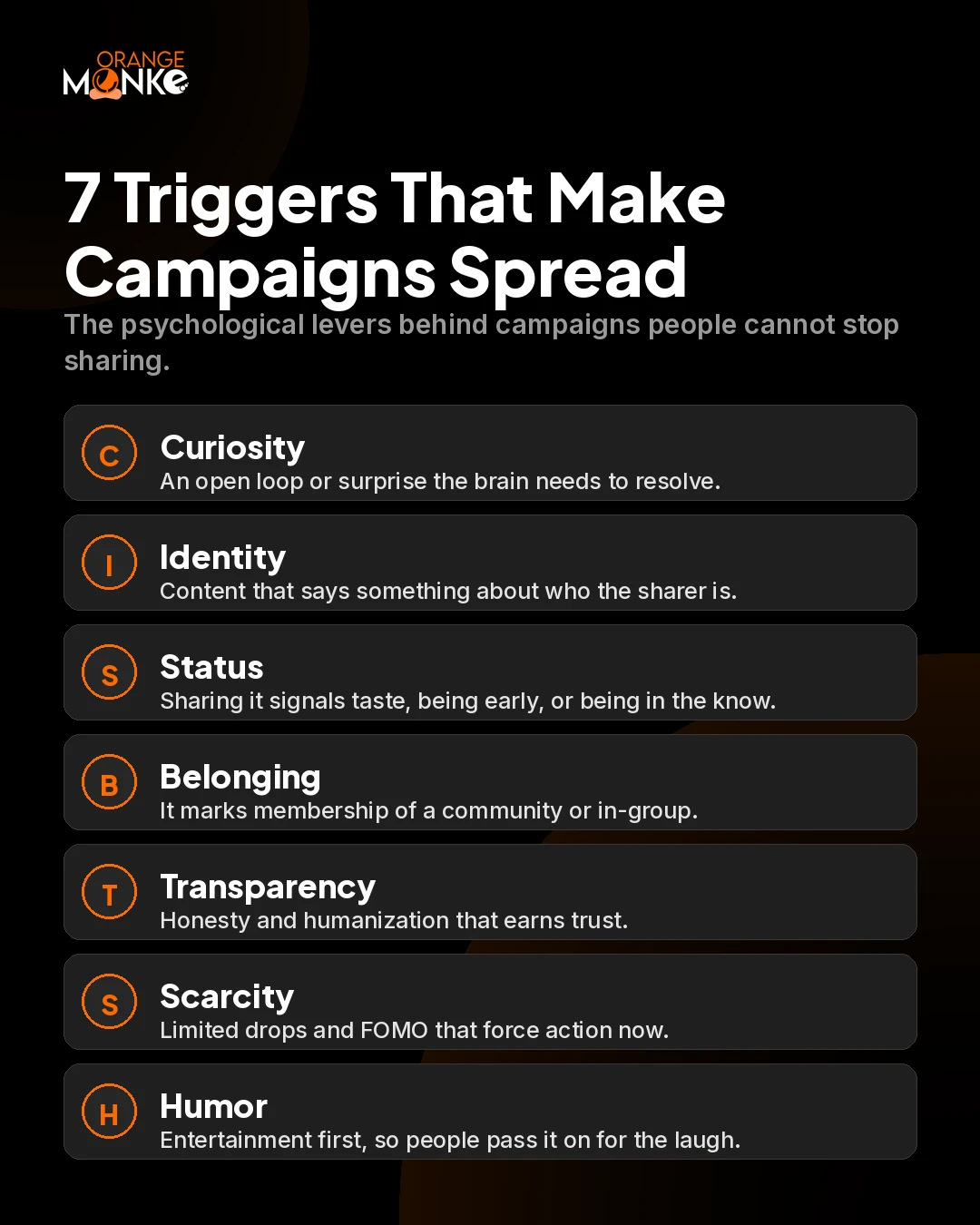
Campaigns go viral when they activate one clear psychological trigger, curiosity, identity, status, belonging, transparency, scarcity, or humor. The mistake is stacking five at once. The sharpest work commits to a single lever and builds everything around it.
| Trigger | What it does | Seen in |
|---|---|---|
| Curiosity & surprise | An open loop or unexpected twist the brain wants to resolve | Absolut x Tabasco, Naukri mirrors |
| Identity & aspiration | Content that says something about who the sharer is | Spotify Daylist, Coca-Cola |
| Status & achievement | Sharing signals taste, being early, or being in the know | GoDaddy, Spotify |
| Belonging & community | Marks membership of a community or in-group | Barbie, Jacquemus x Liline |
| Transparency & humanization | Honesty and realness that earns trust | Dove, Patagonia, Honda CR-V |
| Scarcity & FOMO | Limited drops that force action now | Airbnb Icons, Liquid Death |
| Humor & entertainment | Entertainment first, so people pass it on | Duolingo, Anthropic, State Farm |
Pick one trigger, make it obvious, and design the share moment around it.
What Do the Best Marketing Campaigns Have in Common?
The best campaigns share one structural trait: they are designed for distribution, not just creation. Every standout above has a built-in spread mechanism, it is easy for creators to talk about, easy for press to summarize, and easy for the audience to recreate or react to.
- Participation is easy: there is an obvious way to join in.
- It works on social video: the format is native to the feed, not adapted to it.
- It uses distinctive brand assets: colors, characters, and language the audience already recognises.
- It connects to a larger brand story: the moment reinforces what the brand stands for.
12 Pro Tips to Run Innovative Marketing Campaigns in 2026
Run innovative campaigns in 2026 by leading with story, engineering participation, and designing every idea to spread on social from the start. Marketing is no longer just about promoting products, it is about creating experiences, sparking conversations, and building emotional connections. These 12 tips turn that shift into action. Also learn about the additional content creator tools to help elevate your content.
- Lead With Story, Not ProductAudiences respond to emotional narratives over features. Build campaigns around relatable stories that naturally integrate your brand. Focus on creating characters, conflict, and resolution to evoke empathy, making your brand memorable and meaningful.
- Embrace Product-Led MarketingWhen your product itself creates an emotional or cultural identity (like Spotify Daylist), users will share and distribute organically. Design features that feel personal and exciting, so your product becomes the marketing medium without appearing promotional.
- Experiment With AI CreativelyAI is no longer just a tool for efficiency. Use it for concept ideation, visuals, and even content storytelling, while maintaining brand authenticity. Test AI for generating ideas, personalized content, and innovative visuals that would be impossible to produce manually.
- Make Experiences ShareableWhether experiential (Airbnb Icons) or digital, design campaigns to be social-first, encouraging organic sharing and engagement. Include clear moments or hooks that audiences can capture, photograph, or clip, maximizing viral potential.
- Collaborate With Micro-InfluencersMicro-influencers often drive higher engagement and relatability than celebrities. They’re ideal for niche campaigns and community-building. Leverage authentic voices and localized followings to amplify trust, credibility, and deeper connection with your audience.
- Personalization at ScaleDynamic, personalized content (like Spotify Daylist) increases relevance without feeling invasive. Segment audiences intelligently and deliver contextually relevant messages that feel tailored, boosting emotional resonance and engagement.
- Cultural Relevance Is KeyTap into current trends, humor, or local culture to make campaigns feel timely, relatable, and share-worthy. Monitor social and cultural conversations closely, adapting campaigns to ensure your brand feels current, relevant, and culturally aware.
- Leverage Cross-Platform StorytellingDon’t just post the same content everywhere. Tailor formats for Instagram, TikTok, YouTube, and OTT to maximize reach and engagement. Consider native content, platform algorithms, and audience behavior to make each piece feel purpose-built for its medium.
- Blur Boundaries Between Entertainment and MarketingCampaigns like Nike’s Super Bowl ad or Uber Eats rom-com spots work because they feel like entertainment first, marketing second. Prioritize creating memorable moments and experiences that audiences willingly consume and share instead of pushing overtly branded messaging.
- Harness Purpose-Driven CampaignsHighlight social, environmental, or cultural purpose (WWF Denmark, Barbie T1 Diabetes Doll). Purpose-driven marketing builds trust and long-term loyalty. Tie your campaign to authentic brand values and communicate impact clearly to inspire emotional engagement and advocacy.
- Mix Humor and RelatabilityBrands in “boring” categories (State Farm) can humanize themselves with humor, relatability, and everyday storytelling. Use real-life situations, playful narratives, and gentle satire to make your brand memorable and approachable.
- Test and Iterate FastDigital-first campaigns allow real-time feedback. Monitor engagement and optimize quickly to maximize impact and cultural relevance. Experiment with messaging, formats, and timing, using performance data to refine content for better audience resonance and ROI.
Great campaigns don’t happen by accident. Let’s build yours.
We turn campaign inspiration into a mechanic, a channel plan, and a shareable idea your audience actually joins.
Plan my campaign →How to Build Your Own Innovative Marketing Campaign (Step-by-Step)
Build your own innovative campaign by choosing one audience and one problem, then building a single participation mechanic around them. The examples above look effortless, but they follow a repeatable sequence any team can run.
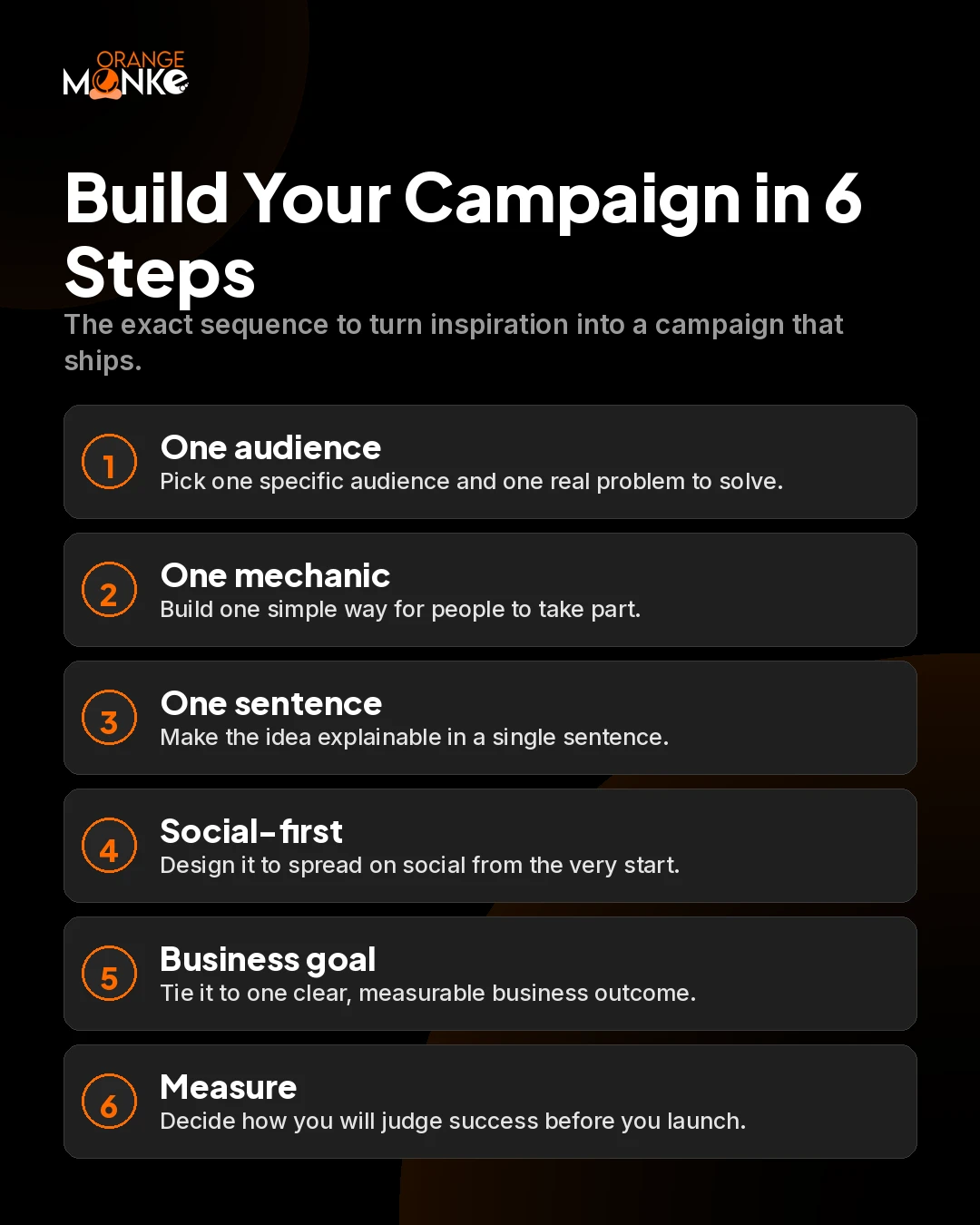
- Choose one audience and one problemPick a specific audience and the single real problem your campaign addresses. Precision here is what makes everything downstream easier.
- Build one simple participation mechanicGive people one obvious way to take part, a prompt, a remix, a submission, or a shareable moment.
- Make it explainable in one sentenceIf you cannot describe the idea in a single line, press cannot summarize it and creators cannot repeat it.
- Design it for social spread from day oneBake the share moment into the concept, not into a post-launch afterthought.
- Tie it to a clear business goalConnect the campaign to one outcome that matters, awareness, leads, or sales.
- Decide how you will measure success before launchChoose your primary metric up front so you can judge the result honestly.
Next step: map your idea against the comparison table above, then turn it into a live plan with a content marketing strategy and, where paid amplification helps, paid marketing to extend reach.
Innovative Marketing on a Small Budget: An SMB Playbook
Small businesses can run innovative campaigns on a small budget by stripping away production value and keeping the underlying idea. The principles behind every major campaign above scale down cleanly, budget changes the reach, not the trigger.
- Personalized email is the highest-ROI SMB tactic: a year-in-review or benchmark email needs data, not a film crew.
- Turn customers into creators: a simple UGC prompt or gallery gives you distribution for free.
- Run one branded hashtag challenge: feature the best submissions to reward participation.
- Use founder storytelling: the human story behind your product travels on social and builds trust.
The common thread is the same one that drives durable organic traffic: one clear, shareable idea beats ten scattered messages.
How Is AI Changing Marketing Campaigns in 2026?
AI is changing marketing campaigns in 2026 by becoming a creative collaborator, generating visuals, personalizing content, and scaling ideas that were impossible to produce manually. Brands like FILA and WWF Denmark used AI to create surreal, shareable work; others now do the opposite, proving their work is real in a feed full of synthetic content.
Both moves point to the same lesson: AI is a tool for creativity and personalization, but the idea still has to be human. AI also changes how people discover campaigns, which is why campaign content should be built to surface in AI Overviews and AI Mode, not just social feeds.
Conclusion
The key lesson from the best marketing campaigns of 2025 and 2026 is simple: innovation isn’t about doing more, it’s about meaning more. The campaigns that worked didn’t rely on big budgets or flashy tech, they succeeded by understanding human behavior, platform culture, and emotional relevance. From Naukri turning a commute into a mirror moment, to Spotify making identity shareable, to Heinz fixing a 75-year-old fry box, winning brands built participation before spend.
As execution becomes the real differentiator, the brands that win will be the ones that turn insight into a repeatable system. At Orange MonkE, we help brands do exactly that, combining culture-first strategy, AI-powered content, and distribution so campaigns don’t just launch, they live and grow. Happy campaigning.
Turn one good idea into a campaign engine that keeps shipping.
Strategy, content, and distribution wired together, so your brand stays culturally relevant every month, not once a year.
Build my content engine →Frequently Asked Questions
A marketing campaign is innovative in 2026 when it engineers participation, personalization, cultural timing, and creator-led distribution rather than simply spending more on media.
- Participation: the audience acts inside the campaign instead of just watching it.
- Personalization: data or AI makes each person feel individually seen.
- Cultural timing: it ties to a real moment as it happens, not months later.
- Creator-led spread: creators and customers carry the distribution.
Innovation is about meaning, not budget, which is exactly why a strong content marketing strategy beats a bigger ad spend.
No, innovative marketing campaigns do not need big budgets, because the idea and the participation mechanic matter more than production value.
- Earned over paid: community-led ideas spread cheaply when the mechanic is strong.
- Iconomics: reworking an asset you already own costs little, as Heinz’s fry box showed.
- Budget scales reach, not the trigger: spend amplifies a working idea; it cannot rescue a weak one.
Small teams win by focusing on one sharp idea, the same discipline behind steady organic traffic growth.
An innovative campaign changes how the audience participates or how the brand behaves, while a creative campaign changes how the message looks or sounds.
- Creative: a fresh execution of a familiar format.
- Innovative: a new mechanic, behavior, or relationship with the audience.
- Overlap: the best work is both, a new idea executed beautifully.
If you want work that is genuinely new rather than just polished, start with your audience, not your creative assets.
Marketing campaigns go viral when they activate one clear psychological trigger, such as curiosity, identity, status, belonging, transparency, scarcity, or humor.
- One trigger, not five: the sharpest campaigns commit to a single lever.
- Identity and humor travel fastest: people share what reflects them or makes them laugh.
- Scarcity forces timing: limited drops convert attention into action.
Pick one trigger and build the whole idea around it, then let your social media distribution do the rest.
Yes, small businesses can use the same tactics as big brands by stripping away the production value and keeping the underlying idea.
- Personalized email: the highest-ROI SMB tactic, no film crew required.
- UGC and community: turn existing customers into your distribution.
- One shareable idea: beats ten scattered messages every time.
The mechanics scale down cleanly once you know your audience, which starts with finding your target audience.
AI is changing marketing campaigns in 2026 by acting as a creative collaborator for ideation, visuals, and personalization, not just a tool for efficiency.
- Creative generation: surreal, at-scale visuals that were impossible before, as with FILA.
- Personalization: dynamic content tailored to each person.
- The ‘real’ counter-move: some brands now prove work is done for real to stand out.
AI also changes how people search, which is why campaign content should be built for AI Overviews and AI Mode.
The fastest campaign format for B2B brands is usually a benchmark report, data-driven email, or founder-led story, because these build trust quickly without heavy production.
- Benchmark or data content: gives press and prospects a reason to cite you.
- Founder storytelling: humanizes the brand and travels on LinkedIn.
- Educational drip: nurtures a considered, longer B2B buying cycle.
Pair it with a clear funnel by running SEO and PPC together.
You measure the success of a marketing campaign by deciding on one primary metric before launch and tying it to a clear business goal.
- Pick the metric first: reach, participation, leads, or sales, not all at once.
- Tie it to revenue: engagement only matters if it moves the business.
- Track earned spread: shares, mentions, and UGC show the idea is traveling.
If you want that measurement built in from day one, our social media marketing team sets it up before launch.
The most innovative marketing campaigns of 2025 and 2026 included Spotify Daylist, Nike, Chili’s, Barbie, and Airbnb in 2025, and Heinz, Absolut x Tabasco, Anthropic, Honda, and Jacquemus in 2026.
- 2025: leaned into emotional storytelling, product-led virality, and purpose.
- 2026: shifted toward physical products, unlikely partnerships, and proving things are real.
- The constant: the audience is part of the campaign, not just the target.
The full breakdown of all 30 sits above, and you can turn any of it into a live plan with content that ranks and converts.