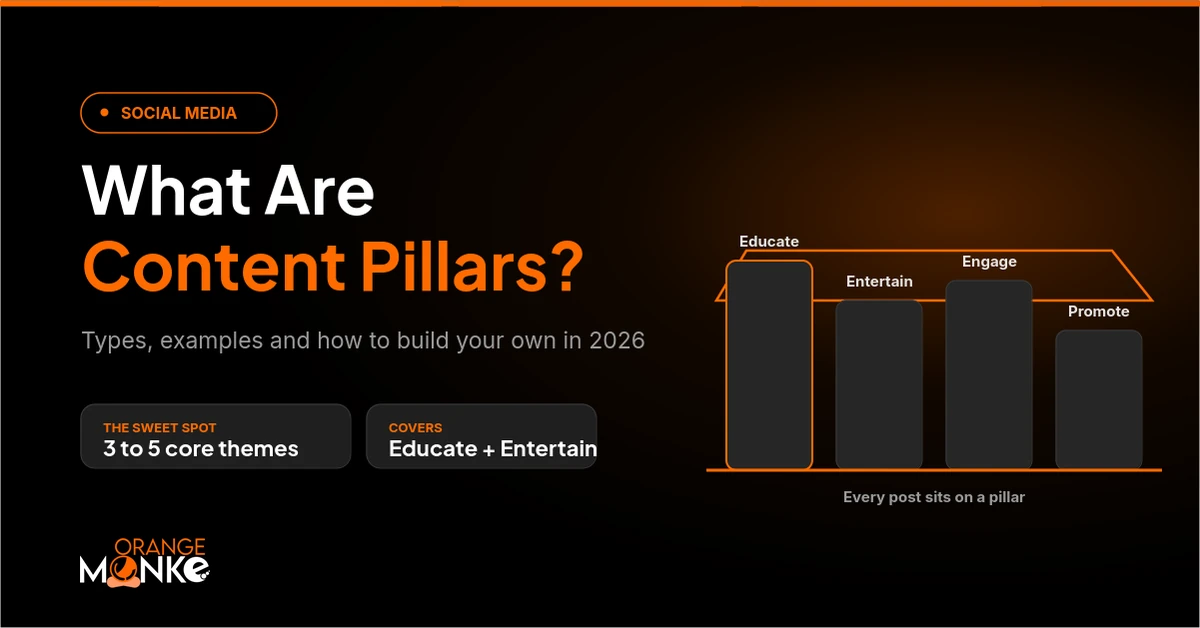
A content pillar is a core topic or theme that a brand's content strategy is built around. Most brands use 3 to 5 pillars, such as education, community, behind the scenes and product, so every piece of content stays focused, consistent and easy to plan.
Content pillars are the 3 to 5 core themes that decide what a brand talks about, and every post, video or article should support one of them. Without them, content turns into a string of random ideas that nobody remembers.
When I plan content for a brand, pillars are the first thing I set, before a single caption is written. They answer the question every content team asks on a Monday morning: what do we post this week, and why? Get the pillars right and the calendar almost writes itself. Get them wrong and even good content feels scattered. This is the same foundation we build in every content marketing strategy for small businesses. In this guide, I will walk you through what content pillars are, the types that work, how many you need, and the exact process I use to build them, including how AI fits in and how pillars connect to SEO.
What Are Content Pillars?
Content pillars are the broad themes a brand returns to again and again, chosen because they match what the audience cares about and what the business wants to be known for. Each pillar holds many individual posts.
Think of your brand as a house. The pillars are the load-bearing columns. Individual posts are the furniture: you can move it around, swap it out and add more, but the columns decide the shape of the house.
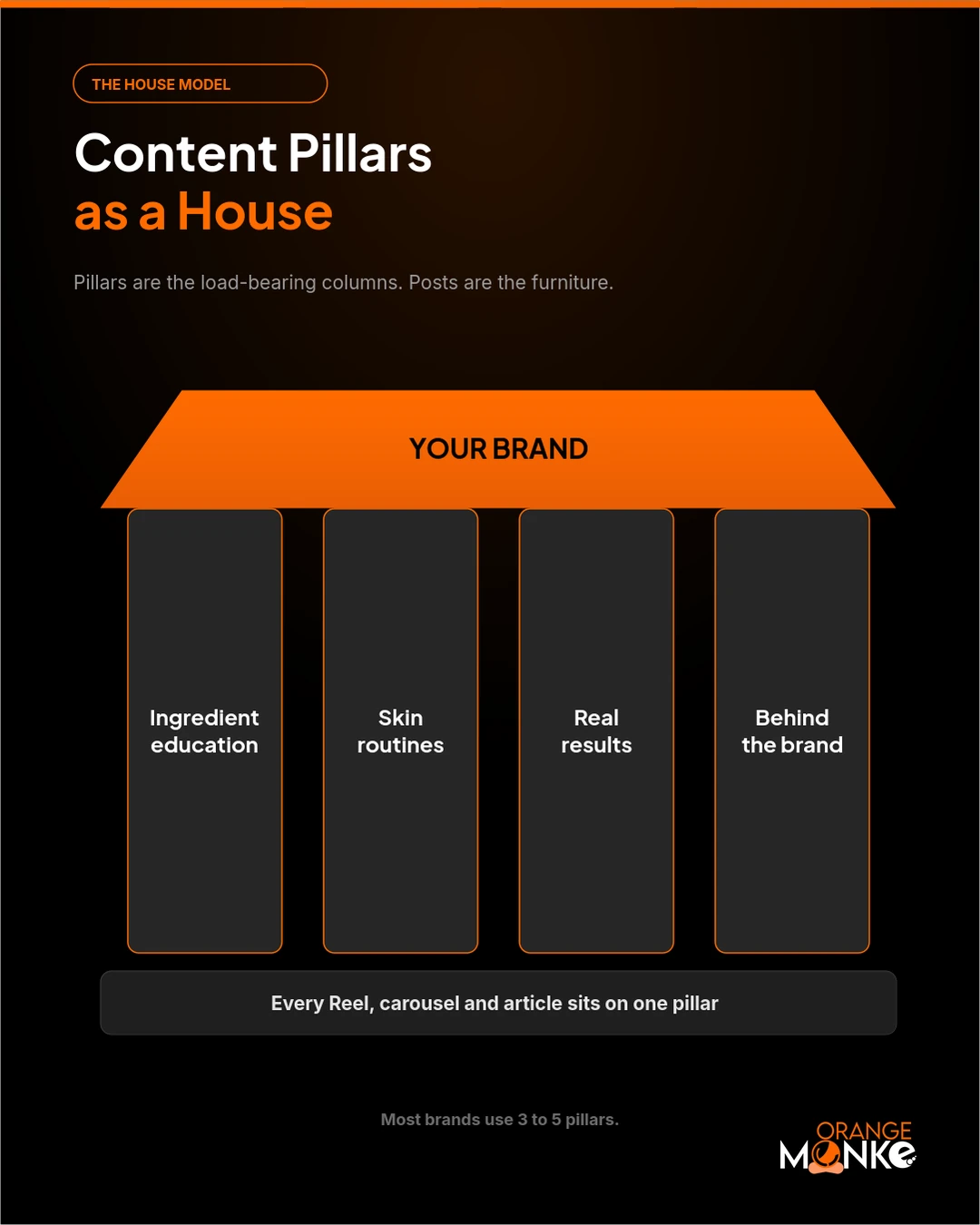
To make this practical, I will use one running example through this guide: a direct-to-consumer skincare brand. Its four content pillars might be:
- Ingredient education: what niacinamide, retinol and SPF actually do.
- Skin routines: morning and night routines for different skin types.
- Real results: customer reviews, before-and-after stories and user posts.
- Behind the brand: how products are formulated, tested and packed.
Every post the brand publishes, whether a Reel, a carousel or a blog article, fits into one of these four.
How Are Content Pillars Different From Content Buckets and Themes?
Content pillars are long-term strategic themes, content buckets are the post categories inside a pillar, and content themes are short-term topics such as a monthly campaign. The terms are often mixed up, but they sit at different levels.
- Content pillar: a core brand theme that lasts months to years. Example: ingredient education.
- Content bucket: a repeatable post type inside a pillar, lasting weeks to months. Example: "ingredient of the week" carousels.
- Content theme: a short campaign or topic focus, lasting days to weeks. Example: monsoon skincare month.
In short, pillars set the direction, buckets make the pillars repeatable, and themes keep them fresh.
Why Do Content Pillars Matter?
Content pillars matter because they turn content from guesswork into a system, making a brand easier to recognise, faster to plan for and easier to measure. Here is what changes once pillars are in place.
- They build authority. Returning to the same few topics shows your audience, search engines and AI tools what you are an expert in.
- They save time and prevent burnout. The team stops starting from a blank page every week. Each pillar is a ready source of ideas.
- They make your brand recognisable. Followers quickly learn what to expect from you, which is why they follow in the first place.
- They support SEO. Focused themes on your website group naturally into topic clusters, which helps you rank for related searches.
- They keep teams aligned. Designers, writers, freelancers and agencies all work from the same brief.
- They make results measurable. When every post is tagged to a pillar, you can see which themes drive engagement and leads, and which do not.
The real question is not whether you need pillars. It is which ones to choose.
What Types of Content Pillars Can You Use?
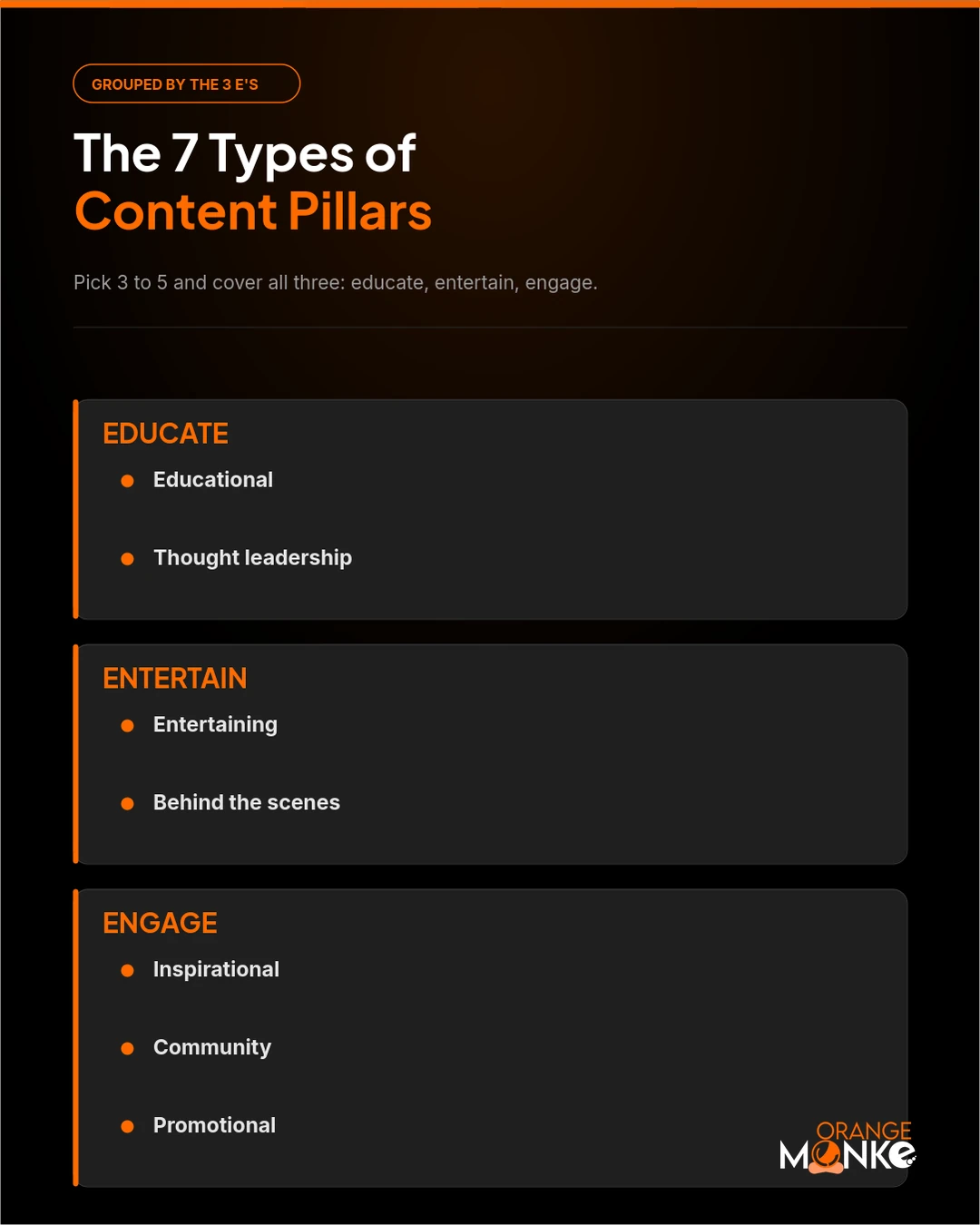
The seven most useful types of content pillars are educational, entertaining, inspirational, promotional, behind the scenes, community and thought leadership. Most brands pick three to five of these and shape them around their own audience.
- Educational: builds trust by teaching. Best as carousels, tutorials and guides. Example: "Retinol vs niacinamide: which one do you need?"
- Entertaining: drives reach and shares. Best as Reels, memes and trends. Example: a skincare myth-busting skit.
- Inspirational: creates an emotional connection. Best as Stories, quotes and transformations. Example: a customer's confidence journey.
- Promotional: turns attention into sales. Best as product demos, offers and launches. Example: a new sunscreen launch Reel.
- Behind the scenes: makes the brand human and transparent. Best as Stories and day-in-the-life videos. Example: how a batch is formulated and tested.
- Community and user content: turns followers into participants. Best as polls, Q&As and reposted customer posts. Example: reposting customer routine videos.
- Thought leadership: positions the brand as an authority. Best as long posts, articles and expert talks. Example: the founder on clean-label claims.
Two shortcuts help when choosing. First, most pillars serve one of the three E's: educate, entertain or engage. A healthy mix covers all three. Second, when people talk about the five pillars of content, they usually mean the first five types in this list.
How Many Content Pillars Should You Have?
You should have 3 to 5 content pillars, because fewer makes your feed repetitive and more spreads your team too thin to be consistent. Three suits small teams; five suits brands posting daily across several platforms.
Once the pillars are set, decide the mix. There is no universal ratio, but this is the starting split I would test for the skincare brand:
- 40% ingredient education
- 25% skin routines
- 20% real results
- 15% behind the brand, including product posts
Notice that promotion is not its own large slice. Sales content works best when it is woven into value-led pillars, not posted on its own every other day. Review the mix after 90 days and shift it towards the pillars your audience responds to.
How Do You Create Content Pillars?
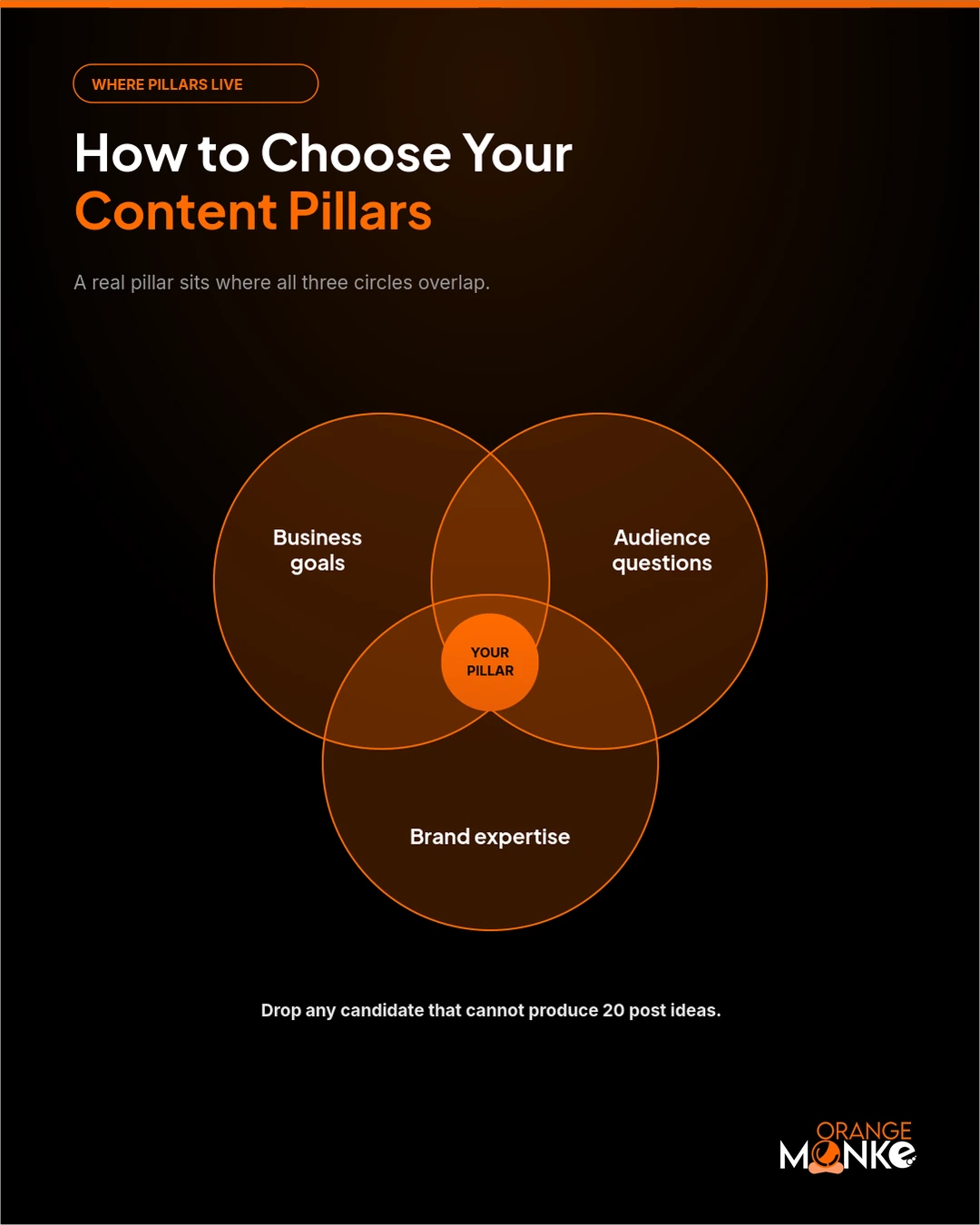
You create content pillars by finding where three things overlap: your business goals, your audience's real questions, and the topics your brand can speak about with authority. This is the six-step process I follow for every brand.
Step 1: Start With Your Business Goals
Your content pillars should start from business goals, because a pillar that does not support a goal is just a hobby. Write down what the next 12 months must achieve: more leads, a product launch, brand awareness in a new city, or better customer retention. For the skincare brand, the goals are to build trust with first-time buyers and reduce questions to customer support. Both point straight to an education-led strategy.
Step 2: Understand Your Audience and Their Questions
The best pillar ideas come from the questions your audience already asks, not from what the brand wants to say. Collect them from comments, DMs, reviews, sales calls, support tickets and search data. Group the questions you find. Clusters such as "which product suits my skin" and "how do I use this correctly" are pillars waiting to be named. If you have not mapped your audience yet, start with our guide on finding your target audience.
Step 3: Audit What Already Works
Your existing content shows which topics your audience already rewards, so audit your last 30 to 50 posts before choosing new pillars. Tag each post by topic, then compare engagement, saves, shares and clicks. Patterns appear quickly. If routine videos consistently outperform product photos, routines deserve to be a pillar.
Step 4: Choose Your 3 to 5 Pillars
Choose pillars where your business goals, audience questions and brand expertise overlap, and drop any that cannot produce at least 20 post ideas. A pillar that runs dry in a month is too narrow.
I test every candidate with five questions before it makes the final list:
- Does it support a business goal?
- Does the audience ask about it?
- Can we speak about it with genuine authority?
- Can it produce 20 or more post ideas?
- Can we measure its results?
A candidate that fails two or more of these is not a pillar yet.
Step 5: Match Formats and Channels to Each Pillar
Each pillar needs formats that suit it, because education works best as carousels and guides while entertainment works best as short video. Assign two or three core formats and the main channel for every pillar. For the skincare brand, ingredient education becomes Instagram carousels and blog guides, routines become Reels and YouTube Shorts, and real results become reposted customer videos and review graphics.
Step 6: Build a Content Bank and Tag Every Post
A content bank turns pillars into a steady calendar, and tagging every post by pillar is what lets you measure which pillars work. Brainstorm 10 to 20 ideas per pillar and keep them in one shared sheet or tool. Plan the calendar from that bank, following your content mix. Tag each published post with its pillar so the monthly review takes minutes instead of hours.
Content Pillar Template You Can Copy
This content pillar template captures everything a team needs to plan from one pillar in a single row. Copy it into a sheet and fill in one row per pillar.
| Field | What to fill in |
|---|---|
| Pillar name | The core theme, in 2 to 4 words |
| Business goal | The goal this pillar supports |
| Audience question | The question it answers for your audience |
| Core formats | 2 or 3 formats that suit the theme |
| Main channel | Where it performs best |
| Posts per week | How often you will publish it |
| Example post | One headline to test the pillar |
Here is the template filled in for the skincare brand, one row per pillar:
| Pillar | Goal | Audience question | Formats & channel | Example post |
|---|---|---|---|---|
| Ingredient education | Build trust with first-time buyers | "Which ingredient suits my skin?" | Carousels & blog guides, 2/week | "Niacinamide in 60 seconds" |
| Skin routines | Increase repeat purchases | "How do I use these together?" | Reels & Shorts, 1 to 2/week | "My 3-step night routine" |
| Real results | Social proof for new buyers | "Does this actually work?" | Customer videos & reviews, 1/week | A reposted customer routine |
| Behind the brand | Brand trust and transparency | "Who makes this and how?" | Stories & short videos, 1/week | "How we test for irritation" |
How Can You Use AI to Develop Content Pillars?
AI speeds up the research and brainstorming behind content pillars, but choosing the final pillars still needs human judgement about your brand, goals and audience. Use it as a fast analyst, not as the strategist. The most useful approach is to apply AI inside the same six steps, so it sharpens the process instead of replacing it:
- Understand the audience. AI summarises reviews, comments, DMs and support tickets into common questions. You decide which pain points matter to the business.
- Audit your content. AI groups past posts by theme and compares their performance. You check that the data is complete and fair.
- Find pillar ideas. AI suggests 8 to 10 candidate themes from your audience questions and keywords. You pick the final 3 to 5 that fit your expertise.
- Test the pillars. AI generates 20 post ideas per candidate to show which run dry. You judge brand fit, tone and priorities.
- Match formats. AI drafts a content mix and suggests formats per platform. You decide what your team can realistically produce.
- Fill the calendar. AI drafts hooks, captions and outlines. You make the final edits, check facts and keep the brand voice.
Which AI Prompts Help You Build Content Pillars?
The best AI prompts for content pillars give the tool your own data, such as customer questions or post performance, and ask it to find patterns rather than invent ideas. Copy any of these five prompts, fill in the [brackets], and paste your own data where marked:
You are a senior content strategist. I run a [business type] that
sells [product or service] to [target audience] in [city/country].

Below are real questions and comments from our customers, taken
from reviews, DMs, sales calls and support tickets.

Your task:
- Group the questions into 5 to 7 themes.
- For each theme, give: a pillar name (2 to 4 words), the customer
  need behind it, how many questions fall under it, and 3 post ideas.
- Recommend the 3 to 5 strongest themes as our content pillars,
  with a one-line reason for each.
- Present the result as a table, then list your recommendation.

Customer questions: [paste 30 to 100 questions here]
Act as a social media analyst. Below is a table of our last [number]
posts: date, topic, format, reach, likes, comments, saves, shares,
link clicks.

Your task:
- Tag each post with one theme.
- For each theme, calculate average reach, average engagement rate
  ((likes + comments + saves + shares) / reach) and average saves.
- Rank the themes from strongest to weakest.
- Recommend which themes to keep as pillars, improve or drop.

Show the calculations in a table first. Do not guess missing
numbers; flag them instead.

Posts: [paste your analytics export here]We are a [business type] selling [product/service] to [audience]. One proposed content pillar is "[pillar name]", covering [one-line description]. Your task: - Write 20 distinct post ideas for this pillar, each with a hook and a format (carousel, Reel, Story, blog post or LinkedIn post). - Mark any ideas that overlap or repeat. - Rate the pillar out of 10 for depth (can it last 6 months?) and relevance to our audience, with a two-line explanation. - If the score is below 7, suggest a sharper version of the pillar.
Our content pillars are: [pillar 1], [pillar 2], [pillar 3],
[pillar 4].

We can publish [number] posts a week on [platforms]. Our main goal
this quarter is [goal].

Create a 4-week content calendar as a table with columns: week,
day, platform, pillar, format, hook, call to action. Keep
promotional posts to no more than 20% of the total, and make sure
every pillar appears at least once a week.
You are a senior content strategist. We are launching a
[business type] called [brand name] that sells [product/service]
to [audience] in [location]. Our brand voice is [3 adjectives].
Our top goal for the next 12 months is [goal]. Our 3 competitors
are [competitor 1, 2, 3].

Your task:
- Suggest 5 content pillars that fit our goal and audience, and
  avoid copying what the competitors already own.
- For each pillar: the audience question it answers, the best 2
  formats, and 3 example post titles.
- Recommend a starting content mix as percentages adding to 100.
- List 3 questions we should ask real customers to validate these.
What Should You Watch Out For When Using AI?
AI suggests generic pillars when it lacks context, so feed it your own data, check every fact, and keep your brand voice in the final content. Left alone, most tools will recommend the same five pillars to every business.
- Give it real inputs. Reviews, analytics and sales questions produce specific pillars; a one-line brief produces clichés.
- Verify facts and claims. This matters most in regulated areas such as health, finance and skincare.
- Edit for voice. AI drafts are a starting point. Content that sounds like everyone else will not build authority. Our guide to E-E-A-T in SEO explains why real expertise matters more than ever.
What Do Content Pillars Look Like in Practice?
Content pillars look different in every industry, but strong ones always mix education, proof and personality with a smaller share of promotion. These examples show how the same method adapts across businesses.
- E-commerce fashion: styling tips, new arrivals, customer looks, behind the design. Example: "3 ways to style one kurta."
- Café or restaurant: menu stories, kitchen behind the scenes, customer moments, local community. Example: "How our cold brew is made."
- B2B SaaS: product education, industry insights, customer success, team and culture. Example: "5 reports your finance team should automate."
- Clinic or healthcare: health education, doctor expertise, patient stories, clinic life. Example: "When should you see a dermatologist?"
- Online school: learning tips, parent guidance, student achievements, teacher spotlights. Example: "How to build a study routine at home."
- Real estate: area guides, buying advice, property tours, client stories. Example: "What to check before buying a flat."
- Coach or consultant: frameworks, client transformations, personal story, industry myths. Example: "The 3 questions I ask every new client."
- Lifestyle creator: daily routines, recommendations, personal stories, audience Q&As. Example: "What I eat in a busy workday."
Notice that product or promotional content rarely owns a whole pillar. It rides inside education, proof and stories, where it feels useful rather than pushy.
What Are Instagram Content Pillars for a B2B Service Business?
The best Instagram content pillars for a B2B service business are expertise, client proof, process and people, because B2B buyers need to trust your thinking before they book a call. Instagram is a trust channel for services, not a direct sales channel. Here is how I would set this up for a marketing or consulting firm:
- Expertise: proves you know your field. Format: carousels. Example: "4 signs your website is losing leads."
- Client proof: proves you get results. Format: case study carousels and testimonial Reels. Example: "Case study: fixing a clinic's local search."
- Process: proves you are organised and transparent. Format: Reels and Stories. Example: "What happens in our first week with a client."
- People and culture: proves clients will enjoy working with you. Format: Stories and team Reels. Example: "Meet the strategist behind your account."
A realistic weekly rhythm for a small team is 4 posts: two expertise carousels, one client proof post, and one process or people Reel, with daily Stories that repurpose all four. The same pillars carry naturally to LinkedIn, and because Instagram rewards early engagement, timing them around your audience's active hours helps, as our breakdown of the Instagram algorithm explains. For more on reaching and growing a following, see our guide to building a social media brand from scratch.
Know your pillars but short on time to create the content? Our social media marketing team turns pillars into a calendar that runs every week, so your feed stays consistent without the Monday scramble.
How Are Content Pillars Different From Topic Clusters?
Content pillars are the broad themes a brand talks about on every channel, while topic clusters are an SEO structure where one pillar page links to a group of related articles on a website. One is a brand strategy; the other is a site architecture.
| Content pillars | Topic clusters | |
|---|---|---|
| What it is | 3 to 5 core brand themes | One pillar page plus linked cluster articles |
| Where it is used | Social media, email, video and the blog | Mainly your website and blog |
| Main goal | Consistent messaging and audience recognition | Topical authority and search rankings |
| Built from | Business goals and audience needs | Keyword research and search intent |
| Measured by | Engagement, reach and leads per pillar | Rankings, organic traffic and internal links |
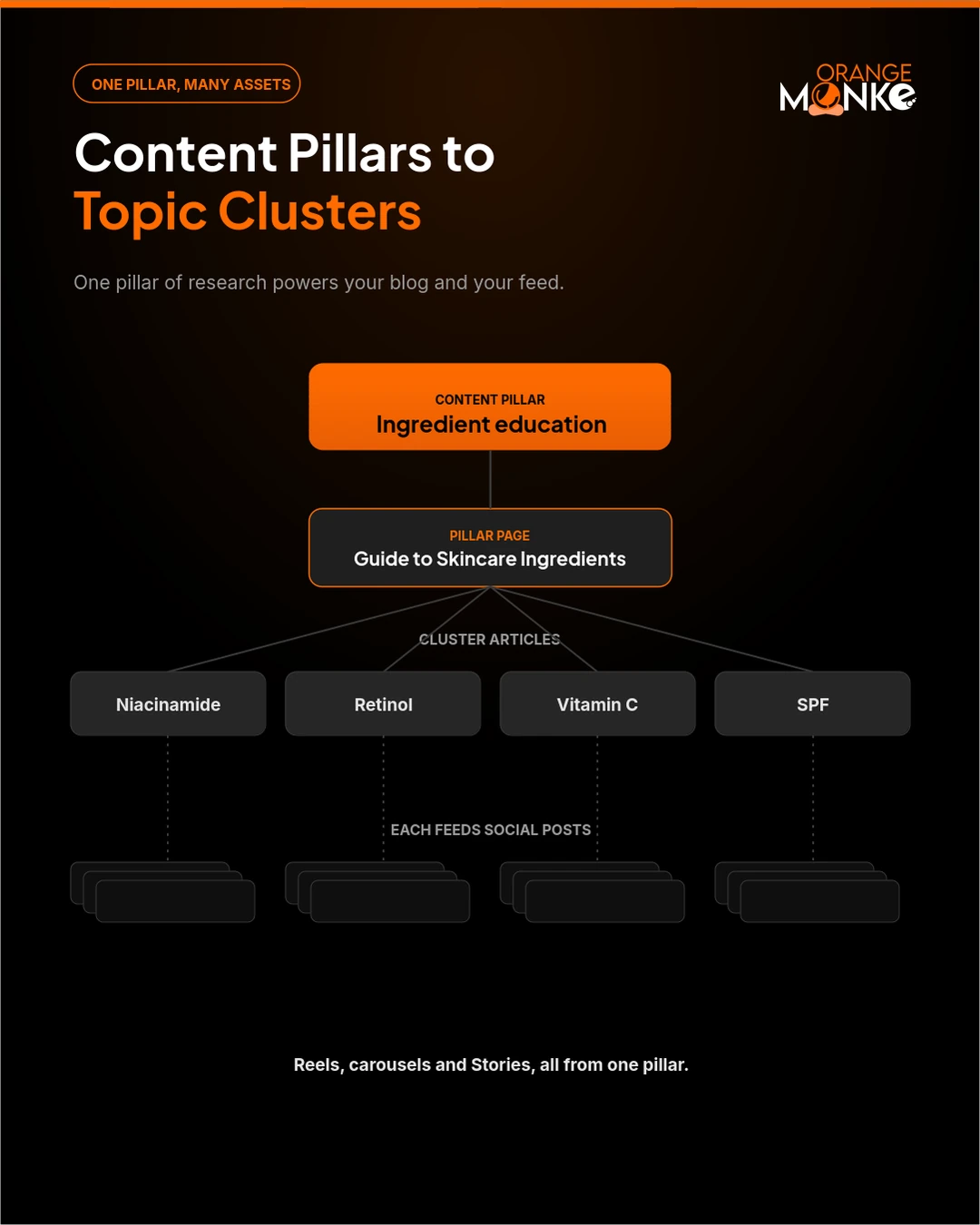
The two work best together. Each content pillar can become a topic cluster on your website. For the skincare brand, the ingredient education pillar becomes a pillar page called "The Complete Guide to Skincare Ingredients", supported by cluster articles on niacinamide, retinol, vitamin C and SPF. Each of those articles then feeds several social posts, so one piece of research powers the blog and the feed.
What Is a Pillar Page?
A pillar page is a long, in-depth article that covers a broad topic from end to end and links to shorter articles that go deeper into each subtopic. It is the hub of a topic cluster, and the cluster articles link back to it. Three formats are common:
- The complete guide: covers a topic from basics to advanced, like the article you are reading now.
- The "what is" page: defines a concept in depth, with examples and related terms.
- The resource hub: curates your best articles, tools and templates on one topic.
Pillar pages help SEO because they concentrate internal links and show search engines that your site covers a subject thoroughly. To see how keyword choice feeds this structure, read our guide on how SEO keywords drive rankings and traffic, and our walkthrough on how to write SEO-optimized blog posts that rank for the cluster articles themselves.
How Do You Keep Your Content Pillars Working?
You keep content pillars working by measuring each pillar's results every month, reviewing the mix every quarter, and replacing any pillar that stops earning attention. Pillars are a strategy, not a tattoo.
How Do You Measure Content Pillar Performance?
You measure content pillar performance by tagging every post with its pillar and comparing average results per pillar, not per post. A single viral post can hide a weak pillar. Track these for each pillar every month:
- Reach and engagement rate: is the pillar getting seen and noticed?
- Saves and shares: is it genuinely useful? These are the strongest signals of value.
- Clicks and enquiries: is it moving people towards the business?
- Production effort: is the return worth the time it takes to make?
After 90 days, give more space to the pillars that lead, and rework or replace the ones that lag.
What Are the Most Common Content Pillar Mistakes?
The most common content pillar mistakes are choosing too many, making them too broad, and letting promotion take over, all of which bring back the random posting pillars are meant to fix.
- Too many pillars. Seven pillars on a two-person team means none gets done well.
- Pillars that are too broad. "Marketing" is an industry, not a pillar. "Local SEO for clinics" is a pillar.
- Too much promotion. If every pillar leads to a sales post, followers stop listening.
- Copying competitors. Their pillars fit their audience, not yours.
- Never reviewing. Audiences change. Pillars should evolve with them.
Conclusion: Build the Pillars, Then Let the Calendar Fill Itself
Content pillars give your brand a clear point of view, a calendar that is easy to fill, and a way to measure what actually works. Start with 3 to 5 pillars drawn from your goals and your audience's real questions, then review them every quarter.
If you want a team that builds your pillars and turns them into content every week, Orange MonkE's content writing services can help you plan, create and measure it.
We turn pillars into content that runs weekly.
From pillar strategy to a full calendar of Reels, carousels and articles, our team plans, creates and measures it, so every post has a job.
Explore content writing services →Frequently Asked Questions
An example of a content pillar is "ingredient education" for a skincare brand, where every post teaches customers how ingredients work and builds trust before they buy.
- Under it: carousels on niacinamide, Reels on SPF, myth-busting posts.
- Why it works: it answers a real buyer question and supports a business goal.
A good pillar can produce 20-plus post ideas without running dry.
The difference between content buckets and content pillars is scope: pillars are the long-term themes of your strategy, while buckets are repeatable post types inside a pillar.
- Pillar: a core theme lasting months to years, like ingredient education.
- Bucket: a repeatable format inside it, like a weekly "ingredient of the week" carousel.
Pillars set direction; buckets make them repeatable.
The five pillars of content most brands use are educational, entertaining, inspirational, promotional and community content, which together cover the three E's.
- The three E's: educate, entertain and engage.
- Promotion: kept to a small, value-led share, not its own big slice.
A healthy mix touches all three E's every week.
The 5 pillars of content strategy usually refer to process rather than themes: audience research, content creation, distribution, measurement and optimisation.
- Where pillars fit: inside the creation stage, deciding what you make.
- The rest: cover who it is for, where it goes, and how you improve it.
Content pillars and content strategy work at different levels of the same plan.
Content pillars can and should change over time as your audience, products and goals evolve, so treat them as a living strategy rather than a fixed rule.
- Review quarterly: keep the pillars that lead on engagement and enquiries.
- Replace: any pillar that has stopped earning attention.
Pillars are a strategy, not a tattoo.
AI can suggest content pillars for your brand, but it cannot choose them for you, because the final call needs human judgement about your goals and expertise.
- Feed it: your customer questions and post performance to find patterns.
- You decide: which 3 to 5 fit your brand and can last.
Use AI as a fast analyst, not the strategist.
You need topic clusters alongside content pillars if you want your website to rank on Google, because pillars guide messaging while clusters organise your blog for search.
- Pillars: guide what you say across every channel.
- Clusters: show search engines your depth on each theme.
Each content pillar can become a topic cluster on your site.