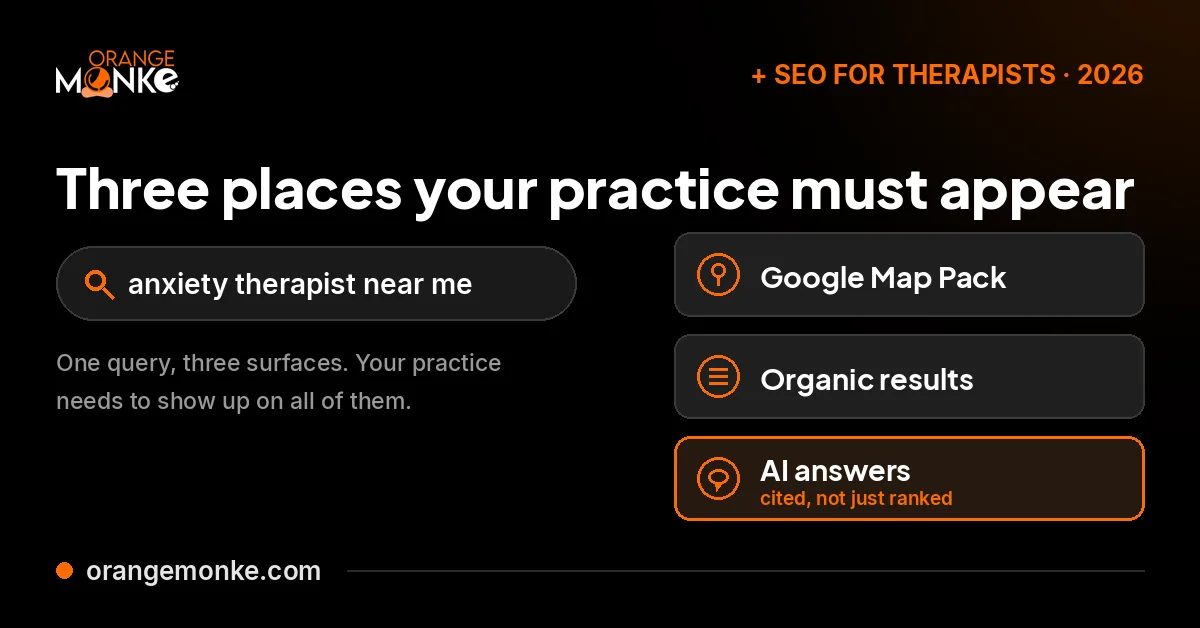
Most therapy clients now start their search on Google or an AI assistant, not with a referral. They type a query like anxiety therapist near me, scan the map listings and the first few results, and shortlist two or three practices before anyone picks up a phone.
If your practice does not appear in that first screen, the client books with someone who does. That is the entire case for SEO for therapists, and it holds whether you are a psychotherapist, counsellor, psychologist, or a rehab clinician.
This guide covers the full system for 2026: keywords, your website, the Google Map Pack, backlinks, and the newest layer, getting quoted by AI tools like ChatGPT and Google AI Overviews.
SEO for therapists is the work of making your practice easy to find on Google, Google Maps, and AI search tools. The core pieces are a complete Google Business Profile, one dedicated page per specialty, consistent directory listings, steady HIPAA-safe reviews, and answer-first content that AI engines can quote. Most practices see meaningful movement in 3 to 6 months.
What Is SEO for Therapists?
SEO for therapists is the work of making a therapy practice easy to find when someone searches Google, Google Maps, or an AI tool for help in their area. It is not a single tactic. It is a set of connected signals that tell search engines your practice is real, qualified, and relevant to the person searching.
The work splits into three layers, and knowing which layer is broken tells you where to start:
- On-page SEO: the pages you own, including page titles, headings, and a dedicated page for each specialty you treat.
- Local SEO: your Google Business Profile, reviews, and the consistency of your listings across directories.
- Content SEO: answer-first pages and posts that help Google and AI tools understand exactly who you help and how.
The same principles apply whether you call it therapist SEO, therapy practice SEO, or SEO for psychologists and counsellors. The searcher's behaviour is identical, so the playbook is too. Start by finding your target audience and the exact words they use, because everything below builds on that.
Why Do Therapists Need SEO in 2026?
Therapists need SEO because most clients now verify and compare practices online before they reach out, and a directory profile alone no longer fills a calendar. Psychology Today lists hundreds of therapists per city, so a profile there puts you in a queue, not at the front of it.
Reviews make the gap measurable. Zocdoc data cited across the industry shows providers with 50 or more reviews received 10 times as many bookings as those with fewer than 10, and providers with over 100 reviews saw a 27-fold increase. BrightLocal's 2025 Local Consumer Review Survey found 83% of consumers use Google to read reviews before choosing a local business.
SEO also compounds where ads do not. A paid campaign stops producing the day you pause it, while a page that ranks keeps bringing enquiries for years. We saw the same pattern in our healthcare SEO case study, where organic visibility kept climbing long after the initial work.
Why does Google hold therapy websites to a higher standard?
Google holds therapy websites to a higher standard because therapy is classified as YMYL, short for Your Money or Your Life, where a bad answer can cause real harm. Health, finance, and legal content all sit in this bucket, and Google evaluates it far more strictly than a recipe blog.
The evaluation framework is E-E-A-T: Experience, Expertise, Authoritativeness, and Trustworthiness. In practice that means a named clinician, verifiable credentials, a link to your licensing board, and consistent practice details. A therapy site with no identifiable owner has almost no chance of ranking, no matter how good the writing is. Weak E-E-A-T is the single most common reason therapy websites stall, which is why the SEO best practices for this niche start with proving who you are. If a calendar full of enquiries is the goal, full-service SEO treats trust signals as the foundation, not an afterthought.
How Do Clients Find Therapists Now?
Clients find therapists through four doors in 2026: the Google Map Pack, organic search results, therapy directories, and AI assistants. A strong practice shows up in all four, because different clients trust different doors.
The newest door is growing fastest. OpenAI reported in March 2026 that ChatGPT reaches 900 million weekly users, and people increasingly ask it questions like which therapist near me works with ADHD adults. AI assistants answer by quoting sources, so the practices with clear, citable pages get named while everyone else stays invisible.
None of this means traditional search is finished. The debate over whether SEO is dead keeps resolving the same way: the fundamentals still decide who gets found, and AI search rewards exactly the same fundamentals. The rest of this guide works through each door in order of impact.
Which Keywords Should Therapists Target?
Therapists should target keywords that combine a specialty with a location, such as anxiety therapist Toronto or couples counseling near me, because those searches come from people ready to book. Broad single words like therapist are dominated by directories and convert poorly.
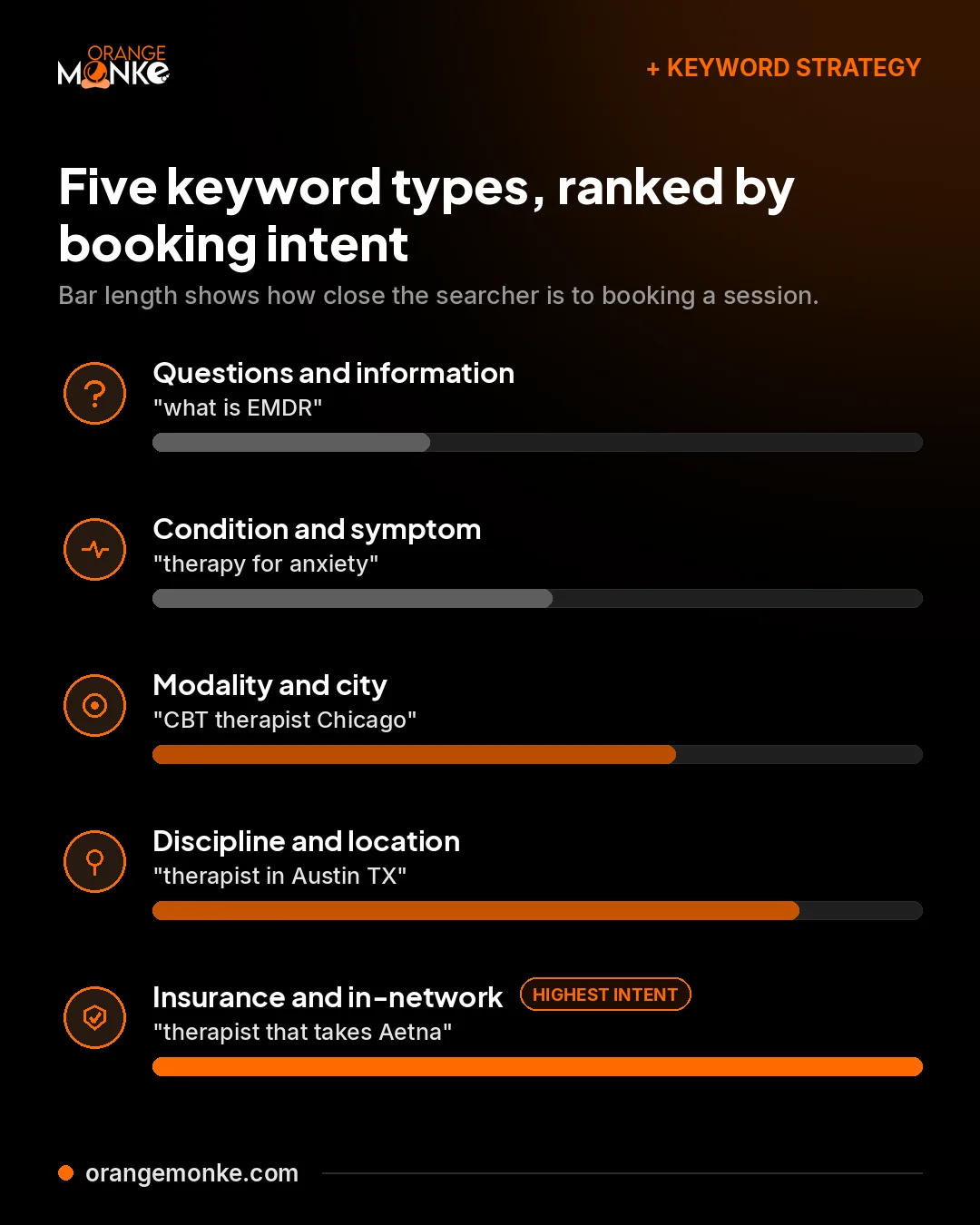
Every therapist keyword falls into one of five buckets, and each bucket signals a different level of booking intent. The graphic below ranks them.
To size the opportunity, here are real US monthly search volumes for common therapy keywords, drawn from Google Ads data in July 2026. The table shows why the biggest numbers are often the wrong targets.
| Keyword | US monthly searches | Best target page |
|---|---|---|
| therapist near me | 368,000 | Map Pack via Google Business Profile |
| therapy for anxiety | 135,000 | Anxiety specialty page, city-qualified |
| therapy for depression | 110,000 | Depression specialty page |
| dbt therapy | 90,500 | Modality page |
| marriage counseling near me | 74,000 | Couples specialty page plus Map Pack |
| ifs therapy | 60,500 | Modality page |
| couples therapy near me | 49,500 | Couples specialty page plus Map Pack |
| ocd therapy | 33,100 | OCD specialty page |
| what is emdr | 22,200 | Blog post, the format AI tools quote |
| how much does therapy cost | 6,600 | Fees page |
Ignore the giant near me numbers, which the Map Pack and directories win, and build pages for the city-qualified slice you can actually rank for.
Map 10 to 15 primary keywords to specific pages before you write anything, so no two pages compete for the same term. If the process is new to you, our guide on keyword research for beginners walks through it step by step.
Why do insurance keywords convert best?
Insurance keywords convert best because someone searching therapist that takes Aetna has already decided to book and is only confirming they can afford you. These searches are the most under-used opportunity in therapist SEO.
Name every insurer you accept on your website, and put the list on each specialty page rather than one buried insurance page. Include Medicare and Medicaid by name, because those searches are frequent and almost no competitor targets them.
How Do You Optimise a Therapy Website Page by Page?
You optimise a therapy website by giving every page one primary keyword and one job, starting with a dedicated page for each specialty you treat. A single Services page listing everything is the single largest reason established therapy sites plateau, because Google ranks individual pages for individual topics.
A page called Anxiety Therapy in Austin can rank for that search. A page called Services cannot. Each specialty page needs 500 to 1,000 words in your own clinical voice: who you help, your approach, what a first session looks like, insurances accepted, and a clear booking call to action. Professional content writing services exist precisely because these pages carry the revenue.
What on-page elements matter most?
The title tag, H1, meta description, and internal links matter most, because they tell Google and clients what each page is about before a word of body copy is read. Get these five right on every page:
- Title tag: primary keyword plus location plus practice name, under 60 characters.
- One H1 per page: matching or closely mirroring the title tag.
- Meta description: a warm, clear 150 to 160 character invitation that earns the click.
- Image alt text: natural descriptions of every image, which also helps accessibility.
- Internal links: every blog post links to the specialty page it supports, passing authority where it earns money.
Skip relics like the meta keywords tag, which Google has ignored since 2009, a story we cover in our meta keywords myth breakdown. If auditing tags page by page is not how you want to spend evenings, on-page SEO services handle the whole sweep.
A blog is optional but powerful once the money pages exist. One post per month targeting a question keyword builds topical authority, and our guide to writing blog posts that rank plus a simple content marketing strategy keep the cadence sustainable.
How Does Local SEO Get Your Practice Into the Map Pack?
Local SEO gets your practice into the Map Pack through your Google Business Profile, consistent listings, and steady reviews, because those are the signals Google weighs for the three map slots. Whitespark's 2026 Local Search Ranking Factors survey of 47 local SEO experts puts Google Business Profile signals at roughly 32% of local pack ranking weight, with proximity to the searcher the top single factor at 55%.
You cannot ethically change your distance from a searcher, so the work is maximising relevance and prominence. The checklist below is the whole game for a single-location practice.
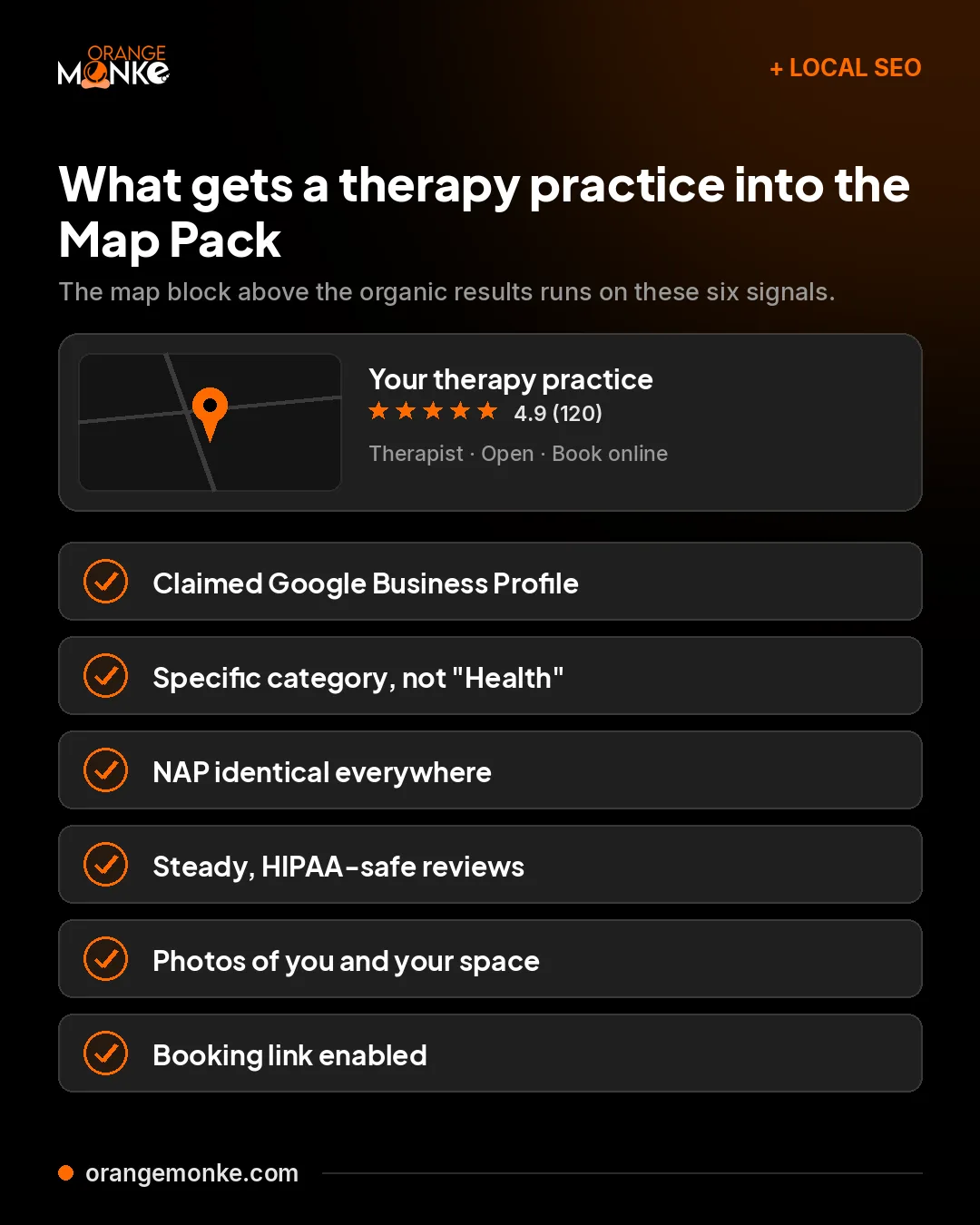
Two of those signals deserve extra detail. First, the category: choose Psychotherapist, Marriage and Family Therapist, or your exact discipline, never a generic health label, because the specific category is what matches you to specific searches. Our Google Business Profile optimisation service exists because this one profile outweighs everything else in local results.
Second, NAP consistency: your name, address, and phone number must be identical on your website, your profile, and every directory. Even St versus Street variations dilute trust. Local SEO services typically start with a citation cleanup for exactly this reason, and you can self-check with our free Local SEO checklist.
How do reviews work without breaking HIPAA?
Reviews work under HIPAA when you invite feedback in general terms and never confirm publicly that any reviewer is a client. Ask at natural moments using language your licensing board permits, share a direct link to your review page, and reply to every review with a brief, privacy-safe thank you that references no conditions, treatment, or appointment history.
Pace beats volume. A few new reviews every month look natural to Google and to future clients, a pattern we unpack in our guide to building review velocity.
Clients are searching for a therapist near you. Are they finding your practice?
We build the local visibility, review engine, and specialty pages that put therapy practices at the top of Google Maps.
Grow my practice →What Technical SEO Basics Do Therapy Sites Need?
Therapy sites need eight technical basics, and most platforms like WordPress and Squarespace handle them with light configuration rather than code. Technical weaknesses erode the trust Google extends to a YMYL site, so this list is worth an afternoon:
- HTTPS: an SSL certificate, non-negotiable for a site discussing mental health.
- Mobile-responsive design: people searching during a hard moment do it on a phone.
- Page speed: under 3 seconds, checked with PageSpeed Insights, with compressed images.
- XML sitemap: submitted in Google Search Console so Google finds every page.
- Meta titles and descriptions: unique on every page.
- Clean heading structure: one H1, logical H2 sections.
- No broken links: audited quarterly.
- Schema markup: LocalBusiness and FAQPage structured data, which supporting plugins generate.
Run your site through our free SEO audit tool to see which items fail today. If the report comes back heavy, technical SEO services clear the whole list in the first month of an engagement.
How Do Therapists Earn Backlinks Without Buying Them?
Therapists earn backlinks through directories, licensing bodies, local press, podcasts, and provider partnerships, and never by buying links, which risks a site-wide penalty. Quality beats quantity in this niche: one link from a reputable health source outweighs dozens of generic directory entries.
Work the ladder from easiest to strongest:
- Therapy directoriesPsychology Today, TherapyDen, GoodTherapy, and Zencare give you citations and links in an afternoon, with your name, address, and phone identical on each.
- Your licensing bodyA public find-a-member page on a regulator or association site is the highest-authority therapy backlink available, and it verifies your licence at the same time.
- Local pressPitch commentary during mental health awareness month, back-to-school stress season, or winter low-mood coverage. One local news link is worth more than 50 directory links.
- Podcasts and guest postsPitch 5 to 10 shows in your specialty, and the show notes link comes with an audience of potential clients attached.
- Provider partnershipsPsychiatrists, family doctors, physiotherapists, and doulas all keep resource pages, and a referral relationship naturally earns a listing.
Everything on that ladder is clean, sustainable white hat SEO. Link farms and paid placements are what Google's spam systems exist to catch, and a penalty on a small practice site can erase years of work.
How Do You Get Cited in AI Overviews and ChatGPT?
You get cited by AI tools by publishing answer-first content with named credentials, because engines like ChatGPT, Perplexity, and Google AI Overviews quote the source that states the answer most clearly. This practice is called GEO, generative engine optimisation, and its close cousin AEO, answer engine optimisation, and it is the biggest gap between therapy sites that grow in 2026 and those that stall.
The good news is that GEO is not a second job. It is a formatting layer on top of the SEO work you have already done in this guide. The graphic below shows what AI engines actually read on a therapy site, and what they skip.
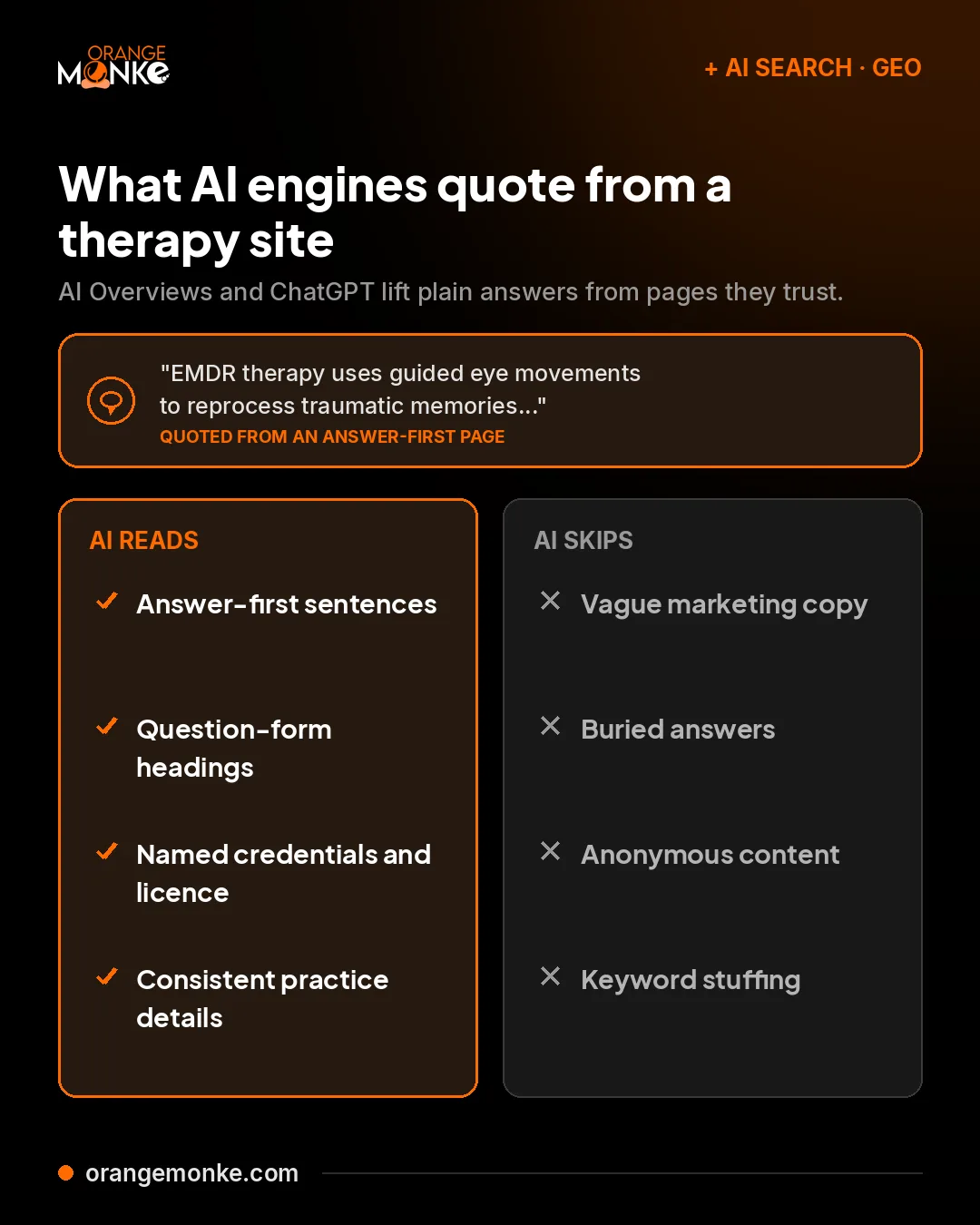
Apply five mechanics to every important page:
- Answer in the first sentenceOpen every section with the direct answer, then elaborate. AI systems lift the first self-contained sentence, exactly the way this article is written.
- Use question-form headingsMatch the exact questions clients ask, such as how much does therapy cost, because engines map questions to headings.
- Name yourself and your licenceAn author byline with licence type and a link to your regulator turns anonymous text into a citable expert source.
- Keep facts consistent everywhereThe same practice name, offerings, and details across your site, profile, and directories give AI systems the confidence to name you.
- Add FAQ schemaStructured question-and-answer markup makes your answers machine-readable for both Google features and AI crawlers.
These same signals are reshaping every niche, as our roundup of 2026 SEO trends shows. If you want the citations without learning the mechanics, AI SEO services covering AEO and GEO are our specialist lane.
How Long Does SEO Take for a Therapy Practice?
SEO for a therapy practice moves in stages: profile and technical fixes lift visibility within weeks, while competitive organic rankings take 3 to 6 months and compound from there. Anyone promising page one in two weeks is describing work that will not survive the next update.
- Months 1 to 2: foundation. Google Business Profile completed, technical issues fixed, money pages tightened. Map visibility often moves first.
- Months 3 to 4: traction. Specialty pages index and long-tail, city-qualified queries start bringing impressions.
- Months 5 to 8: growth. Strong pages climb, and the constraint shifts to authority and content quality.
- Months 9 to 12: compounding. Earlier pages pull impressions, newer pages index faster, and enquiries become predictable.
Measure leading signals rather than vanity numbers: impressions in Google Search Console, map visibility, and enquiry quality. Pair Search Console with GA4 traffic tracking so you can see which pages produce actual contact-form fills. The stages hold even for tiny sites, as our walkthrough on starting SEO on a small website shows.
Should You Do SEO Yourself or Hire an Agency?
Do SEO yourself if you have 5 to 10 hours a month and one location, and hire help when you are in a competitive market or your time is worth more in sessions. Everything in this guide is doable solo, and the first month of fixes needs no specialist at all.
The honest maths is opportunity cost. Ten hours of DIY SEO is ten client sessions of revenue, every month, indefinitely. Once a practice is established, most owners find that a specialist running the engine pays for itself in one or two retained clients, especially when SEO is coordinated with paid campaigns, a pairing we cover in combining SEO and PPC.
If you do hire, screen hard. A good partner explains the plan in plain language, diagnoses before quoting, and understands that therapy is YMYL with HIPAA constraints. Walk away from anyone guaranteeing rankings, hiding behind jargon, or pushing long lock-in contracts. Our list of the best digital marketing agencies shows what credible looks like, and our dedicated SEO services for therapists page shows exactly what a therapist-specific engagement includes.
Conclusion
Ranking a therapy practice in 2026 comes down to five moves: a complete Google Business Profile, one page per specialty, consistent listings, steady HIPAA-safe reviews, and answer-first content that AI engines can quote. None of it requires tricks, and all of it compounds.
Start with the layer that is most broken. If the Map Pack ignores you, fix the profile and citations first. If searchers land on your site and leave, fix the specialty pages. If nothing about you appears in AI answers, add the GEO layer.
At Orange MonkE, we run this exact system for therapy practices across the US, UAE, and India, from local visibility to AI citations. The work is ethical, HIPAA-aware, and built to keep your calendar full long after the first ranking arrives.
You did not train for years to spend evenings on SEO. Let us handle the rankings.
From technical fixes to content and AI citations, we run the whole engine while you run your sessions.
Get a free SEO audit →Frequently Asked Questions
SEO for therapists is the work of making a therapy practice easy to find when people search Google, Google Maps, or AI tools for help in their area.
- On-page SEO: your website pages, titles, headings, and specialty content.
- Local SEO: your Google Business Profile, reviews, and directory listings.
- Content SEO: answer-first pages that Google and AI assistants can quote.
Start with whichever layer is weakest, and if you want a done-for-you plan, our SEO services for therapists cover all three.
SEO for a therapy practice typically shows early movement within weeks and meaningful results in 3 to 6 months, with compounding growth after that.
- Weeks 1 to 8: Google Business Profile fixes and technical cleanup produce the first visible lifts.
- Months 3 to 6: specialty pages start ranking for city-qualified keywords.
- Months 6 to 12: authority compounds and new pages index faster.
The early wins usually come from fixing what is broken, which is why a technical SEO audit is the right first month of work.
SEO is worth it for a private therapy practice because one well-optimised page keeps bringing enquiries for years, while paid ads stop the moment you stop paying.
- Break-even maths: a single retained client usually covers months of SEO investment.
- Compounding: each new page adds authority to every page you already have.
- Ownership: unlike a directory profile, you own your website and its rankings.
If your calendar depends entirely on directories or referrals, full-service SEO is the channel that removes that dependence.
The best SEO keywords for therapists combine a specialty with a location, such as anxiety therapist Toronto or couples therapy near me, because they match people ready to book.
- Location plus specialty: the highest-converting pattern for specialty pages.
- Insurance keywords: phrases like therapist that takes Aetna signal a qualified buyer.
- Question keywords: queries like what is EMDR feed blog posts and AI citations.
Map 10 to 15 primary keywords to specific pages before writing anything, then let on-page SEO services handle the placement.
Therapists improve local SEO by completing their Google Business Profile, keeping their name, address, and phone number identical everywhere, and earning steady reviews.
- Profile completeness: every field filled, a specific category, and recent photos.
- NAP consistency: identical details across your site, profile, and directories.
- Review velocity: a few new reviews each month beat a one-time burst.
Local visibility is the fastest lever for most practices, and our local SEO services are built around exactly these signals.
You optimise a Google Business Profile for a therapy practice by choosing the most specific category, completing every section, and adding each specialty as a separate service.
- Category: pick Psychotherapist or Marriage and Family Therapist, never a generic health label.
- Description: use the full space and the language clients actually search.
- Services and photos: list every specialty and upload real photos of you and your space.
A complete profile is the single biggest local ranking lever, which is what our Google Business Profile optimisation service delivers.
Psychology Today helps therapist SEO as a citation and referral source, but it cannot replace your own website because you are renting visibility on someone else’s domain.
- What it gives you: a trusted backlink, a citation, and profile traffic.
- What it cannot give you: ownership, ranking equity, or standout positioning among hundreds of profiles.
- The balance: keep the profile accurate, but invest in pages you own.
Treat directories as one layer of an ecosystem, then build the authority layer with off-page SEO services.
Therapists show up in AI search results by publishing clear, answer-first content with named credentials, so tools like ChatGPT and Google AI Overviews can quote and cite the page.
- Answer first: state the direct answer in the opening sentence of each section.
- Question headings: match the exact questions clients ask AI assistants.
- Verifiable identity: show your licence, credentials, and consistent practice details.
This is the fastest-growing discovery channel for health practices, and our AI SEO services specialise in earning those citations.
Therapists ask for reviews without breaking HIPAA by inviting feedback in general terms and never confirming, in public, that any reviewer is a client.
- The ask: share your review link at natural moments, using language your licensing board permits.
- The response: reply to every review with a brief, privacy-safe thank you that references no treatment details.
- The pace: steady monthly reviews look natural to Google and to future clients.
Reviews are a ranking factor and a trust signal at once, and reputation management keeps the process compliant.