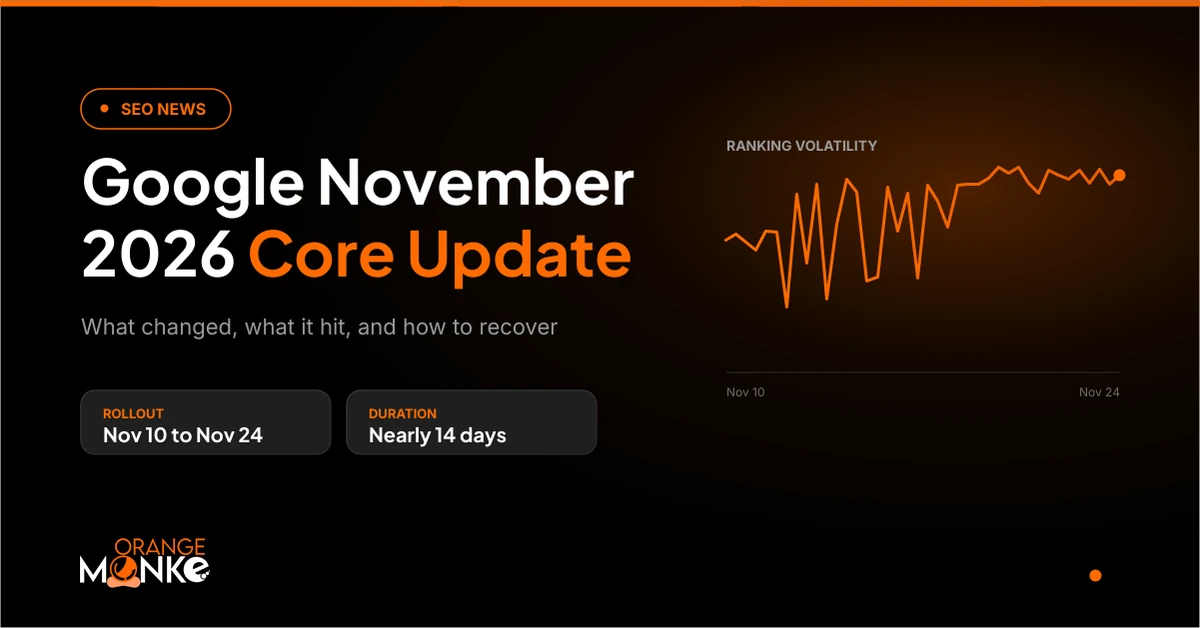
The Google November 2026 core update rolled out from November 10 to November 24, 2026, taking nearly 14 days, and it was a broad, global update with no officially named target. SEOs observed templated and programmatic pages losing visibility while strong product and brand pages held. Recovery means waiting a full week, reading your data carefully, and improving pages with real quality issues.
Google's November 2026 core update is the third broad core update of the year, and it reshuffled rankings across every language and region between November 10 and November 24. Google confirmed only the timing, not what the update rewards or demotes, so most of what we know about its impact comes from SEOs watching their own data.
This guide covers what the November 2026 core update is, when it launched and finished, what SEOs observed it hitting, how to tell if it affected you, and the exact steps to recover, including how the holiday season and a preannounced December update complicate the picture. It builds on the same approach we used for the Google May 2026 core update.
What Is the Google November 2026 Core Update?
The Google November 2026 core update is a broad, global change to Google's core ranking systems that ran from November 10 to November 24, 2026, and adjusts how Google weighs quality and relevance across all types of sites. It is not aimed at any single tactic or niche.
A core update does not target spam or a specific violation. Instead, it re-evaluates how well pages satisfy searchers and rebalances the weight Google gives to existing signals, which is why rankings can move even when nothing on your site changed. Google describes it as a regular update meant to better surface relevant, satisfying content. To see which signals a core update rebalances, our guide to SEO ranking factors breaks them down.
When Did the November 2026 Core Update Launch and Finish?
The November 2026 core update launched on November 10, 2026 and finished on November 24, 2026, a rollout of nearly 14 days that stayed within the two-week window Google gave at the start. It applied globally across all languages.
Noticeable movement started around November 13, three days into the rollout, with Search Engine Roundtable reporting volatility as early as November 9, the day before Google confirmed it. SEOs tracking the update saw large swings in Search Console through the middle of the rollout, and third-party tools only lined up with Search Console data toward the end. Expect tremors and partial reversals even after completion, because Google often keeps tuning its core systems.
What Did the November 2026 Core Update Target?
The November 2026 core update named no official target, but SEOs widely observed templated and programmatic pages losing visibility while genuine product, brand and people-first pages held steady. Treat this as pattern-spotting, not confirmation from Google.
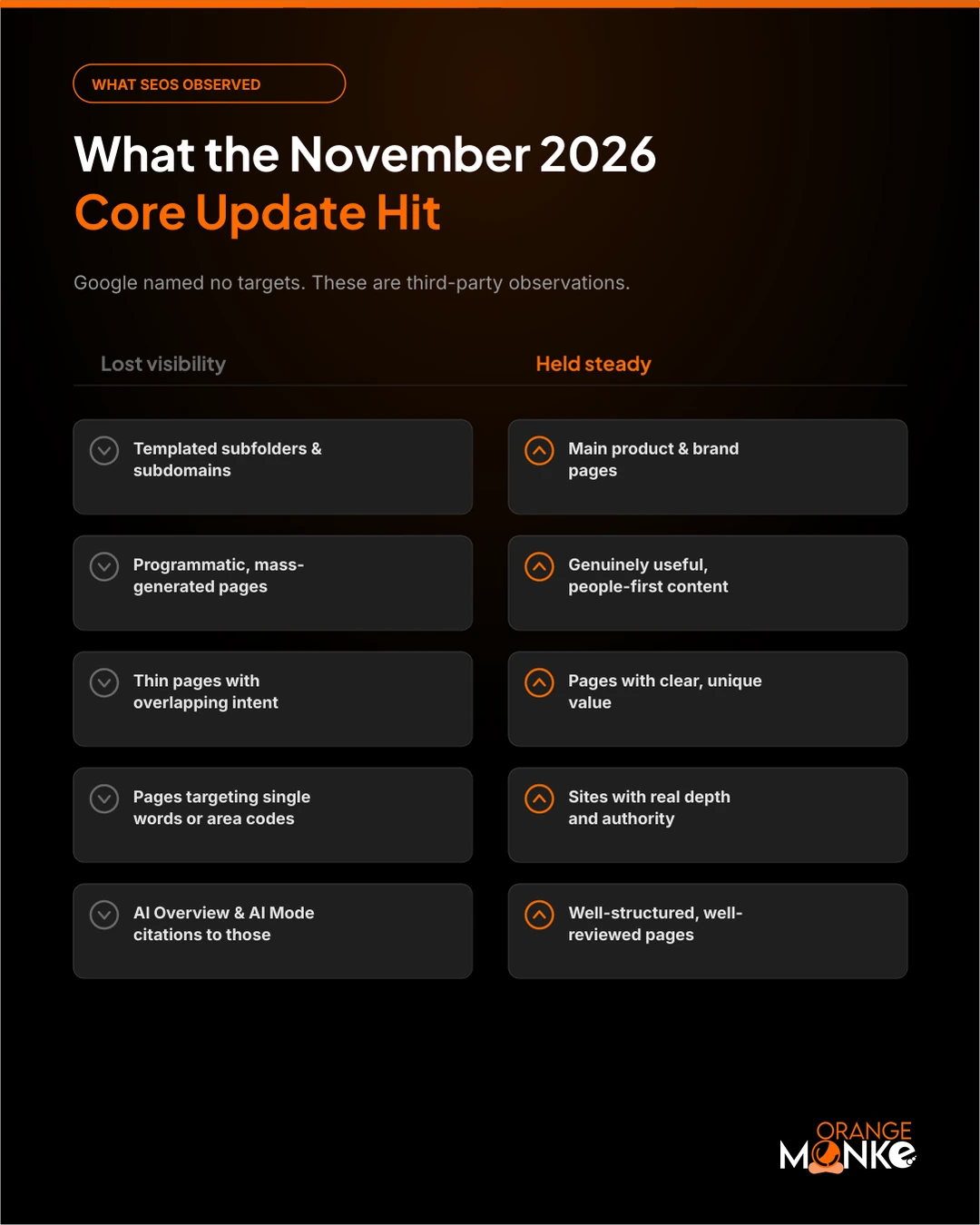
Analysts including Lily Ray and Glenn Gabe reported that the clearest losses sat in large sets of templated subfolders and subdomains, the kind of programmatic pages built from one template repeated across thousands of near-identical URLs targeting single words, area codes or comparison searches. Pages with real, unique value tended to hold. The same thin, templated sections also saw fewer citations in AI Overviews and AI Mode. The lesson is the one every core update repeats: build pages for people, not for scale, which is exactly what our beginner's guide to white-hat SEO teaches.
Where Does This Fit in Google's 2026 Core Update Cycle?
The November 2026 core update is the third core update of the year, following the March and May updates, and Google has already preannounced a December 2026 core update. Core updates now arrive every few months, so recovery work has to be continuous.
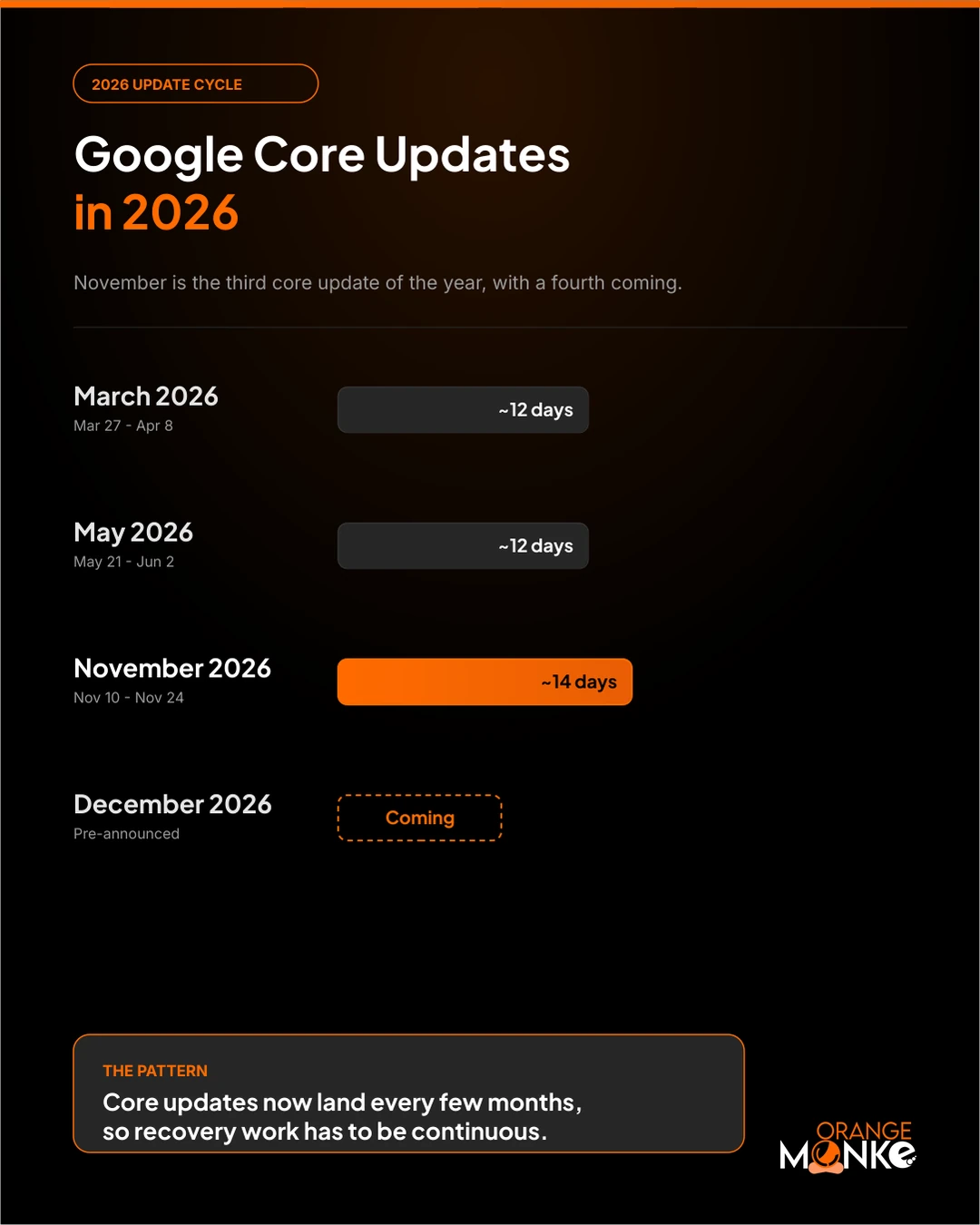
| Core update | Rollout window | Duration |
|---|---|---|
| March 2026 Core Update | Mar 27 to Apr 8 | ~12 days |
| May 2026 Core Update | May 21 to Jun 2 | ~12 days |
| November 2026 Core Update | Nov 10 to Nov 24 | ~14 days |
| December 2026 Core Update | Preannounced | Coming |
For context, the 2026 rollouts have been short: the November 2024 core update took nearly 24 days and the November 2023 one almost 26, so this year's two-week rollouts are fast by comparison.
How Do You Know If the November 2026 Core Update Hit You?
You were likely hit by the November 2026 core update if your organic clicks and rankings shifted sharply between November 13 and November 24 and the movement held after the rollout finished. Confirm the timing before you act on anything.
Work through this quick check:
- Match the dates. Overlay your Search Console drop or gain against the November 10 to 24 window, and remember movement that began before November 10 points elsewhere.
- Wait for it to settle. Mid-rollout swings reverse, so a real impact is one that holds after November 24.
- Look at the page level. Use page-path filters to see whether templated or programmatic folders moved while your core pages held.
- Rule out noise. Exclude the October 31 to November 2 bot click spike and the November 9 to 11 generative-AI logging anomaly, both of which distort the data.
If the dates do not line up, the cause may be seasonal or technical rather than the update. Our guide on what to do when website traffic drops suddenly walks through the full list of causes.
How to Recover From the November 2026 Core Update
Recovering from the November 2026 core update means waiting at least one full week after completion, reading your data against a clean baseline, and improving the pages with genuine quality problems. There is no reconsideration request for an algorithmic core update.
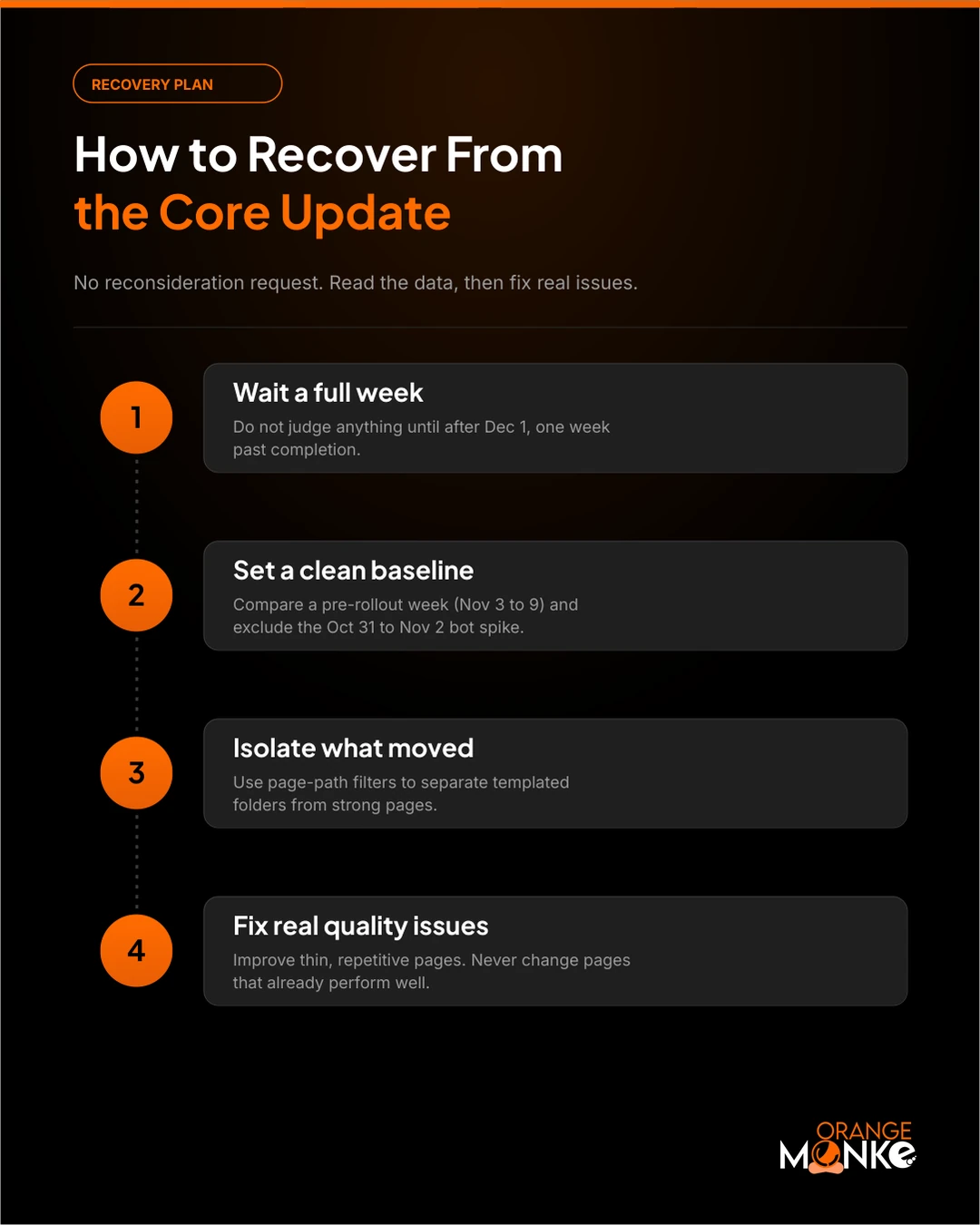
Follow this recovery sequence:
- Wait a full week. Do not judge anything until after December 1, roughly one week past the November 24 completion, so the data stabilises.
- Set a clean baseline. Compare a pre-rollout week such as November 3 to 9 against your post-update data, excluding the late-October bot spike that would skew the comparison.
- Isolate what moved. Use page-path filters to separate templated or programmatic folders from your strongest pages, and compare holiday traffic against the same period last year.
- Fix real quality issues. Improve thin, repetitive or overlapping pages, and study the competitors that now outrank you. Never change pages that already perform well.
Recovery from a core update usually takes until the next core update for Google to fully reassess your fixes, so treat it as sustained quality work rather than a quick patch. Strong, trustworthy content is the throughline, which is why E-E-A-T matters more with every update.
How Did the November 2026 Core Update Affect AI Overviews and AI Mode?
The November 2026 core update appeared to cut AI Overviews and AI Mode citations for the same templated and programmatic sections that lost organic visibility, because AI features draw on the same ranking systems a core update rebalances. Strong pages kept their citations.
This matters because AI Overviews now sit above the organic results for many searches, so losing a citation there compounds a ranking drop. The pages that keep getting quoted are the ones with clear, well-structured, trustworthy content, the same qualities a core update rewards. Our guide to Google AI Overviews and AI Mode covers how to earn those citations, and our AI SEO services are built to win them.
What Should You Do Now, With a December Core Update Coming?
With a December 2026 core update already preannounced, the smart move now is to hold steady, finish your diagnosis after December 1, and invest in genuine content quality rather than quick fixes. Panic edits mid-cycle only muddy your data.
- Do not panic-edit. Sweeping changes before you have clean data make the next update impossible to read.
- Prioritise real improvements. Consolidate thin pages, deepen genuinely useful ones, and cut programmatic clutter.
- Keep publishing quality. Steady, people-first publishing is the safest posture before another core update. Our guide to getting organic traffic covers the fundamentals that survive every rollout.
The Bottom Line on the November 2026 Core Update
The November 2026 core update rewarded genuinely useful, people-first pages and pulled visibility from templated, programmatic content, so the winning response is better content, not quick tricks. If you were hit, read your data carefully, fix the real problems, and give Google time to reassess.
At Orange MonkE, this is the exact process we run for clients after every core update: a clean diagnosis that separates seasonal noise from real losses, then a prioritised plan to rebuild quality. If the November 2026 core update hit your rankings, our SEO services team will find what changed and get your traffic climbing again before December's update lands.
Find what changed before December's update.
We separate seasonal noise from real losses, pinpoint the pages the November core update hit, and rebuild quality so you recover in classic and AI search alike.
Explore our SEO services →Frequently Asked Questions
The Google November 2026 core update started on November 10, 2026 and finished on November 24, 2026, a rollout of nearly 14 days that stayed within Google's two-week estimate.
- Global: it applied across all languages and regions.
- Impact: noticeable movement began around November 13.
Wait until after it completed before judging any change to your rankings.
The November 2026 core update named no official target, but SEOs observed templated and programmatic pages losing visibility while genuine, people-first pages held steady.
- Lost ground: thin, mass-generated pages built from one repeated template.
- Held steady: product, brand and uniquely useful pages.
Core updates reward quality, so there is no single violation to fix.
No, a core update drop is not a penalty, because core updates rebalance how Google weighs quality and relevance rather than punishing a specific violation.
- Not a manual action: there is nothing to appeal or disavow.
- The fix: improve overall content quality over time.
A drop means other pages now satisfy searchers better, not that you broke a rule.
The November 2026 core update took nearly 14 days to roll out, from November 10 to November 24, within the two-week window Google gave at launch.
- Faster than past Novembers: 2024 took ~24 days and 2023 almost 26.
- In line with 2026: March and May each ran about 12 days.
Expect minor tremors even after a rollout is marked complete.
You recover from the November 2026 core update by waiting a full week, comparing clean before-and-after data, and improving the pages with real quality problems.
- Diagnose: isolate which folders moved using page-path filters.
- Fix: deepen thin pages and never touch ones that still perform.
Full recovery usually takes until the next core update reassesses your site.
You should analyse your Search Console data at least one full week after the November 2026 core update completed, so wait until after December 1 before drawing conclusions.
- Baseline: compare against a pre-rollout week like November 3 to 9.
- Exclude noise: the late-October bot spike and the Nov 9 to 11 logging anomaly.
Adjust for holiday seasonality by comparing to the same period last year.
The November 2026 core update appeared to reduce AI Overviews and AI Mode citations for the same templated sections that lost organic visibility, since AI features use the same ranking systems.
- Compounding loss: a missing citation sits on top of a ranking drop.
- What keeps citations: clear, trustworthy, well-structured content.
Strong pages kept both their rankings and their AI citations.
Yes, Google has preannounced a December 2026 core update, so another round of ranking movement is expected soon after the November rollout settles.
- Plan ahead: finish your November diagnosis before December begins.
- Stay steady: invest in quality rather than quick pre-update fixes.
Core updates now arrive every few months, so recovery is ongoing work.