SEO ranking factors are the signals search engines like Google use to decide which pages appear, and in what order, for a search. The most important in 2026 are content that matches search intent, quality backlinks, E-E-A-T signals, crawlable and indexable pages, and a fast, mobile-friendly page experience.
Google ranks pages using signals about relevance, quality, usability and context, and in 2026 the signals that matter most are helpful content, strong links, technical health and a good page experience. Everything else is secondary.
Most ranking factor lists treat every signal as equal. They list 200 items, mix confirmed factors with guesswork, and leave you with no idea where to start. In real SEO audits the pattern is consistent: a small set of factors does most of the work, and a long list of popular "factors" does almost nothing. This guide separates the two. For every factor, you will see whether Google has confirmed it or whether it is based on industry observation, so you can spend your time where it actually moves rankings.
What Are SEO Ranking Factors?
SEO ranking factors are the measurable signals Google's systems use to judge how relevant, useful and trustworthy a page is for a specific search. Each one nudges a page up or down; none decides a ranking on its own.
Think of them as evidence. A page that answers the query well, loads quickly, is linked to by trusted sites and comes from a credible source gives Google plenty of evidence to rank it. A page missing most of that evidence rarely ranks, however well its keywords are placed.
How Many Ranking Factors Does Google Use?
Google does not publish a count of its ranking factors; it once described using more than 200 signals, but today it explains ranking through automated ranking systems that each weigh many signals. The famous "200 ranking factors" lists are compilations of confirmed signals, patents and educated guesses. That is why a list is less useful than a priority order. Knowing which signals Google has confirmed, and which are myths, matters far more than knowing all 200.
What Does "Ranking by SEO" Mean?
Ranking by SEO means improving a page's position in organic search results by strengthening the signals Google uses to rank pages, without paying for ads. Your ranking is the position your page holds for a given search, such as position 3 for "best CRM for small business".
How Does Google Decide Rankings?
Google decides rankings in four stages: it crawls pages, indexes what it understands, ranks indexed pages for each query, and serves the results that best fit the searcher's context. A page can only compete in the ranking stage if it passes the first two.
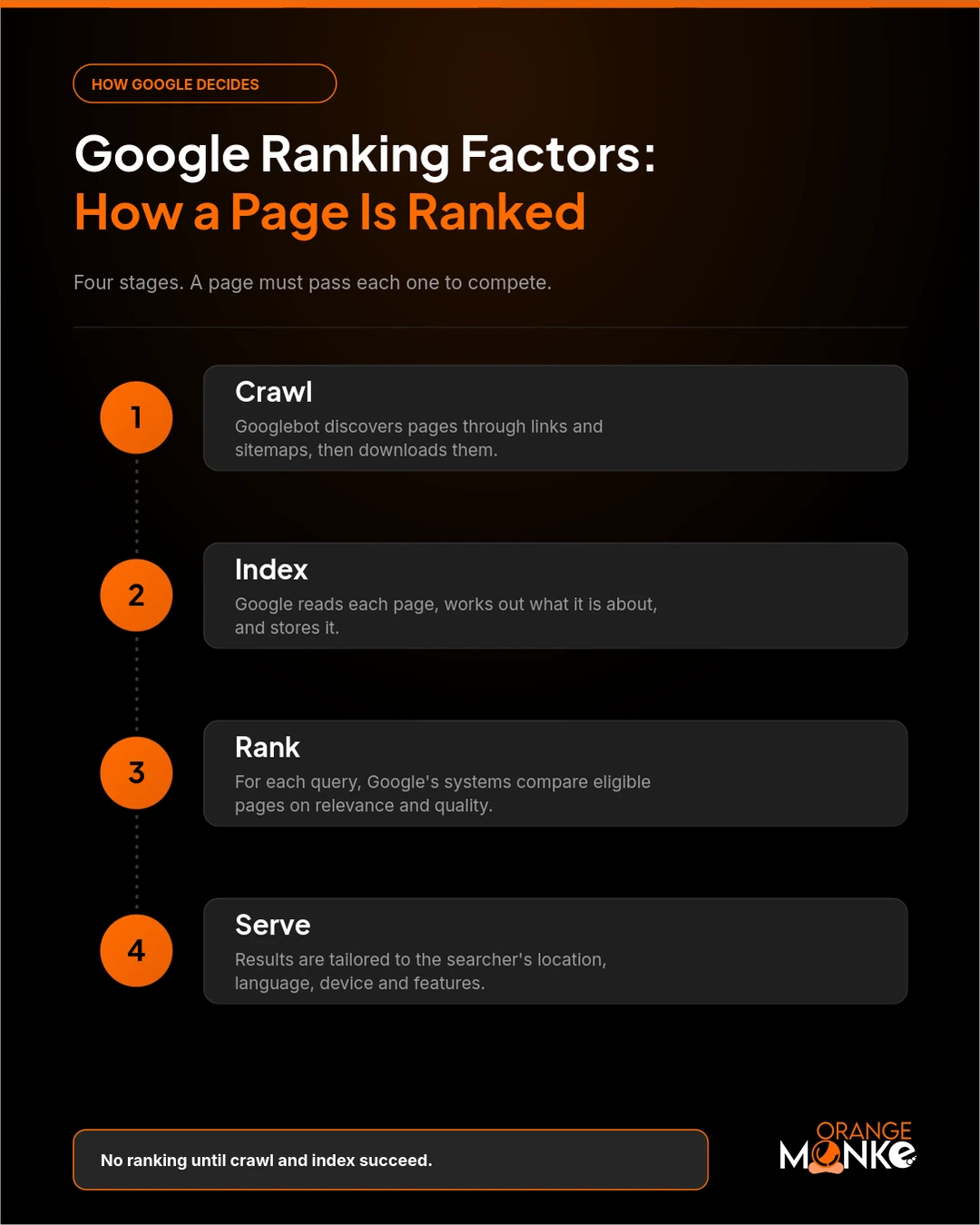
- Crawling. Googlebot discovers pages through links and sitemaps and downloads them. Blocked, orphaned or broken pages may never be found.
- Indexing. Google reads the content, works out what the page is about and stores it. Thin, duplicate or low-quality pages may be crawled but not indexed.
- Ranking. For each search, Google's systems compare every eligible page on relevance, quality and usability.
- Serving. Results are adjusted for the searcher's context, such as location, language and device, and shown with features like AI Overviews, maps or images.
What Are Google's Ranking Systems?
Google's ranking systems are automated processes that each look at a group of signals, such as link analysis, freshness, reviews, original content and spam detection, and combine them to order results. Google publicly lists many of them in its ranking systems guide. Together, these ranking systems are what most people mean by "the Google algorithm" or "the SEO algorithm". There is no single formula; there are many systems working at once.
A few are worth knowing because they explain why certain factors matter:
- Link analysis systems (including PageRank): use links between pages to understand what pages are about and how important they are.
- Freshness systems: show newer content for queries where recency matters, such as news or "2026" searches.
- Reviews system: rewards in-depth, first-hand reviews over thin summaries.
- Passage ranking: can rank a specific section of a long page for a narrow query.
- Spam detection systems: demote or remove pages that use manipulative tactics.
Since 2024, Google has said helpfulness is assessed within its core ranking systems rather than by a separate helpful content system. That is why content quality now runs through almost every factor below. If your pages are not showing up at all, the problem is usually crawling or indexing, not ranking. Our guide on why a website is not showing on Google covers those fixes.
How Do Google Algorithm Updates Change Ranking Factors?
Google algorithm updates, especially core updates, change how much weight its systems give to existing signals rather than adding brand-new ranking factors. That is why rankings can shift after an update even when nothing on your site changed. Core updates usually reward pages that better satisfy searchers and lower pages that were ranking above their quality. The fix is rarely a quick technical tweak; it is improving content quality and relevance across the site. Our coverage of the Google May 2026 core update shows how this plays out.
What Are the Most Important SEO Ranking Factors in 2026?
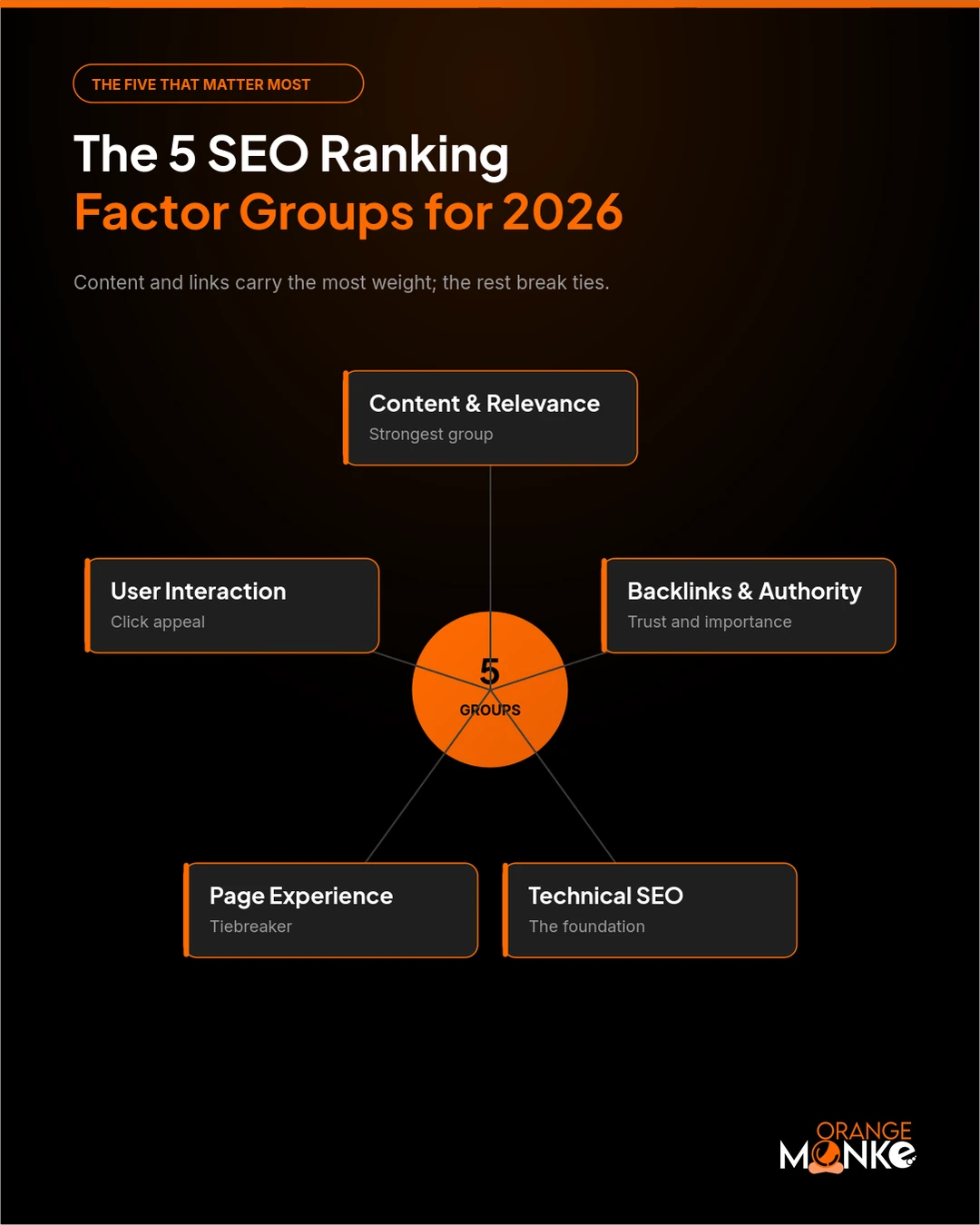
The most important SEO ranking factors in 2026 fall into five groups: content quality and relevance, backlinks and authority, technical SEO, page experience, and how searchers interact with your results. Content and links carry the most weight; the rest decide who wins between close competitors.
Each factor below carries one of three tags:
- Confirmed: Google has publicly said it uses this signal.
- Indirect: Google says it is not a direct factor, but it influences factors that are.
- Observed: not confirmed by Google, but consistently seen in ranking data and audits.
What Is the Difference Between On-Page and Off-Page Ranking Factors?
On-page ranking factors are signals you control on your own pages, such as content, keywords, titles, internal links and page speed, while off-page ranking factors come from outside your site, mainly backlinks, brand mentions and reviews. Technical factors are often grouped with on-page because they also live on your site. In the groups below, content quality, technical SEO and page experience are on-page factors. Backlinks and authority are the main off-page factors. Strong rankings need both: on-page factors make a page relevant, and off-page factors show the web trusts it.
Content Quality and Relevance
Content quality and relevance is the strongest group of ranking factors, because Google's first job is to find the page that best answers the searcher's question. No amount of technical work compensates for content that misses the intent.
- Search intent match (Confirmed). Your page must deliver the type of answer the searcher wants: a guide, a list, a product page or a local result. Check what already ranks before you write. Read more on why search intent matters for SEO.
- Helpful, people-first content (Confirmed). Google's core systems reward content created to help people, with original insight and complete answers, over content written only to rank.
- Keywords in the right places (Confirmed). Using the words people search for in your title tag, H1, subheadings and opening paragraph is still one of the most basic relevance signals. Stuffing them is not.
- E-E-A-T (Indirect). Experience, expertise, authoritativeness and trust are not a single score, but Google's systems look for signals that align with them, especially for health, finance and other high-stakes topics. Our guide to E-E-A-T in SEO explains how to show it.
- Content freshness (Confirmed for time-sensitive queries). Newer, updated content ranks better for searches where recency matters, such as news, prices or "2026" topics. Updating an evergreen guide without adding value does not help.
- Original content (Confirmed). Google's systems try to surface original reporting and first-hand information over copies and rewrites.
- Topical authority (Observed). Sites that cover a subject in depth, through a cluster of interlinked articles, tend to rank more easily for new pages on the same subject.
Backlinks and Authority
Backlinks remain a confirmed ranking factor in 2026, because Google still uses links between pages to judge importance and trust, but relevance and quality now matter far more than quantity. One link from a respected site in your industry is worth more than hundreds of directory links.
- Link quality and relevance (Confirmed). Links from trusted, topically related sites carry the most weight.
- Anchor text (Confirmed). The clickable text of a link helps Google understand what the linked page is about. Natural, descriptive anchors work best.
- Internal links (Confirmed). Links between your own pages help Google discover content and understand which pages matter most. This is one of the highest-return, lowest-effort fixes on most sites.
- Link spam (Confirmed, as a negative). Bought, exchanged or automated links can be ignored or trigger manual actions. Our guide to the Google disavow links tool covers when to act.
Technical SEO Ranking Factors
Technical SEO ranking factors decide whether Google can find, read and trust your pages at all, so they act as the foundation every other factor depends on. A technical problem can block rankings no matter how good the content is.
- Crawlability and indexability (Confirmed). Pages must be reachable through links or sitemaps and must not be blocked by robots.txt or noindex tags.
- Mobile-first indexing (Confirmed). Google uses the mobile version of your site for indexing and ranking, so missing content or broken layouts on mobile cost rankings.
- HTTPS (Confirmed, lightweight). A secure connection is a small ranking signal and a basic trust requirement.
- Duplicate content and canonicals (Confirmed). Google groups duplicate pages and picks one to show. Clear canonical tags stop you from competing with yourself.
- Structured data (Indirect). Schema markup is not a ranking factor, but it helps Google understand the page and can unlock rich results that improve clicks.
- Site architecture (Observed). A logical structure, where key pages sit within a few clicks of the homepage, helps both crawling and internal link flow.
Page Experience and Core Web Vitals
Page experience is a confirmed but lighter ranking factor: Google uses Core Web Vitals and other usability signals, but a great experience rarely beats more relevant content. It works as a tiebreaker between pages of similar quality.
- Core Web Vitals (Confirmed). Loading speed (LCP), responsiveness (INP) and visual stability (CLS) measure real user experience.
- Page speed (Confirmed). Slow pages lose visitors and rankings, especially on mobile. See how page speed affects SEO rankings.
- Mobile usability (Confirmed). Text must be readable and buttons usable on small screens.
- No intrusive interstitials (Confirmed). Pop-ups that block content on mobile can hold a page back.
User Interaction and Click Appeal
Google has confirmed it uses aggregated, anonymised interaction data to check whether results are relevant, so pages that earn clicks and satisfy searchers tend to hold their positions. This is not the same as bounce rate from your analytics tool.
- Title tags (Confirmed). Your title is both a relevance signal and your first impression in results.
- Meta descriptions (Indirect). Not a ranking factor, but a compelling description lifts click-through rate.
- Satisfying the search (Observed). Pages that fully answer the query, so searchers do not return to the results to try another page, consistently perform better.
To put the on-page factors into practice, work through our on-page SEO checklist.
Which SEO Ranking Factors Are Myths?
The most common SEO ranking factor myths are meta keywords, bounce rate, social media shares, domain age, keyword density and word count, none of which Google uses as a direct ranking signal. Chasing them wastes time that could go into factors that work.
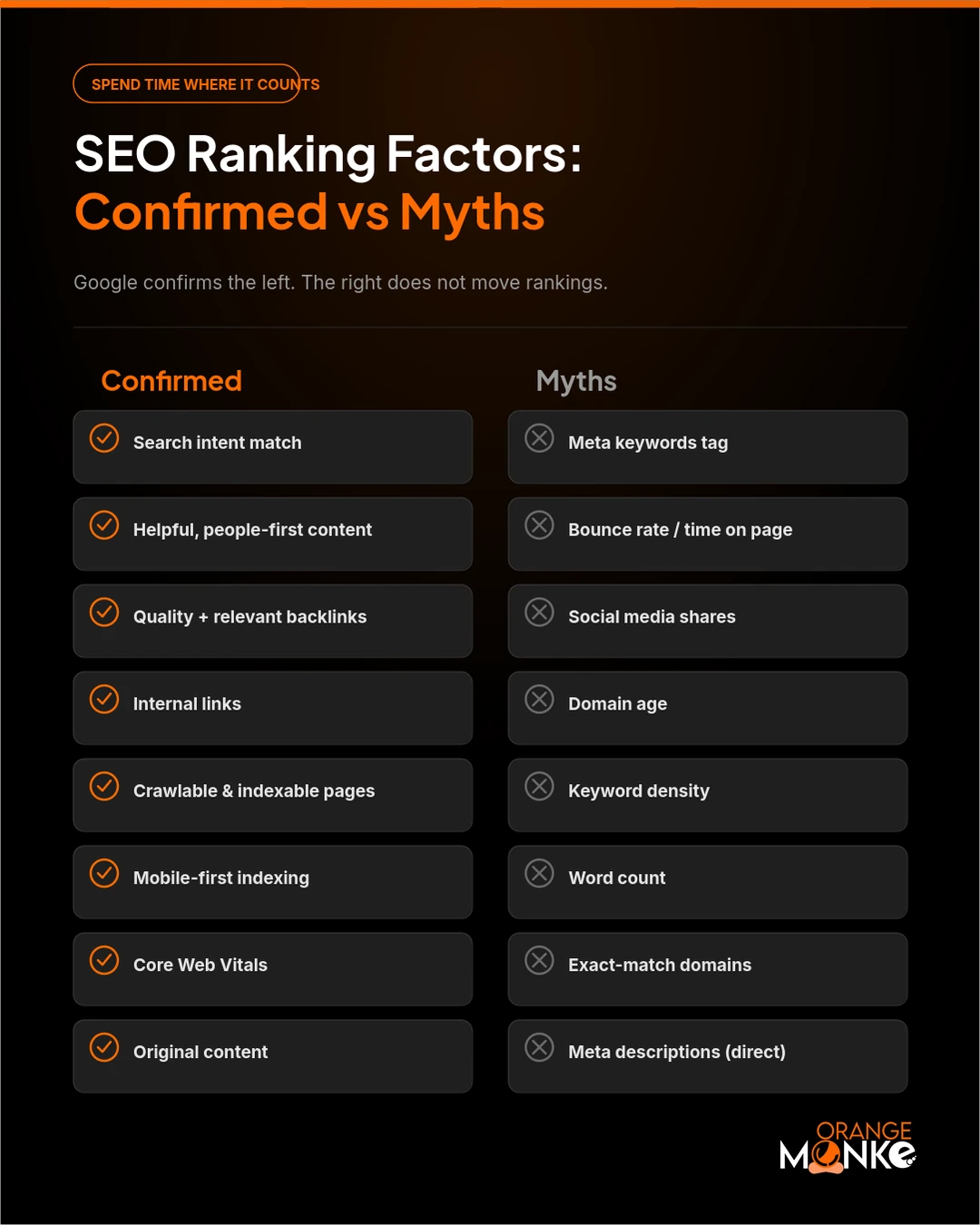
- Meta keywords: not used. Google stopped using the meta keywords tag for web ranking in 2009 because it was so widely abused. Our full breakdown of meta keywords in SEO explains why.
- Meta descriptions: not a direct factor. Google has said meta descriptions do not affect rankings. They still matter for click-through rate, so write them well.
- Bounce rate and time on page: not used from your analytics. Google has said it does not use Google Analytics data for ranking. A high bounce rate is often fine when a page answers the question quickly.
- Social signals: not direct. Likes and shares on social media are not a ranking signal. Social can still help indirectly by getting content seen, shared and linked to.
- Domain age: not a factor. Google representatives have said a domain's age does not help rankings. Older sites often rank well because they have built links and content over time, not because of the date.
- Keyword density: not a factor. There is no ideal percentage. Write naturally and cover the topic fully.
- Word count: not a factor. Google has said length is not a ranking signal. Long content ranks when the topic needs depth, not because it is long.
- Exact-match domains: no special boost. Google has a system specifically to stop low-quality sites ranking just because the domain contains the keyword.
Why Do These Myths Keep Spreading?
Ranking factor myths spread because they often correlate with rankings, even though they do not cause them. Top-ranking pages tend to be longer, older and more shared because they are genuinely useful, not because length, age or shares are signals. The practical rule: if a tactic only makes sense to a search engine and adds nothing for the reader, it is unlikely to be a lasting ranking factor.
How Do Ranking Factors Affect AI Overviews and AI Search?
AI Overviews draw on the same ranking factors as regular search: Google has said there is no special optimisation required, and a page must be indexed and eligible to appear as a snippet to be cited. In practice, pages that rank well and answer clearly are the ones AI features quote. What changes is which pages get picked. AI answers favour content that is easy to extract and trust:
- Answer first. Open every section with a direct, self-contained answer to its heading.
- Clear structure. Question-style headings, short paragraphs, lists and simple tables help systems lift the right passage.
- Specific facts. Named entities, dates and numbers are more quotable than general claims.
- Visible expertise. Author bios, first-hand examples and cited sources support the E-E-A-T signals AI features rely on.
- Crawl access. Do not block the crawlers you want to be cited by.
The same principles apply to other AI search tools such as ChatGPT and Perplexity, which also favour clear, well-sourced pages. For the details, read our guide to optimising for Google AI Overviews and AI Mode.
What Are the Local SEO Ranking Factors?
Google ranks local results on three confirmed factors: relevance, distance and prominence. Everything in local SEO works by strengthening one of these three.
- Relevance: how well your Google Business Profile matches the search. Your primary category, services and description drive this.
- Distance: how far your business is from the searcher or the location in the search. You cannot change it, but you can make sure your address and service areas are accurate.
- Prominence: how well known and trusted your business is, based on reviews, ratings, links, citations and mentions across the web.
The practical levers are a complete and accurate Google Business Profile, a steady flow of genuine reviews, consistent name, address and phone details across directories, and location pages on your website. Our guide to the top local SEO factors and our tips for ranking in the Google 3-pack go deeper.
Not sure which ranking factor is holding your site back? Orange MonkE's SEO team audits all five groups and tells you what to fix first, and our AI SEO services make sure those same pages get cited in AI Overviews too.
How Do You Use Ranking Factors to Rank Higher on Google?
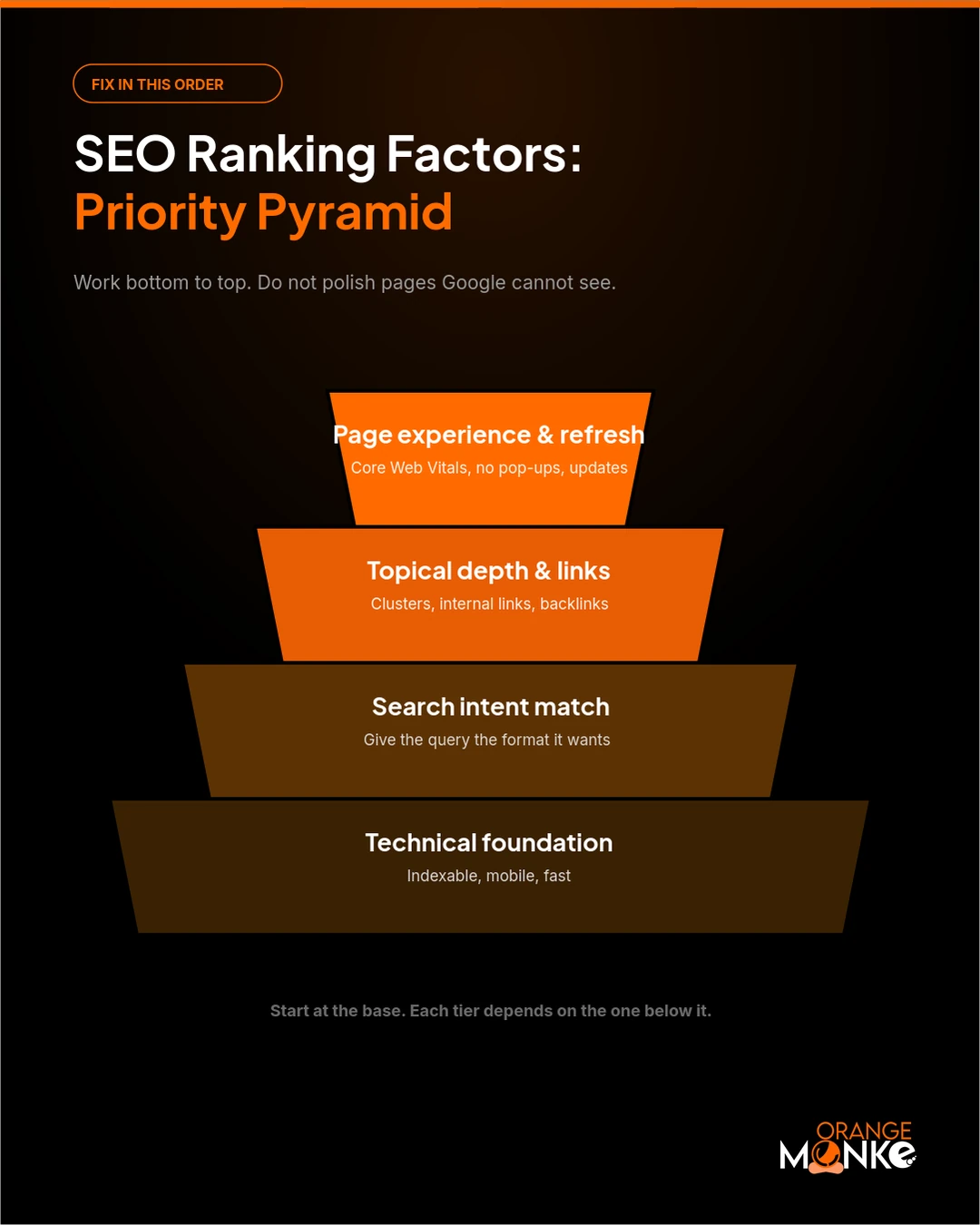
You rank higher on Google, and reach the first page, by fixing the factors in order of impact: first remove technical blockers, then match search intent, then build topical depth and links, and only then fine-tune page experience. Working in this order stops you polishing pages Google cannot properly see.
What Is the 80/20 Rule in SEO?
The 80/20 rule in SEO means a small share of your pages, keywords and fixes drives most of your results, so the fastest gains come from improving what already performs or nearly performs. Pages ranking in positions 5 to 15 are usually the best place to start.
A Priority Order That Works
- Fix indexing and technical blockers. Check that key pages are indexed, not blocked, and load on mobile. Nothing else matters until this is clean.
- Match search intent on your most valuable pages. Compare each page with what ranks today and close the gaps in format, depth and answers.
- Improve titles, headings and opening paragraphs. Put the main keyword and a clear promise in the title and H1, and answer the query in the first lines.
- Build topical depth with internal links. Add supporting articles around each core topic and link them to the main page and to each other.
- Earn relevant backlinks. Create content worth citing, such as original data, tools and expert guides, and promote it to sites in your industry.
- Tune page experience and refresh content. Improve Core Web Vitals, remove intrusive pop-ups, and update pages when facts, prices or years change.
Search engine positioning is a long game. Our guide on search engine positioning explains how to hold rankings once you win them.
How Do You Rank #1 on Google?
You rank #1 on Google by choosing keywords you can realistically win, then building a page that answers the query better than the current top result and earning more trusted links to it. Position one is earned against specific competitors, not against an abstract checklist.
- Pick winnable keywords. Target terms where the current top pages come from sites with authority similar to yours.
- Study the current #1. Note its format, depth, freshness and the questions it answers.
- Build a clearly better page. Answer faster, cover what the top result misses, and add first-hand examples or original data.
- Point internal links at it. Link from your strongest related pages with descriptive anchor text.
- Earn a few relevant backlinks. A handful of links from respected sites in your niche often closes the final gap.
How Do You Check Your SEO Rankings?
You check your SEO rankings most reliably in Google Search Console, which shows the average position, clicks and impressions for every query your pages appear for. Rank-tracking tools add daily tracking and competitor views. In Search Console, open the Performance report, switch on "Average position", and filter by page or query. Treat average position as a trend, not an exact rank, because positions vary by location, device and search features.
What Is a Good SEO Ranking?
A good SEO ranking is a top-3 position for your most valuable keywords, because the first few organic results collect most of the clicks, while page one (positions 1 to 10) is a realistic first target for competitive terms. Below page one, traffic is usually minimal.
SEO Ranking Factors Checklist
This SEO ranking factors checklist condenses the confirmed factors into one list you can run on any important page. Tick each item before you publish or update a page.
- The page matches the search intent of its main keyword
- The main keyword appears in the title tag, H1 and opening paragraph
- The content answers the query fully, with original insight or examples
- The author and sources show real expertise and trust
- The page is indexed, not blocked, and has a clear canonical URL
- The page loads fast and passes Core Web Vitals on mobile
- The page works on mobile with no intrusive pop-ups
- The site uses HTTPS
- At least three relevant internal links point to the page
- The page has earned links from relevant, trusted sites
- The title and meta description give searchers a reason to click
- Facts, prices and years are up to date
Conclusion: Focus on What Google Actually Confirms
The SEO ranking factors that matter in 2026 are the ones Google has confirmed: relevant, helpful content, quality links, crawlable pages and a solid page experience. Focus on those in the right order, ignore the myths, and rankings follow.
If you want experts to find and fix what is holding your site back, Orange MonkE's SEO services start with a full audit across every factor in this guide, and our AI SEO services extend that work to AI Overviews and AI search.
Find the factor holding your site back.
We audit all five ranking-factor groups, fix them in order of impact, and extend the work to AI Overviews, so you climb in classic and AI search alike.
Explore our SEO services →Frequently Asked Questions
Google does not publish how many ranking factors it uses, and no complete public list exists, because ranking now runs through many automated systems that each combine many signals.
- The "200" figure: an old description, not an official count.
- What matters more: knowing which signals are confirmed and which are myths.
A priority order beats a long list every time.
The most important SEO ranking factor is content that fully matches the searcher's intent, because relevant, helpful content is the foundation everything else builds on.
- First: match the intent and answer the query completely.
- Then: backlinks, technical health and page experience decide which relevant page wins.
No technical work compensates for content that misses the intent.
Backlinks are still a ranking factor in 2026, because Google continues to use links to judge a page's importance and trust.
- Quality over quantity: one relevant, trusted link beats hundreds of directory links.
- Relevance matters: links from topically related sites carry the most weight.
Earn a few strong links rather than chasing volume.
Page speed is a confirmed ranking factor, measured mainly through Core Web Vitals, but it acts as a tiebreaker rather than a primary signal.
- Helps: a faster page edges out a similar-quality competitor.
- Will not: outrank a more relevant page on speed alone.
Fix speed after content and links, not before.
Meta descriptions are not a ranking factor, as Google has confirmed, but they still matter for your click-through rate from the results.
- No direct effect: the description does not change your position.
- Indirect value: a compelling description earns more clicks at the same rank.
Write them for the searcher, not the algorithm.
The 80/20 rule in SEO means about 20% of your pages, keywords and fixes produce most of your results, so you start where the gains are biggest.
- Best starting point: pages already ranking on page one or two.
- Why: small improvements there bring the fastest traffic gains.
Improve what already nearly performs before writing anything new.
Ranking on Google usually takes three to six months for a new page on an established site, and longer for new sites or competitive keywords.
- Faster: pages already close to page one can improve within weeks of an update.
- Slower: new domains and competitive terms take longer to build trust.
Treat SEO as a compounding investment, not a quick switch.
Your SEO ranking is determined by how well your page matches the search intent, the quality and trust of your content and links, and whether Google can crawl, index and render it well.
- On-page: intent match, content quality, titles and internal links.
- Off-page: trusted, relevant backlinks and brand mentions.
Strong rankings need both relevance and trust, plus a page Google can read.
No one can guarantee a #1 ranking on Google, and Google's own guidance on hiring an SEO warns against anyone who promises it.
- Why not: rankings depend on Google's systems and your competitors, which no agency controls.
- What is real: a sound strategy that steadily improves your positions over time.
Be wary of any provider promising guaranteed positions.