Yes, it's possible to track brand mentions in AI search, and the best ways combine structured prompt testing across ChatGPT, Perplexity, Gemini, and Google AI Overviews with tracking the citations, sources, and sentiment behind each mention. Below are 9 practical methods, the metrics that actually matter, and the mistakes that quietly waste most teams' effort.
What Are Brand Mentions in AI Search?
A brand mention in AI search is when ChatGPT, Perplexity, or Google AI Overviews name your company in an answer, a moment worth tracking since AI Overviews already appear on roughly 48% of Google searches (BrightEdge, February 2026). These mentions typically show up in three forms: a direct citation with a linked source, a bare mention with no link, or an inclusion inside a broader recommendation or shortlist.
This is a genuinely different thing from a search ranking. A traditional SERP position tells you where you sit on a page. An AI mention tells you whether you exist in the answer at all. There's no page two in a generated response. You're either part of the answer or you're invisible to that user completely. The stakes compound from there: organic click-through drops roughly 61% when an AI Overview appears, even for pages ranking #1 (Seer Interactive, September 2025).
Is It Possible to Track Brand Mentions in AI Search?
Yes, tracking brand mentions in AI search is entirely possible by running the same test prompts across 6 major AI platforms and recording what comes back, a different method than rank tracking since AI answers aren't indexed the way search results pages are. But there's a catch worth knowing upfront.
The catch is that AI responses aren't static. The same prompt asked twice can return different answers depending on phrasing, timing, or which model version is running. That doesn't make tracking impossible, it means tracking has to be structured and repeated rather than a single check-and-done exercise. A one-time test tells you what happened once. A repeated, structured process tells you an actual pattern.
How Is Tracking AI Brand Mentions Different From Traditional Monitoring?
Traditional brand monitoring tracks rankings and backlinks across indexed pages, while AI brand monitoring tracks inclusion inside a generated answer, a shift reflected in organic click-through dropping roughly 61% when an AI Overview appears (Seer Interactive, September 2025). The shift is from position and volume to inclusion and framing.
| Comparison Point | Traditional Monitoring | AI Search Monitoring |
|---|---|---|
| Visibility signal | Ranking on a search results page | Inclusion inside a generated answer |
| User action | Clicks and site visits | Reading the answer, often without a click |
| Tracking method | Keyword rank tracking, backlinks | Structured prompt testing, response analysis |
| What you're measuring | Volume and position | Mention rate, sentiment, and positioning |
| Stability | Static, repeatable results | Dynamic, can vary run to run |
The terminology around this is still settling. Some teams call this metric "AI visibility." Others, following a share of voice model, call it "share of model," a measure of how often your brand is the one an AI system actually recommends rather than just one of several options mentioned. Others frame the whole discipline as "AEO," answer engine optimization, or "GEO," generative engine optimization, a term coined in a November 2023 research paper by Aggarwal and colleagues at Princeton, the Allen Institute for AI, Georgia Tech, and IIT Delhi, later published at KDD 2024. That same research found that adding specific statistics, quotable sentences, and cited sources lifted content's visibility in AI answers by 30 to 40% in controlled testing. These aren't competing facts, they're competing names for closely related ideas, so don't be surprised if a tool or an agency uses a term that sounds unfamiliar. Ask what it's actually measuring before assuming it's something new.
9 Best Ways to Track Brand Mentions in AI Search
The 9 best ways to track brand mentions in AI search combine structured prompt testing, citation tracing, and competitor comparison, since a single check tells you almost nothing about a pattern that only repetition reveals. Here are nine practical methods, roughly in order from simplest to most advanced.
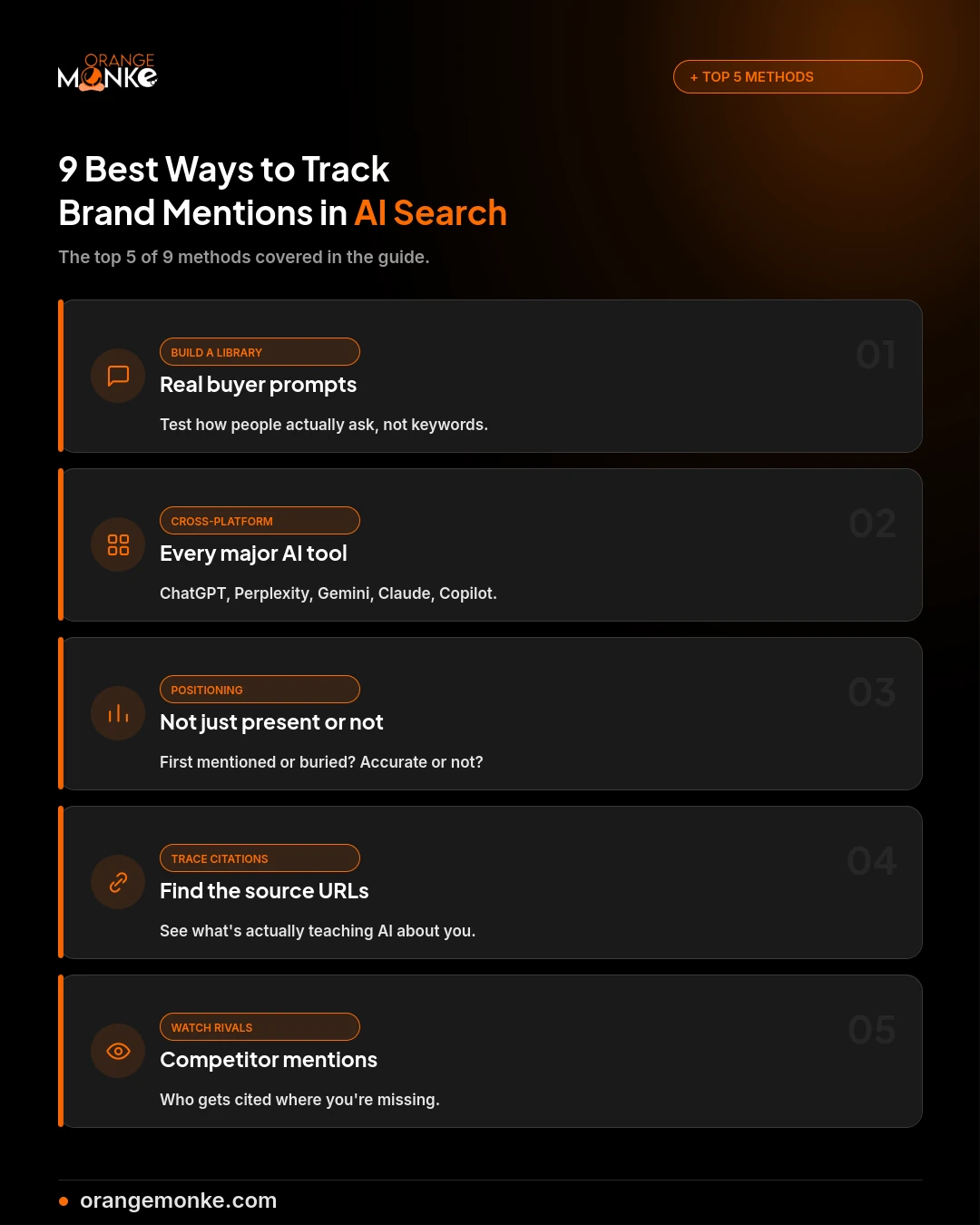
- Build a prompt library from real buyer questions. Don't test generic keywords. Test the actual, longer, conversational questions a buyer would type into ChatGPT, like "what's the best project management tool for a 10-person team" rather than just "project management tool." Pull these from your existing keyword research, your support tickets, and Google's "People Also Ask" boxes.
- Run the same prompts across every major AI platform. ChatGPT, Perplexity, Gemini, Copilot, Claude, and Google AI Overviews all draw from different sources and behave differently. A brand that shows up consistently across all of them has real, durable visibility. A brand that only shows up in one has a narrow, fragile signal.
- Record not just whether you appear, but how. Are you the first brand mentioned or buried at the bottom of a list? Are you described accurately? Is the tone positive, neutral, or subtly critical? These details shape a reader's decision before they've clicked anything, so a raw "mentioned or not" count misses most of the story.
- Trace the citations back to their source URLs. When an AI system links a source, that URL tells you exactly which page taught the model what it knows about you. Tracking these source URLs over time shows you whether your own content is being pulled from, or whether the model is relying entirely on third parties to describe you. This matters more than it might seem: 84% of AI citations come from earned media rather than brand-owned websites (Muck Rack, May 2026), so a strategy built only around your own site is missing most of the picture.
- Track which AI Overviews your brand appears in. Google's AI Overviews sit directly inside regular search results, so tracking the keywords that trigger an overview, and whether your brand is cited inside it, connects your existing SEO keyword list directly to this newer visibility layer.
- Watch your competitors in the same prompts. Every prompt you run for your own brand should also surface who else gets mentioned. A competitor showing up consistently where you don't is one of the clearest, most actionable signals you can get: it tells you the AI has a source it trusts for that specific question, and right now that source isn't you. Checking which competitors get cited instead of you is the same instinct behind competitor traffic analysis, just pointed at AI answers instead of rankings.
- Monitor the sentiment behind your mentions, not just the count. A brand can be mentioned frequently and still be described in a lukewarm or outdated way, especially if an old negative review or an abandoned product page is still feeding the model's understanding of you. Being counted isn't the same as being recommended.
- Track referral traffic that originates from AI platforms. Most analytics platforms can now segment traffic arriving from chat.openai.com, perplexity.ai, and similar referrers. This closes the loop between "we were mentioned" and "that mention actually sent someone to our site," which is the difference between a vanity metric and a business one.
- Repeat the entire process on a fixed schedule. A single audit is a snapshot, not a trend. Set a recurring cadence, monthly is a reasonable default for most businesses, and log results the same way each time so you can actually compare month over month instead of just accumulating disconnected screenshots.
Which AI Platforms Should You Track Across?
Track brand mentions across 6 major AI platforms at minimum, ChatGPT, Perplexity, Google AI Overviews, Gemini, Claude, and Copilot, since each draws on different sources and reaches a different slice of your audience. Skipping platforms creates blind spots that are easy to miss until a competitor points them out first.
- ChatGPT is the highest-volume platform for exploratory, recommendation-style questions.
- Perplexity leans heavily on citations and source transparency, making it a good platform for checking which of your pages actually get linked.
- Google AI Overviews sits inside regular search results, so it connects directly to keywords you're likely already tracking.
- Gemini is closely tied to Google's broader search ecosystem and worth checking for consistency with AI Overviews.
- Claude is increasingly used for business research and document-heavy queries, relevant for B2B brands especially.
- Copilot is embedded inside Microsoft's productivity tools, reaching users who may never open a dedicated chat app at all.
Most businesses find out by accident, if at all.
A free AI visibility audit shows exactly what ChatGPT, Perplexity, Gemini, and Google's AI say about your business today, and where competitors get cited instead of you.
Get your free AI visibility audit →What Metrics Should You Track for AI Brand Mentions?
Track 5 core metrics for AI brand mentions, mention rate, positioning, sentiment, citation share, and referral traffic, since fixating on one number alone, usually raw mention count, is how teams end up optimizing for the wrong thing. Tracking all five gives a far more complete picture than any single number.
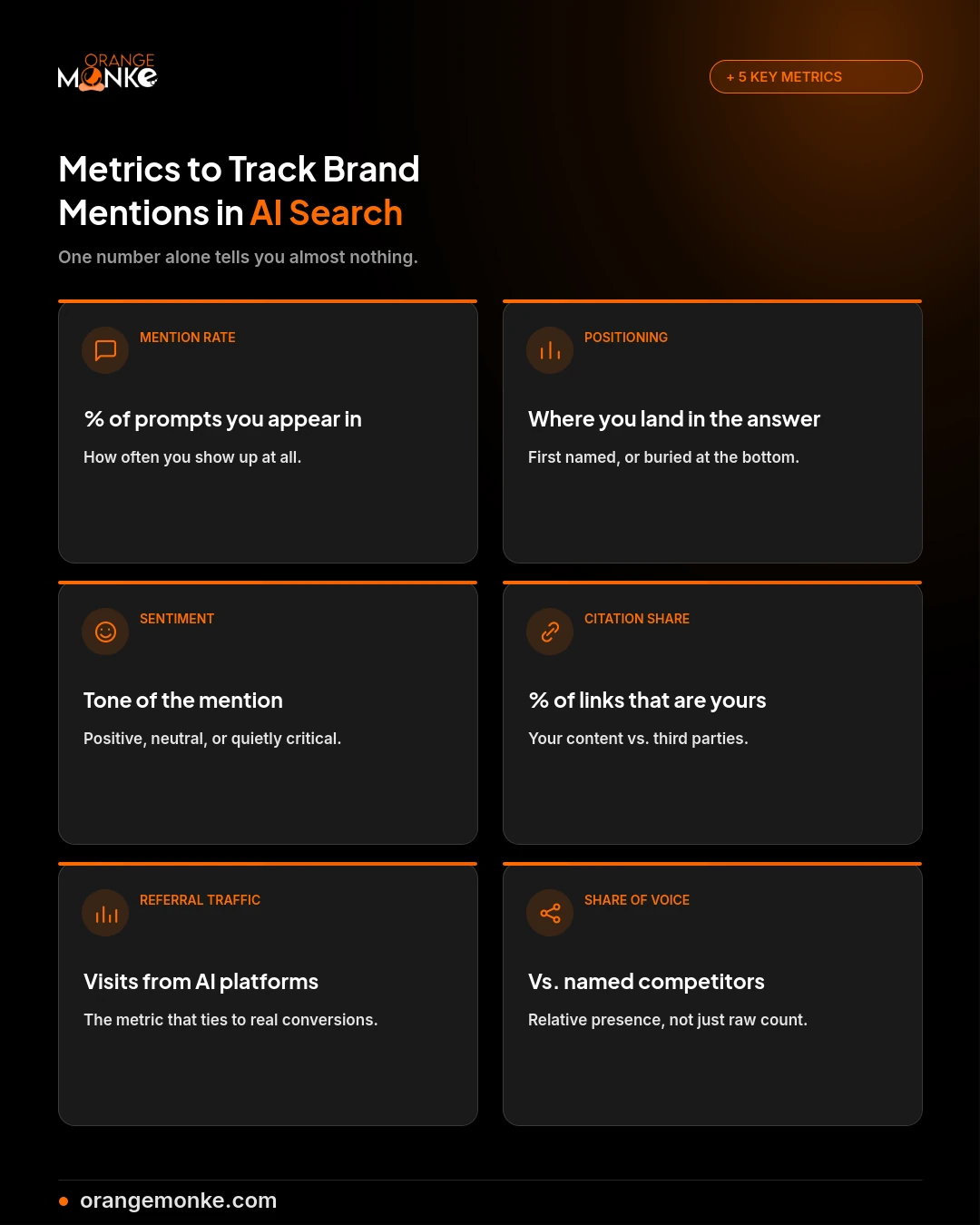
- Mention rate: the percentage of your test prompts where your brand appears at all.
- Average positioning: where you typically land when multiple brands are mentioned in the same answer.
- Sentiment: whether the framing is positive, neutral, or negative when you do appear.
- Citation share: the percentage of linked sources in a response that point to your own content versus a third party describing you.
- AI referral traffic: actual site visits originating from AI platforms, tracked through your existing analytics. Our Google Analytics for SEO walkthrough covers how to set this up if you haven't already.
How Do You Identify the Right Prompts to Test?
The right prompts to test mirror real buyer language, like "what should I look for in a project management tool for a small team," not the bare keyword "project management tool," since specific phrasing produces a far more realistic visibility signal. A keyword-style query almost never matches how someone actually talks to an AI assistant.
Pull prompt ideas from three places: your existing keyword research, filtered down to genuinely conversational, question-style queries; your own sales and support conversations, since customers often ask AI the same things they'd ask a salesperson; and community platforms like Reddit and Quora, where you can see exactly how your audience phrases comparison and recommendation questions in their own words.
How Do You Increase Your Brand Mentions in AI Search?
Increasing brand mentions in AI search means giving AI systems clear, citable information, since only about 12% of the pages ChatGPT cites also rank in Google's top 10 (EMGI Group, April 2026), proving ranking well and getting cited are related but genuinely separate goals. There's no shortcut that bypasses having something genuinely citable.
Structure your content around entities, not just keywords. Make sure your brand name, what you do, and who you serve are stated plainly and consistently across your website, not just implied through clever copy.
Publish genuinely authoritative content. Guides, original research, and detailed comparisons give AI systems something substantive to pull from. A thin product page gives it almost nothing.
Build real third-party citations. AI systems weigh outside sources heavily, sometimes more than your own site. Digital PR, expert quotes, and mentions in industry publications all feed this.
Keep your information current everywhere it appears. An outdated price, a discontinued product, or a stale review can actively work against you if a model happens to pull from it.
For reference, Orange MonkE's own AI SEO plans start at $1,499 a month for the audit, crawler access fixes, and answer-ready restructuring covered above, scaling to $2,999 a month for ongoing content and citation tracking. See the full AI SEO service breakdown.
Common Mistakes When Tracking AI Brand Mentions
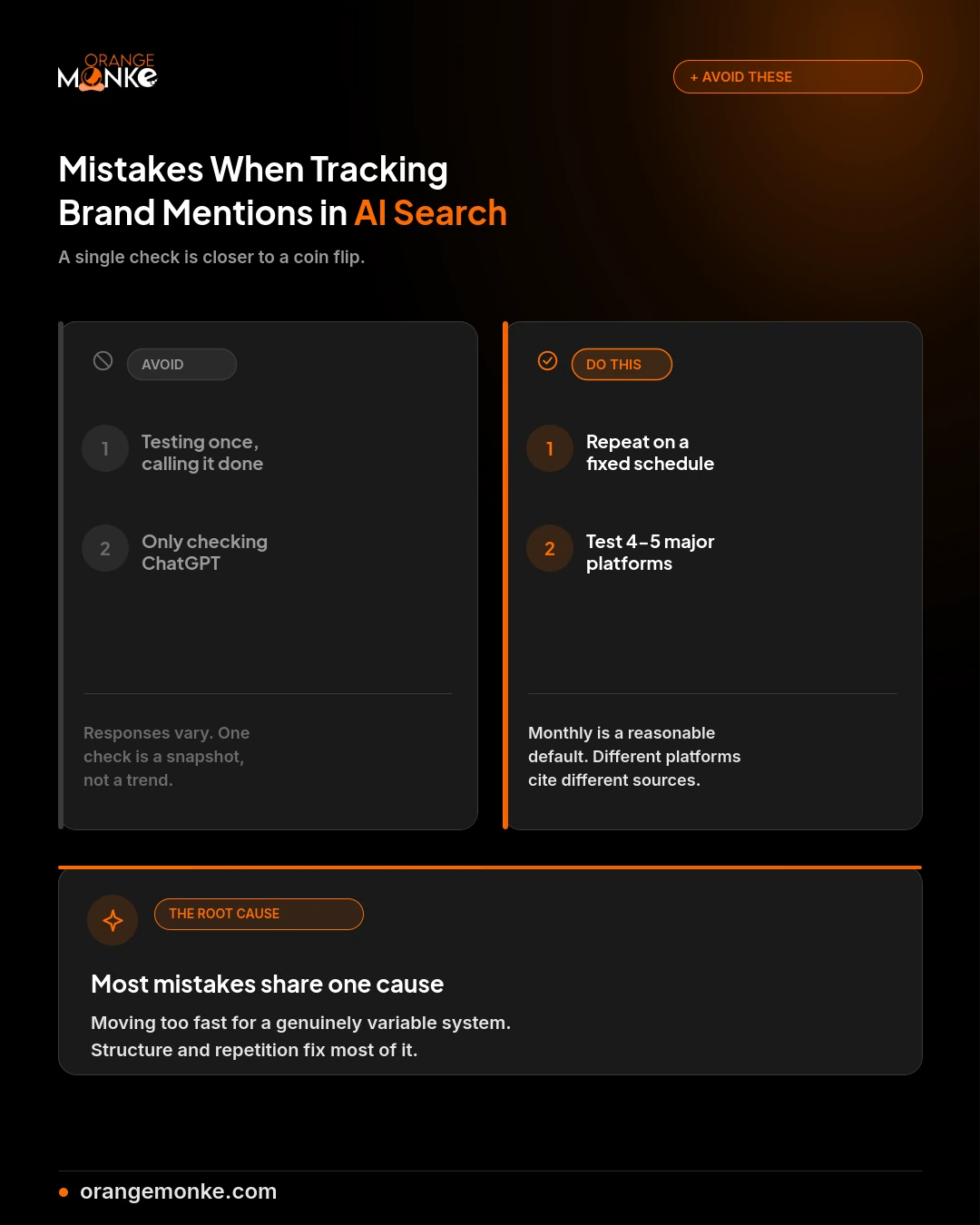
Tracking AI brand mentions fails in 6 common ways, and the costliest is testing once and treating the result as fact, when AI responses are dynamic enough that a single check is closer to a coin flip than a measurement. Most of the other common mistakes stem from the same root: moving too fast for a genuinely variable system.
| Mistake | Why It's a Problem | Better Approach |
|---|---|---|
| Testing a prompt once and stopping | AI responses vary; one result isn't a trend | Repeat the same prompts on a fixed schedule |
| Only checking ChatGPT | Different platforms cite different sources | Test across at least four to five major platforms |
| Counting mentions without checking sentiment | A frequent but negative mention isn't a win | Track tone and accuracy alongside raw count |
| Using keyword-style queries instead of real questions | Doesn't reflect how people actually prompt AI | Write prompts the way a real buyer would ask them |
| Ignoring where citations come from | Misses whether your own content is being used | Trace citations back to source URLs |
| Assuming a paid tool is required to start | Delays getting any real data | Start with free manual testing, upgrade later if needed |
How Is AI Search Changing SEO and Brand Monitoring?
AI search adds a second visibility layer on top of SEO rather than replacing it, a shift visible in the fact that 82.5% of AI Overview citations point to deep, specific pages instead of homepages (2026 citation analyses). Most of the underlying work overlaps: clear content, real authority, and consistent information still do most of the heavy lifting.
What's changed is what "success" looks like. A page can rank well and still never get quoted inside an AI answer if it isn't written in a way that's easy to extract and cite. That's less about keyword density and more about stating things plainly enough that a system summarizing your industry can lift a clean, accurate sentence directly from your page. Teams that treat this as a new coat of paint on old SEO habits tend to be the ones left out of the answer.
Conclusion: Make Brand Mentions Part of Your Regular SEO Work
Tracking brand mentions in AI search works the same way rank tracking always has: pick the right signals, measure them consistently, and act on what changes. The 9 methods, 5 metrics, and 6 mistakes covered above give you everything needed to start this week, whether that's a spreadsheet and an afternoon or a dedicated monitoring tool.
At Orange MonkE, we help brands close the gap between being occasionally mentioned and being the answer AI systems reach for first, through the same entity work, answer-ready content, and citation tracking covered in this guide. Whether you handle this in-house or bring in a team, the point stands: the businesses winning in AI search in 2026 are the ones actually measuring it, not guessing.
Being named once isn't the same as being the answer.
We build the entity signals, answer-ready content, and citation tracking that turn occasional mentions into consistent AI recommendations.
Talk to an AI SEO strategist →Frequently Asked Questions
Winning brand visibility in AI search means being one of the 3 to 5 sources a typical AI answer actually cites, not just an occasional mention among competitors, and that comes down to consistency across multiple independent sources.
- Being mentioned: your brand shows up sometimes, among others.
- Winning visibility: your brand is the one an AI system defaults to recommending.
- What closes the gap: the same claim about your brand repeated across several credible, independent sources, not just your own site.
This is closer to a competitive position than a one-time fix. Treat it the same way you'd treat a ranking you're trying to hold, not a box you check once.
Tracking brand mentions broadly means monitoring the wider web with tools like Google Alerts or social listening platforms, while tracking brand mentions in AI search specifically requires prompts tested across 6 major AI platforms, covered earlier in this guide.
- General web mentions: Google Alerts, social listening tools, and manual searches across social platforms.
- AI search mentions: structured prompts run repeatedly across ChatGPT, Perplexity, and similar platforms.
- Why the distinction matters: the two feed each other. What the wider web says about you is often exactly what an AI system learns from.
If you're only doing one of these, you're seeing half the picture.
Getting your company to show up in AI search starts with stating what you do in one consistent sentence across the 3 places that describe you most, your site, your Google Business Profile, and your social bios, since a system can't recommend a brand it can't confidently describe.
- Name what you do, plainly: on your site, your Google Business Profile, and anywhere else your company is described.
- Keep it consistent: the same core description across every platform, not five slightly different versions.
- Give it something to cite: structured, specific content beats a vague "about us" page every time.
This is a foundation issue more often than a tactics issue. Companies with fuzzy self-descriptions rarely fix that with better prompts alone.
Getting mentioned in AI search mostly requires third-party validation, since 84% of AI citations come from earned media rather than brand-owned websites (Muck Rack, May 2026), not just your own claims about yourself.
- Publish first: a detailed guide or comparison gives AI something concrete to pull from; a thin product page doesn't.
- Get cited elsewhere: expert quotes, digital PR, and genuine third-party coverage carry more weight than your own claims about yourself.
- Stay current: outdated information sitting anywhere on the web can actively work against a fresh mention.
See the full breakdown in the "How Do You Increase Your Brand Mentions in AI Search?" section above for the complete approach.
Yes, tracking brand mentions in AI search is entirely possible by running structured test prompts across 6 major AI platforms and recording whether, how, and how positively your brand appears.
- What you need: a list of real buyer-style prompts and access to the major AI platforms.
- What you don't need: a paid tool to get started, manual testing works for an initial baseline.
- What makes it reliable: repeating the process on a schedule rather than checking once.
The method is different from traditional rank tracking, but it's just as trackable once you treat it as a repeated process instead of a one-time check.
The only reliable way to know is to run the same real-world prompts across both platforms at least once a month and read the responses yourself, since neither platform sends a notification when your brand is mentioned.
- For ChatGPT: ask the questions directly and note whether your brand appears, and how it's described.
- For AI Overviews: search the keywords that already trigger an overview in Google and check the cited sources.
- For both: repeat regularly, since a single check only tells you about that one moment.
This is the exact process covered in the 9 methods above, applied specifically to these two platforms.
An AI mention names your brand in a response, while an AI citation links your specific content as one of the 3 to 5 sources a typical AI answer actually cites, and a brand can get one without the other.
- Mention only: your brand is named, but no link back to your content is included.
- Citation: a specific URL of yours is referenced as the source.
- Why it matters: citations tell you your own content is doing the work; mentions without citations mean a third party is shaping how you're described.
Both are worth tracking, but citations are the stronger signal that your own content is influencing the answer.
Monthly tracking is a reasonable default for most businesses, though competitive or fast-moving categories may benefit from checking every two weeks.
- Monthly: enough to catch meaningful shifts without excessive manual effort.
- Bi-weekly: better for categories where competitors are actively investing in AI visibility.
- The key habit: log results the same way every time so months are actually comparable.
Consistency in how you track matters more than the exact frequency you pick.
Yes, manual tracking is a legitimate way to start: pick 10 to 15 real buyer prompts, test them across each platform yourself, and treat it as a genuine baseline before the process becomes too time-consuming to sustain by hand.
- Good for: establishing an initial baseline and understanding the process firsthand.
- Gets harder at scale: once you're tracking dozens of prompts across multiple platforms monthly.
- When to consider a tool: once manual tracking starts eating more time than the insight is worth.
Start manual. Upgrade only once the manual process is genuinely the bottleneck, not before.
Yes, traditional SEO remains a foundation for AI visibility, but it isn't sufficient alone since only 12% of the pages ChatGPT cites also rank in Google's top 10 (EMGI Group, April 2026), meaning ranking and citation are related but separate goals.
- What carries over: authoritative content, strong entity signals, credible third-party mentions.
- What's additional: writing in a way that's easy for a model to lift a clean, accurate sentence from.
- The practical result: good SEO is a strong foundation, not a finished AI visibility strategy on its own.
This is the exact overlap our AI SEO plans are built around, layered on top of the SEO fundamentals, not replacing them.