A good business name is memorable, easy to say, relevant to what you do, and available as a domain and trademark. Below you'll find business name ideas organized by industry (cleaning, photography, construction, online business, and more), by tone (catchy, creative, professional), and by business size, plus a repeatable process for choosing one that actually works.
What Makes a Good Business Name?
A good business name passes four tests: people remember it, they can say it after hearing it once, it hints at what you do, and it's actually available to register. Miss any one of these and the name creates friction for years.
Memorability matters more than cleverness. A name that's technically clever but forgettable loses to a plain name people can recall. Availability matters more than most founders expect too. A name you love that's already trademarked in your industry, or whose domain is taken, can cost you a rebrand a year in, after customers, reviews, and signage are already tied to it.
There's also a fifth test worth adding once the first four are satisfied: does the name still work if the business grows? A name locked tightly to one product, one city, or one narrow service can become a liability the moment you expand, so it's worth stress-testing your shortlist against where you expect to be in three to five years, not just where you are on day one. Whatever you land on, remember the name and the logo are built together, so it's worth briefing your graphic design work at the same time as your naming shortlist, not after.
How Do You Choose a Business Name That Works?
Choosing a business name works best as a five-step process: define your tone, brainstorm without filtering, cut anything hard to spell or say, check availability, then test the finalists on real people. Skipping straight to a favorite name without this process is how founders end up rebranding.
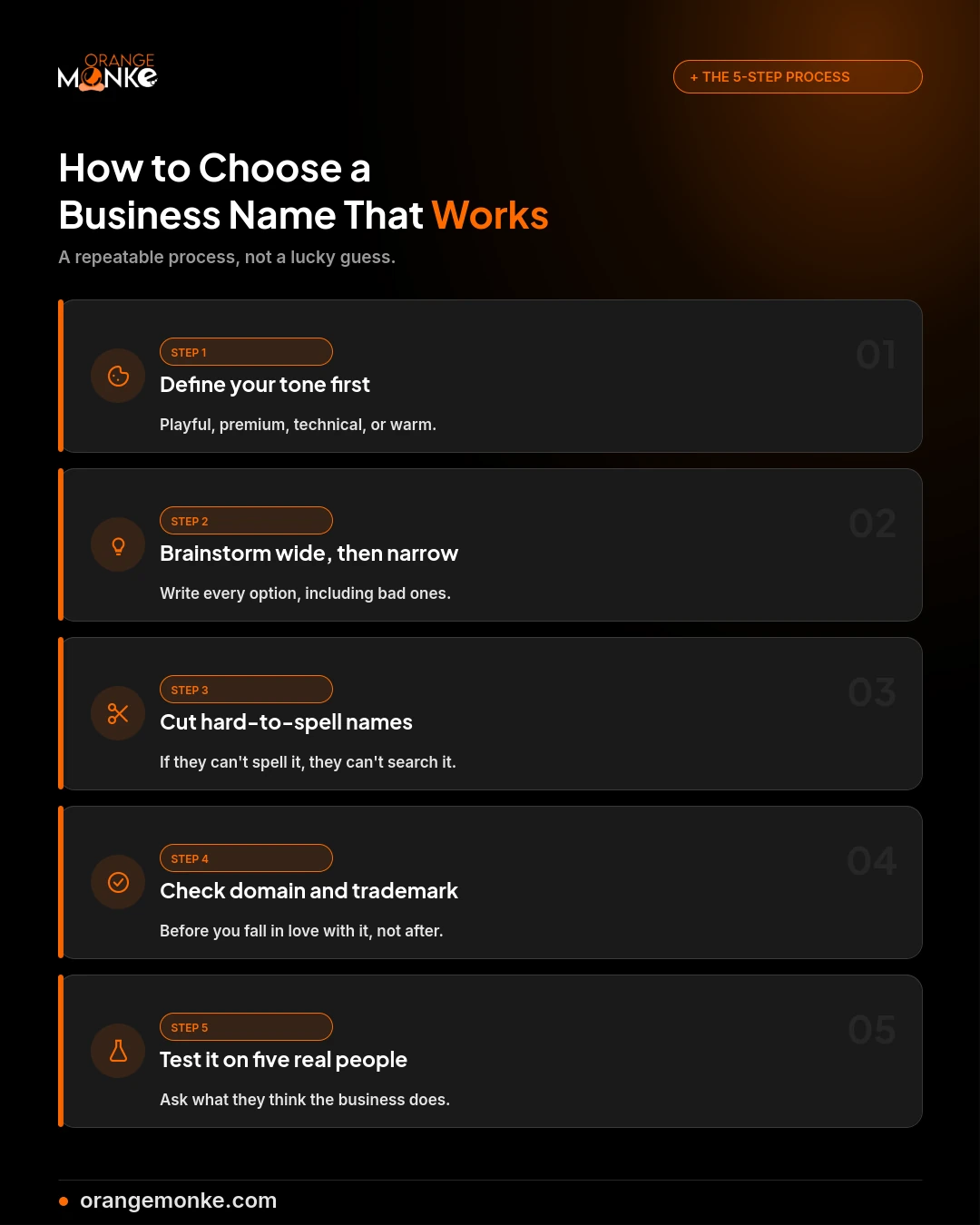
Step 1: Define your tone first. Decide if you want the name to feel playful, premium, technical, or warm before you write a single option. This single decision eliminates half of the vague ideas that would otherwise sound good in isolation but wrong for the business.
Step 2: Brainstorm wide, then narrow. Write down every option that comes to mind, including bad ones. Good names often show up after the obvious ones are already on the page, once the easy, expected options are out of your head and out of the way.
Step 3: Cut anything hard to spell or pronounce. A name a customer can't spell is a name they can't search for later, which quietly costs you word-of-mouth traffic. If someone has to ask "is that spelled with a Y or an I," that friction compounds every time someone tries to recommend you.
Step 4: Check domain, trademark, and social availability. Do this before you fall in love with a name, not after. A five-minute search can save months of legal back-and-forth later.
Step 5: Say it out loud to five people who aren't you. Ask what they think the business does. If the answers are wildly different from what you intended, keep testing. Founders are notoriously bad judges of their own name because they already know what it means; a stranger doesn't have that advantage, which is exactly why their reaction is the useful data point.
Treat this as a loop, not a straight line. It's normal to return to Step 2 after Step 4 rules out a favorite option, and doing that once or twice is a sign the process is working, not a sign you picked badly the first time. Once you've landed on a direction, confirming your target audience is worth doing in parallel, since the audience you're naming for should shape the tone you picked in Step 1.
Business Name Ideas by Industry
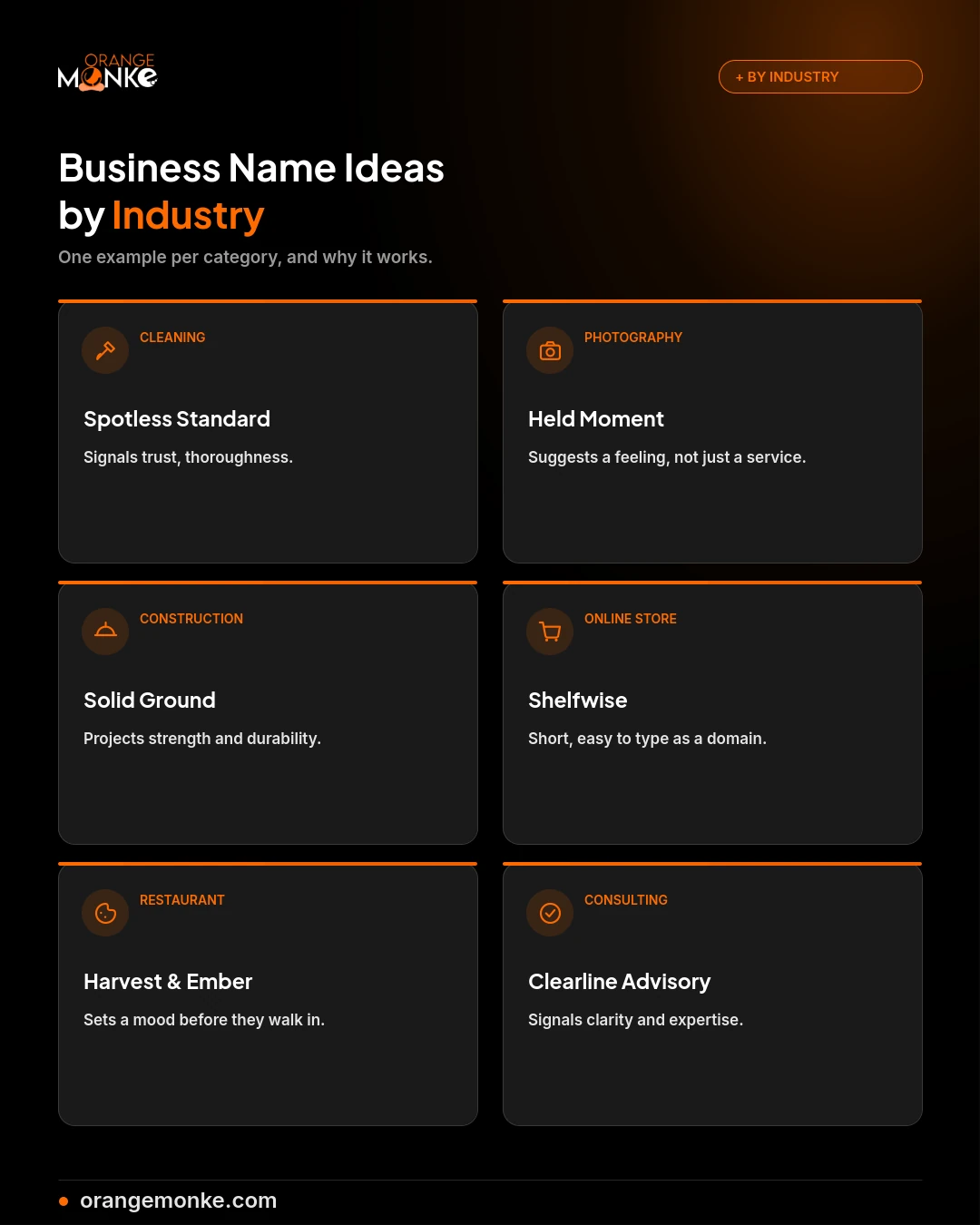
Industry-specific business name ideas work because they signal relevance instantly, a name for a cleaning company should sound different from a name for a photography studio. Below are original name ideas across fourteen common industries, each with a short note on the tone that tends to work best.
Cleaning Business Name Ideas
Cleaning business name ideas should signal thoroughness, reliability, and trust, since customers are handing over access to their home or office.
- Spotless Standard
- Bright Corner Cleaning
- ClearView Home Services
- Fresh Start Cleaners
- TidyLine Solutions
- Polished Habitat
- NeatWorks Cleaning Co.
- Everclean Residential
- Groundwork Cleaning Crew
- Pure Sweep Services
The strongest names in this list lean on plain, trust-building words like "clear," "fresh," and "pure" rather than anything playful. Cleaning is a trust business first, so save the personality for your reviews and reserve the name for reliability.
Photography Business Name Ideas
Photography business name ideas work best when they suggest a moment, a feeling, or a specific style rather than just the word "photography" itself.
- Quiet Light Studio
- Held Moment Photography
- Farline Portraits
- The Still Frame Co.
- Afterglow Imagery
- Northbound Photo Studio
- Candid Field Photography
- Wren & Lens
- Softlight Collective
- Between Frames Studio
Notice how few of these actually include the word "photo" or "photography." That word is often implied by context (a portfolio site, an Instagram grid), which frees the name itself to carry mood instead of just function.
Construction Business Name Ideas
Construction business name ideas need to signal strength, precision, and durability, since customers are trusting the name with a major financial decision.
- Solid Ground Builders
- Keystone Frame Construction
- TrueLevel Contracting
- IronPoint Builders
- Foundry Row Construction
- Anchorstone Building Co.
- BuiltRight Contracting
- Summit Frame Builders
- Bedrock Construction Group
- Sturdy Line Builders
Words like "keystone," "anchor," and "foundation" do double duty here: they're literal construction terms and they carry an emotional promise of stability, which is exactly what a customer wants to feel before signing a large contract.
Online Business Name Ideas
Online business name ideas should work as a domain first, since an ecommerce or digital brand lives or dies on how easily people can type and find it.
- Shelfwise
- Cartloom
- Nettle & Co.
- OrderPath
- BrightAisle
- Fetchbox
- Loopwell Goods
- Parcel & Palm
- Clickfield Market
- Quietstock Co.
Short, single-word or two-word names dominate this category for a reason: they're faster to type into a browser, easier to fit into a logo, and less likely to collide with an already-taken domain than a long descriptive phrase. If you're weighing platforms for the store itself, our breakdown of the best ecommerce platforms covers that decision separately.
Restaurant and Cafe Business Name Ideas
Restaurant and cafe business name ideas should hint at the food, the mood, or both, since diners decide whether to walk in within seconds.
- The Copper Ladle
- Harvest & Ember
- Kettle Row Cafe
- Salt & Second Table
- The Slow Simmer
- Corner Loaf Bakery
- Amber Spoon Kitchen
- The Daily Table
- Cinder & Sage
- The Quiet Kettle
A good restaurant name often works like a tiny piece of scene-setting. "Harvest & Ember" tells a diner almost nothing factual about the menu, but it sets an expectation of warmth and seasonal cooking before they've even opened the door.
Fitness and Wellness Business Name Ideas
Fitness and wellness business name ideas should signal energy or calm depending on whether the business is about intensity or recovery.
- IronWell Fitness
- Steady State Studio
- Pulse Line Training
- The Recovery Room
- GritWorks Gym
- Balance & Barbell
- Fieldhouse Fitness Co.
- Calm Current Wellness
- Forge & Flow Studio
- Anchor Breath Wellness
These split cleanly into two moods. "GritWorks" and "Pulse Line" promise intensity. "Calm Current" and "Anchor Breath" promise the opposite. Pick the mood that matches your actual class schedule, not the mood you wish you offered.
Beauty and Salon Business Name Ideas
Beauty and salon business name ideas should feel polished and a little indulgent, since the visit itself is part of the product.
- Velvet Chair Studio
- The Glow Room
- Bloom & Brush Salon
- Polished Edit
- Soft Hour Beauty Bar
- The Finishing Touch Studio
- Mirror & Mist Salon
- Gilded Lash Co.
- Powder Room Studio
- The Late Bloom Salon
Texture words like "velvet," "polished," and "gilded" work hard in this category because they let a customer feel the experience before they've booked it, which matters in a business built on how people feel leaving, not just how they look.
Real Estate Business Name Ideas
Real estate business name ideas need to project trust and local expertise, since buying or selling property is one of the largest decisions a customer makes.
- Cornerstone Realty Group
- Bluepoint Properties
- Homeward Path Realty
- Anchorline Real Estate
- Fieldstone Property Group
- The Keyholder Realty
- Northgate Homes
- Trueground Realty
- Lighthouse Property Partners
- Maple Row Realty
Real estate names lean heavily on words tied to place and permanence: stone, ground, gate, anchor. That's not an accident. Buyers are looking for a sense of stability in the biggest purchase of their life, and the name is often their first signal of it.
Consulting Business Name Ideas
Consulting business name ideas should signal expertise and clear thinking without sounding stiff or generic.
- Clearline Advisory
- Northbridge Consulting
- Vantage Point Strategy
- The Counsel Group
- Plainview Advisors
- Merit Path Consulting
- Groundwork Strategy Co.
- Anchor Point Advisory
- Sightline Consulting
- The Clarity Practice
Consulting names live or die on the word "clear" in some form, whether it's literal ("Clearline," "Plainview") or implied ("Vantage Point," "Sightline"). That's because the entire pitch of a consultant is turning a client's confusion into clarity, so the name should already promise that.
Fashion and Clothing Business Name Ideas
Fashion and clothing business name ideas should reflect the specific style or niche the brand occupies, not fashion in general.
- Thread & Fold
- The Tailored Line
- Salt Coast Apparel
- Muted Form Studio
- Loom & Layer
- The Cut Standard
- Wildseam Clothing Co.
- Pressed Linen Co.
- Faircloth Studio
- The Quiet Wardrobe
Avoid the trap of naming a clothing brand after "fashion" itself. The strongest names here reference materials (thread, loom, linen) or construction (fold, cut, seam), which reads as more specific and more credible than a generic style word.
Landscaping and Gardening Business Name Ideas
Landscaping and gardening business name ideas should feel rooted and seasonal, reflecting the outdoor, growth-oriented nature of the work.
- Rootline Landscaping
- Green Hollow Gardens
- Bloomfield Outdoor Co.
- Timber & Thistle
- The Growing Ground
- Cultivate Landscape Co.
- Fernway Gardens
- Stonepath Outdoor Design
Nature-derived names age well here because the work itself is seasonal and ongoing. A name like "Rootline" or "The Growing Ground" implies a relationship that continues year after year, which is exactly the kind of client a landscaper wants.
Auto Repair Business Name Ideas
Auto repair business name ideas should emphasize speed, reliability, and technical skill, since customers want their vehicle fixed right the first time.
- TrueGear Auto Repair
- Roadline Motors
- Precision Point Auto
- The Steady Mechanic
- Torque & Tune Garage
- Driveline Auto Care
- Ironhand Motors
- QuickTurn Auto Shop
Words tied to mechanics and motion (gear, torque, driveline) signal technical competence at a glance, while words like "steady" and "precision" reassure a customer who may not know much about cars but wants to trust the person who does.
Childcare and Daycare Business Name Ideas
Childcare and daycare business name ideas should feel warm, safe, and cheerful, since parents are choosing based on trust above almost everything else.
- Little Sprout Daycare
- Sunny Path Childcare
- Gentle Beginnings
- The Playful Nest
- Bright Steps Daycare
- Cozy Cub Care
- Meadow Lane Childcare
- Happy Roots Daycare
Soft, nature-adjacent words (sprout, meadow, nest) paired with warmth words (gentle, cozy, sunny) do the most work here, since the name is often a parent's very first impression before they've toured the facility or met a single teacher.
Event Planning Business Name Ideas
Event planning business name ideas should feel celebratory and organized at the same time, since clients need both creativity and flawless execution.
- Gathered Occasions
- The Detail Table
- Bloom & Bind Events
- Momentum Event Co.
- The Guest List Studio
- Radiant Occasions
- Tableside Events Co.
- The Finer Details Planning
The best event-planning names hint at precision (detail, table, list) alongside celebration (bloom, radiant, gathered), because clients are really buying peace of mind that nothing will be forgotten, wrapped inside something that still feels festive.
A name is one decision. The content around it is another.
Once you've shortlisted a name, the copy, pages, and positioning built around it are what actually make it findable and credible.
See content writing services →Catchy Business Name Ideas
Catchy business name ideas rely on rhythm, rhyme, or alliteration to make a name stick after one hearing. These techniques work across almost any industry, not just playful ones.
- Snap & Sort
- FizzForward
- PopPath Studio
- Kick & Company
- Tick Tock Trades
- Buzzline Media
- Click & Carry
- Dash & Dine
- Flip & Fold Co.
- Swift & Sure Services
Alliteration and rhyme both work for the same underlying reason: they're easier for the brain to hold onto than a random word pair, since the repeated sound gives the memory something to latch onto. Use the technique sparingly though, since a name that's catchy but says nothing about the business still leaves work for your marketing to do.
Creative and Unique Business Name Ideas
Creative and unique business name ideas combine unexpected words, invented terms, or metaphors to create something no competitor already owns. The goal isn't to sound strange for its own sake, it's to sound like nothing else in the category.
- Amberfold
- The Quiet Anchor
- Tin Roof Collective
- Hollow & Bright
- Paper Lantern Co.
- The Long Table
- Driftline Studio
- Coppervale
- The Salt Meridian
- Lowlight Collective
A useful test for this category: search the name on its own before you commit. If nothing relevant comes up, that's usually a good sign that you've found genuine white space rather than an accidental collision with an existing brand.
Small Business Name Ideas
Small business name ideas often work best when they feel personal, local, or founder-driven rather than corporate. A name that sounds like a person or a place tends to build trust faster in a local market.
- Maren's Corner Shop
- The Village Bench
- Hallow & Co.
- Oak Street Goods
- Founders Row
- The Local Hand
- Two Doors Down
- Kettle & Kin
- The Neighbor's Table
- Harlow & Sons
Corporate naming conventions (adding "Group," "Solutions," or "Enterprises") often work against a small, local business rather than for it. Customers choosing a local shop over a chain are often specifically looking for the opposite feeling, and the name is one of the fastest ways to signal it. A documented content marketing strategy tends to matter more for this category than the name alone, since a small local brand wins on consistency over time, not a single clever choice.
Smart and Professional Business Name Ideas
Smart and professional business name ideas make the value proposition obvious at a glance, which matters most for B2B, healthcare, and financial services.
- Precision Path Solutions
- ClearMetric Advisors
- Steadfast Systems
- TrueScope Consulting
- Keystone Analytics
- Northline Financial
- Clarity Works Group
- Meridian Advisory
- Vantage Ledger Group
- Groundtruth Solutions
These names trade personality for clarity, and that's usually the right trade in categories where a buyer is evaluating competence over charm. A slightly dry name that clearly signals expertise will usually outperform a clever one in a B2B buying decision.
Should You Use a Business Name Generator?
A business name generator can be a useful starting point for raw options, but it should never be the last step, since generators can't check trademark conflicts or tell you how a name actually feels to your specific audience.
Generators are genuinely good at one thing: producing volume. If you're stuck at zero ideas, typing a few keywords into a generator and scanning fifty options can break the blank-page problem faster than staring at an empty document. Treat the output as raw material, not a finished shortlist. Try the generator below to see what raw output actually looks like.
Pick an industry and a tone, then generate. Every name is a fresh combination, not a fixed list.
Generated locally in your browser. Always run any name you like through the availability checklist above before you commit.
Where generators fall short is judgment. They can't tell you that a name sounds too close to a competitor's, that it's awkward to say out loud, or that it doesn't fit the tone you actually want. Every option a generator produces still needs to go through the same five-step process covered earlier, brainstorm, cut, check availability, and test on real people, before it's a real candidate.
A reasonable workflow is to use a generator for volume in Step 2 of the naming process, then apply Steps 3 through 5 exactly as you would to any name you thought of yourself. If you want a second opinion once you've narrowed it down, that's the same kind of judgment call our SEO services team applies when weighing a new page or domain against what's already ranking, since a business name and a URL slug live under a lot of the same constraints.
How Do You Check If a Business Name Is Available?
Checking business name availability means confirming the domain, the trademark, the state business registry, and social handles before you commit, not after. Skipping any one of these can force an expensive rebrand later.
- Domain: search the exact name plus common variations through any domain registrar.
- Trademark: search the USPTO database (or your country's equivalent) for conflicts in your industry category.
- State registry: confirm the name isn't already registered as a business entity in your state.
- Social handles: check whether the name is usable as a consistent username across the platforms you'll actually use.
Do these checks in this order, not randomly, since a trademark conflict is the most expensive problem to discover late and the domain check is the fastest way to eliminate an option before you invest more time in it.
What Business Naming Mistakes Should You Avoid?
The most common business naming mistake is picking a name before checking availability, which forces a costly rebrand once materials, signage, and customer trust are already built around it.
| Mistake | Why It Causes Problems | Better Approach |
|---|---|---|
| Choosing before checking availability | May need to rebrand after launch | Run domain, trademark, and registry checks first |
| Picking something too generic | Gets lost among competitors | Add one distinctive, ownable word |
| Overly clever spelling | People can't find you online | Keep spelling simple unless the twist is the whole point |
| Copying a competitor's naming style | Weakens differentiation, risks legal issues | Study competitors, then deliberately diverge |
| Ignoring future growth | A narrow name limits expansion | Choose a name that fits your next stage, not just day one |
| Skipping the pronunciation test | Mispronounced names get less word-of-mouth | Say it out loud to five people before deciding |
Most of these mistakes share a root cause: moving from idea to decision too fast. A name that survives all six checks in this table is far more likely to still feel right two years in than one chosen purely on first impression.
How Is AI Search Changing Business Naming?
Business names now have to work for AI search tools, not just human customers, because assistants like ChatGPT and Google's AI Overviews increasingly summarize and recommend businesses by name. A name that's easy for a person to parse is usually easy for an AI system to parse too, but the reverse isn't always true for overly abstract or invented names.
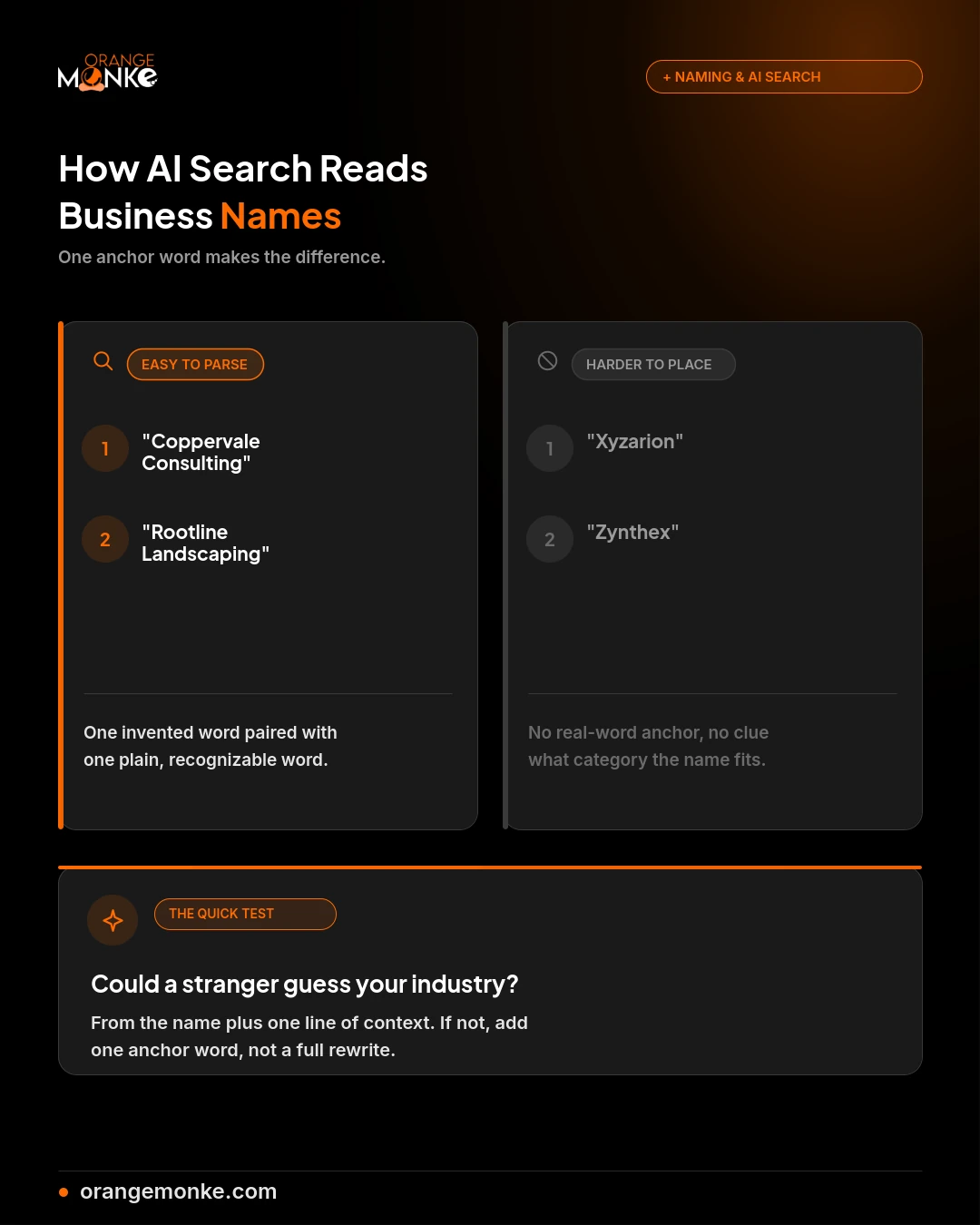
Names built entirely from invented syllables with no real-word anchor can be harder for AI systems to associate with a category or service, since there's no existing language pattern to draw on. A name that pairs one invented or unusual word with one plain, recognizable word, like "Coppervale Consulting" rather than just "Coppervale," gives both humans and AI systems something concrete to hold onto. This is the same underlying shift covered in how AI answer engines read content, just applied to a name instead of a page.
This doesn't mean naming has to sacrifice creativity for literalism. It means testing a shortlisted name by asking whether a stranger, or an AI system summarizing your website, could correctly guess your industry from the name plus one line of context. If the answer is no, the name may need a small anchor word added, not a full rewrite.
The practical upshot is that the supporting content around your name now matters as much as the name itself. A distinctive name paired with clear, consistent descriptions across your website, Google Business Profile, and social bios gives AI systems repeated, unambiguous signals about who you are, which matters more the more abstract the name itself is. This is exactly the gap our AI SEO services are built to close once the name itself is locked in.
Findable is what happens after the name.
The SEO and content built around your new name are what make it show up, rank, and get recommended, by search engines and AI alike.
Get a free content audit →Frequently Asked Questions
A good business name usually comes from a structured process: define your tone, brainstorm broadly, cut anything hard to spell, check availability, then test finalists on real people.
- Start wide: write every option down before judging any of them.
- Filter for memorability: cut names people can't repeat after one hearing.
- Test before committing: ask people outside your team what they think the name means.
Skipping the testing step is the most common reason founders end up second-guessing their name after launch.
A catchy business name usually relies on rhythm, rhyme, alliteration, or a short, punchy word combination that's easy to repeat.
- Rhythm: short words in a pattern that's easy to say quickly.
- Alliteration: repeated starting sounds, like "Buzzline" or "Click & Carry."
- Simplicity: one clear idea, not three ideas crammed together.
Catchy doesn't mean silly. Plenty of catchy names are still professional.
Trademark costs vary by country and filing method, so check your national trademark office's current fee schedule rather than relying on a fixed number, since fees change and vary by category.
- Government filing fees: paid directly to the trademark office per class of goods or services.
- Attorney fees: optional but common for anything beyond a straightforward filing.
- Ongoing costs: renewals are required periodically to keep protection active.
Budget for both the filing and the time it takes, since trademark review isn't instant.
Including a keyword can help local or highly specific businesses get found faster, but it isn't required and can limit growth if the business expands beyond that keyword later.
- Helps with: hyper-local services where customers search by exact category and city.
- Can limit: a business that later adds services outside the original keyword.
- Middle ground: pair one keyword with one distinctive word rather than using the keyword alone.
A name doesn't need to be a keyword to be found. Strong content and consistent listings do most of that work regardless.
Yes, you can change a business name later, but it typically means updating your registration, trademark, domain, signage, and every customer-facing touchpoint at once.
- Legal steps: re-register the new name and update or refile any trademark.
- Digital steps: new domain, updated social handles, redirects from the old site.
- Trust cost: existing customers and reviews tied to the old name don't automatically transfer.
Rebranding is possible at any stage, but it's meaningfully more expensive the longer you wait.
Check a business name by searching your state's business registry, the trademark database, domain availability, and social platforms, since a name can be free in one place and taken in another.
- State registry: confirms whether another entity already operates under that name locally.
- Trademark database: checks for protected names in your specific industry category.
- Domain and social: confirms whether you can actually claim the name online.
A name passing one check but failing another is common, so run all four before committing.
A business name is the legal name registered with government authorities, while a brand name is what customers actually see and remember, and the two can be the same or different.
- Business name: used on legal documents, tax filings, and contracts.
- Brand name: used on the website, signage, and marketing materials.
- Common setup: a company registers under a formal legal name but operates publicly under a shorter brand name (a "doing business as" name).
Most small businesses keep both identical for simplicity, but it isn't required.
Yes, a business name that clearly signals what you do and who you serve is easier for AI search tools to correctly categorize and recommend than a name built from entirely invented syllables.
- Clear names: get summarized and recommended more accurately by AI assistants.
- Abstract names: may need more supporting content to establish what the business actually does.
- The fix: pair one distinctive word with one plain, recognizable word so both humans and AI systems have something concrete to anchor to.
This is a newer consideration in naming, but it follows the same logic that's always applied to human clarity.
Real words tend to be easier to find and remember early on, while invented words are easier to trademark and own outright, so the right choice depends on whether discoverability or exclusivity matters more to you.
- Real words: faster for customers to understand and search, harder to trademark cleanly since they're often already in use somewhere.
- Invented words: easier to own legally and as a domain, but require more marketing effort to build initial recognition.
- A middle path: slightly altered real words (dropping a letter, combining two words) often capture some benefit of both approaches.
Neither approach is objectively better. A well-funded brand with a long runway can afford to build recognition for an invented word; a bootstrapped local business usually benefits more from a real word that explains itself immediately.