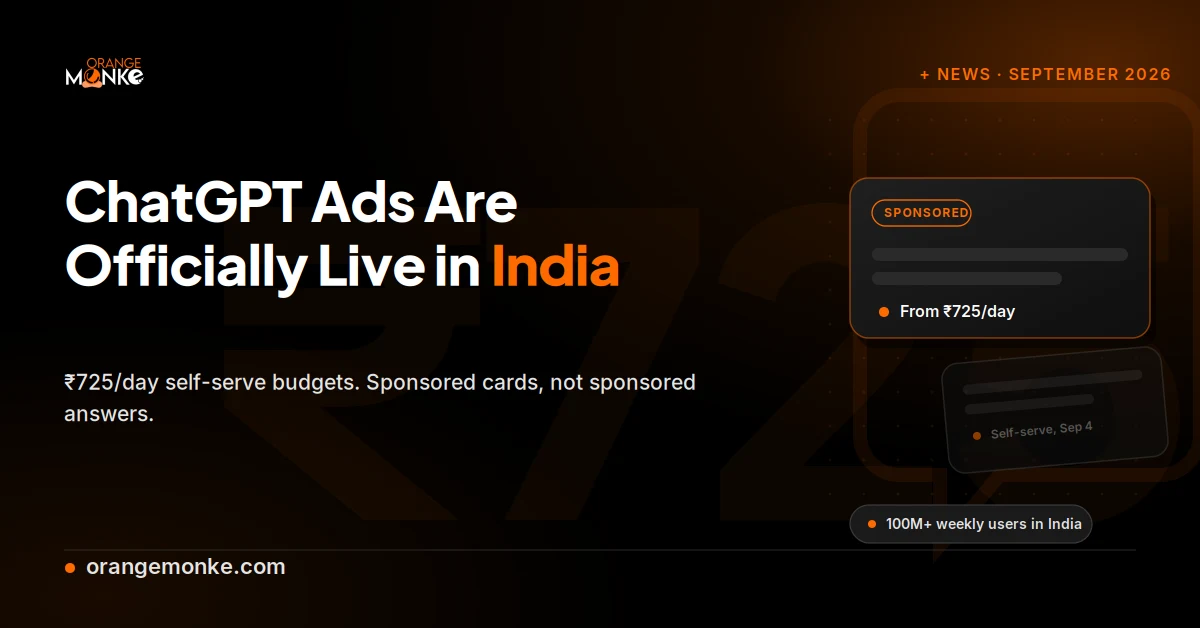
ChatGPT ads went live in India on August 27, 2026, with more than 50 brands in the initial rollout. A self-serve ChatGPT Ads Manager opened to any business on September 4, 2026, with daily budgets starting at ₹725. Ads appear as sponsored cards below ChatGPT's answer, shown only to logged-in users on the Free and ₹399 Go plans. OpenAI says advertising does not influence what ChatGPT recommends. WPP and Omnicom are the first agency partners.
ChatGPT ads are no longer a future possibility in India. They are live, priced, and open to any business willing to test them. OpenAI switched on managed campaigns on August 27, 2026, and followed it up a week later with self-serve access, moving faster than most reporting on the topic has kept up with. Search “chatgpt ads news” today and you’ll still find pieces describing this as a Q3 2026 rollout stuck in closed beta. It already happened.
Here’s what launched, what it costs, what industry voices are saying, and what it means for brands weighing whether to spend.
What Just Launched?
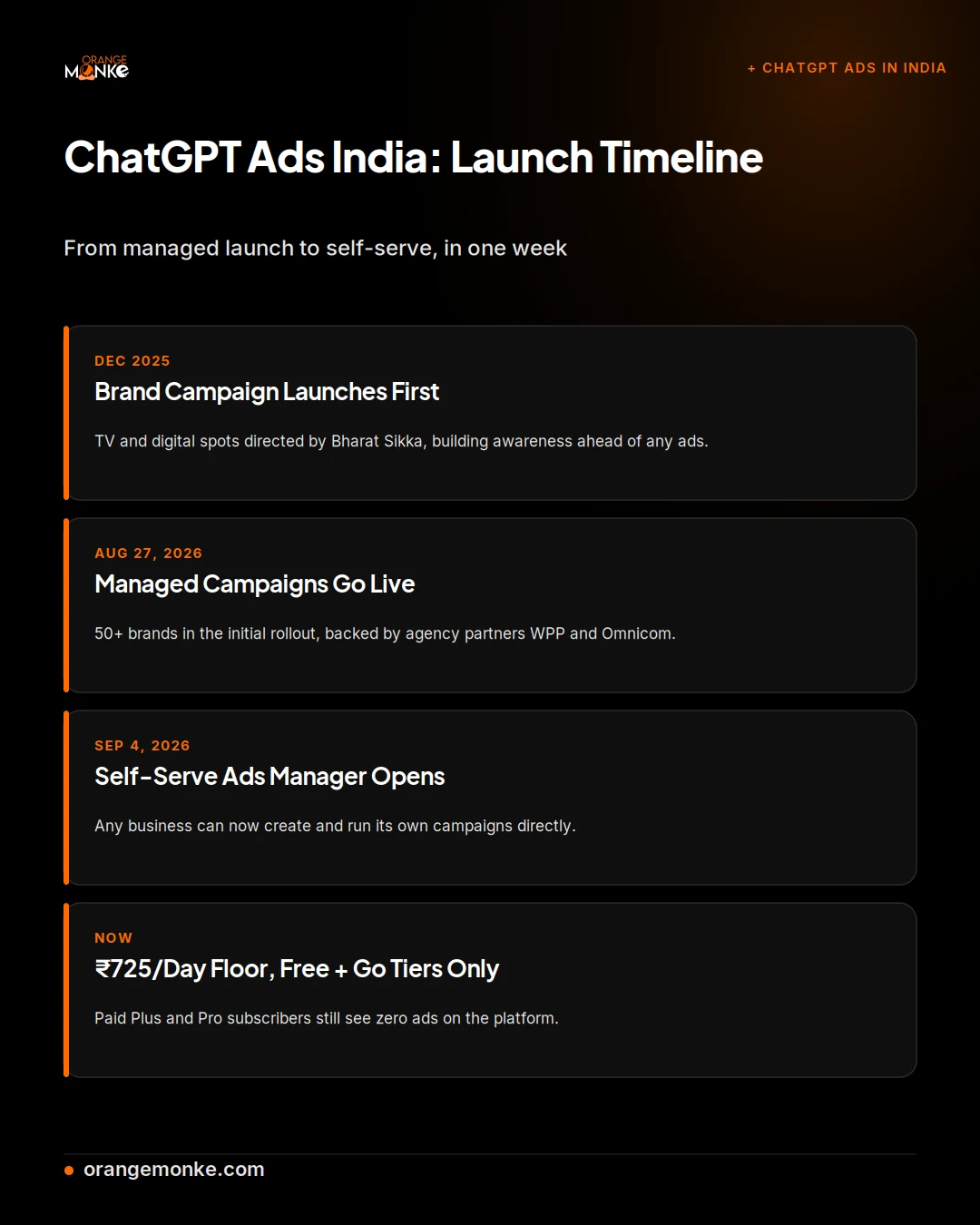
OpenAI rolled out advertising inside ChatGPT for Indian users in two stages. Managed campaigns began August 27, 2026, backed by agency partners WPP and Omnicom and more than 50 launch brands. The self-serve ChatGPT Ads Manager followed on September 4, 2026, opening the platform to any advertiser rather than a handful of partners.
The mechanics, confirmed so far:
- Ad format: Sponsored cards appear below ChatGPT’s answer, clearly labeled, never inside the response itself.
- Pricing: Daily budgets start at ₹725 on the self-serve platform, with auction-based pricing beyond that floor.
- Audience: Ads show only to logged-in adults on the Free plan and the ₹399 Go plan. Paid Plus, Pro, and higher tiers stay ad-free.
- Data: Advertisers receive aggregate metrics only, such as impressions and clicks, never chat content or user identity.
- Scale: India is ChatGPT’s second-largest market, with more than 100 million weekly users and usage that has doubled year on year.
This is a meaningfully different starting position than the last time Orange MonkE covered ChatGPT ads, when the format existed only as an announced intention with no public platform, no pricing, and limited US-only testing. That’s worth knowing if you’ve read ChatGPT ads coverage before and assumed the details hadn’t changed.
Why Is This Being Called a Turning Point for AI Advertising in India?
Search advertising runs on keywords. A user types “best laptop under ₹1 lakh” and that phrase is the entire signal an advertiser gets. A ChatGPT conversation carries far more. The same user might explain they travel often, need long battery life, occasionally edit video, and want something lightweight, a far richer picture of intent than a search query, and the core argument industry voices are making for chatgpt advertising over traditional search ads.
“For a considered strategic decision, the timing is terrible; for a quick test, it is perfect.”
Prashant Puri, Co-founder and CEO, AdLiftPuri has pointed out that the launch lands in the middle of India’s festive shopping season, which turns the next few months into more of a live, large-scale experiment than a proven channel.
“The real advantage is the quality of intent captured in the conversation.”
Kunal Kothari, Chairman and COO, Mobavenue AI Tech LimitedKothari has cautioned against a common assumption: that a ChatGPT user is automatically premium inventory simply for being on the platform. Advertisers, he argues, will pay more only once that richer context reliably converts into measurable outcomes.
What’s the Catch Industry Analysts Are Flagging?
The detail getting the most attention isn’t the launch itself, it’s what the ad does and doesn’t buy. When someone asks ChatGPT for the best option in a category, the AI answers first, and a sponsored card appears underneath. Analysts are drawing a sharp line here: the brand ChatGPT actually names inside the answer carries more trust than a labeled ad below it, because people know the ad is paid.
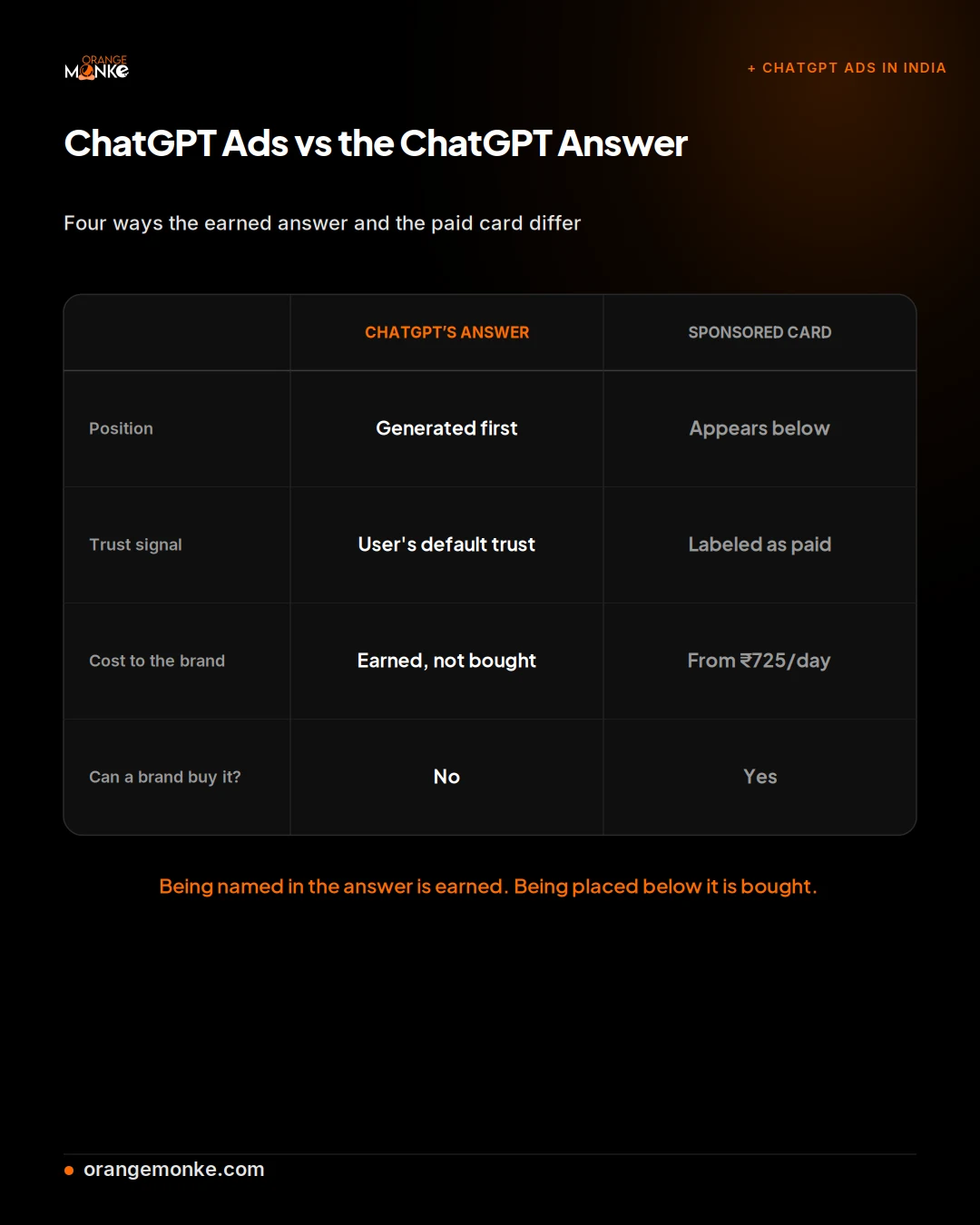
The distinction being made across early coverage: ads on chatgpt buy proximity to a high-intent conversation. They do not buy the recommendation itself. Being named inside the answer is earned through generative engine optimization (GEO), the practice of making content clear and authoritative enough that AI systems choose to cite a brand, not purchased through the ad platform. Orange MonkE’s breakdown of AEO vs SEO goes deeper on how that earned-citation work differs from traditional ranking.
That reframes how brands should read this launch. Running chatgpt paid ads without also investing in GEO means permanently paying to sit beneath whichever competitor ChatGPT recommends for free.
Before you spend on ads, check whether ChatGPT already recommends you.
We audit whether your brand shows up inside AI answers today, across ChatGPT, Google AI Mode, and Perplexity, before you spend a rupee on sponsored placement.
Get a free AI visibility audit →How Do ChatGPT Ads Actually Work?
At a mechanical level, a user asks a question, ChatGPT generates its answer independently, and a sponsored card can appear as a separate element afterward. Ads in ChatGPT rely on advertiser-supplied “context hints” rather than exact-match keywords to decide when a sponsored card might be relevant to the conversation, and OpenAI has said advertising does not influence the response itself.
For a fuller walkthrough of the underlying ad mechanics and format, see Orange MonkE’s ChatGPT Ads Guide. Note that some pricing and availability details in that piece predate the actual India launch and are being refreshed separately.
What Is OpenAI Saying About Privacy?
OpenAI has been specific on this point: ChatGPT ads don’t draw on a user’s personal chat history, and sensitive topics, including health conditions and political views, are excluded from targeting entirely. Advertisers see aggregate performance numbers only.
- Targeting is based on the topic of the current conversation, not a stored profile built from past chats.
- Health, political, and other sensitive subjects are excluded from targeting inputs.
- Advertisers never see individual chat transcripts, only aggregated numbers like impressions and clicks.
For brands used to the granular audience data available on Meta or Google, this is a narrower dataset by design.
Does the Rollout Extend to Hindi, Tamil, and Other Indian Languages?
ChatGPT already handles conversations in multiple Indian languages, including Hindi, Bengali, Tamil, Telugu, and Marathi. OpenAI paired the India push with a brand campaign built for local audiences, including TV and digital spots directed by Bharat Sikka centred on everyday use cases like exam prep and job hunting rather than a product pitch.
How far ad-specific tooling extends into regional languages today is less confirmed. Some reporting on this predates the actual August 27 launch, so treat claims of full multilingual ad support as still developing rather than settled fact.
Which Industries Are Moving First?
Early coverage of the India launch points to categories where people research heavily before buying: travel and hospitality, financial services and insurance, edtech and career platforms, fashion and beauty retail, consumer electronics, and food delivery. The common thread isn’t the industry itself, it’s whether the category involves genuine back-and-forth research before a purchase, which is exactly the kind of conversation ChatGPT ads are built to sit inside.
What Should Marketers Track as the Rollout Continues?
Performance is the real test of whether chatgpt advertising earns a bigger slice of budget. Analysts are pointing brands toward clicks, conversions, customer acquisition cost, and brand consideration, the same fundamentals used to judge any new channel, applied here without an established benchmark yet.
Early campaigns are best treated as a learning exercise rather than a fixed media buy. There’s no historical data to compare against, so early results say more about a brand’s own creative and targeting than about the channel’s ceiling. It’s also worth tracking paid visibility and organic AI visibility separately, using a process like the one in Orange MonkE’s guide to tracking competitor rankings in AI search results. Since ads don’t influence ChatGPT’s answers, a strong ad campaign says nothing about whether a brand’s product pages, reviews, and FAQs are good enough to earn a citation on their own.
How Do ChatGPT Ads Compare to Google and Meta?
The table below lines up the three channels on the points that matter most before you shift budget.
| ChatGPT Ads | Google Ads | Meta Ads | |
|---|---|---|---|
| Signal used | Conversational context | Search keywords | Interests and behaviour |
| Ad position | Below the AI’s answer | Above/beside organic results | In-feed |
| Can you influence the answer? | No | N/A (ads are the result) | N/A |
| Entry budget in India | ₹725/day | Varies, no fixed floor | Varies, no fixed floor |
| Audience reached | Free and Go tier users only | All search users | All platform users |
| Best paired with | GEO / AI visibility work | Traditional SEO | Organic social and creative |
ChatGPT ads sit closer in spirit to search advertising than social advertising, since both are intent-driven. The structural difference is that the “organic result” on ChatGPT is a generated recommendation no one can buy their way into, which is why GEO plays a role here with no real equivalent in Google or Meta advertising.
What Happens Next?
The self-serve platform is days old, so the story is still developing. Pricing will likely shift as more advertisers join, ad formats may expand beyond sponsored cards, and OpenAI’s language and regional tooling is expected to mature alongside the wider rollout. Orange MonkE will keep this page updated as the platform changes.
For now, the read across the advertisers, agency executives, and analysts reacting to the launch is consistent: chat gpt ads are worth testing while the market is uncrowded, but they don’t replace the work of earning a citation inside ChatGPT’s actual answers. At Orange MonkE, we help brands run both sides of that at once, testing chatgpt ads for immediate visibility while building the GEO and AI SEO foundation that gets a brand recommended, not just advertised beneath a competitor.
Every new ad platform raises the floor. Make sure you clear it.
Our AI SEO service builds the authority and content structure that gets your brand cited in AI Overviews and ChatGPT answers, so you’re never just the sponsored card beneath a competitor.
Talk to an AI SEO strategist →Frequently Asked Questions
Yes. ChatGPT ads went live in India on August 27, 2026, and the platform is already open to any advertiser willing to test it.
- Launch date: Managed campaigns began August 27, 2026, with more than 50 initial brand partners, backed by agency partners WPP and Omnicom.
- Self-serve access: The ChatGPT Ads Manager opened to any business on September 4, 2026, just over a week after the managed launch.
- Preceded by a brand campaign: OpenAI ran TV and digital spots directed by Bharat Sikka starting December 2025, building awareness before any ads existed.
- Scale: India is ChatGPT’s second-largest market, with more than 100 million weekly users and usage that has doubled year on year.
See our AI SEO & GEO services to get found inside ChatGPT’s answers, not just beside them.
ChatGPT ads in India start at a daily budget of ₹725 on the self-serve platform.
- Entry point: ₹725/day minimum on the self-serve Ads Manager, open to any business since September 4, 2026.
- Pricing model: Auction-based beyond the floor, so actual cost depends on competition for the conversations you’re targeting.
- Timing advantage: Only a few dozen brands were live at launch, which keeps costs low now compared to where they’ll likely sit in six months.
- No published CPM: Unlike some early reporting suggested, OpenAI hasn’t published a fixed CPM. Cost is auction-driven, not a flat rate card.
See our paid marketing services if you want a team running the media buy end to end.
No. OpenAI has confirmed that advertising does not influence ChatGPT’s answers.
- Separation by design: The AI generates its answer first, and the sponsored card appears afterward as a distinct, clearly labeled element.
- No paid placement inside answers: Brands cannot buy a mention within the actual recommendation, no matter the budget.
- Context hints, not keywords: Ad targeting runs on advertiser-supplied context hints describing relevant situations, not exact-match keyword bidding.
- What this means for you: Being named inside the answer has to be earned through GEO, not bought through the ad platform.
See our AI SEO & GEO services for how that recommendation gets earned.
Ads on ChatGPT reach only logged-in adults on the Free plan and the ₹399 Go plan in India.
- Free and Go tiers: These are the only plans where sponsored cards appear to users.
- Paid tiers stay ad-free: Plus, Pro, and higher subscriptions never show ads, regardless of how much a brand spends.
- Privacy scope: Advertisers get aggregate impressions and clicks only, never chat content, conversation history, or user identity.
- Sensitive topics excluded: Health conditions and political views are excluded from targeting entirely, by OpenAI’s own policy.
See our digital marketing consultation services to plan campaigns around the right tier and channel mix.
Yes, for many brands it’s worth testing early, though it should be treated as a learning exercise rather than a proven channel.
- Low entry cost: The ₹725 daily floor keeps testing affordable for small and mid-sized businesses, not just large launch partners.
- High-intent audience: Users are actively researching and deciding, not passively scrolling a feed.
- Uncrowded market: Only a few dozen brands were live at launch, meaning a cheaper test now than it’s likely to be in six months.
- No fixed benchmark yet: There’s no historical performance data to compare against, so treat early results as a signal about your own creative, not the channel’s ceiling.
See our content writing services to make sure your landing pages are ready before you spend.
ChatGPT ads are a paid placement below the AI’s answer, while GEO is the unpaid work that earns a mention inside the answer itself.
- ChatGPT ads: Buy proximity to the conversation via a sponsored card, and only work while the campaign budget is active.
- GEO: Short for generative engine optimization, the practice of making content clear and authoritative enough that AI systems choose to cite a brand.
- Different cost structures: Ads cost money every day they run; GEO is unpaid but takes longer to compound into a citation.
- Best used together: Ads capture the moment right now, GEO compounds the recommendation over time, so the two cover the full buying journey.
See our AI SEO & GEO services to build both sides of this at once.
Yes, but it means permanently paying to sit beneath whichever brand ChatGPT recommends for free in your category.
- Short-term visibility only: Ads stop working the moment the budget stops, with nothing carrying forward.
- No compounding effect: Without GEO, you never move into the answer itself, no matter how long the campaign runs.
- The pairing that works: Ads for immediate visibility, GEO for the earned, lasting recommendation that keeps working after the ad spend ends.
- The risk of skipping it: A competitor who invests in GEO can end up both named in the answer and unbothered by your sponsored card beneath it.
See our SEO services to start building the organic AI visibility that ads alone can’t buy. For more on why ranking on Google isn’t enough anymore, see Rank 1 on Google But Invisible in ChatGPT.
No. OpenAI has said ChatGPT ads don’t draw on a user’s personal chat history at all.
- Context, not history: Targeting is based on the topic of the current conversation, not a stored profile built from past chats.
- Sensitive topics excluded: Health conditions, political views, and other sensitive subjects are excluded from targeting inputs by policy.
- Aggregate data only: Advertisers never see individual chat transcripts, only aggregated numbers like impressions and clicks.
- Narrower than Meta or Google: This is a smaller targeting dataset than the behavioural profiles used on most performance-marketing platforms.
See our AI SEO & GEO services to understand how AI systems actually use your content to form recommendations.
ChatGPT ads suit categories where people research heavily in conversation before buying, more than any specific industry label.
- Travel and hospitality: Trip-planning conversations naturally lead into hotel or flight questions.
- Financial services and insurance: Users discussing budgets or savings are already in a research mindset.
- Edtech, electronics, and fashion: Course comparisons, spec comparisons, and styling questions all fit the conversational format.
- The real filter: The common thread is genuine back-and-forth research before a purchase, not the industry category itself.
See our paid marketing services to figure out if your category fits this pattern before you commit budget.