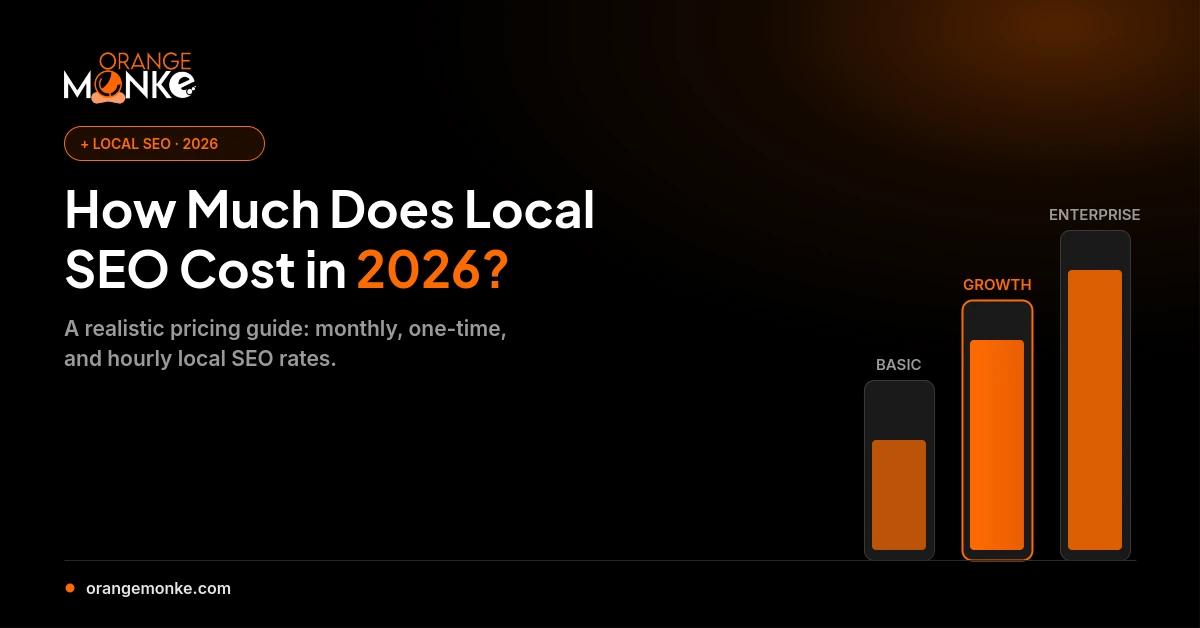
Most businesses pay between $500 and $5,000 per month for local SEO in 2026, with single-location businesses in light competition at the low end and multi-location or high-competition brands at the high end. One-time projects typically run $500 to $5,000, and hourly consulting runs $75 to $300 an hour. The right number depends on your market, not a fixed industry rate.
How Much Does Local SEO Cost in 2026?
Local SEO pricing in 2026 falls into three models: monthly retainers ($500 to $5,000+), one-time projects ($500 to $5,000), and hourly consulting ($75 to $300 an hour). Which one applies to you depends on whether you need ongoing work or a single fix.
Monthly retainers are the most common model, and for good reason. Local rankings move with sustained signals, not a one-time push, so most agencies structure pricing around continuous work, covering ranking in the Google 3-Pack, citation upkeep, content, and reporting, all running every month.
The single biggest driver of your actual number is scope, not the label "local SEO." A $500 package and a $5,000 package can both claim to offer local SEO. One covers a handful of tasks. The other covers a system. Price without scope tells you almost nothing, so treat every quote as a scope question first and a price question second.
What Determines Local SEO Pricing?
Five factors decide where your local SEO quote lands: business size, industry competition, service scope, current site health, and who you hire. Two businesses in the same city can get wildly different quotes because their starting points and goals differ.
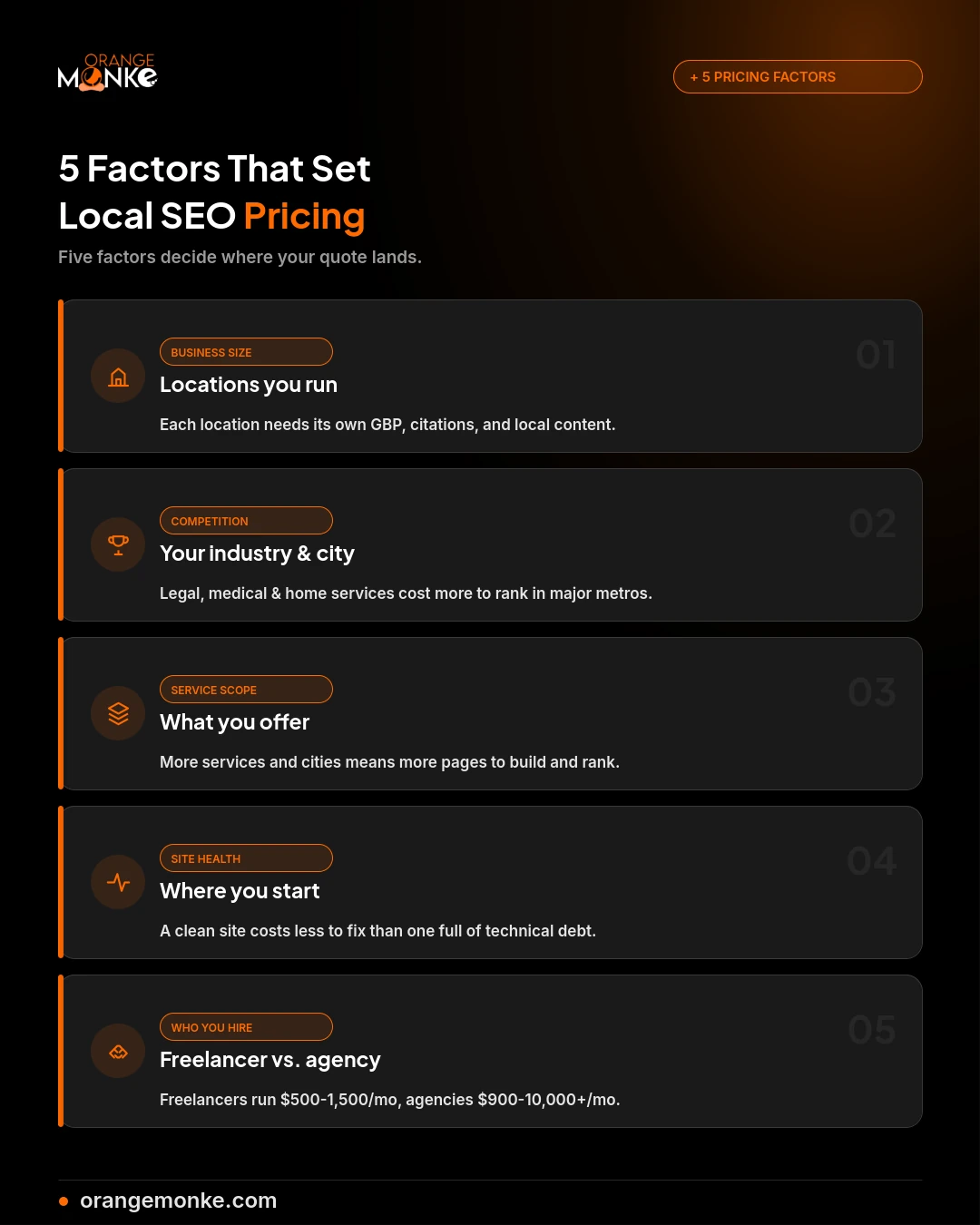
Business size and locations. Every additional location needs its own Google Business Profile, its own citations, and its own localized content. A single-location shop might pay $600 to $1,200 a month. A 10-location brand can run $4,000 to $10,000 or more, because the work scales with each new profile and page, not just the total budget.
Industry and competition. A personal injury lawyer in a major metro competes against dozens of well-funded firms for the same handful of map pack spots, so campaigns there often run $3,000 to $7,000 a month. A niche retailer in a small town might need $500 to $1,000 to hold a strong position, because there's simply less to fight through.
Service scope. A business offering one service needs one set of pages. A business offering ten services across five cities needs fifty potential landing pages. Broader catalogs push content and strategy costs up 30 to 100% compared to a single-service business.
Current site health. A clean, fast, mobile-friendly site is cheaper to optimize than one with duplicate content, broken navigation, or inconsistent business information across directories. Fixing those foundations before you can even start ranking work can add $1,000 to $3,000 to an initial engagement.
Who you hire. Freelancers typically run $500 to $1,500 a month. Boutique agencies run $900 to $3,000. Large agencies run $2,000 to $10,000 or more. Higher pricing usually buys more senior strategy time, more content production, and more reporting infrastructure, not just a bigger logo.
Answer three quick questions for a realistic monthly range, based on the factors above.
Local SEO Pricing Models: Retainer vs. Project vs. Hourly
Retainers suit ongoing growth, project pricing suits defined setup work, and hourly consulting suits narrow troubleshooting. Picking the wrong model for your situation wastes money regardless of the rate.
Best for: Ongoing competitive growth
Strength: Consistent, compounding work, built for local rankings that move with sustained signals rather than a one-time push
Limitation: Requires a real commitment, usually 6-12 months, before the full payoff shows up
Best for: Audits, launches, and cleanups
Strength: Fixed scope and a predictable cost, good for a business with an internal team who just needs a roadmap
Limitation: Doesn't cover ongoing optimization, so rankings can drift without follow-up work
Best for: Troubleshooting and second opinions
Strength: Flexible and low commitment, ideal for a narrow, well-defined problem
Limitation: Hard to predict total spend if the scope isn't tightly defined upfront
A common path is to start with a project-based audit and setup, evaluate results over a few months, then move to a retainer once the foundation is solid and leads start showing up.
Monthly Local SEO Retainer Pricing (2026 Benchmarks)
Monthly local SEO retainers in 2026 typically run $500 to $5,000, split across three rough tiers based on how aggressive the work needs to be. Every agency prices differently, but the tiers below reflect the range seen consistently across current market data.
| Tier | Monthly Cost | Typical Scope |
|---|---|---|
| Basic | $500-$900 | 1 location, light GBP work, basic citations, 1-2 pages per quarter |
| Growth | $900-$2,500 | 1-3 locations, monthly content, review support, stronger reporting |
| Aggressive / Multi-Location | $2,500-$5,000+ | 4+ locations, clustered location pages, heavy link building, advanced reporting |
For reference, this is roughly how Orange MonkE structures its own local SEO packages: an Essential plan starting at $799 a month for a single location, a Growth plan at $1,999 a month for competitive markets, and Enterprise pricing from $4,999 a month, scaled per location for multi-location brands. See the exact tiers and what's included in each.
Most retainer contracts run six to twelve months, because local search results compound rather than spike. Expect early movement around month three to six, with stronger, more durable results building through month twelve and beyond. A provider promising dramatic results in the first few weeks is a red flag, not a selling point.
One-Time Local SEO Project Costs
One-time local SEO projects typically cost $500 to $5,000, depending on depth, and work best for launches, cleanups, or businesses with an internal team who can execute recommendations. This model buys a fixed outcome, not ongoing management.
Common one-time projects include a full local SEO audit covering the site, Google Business Profile, and citations ($750 to $3,000), a complete GBP setup or overhaul per location ($300 to $800), and a bundle of local landing pages for multiple cities or service areas ($1,200 to $5,000).
Project pricing is a strong fit for a new business launching its first local presence, or a company with in-house staff who just need a clear roadmap. It's a weaker fit if you're expecting the results to hold without any follow-up work, since local rankings drift without maintenance.
Hourly Local SEO Consulting Rates
Hourly local SEO consulting runs $75 to $300 an hour in 2026, and makes the most sense for narrow, well-defined problems rather than full strategy ownership. Think GBP suspension recovery, a second opinion on a proposal, or a specific technical fix.
Most consultants sell blocks of five to ten hours rather than single-hour sessions, which usually works out to $750 to $2,000 per engagement. Before agreeing to hourly work, get a clear agenda and a written summary of recommendations. Otherwise you're paying for advice that never turns into action.
Every proposal claims "full local SEO." Few define what that means.
See exactly what's included at every tier, and what your market actually needs, in a free audit with a senior strategist.
Get a free local SEO audit →Local SEO Cost by Business Size
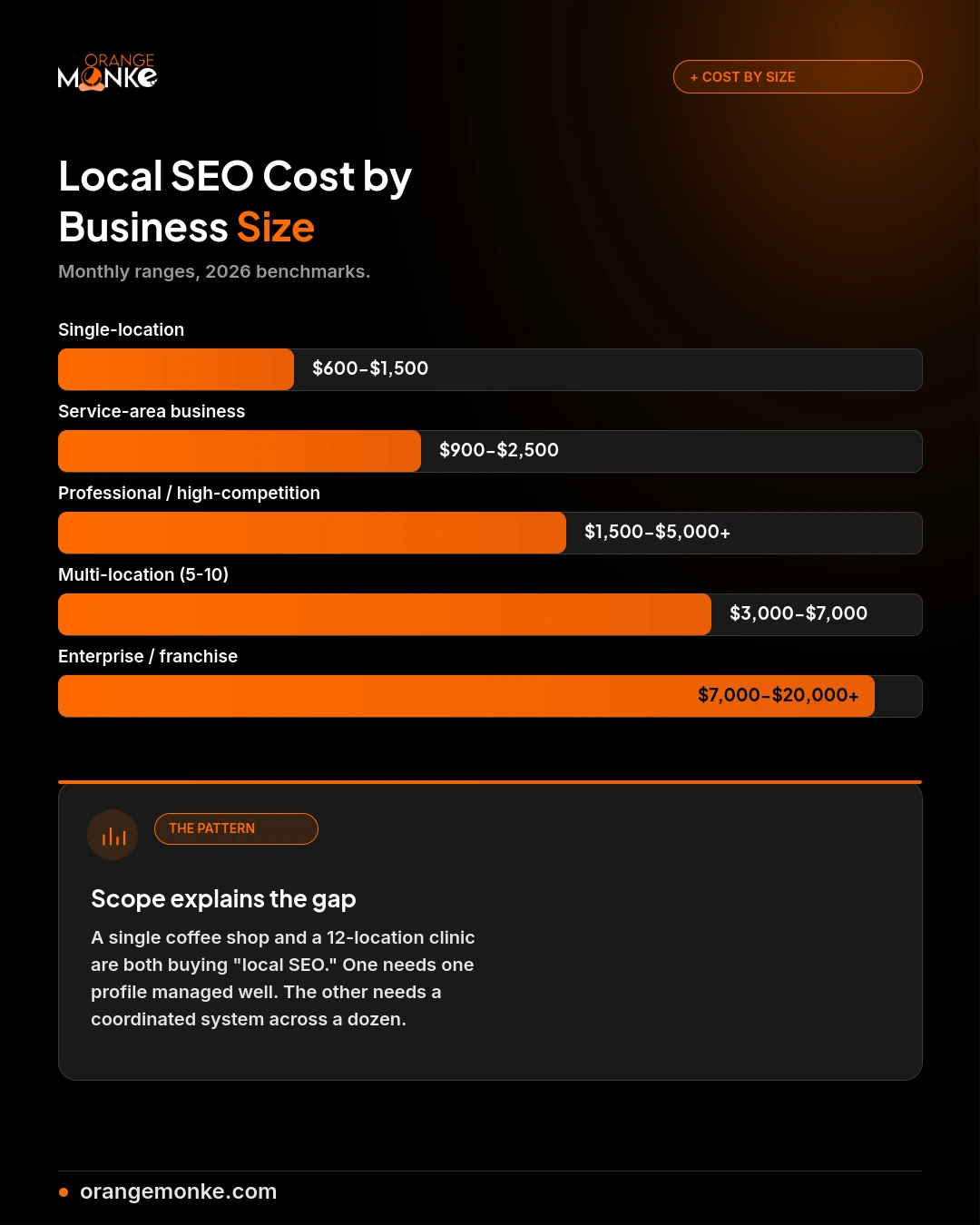
A single-location business typically pays $600 to $1,500 a month, while a multi-location or enterprise brand can run into five figures monthly, driven by how many profiles need individual attention. Business size is the clearest single predictor of where you'll land in the pricing range.
| Business Type | Typical Monthly Range |
|---|---|
| Single-location (restaurant, salon, boutique) | $600-$1,500 |
| Service-area business (plumber, roofer, electrician) | $900-$2,500 |
| Professional / high-competition (law, dental, medical) | $1,500-$5,000+ |
| Multi-location (5-10 locations) | $3,000-$7,000 |
| Enterprise / franchise (10-50+ locations) | $7,000-$20,000+ |
A single-location coffee shop spending $800 a month on Google Business Profile management, basic citations, and review support is solving a fundamentally different problem than a 12-location urgent care chain spending $9,000 a month to coordinate profiles, pages, and reviews across an entire metro area. Both are "local SEO." The scope, not the label, explains the ten-times difference in cost.
Local SEO Cost by Industry (Why Legal, Medical & Home Services Cost More)
Legal, medical, and home services campaigns typically cost more because competitors in those industries already invest heavily in marketing, which raises the bar for everyone else. Industry competition matters as much as business size.
A personal injury lawyer, dentist, or HVAC company in a major metro is often fighting dozens of well-resourced competitors for the same map pack spots and the same handful of high-value keywords. That requires more content, more link building, and more aggressive review management to compete, which pushes monthly budgets toward $3,000 to $7,000 for serious results.
A niche retailer or service provider in a smaller market, with fewer direct competitors actively investing in SEO, can often hold strong local visibility for $500 to $1,200 a month. The work isn't necessarily lower quality. There's simply less resistance to push through.
What's Included in a Local SEO Package?
A standard local SEO package includes Google Business Profile optimization, citation building and consistency, on-page local optimization, content, review management, and monthly reporting. Knowing this list makes it much easier to compare two proposals that look nothing alike on paper.
- Google Business Profile optimization and management: accurate NAP data, categories, photos, and regular posts. Setup typically runs $300 to $800 per location, with ongoing management folded into the monthly retainer.
- Citation building and NAP consistency: getting your business name, address, and phone number listed accurately across directories. Managed campaigns run $300 to $1,500 as a project, or are included in higher-tier retainers.
- On-site content and local landing pages: city or service-area pages, local schema markup, and blog content addressing local questions. Landing pages typically run $200 to $600 each.
- Local link building: links from local news sites, chambers of commerce, and industry associations, usually built into mid-to-high retainers rather than sold as a standalone cheap package.
- Review and reputation management: systems for requesting reviews and responding to feedback across Google and industry platforms.
- Reporting and strategy adjustments: monthly or quarterly reports on rankings, GBP insights, traffic, and leads tied back to local SEO activity.
How Much Should You Budget for Local SEO?
Most businesses allocate 5 to 15% of their total marketing budget to SEO, with local search taking a meaningful share of that for any location-based business. Budgeting works better when it starts from your revenue goals, not from a generic industry benchmark.
A simple way to check the math: if a new local customer is worth $1,000 to your business and you want ten extra customers a month, a $1,500 monthly investment is easy to justify if it consistently produces those leads. That's $18,000 a year in spend generating $120,000 in new revenue, a return most businesses would take without hesitation.
| Annual Revenue | Marketing Budget (8%) | SEO Allocation (30%) | Monthly Local SEO Budget |
|---|---|---|---|
| $500,000 | $40,000/year | $12,000/year | ~$1,000/month |
| $1,000,000 | $80,000/year | $24,000/year | ~$2,000/month |
| $2,500,000 | $200,000/year | $60,000/year | ~$5,000/month |
More competitive industries tend to push the SEO share of the budget higher, simply because search carries more of the lead-generation load in those categories.
Local SEO Pricing and AI Search: What's Changing in 2026
Local SEO pricing in 2026 increasingly has to account for AI-powered search, not just Google Maps and organic rankings, and most pricing guides haven't caught up to that shift yet. Customers now ask ChatGPT, Google's AI Overviews, and Perplexity for local recommendations the same way they used to type "plumber near me" into a search bar.
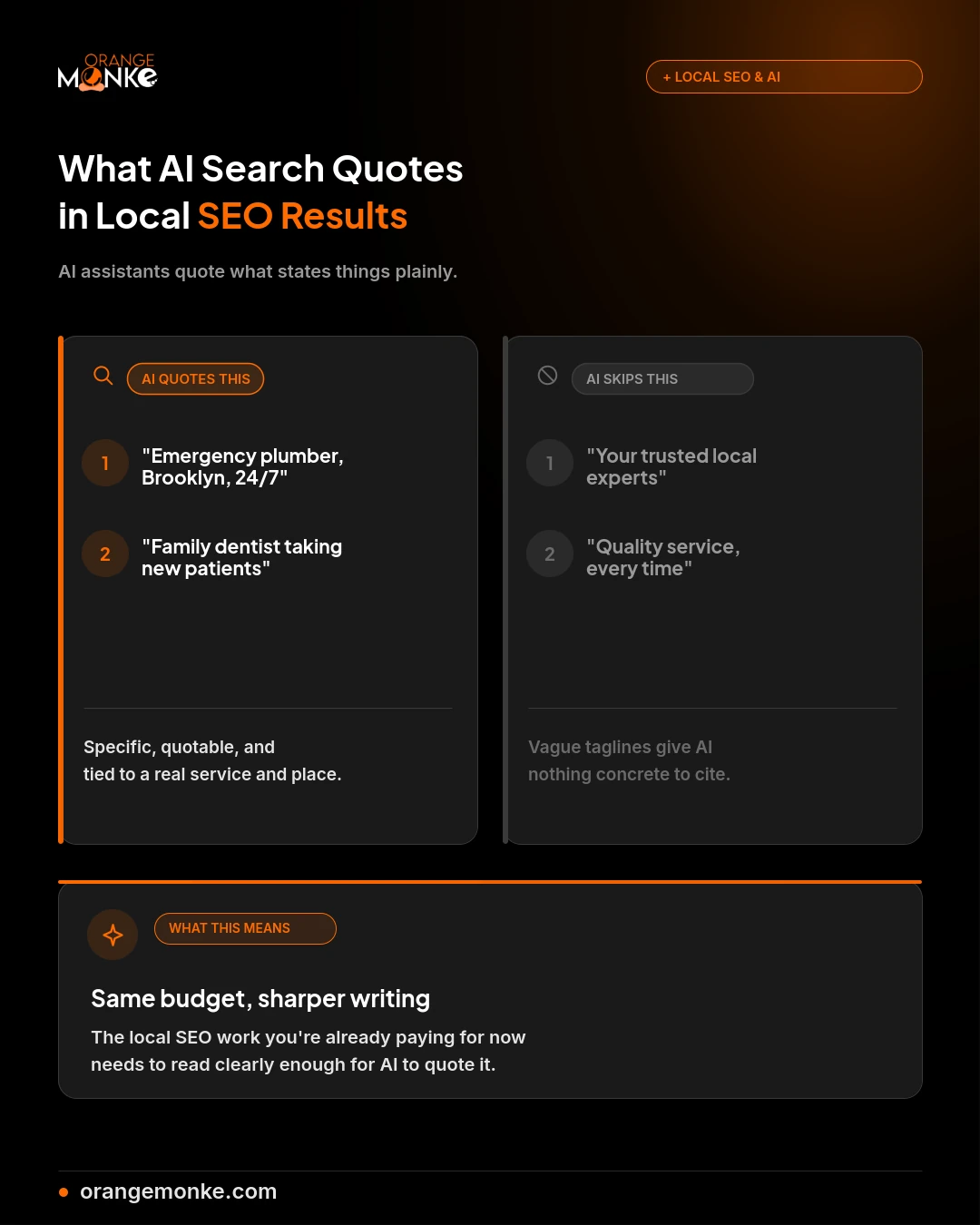
The work required to show up in those answers overlaps heavily with traditional local SEO: accurate business information, strong reviews, clear service descriptions. It also rewards content that states things plainly enough for an AI system to quote directly. A business's Google Business Profile description written as a vague tagline gets skipped by both a human scanning results and an AI system summarizing options. The same description written as a clear, specific statement of what the business does and who it serves works for both.
This doesn't necessarily mean a separate line item on your invoice. It means the work your local SEO budget is already paying for, clear service pages, consistent business information, strong reviews, now needs to be built with AI-readability in mind from the start. Providers who understand this are worth paying a premium for over providers still pricing local SEO as if 2019 search behavior never changed.
Is Local SEO Worth the Cost?
For most location-based businesses, local SEO is one of the highest-ROI marketing channels available, provided it's funded properly and given enough time to work. The return isn't instant, but it compounds in a way paid ads don't.
Industry surveys consistently show a large majority of marketers reporting positive ROI from SEO, and investing in SEO pays off especially for businesses where each customer has meaningful lifetime value. A simple example: $18,000 a year in local SEO spend producing $60,000 in attributable new revenue works out to a 233% return, calculated as (new revenue minus cost) divided by cost. Track calls, direction requests, and form fills back to your local presence, and that kind of math becomes concrete rather than theoretical.
The clearest sign local SEO isn't working is a provider who can only talk about rankings. Rankings are a means, not the outcome. The real questions are whether the phone is ringing more, whether direction requests are climbing, and whether new customers can point to finding you through a local search.
Get a number tied to your market, not a national average.
A free audit scopes exactly what your business needs and what it should cost, no pitch deck, no pressure.
Get your free local SEO audit →Frequently Asked Questions
Most businesses spend between $500 and $5,000 per month on local SEO in 2026, with the exact figure depending on business size, industry competition, and how many locations need coverage.
- Single-location, low competition: $500-$1,200/month
- Service-area or moderate competition: $1,200-$3,000/month
- Multi-location or high-competition industries: $2,500-$10,000+/month
Compare quotes against scope, not just the number. A $600 quote and a $2,500 quote covering the exact same deliverables should be a red flag, not a bargain.
A small, single-location business typically spends $600 to $1,500 a month on local SEO, covering Google Business Profile management, basic citations, on-page optimization, and light content work.
- Assumes: a reasonably clean starting website and a market without extreme competition.
- Tougher categories: legal or medical businesses should expect the higher end of that range or beyond.
- What moves the number: site health, competition, and how many locations need coverage.
That range assumes a reasonably clean starting website and a market without extreme competition.
Local SEO providers typically charge $500 to $5,000 a month depending on the scope delivered, with freelancers at the lower end and full-service agencies at the higher end.
- Freelancers: $500-$1,500/month, best for single-location clients with contained needs
- Boutique agencies: $900-$3,000/month, focused teams with niche expertise
- Large agencies: $2,000-$10,000+/month, more process and capacity for multi-location clients
Price based on the actual hours and deliverables involved, not a flat industry number pulled from a competitor's website.
A typical local SEO package includes Google Business Profile optimization, citation building, on-page local optimization, content creation, review management, and monthly reporting.
- Foundations: GBP optimization, citation cleanup, on-page local SEO.
- Growth add-ons: content production, review generation, local link building.
- Always ask for: a specific list of monthly deliverables, not a vague "full local SEO" promise.
Higher-tier packages add local link building, more frequent content, and deeper competitor analysis.
Yes, local SEO is typically cheaper than paid ads over time, because organic visibility keeps producing traffic after the initial investment, while paid ads stop the moment you stop paying.
- Paid ads: instant visibility, but the flow stops the moment the budget does.
- Local SEO: slower to build, but it becomes an owned asset that keeps producing.
- Most businesses: eventually run both, ads for immediate leads, SEO for the durable base.
Paid search still has a role for immediate lead generation, especially while local SEO is still building momentum.
Freelancers usually suit single-location businesses with straightforward needs, while agencies suit businesses with multiple locations or more complex strategy requirements.
- Freelancer fits: a tightly defined scope, like GBP optimization or citation cleanup.
- Agency fits: work spanning technical SEO, content, and multi-location coordination.
- The deciding factor: how many moving parts your local presence actually has.
A strong freelancer can move quickly on a tightly defined scope. An agency brings more coverage once your needs span multiple disciplines at once.
Most businesses see meaningful ranking improvements within three to six months, with results continuing to build through month twelve and beyond.
- First few weeks: GBP fixes and fresh reviews can lift visibility for less competitive searches almost immediately.
- Three to six months: citation cleanup and content compound into durable Map Pack gains.
- What slows it down: a competitive metro, a messy starting citation profile, or a suspended GBP.
The timeline depends on your starting point and how competitive your market is.
AI search doesn't necessarily add a separate cost, but it does raise the bar for the quality of work your existing local SEO budget should be buying.
- What's the same: the core local SEO signals: GBP, reviews, citations, content.
- What's different: that content now needs to read clearly enough for AI systems to quote it directly.
- The practical result: a provider building for AI visibility from the start is worth a premium.
Clear, specific business information now needs to work for both human searchers and AI systems summarizing local options.