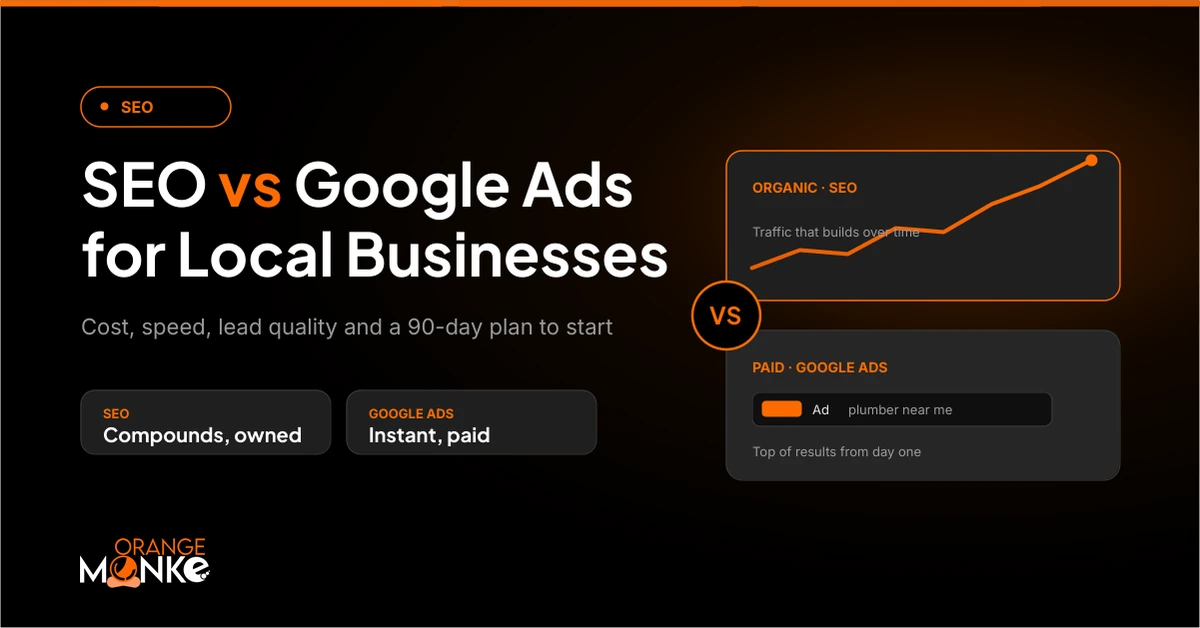
SEO vs Google Ads for local businesses comes down to time versus speed: SEO earns lasting, lower-cost local leads over 3 to 6 months, while Google Ads buys top-of-page visibility and leads from day one. For most local businesses the best answer is both, running Google Ads for instant leads while local SEO and your Google Business Profile compound, then shifting budget to whichever delivers the lower cost per lead.
SEO and Google Ads both put your local business in front of people searching on Google, but they work in opposite ways: SEO earns free, lasting positions in the organic results over months, while Google Ads buys the top spots instantly for a fee per click. The real question is not which is better in the abstract, but which fits your timeline, budget and goals right now.
In this guide I compare the two on cost, speed and lead quality, show when each one wins for a local business, explain how AI Overviews change the picture in 2026, and give you a 90-day plan to start. This is the same framework we use in our local SEO services work with local clients.
What Is SEO for Local Businesses?
SEO for local businesses is the work of earning higher positions in Google's organic results and local map pack, so customers find you without you paying for each click. It combines on-page content, a strong Google Business Profile, local citations and reviews.
For a local business, most of the value sits in the local pack, the three-business map block that shows for "near me" searches. Ranking there depends on relevance, distance and prominence, and it sends a steady stream of calls and visits once you earn it. Our guide to the top local SEO factors breaks down exactly what moves those rankings, and the deeper mechanics live in our SEO ranking factors guide.
What Are Google Ads for Local Businesses?
Google Ads for local businesses are paid listings that appear above the organic results, where you bid on local search terms and pay only when someone clicks. This is the pay-per-click (PPC) model, and Google Ads, formerly known as Google AdWords, is the channel most local businesses use for it. A campaign puts you at the top of the page from the first day it goes live.
For local businesses, the strength of Google Ads is control and speed. You choose the exact "near me" keywords, set a daily budget, target a radius around your location, and start getting calls and form fills within hours. The trade-off is that the moment you pause the budget, the visibility stops.
SEO vs Google Ads: The Key Differences at a Glance
SEO vs Google Ads for local businesses comes down to ownership versus rental: SEO builds an asset you keep, while Google Ads rents attention you lose the moment you stop paying. Each wins on a different job for a local business.
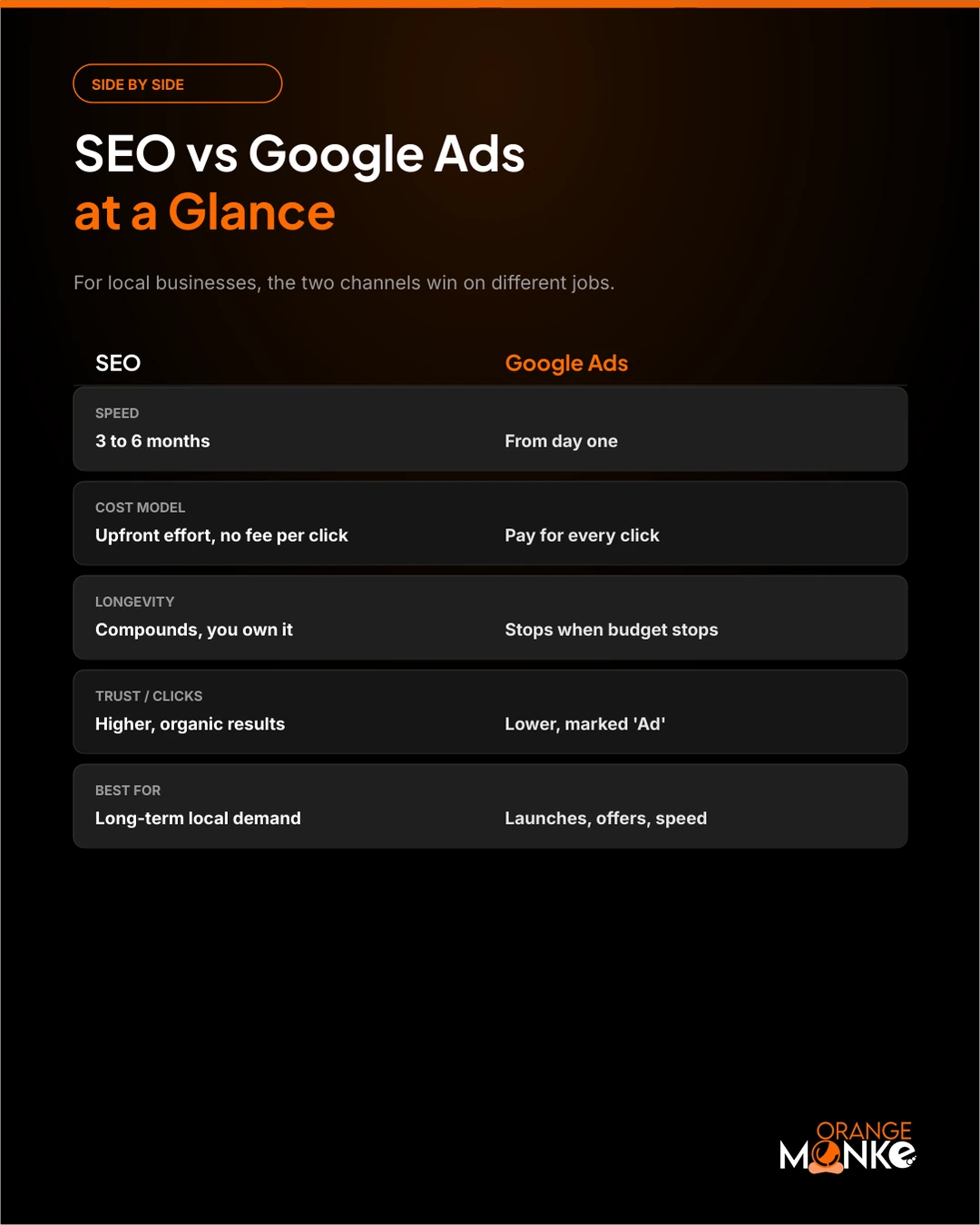
| Factor | SEO | Google Ads |
|---|---|---|
| Speed to results | 3 to 6 months | From day one |
| Cost model | Upfront effort, no fee per click | Pay for every click |
| Longevity | Compounds, you own the traffic | Stops when the budget stops |
| Trust and clicks | Higher, organic results are trusted | Lower, listings are marked "Ad" |
| Control | Indirect, Google decides rankings | Direct, you set keywords and budget |
| Best for | Long-term local demand | Launches, offers, fast leads |
Which Is Cheaper, SEO or Google Ads?
SEO is cheaper than Google Ads over time because you stop paying per visit once you rank, while Google Ads is cheaper to start but charges for every click for as long as you run it. The right lens is cost per lead, not monthly spend.
Google Ads has a clear, immediate cost: you pay a cost per click on every visit, and in competitive local categories like legal, home services or dental that click can run from a few dollars to well over fifty. SEO front-loads its cost into content, technical fixes and link building, then the ongoing cost per lead falls as rankings hold. Here is how the two compare for a typical local business:
| Cost factor | SEO | Google Ads |
|---|---|---|
| How you pay | Monthly retainer or project | Ad spend plus management |
| Cost per extra visit | Effectively zero once ranked | Full cost per click, every time |
| Cost over 12 months | Falls as rankings compound | Flat or rises with competition |
| When budget stops | Rankings and traffic persist | Leads stop the same day |
For a full breakdown of what local SEO actually costs, see our guide on how much SEO costs. The short version: Google Ads wins the first few months on pure cost to acquire a lead, and SEO wins the long game.
Which Is Faster, SEO or Google Ads?
Google Ads is far faster, delivering leads from the first day, while SEO typically takes 3 to 6 months to build meaningful local rankings. If you need customers this week, there is no contest.
That speed gap is exactly why the two pair so well. Google Ads covers the gap while SEO is still climbing, so you are not sitting with zero leads for a quarter. Once your organic rankings and Google Business Profile start producing calls, you can lower the ad budget or point it only at your highest-value keywords.
Which Brings Better-Quality Local Leads?
SEO tends to bring higher-trust, better-quality local leads because searchers click organic results and the local pack more than ads, while Google Ads lets you target high-intent local leads precisely. Quality depends on intent and targeting, not the channel alone.
Organic and local-pack clicks carry built-in trust: people know those businesses earned the position. Google Ads, by contrast, lets you show up only for the exact bottom-of-funnel terms that signal someone is ready to call, like "emergency plumber near me". The best local results come from using organic to win trust and ads to capture urgent demand, which is a core part of how you get organic traffic that converts.
When Should a Local Business Choose SEO?
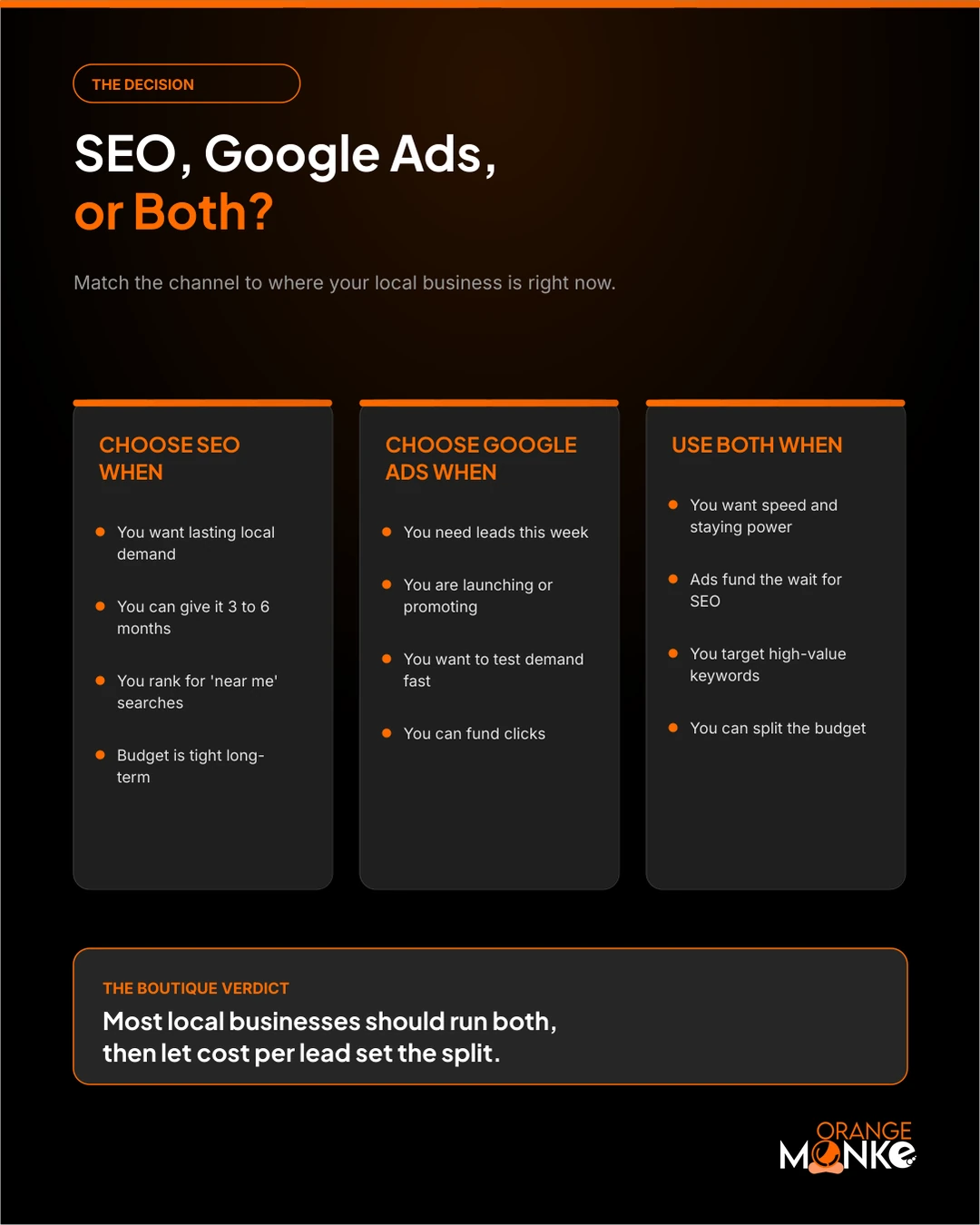
A local business should choose SEO when it wants lasting local demand, can give the strategy 3 to 6 months, and wants to lower its cost per lead over time. It is the better fit for established local businesses playing a long game.
- You want to own your visibility, not rent it from a monthly ad budget.
- Customers regularly search for what you offer with local "near me" intent.
- You can invest for a few months before the returns compound.
- You want to rank in the local pack and Google Business Profile, where trust is highest. Our tips for ranking in the Google 3-pack show how.
When Should a Local Business Choose Google Ads?
A local business should choose Google Ads when it needs leads immediately, is launching or promoting something, or wants to test demand before committing to SEO. It is the better fit when speed and control matter most.
- You need enquiries this week, not next quarter.
- You are launching a new location, service or seasonal offer.
- You want to test demand for a keyword before building content around it.
- You can fund the clicks and want direct control over who sees your listing.
SEO vs Google Ads by Business Type
SEO vs Google Ads by business type shifts the right starting channel: urgent-service businesses lean toward Google Ads, while trust-led and repeat-purchase businesses lean toward SEO. Use this as a first test, then confirm with your own numbers.
| Local business | Start with | Why |
|---|---|---|
| Plumbers, HVAC, locksmiths | Google Ads first | Emergency, high-intent "near me" searches |
| Dentists, clinics, salons | Both | Ads for new patients, SEO for trust and reviews |
| Restaurants, cafes | SEO first | Google Business Profile and local pack drive visits |
| Law firms, accountants | Both | High-value leads justify ad spend; SEO builds authority |
| Retail, boutiques | SEO first | Discovery and local pack, lower click values |
| New local startups | Google Ads first | Test demand fast while SEO is built |
How AI Overviews Change the SEO vs Google Ads Question in 2026
AI Overviews change the SEO vs Google Ads question in 2026 by answering many searches directly at the top of the page, so being cited in the AI answer now matters as much as ranking or bidding below it. This rewards clear, trustworthy content, not paid placement.
For local businesses, AI Overviews pull from well-structured, well-reviewed sources, and they lean on the same signals that strong local SEO already builds: a complete Google Business Profile, genuine reviews and clear, answer-first content. Google Ads still appears, but the clicks above the fold are getting scarcer, so the businesses that win are the ones cited in the AI answer. Our guide to Google AI Overviews and AI Mode covers how to earn those citations, and it is the kind of visibility our local SEO services are built to win.
Why the Best Local Strategy Uses Both Together
The best local strategy runs SEO and Google Ads together, because ads deliver leads now while SEO lowers your cost per lead later, and the two share data that makes each one better. They are partners, not rivals.
Your Google Ads search-term reports reveal exactly which keywords convert, which tells you what SEO content to build next. Meanwhile, strong organic rankings let you cut wasted ad spend on terms you already own. A common starting split for a local business is to weight the budget toward ads early, then move it toward SEO as rankings mature. The one thing to avoid is treating them as an either-or choice when your competitors are running both.
Local SEO vs PPC for Small Businesses: Which Delivers More?
Local SEO vs PPC for small businesses comes down to budget and timeline: local SEO delivers cheaper, compounding leads from the Google map pack, while PPC delivers faster small-business leads you pay for per click. For most small businesses, SEO vs PPC for a local business is not an either-or call; local SEO builds the trusted foundation while a lean PPC budget captures the urgent demand the map pack misses, so the two together beat either one alone.
Not sure whether to start with SEO or Google Ads? Our local SEO team and Google Ads agency audit your local market, your competitors and your numbers, then build the split that gets you leads fastest without wasting spend.
Your 90-Day SEO + Google Ads Starter Plan
Your 90-day SEO and Google Ads plan is the fastest way to decide between the two: run both for 90 days, then let cost per lead make the call. This gives you leads now and real data to guide the long-term split.
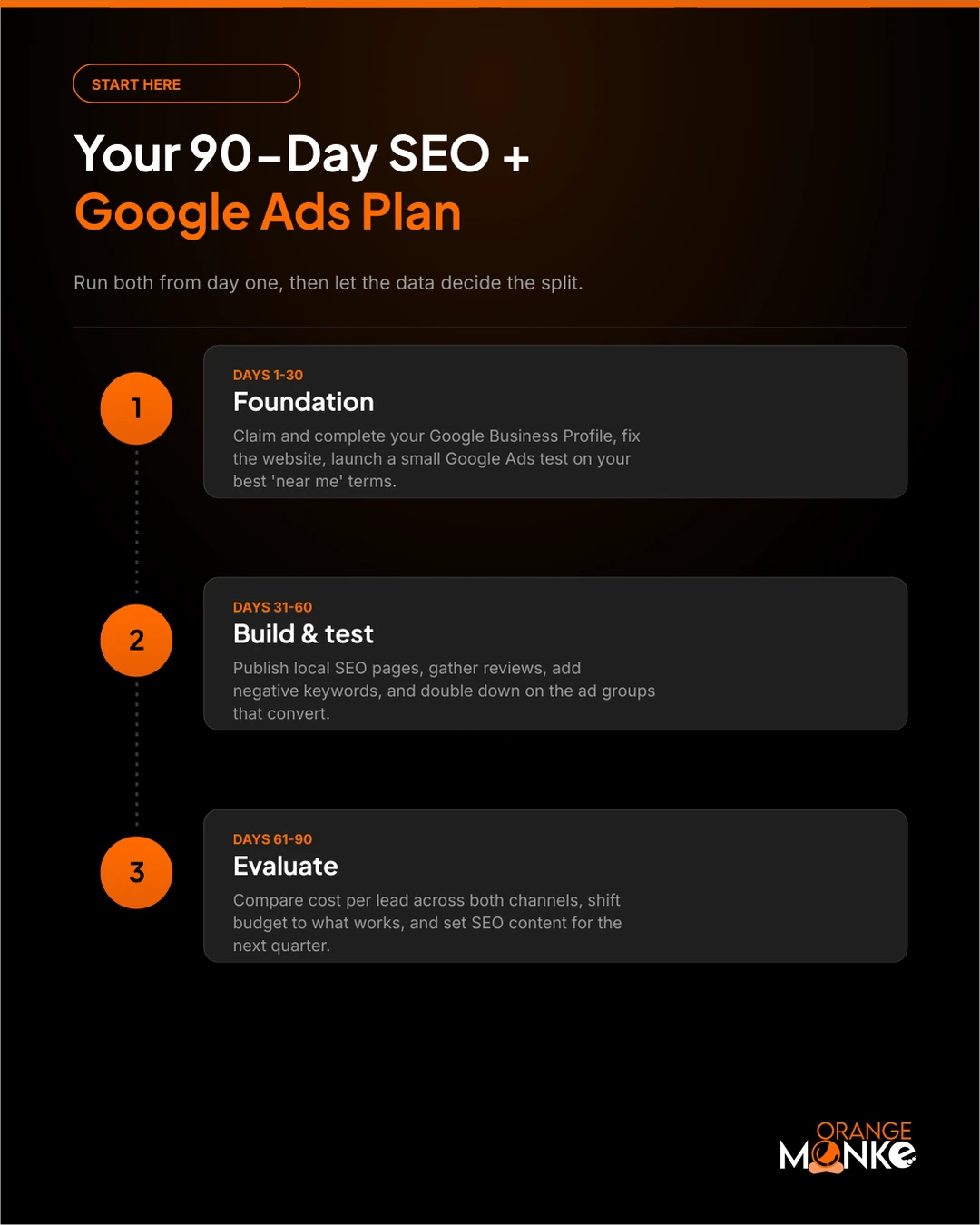
- Days 1 to 30, foundation: Claim and complete your Google Business Profile, fix the website basics, and launch a small Google Ads test on your best "near me" terms.
- Days 31 to 60, build and test: Publish local SEO pages, gather reviews, add negative keywords to cut waste, and double down on the ad groups that convert.
- Days 61 to 90, evaluate: Compare cost per lead across both channels, shift budget to what works, and plan the next quarter of SEO content around your winning keywords.
Keyword research ties the whole plan together, because the terms worth bidding on are usually the terms worth ranking for. Our guide on how SEO keywords drive rankings and traffic shows how to find them.
The Verdict: SEO vs Google Ads for Local Businesses
The SEO vs Google Ads verdict for local businesses is that SEO is the better long-term investment and Google Ads is the better short-term lever, so the winning move is to run both and let cost per lead decide the balance. Start ads for speed, build SEO for staying power, and review the split every quarter.
If you want a team to build and run that balance for you, Orange MonkE pairs local SEO and Google Ads management together, so you capture urgent demand today while you build rankings that keep paying off long after the ad budget is spent.
We build the mix that gets you local leads.
From Google Business Profile and local SEO to a lean Google Ads setup, we run both channels together and shift budget to whatever brings the lower cost per lead.
Explore local SEO services →Frequently Asked Questions
SEO is better for lasting, lower-cost local leads, while Google Ads is better for leads you need right now, so most local businesses benefit from running both.
- SEO: compounding traffic you own, best over 6 to 12 months.
- Google Ads: instant visibility you rent, best for speed and testing.
The winning move is to run both and let cost per lead decide the balance.
SEO is cheaper over time because you stop paying per visit once you rank, while Google Ads charges for every click for as long as you run it.
- Short term: Google Ads wins on cost to get the first leads.
- Long term: SEO wins as rankings compound and cost per lead falls.
Judge both on cost per lead, not on monthly spend.
SEO usually takes 3 to 6 months to build meaningful local rankings, while Google Ads can deliver leads from the very first day a campaign goes live.
- Google Ads: leads within hours of launch.
- SEO: early traction in a few months, compounding after that.
Use ads to cover the gap while SEO climbs.
A local business should start with a budget it can sustain for at least three months, focused on a few high-intent "near me" keywords rather than spread thin across many.
- Start small: fund your best bottom-of-funnel terms first.
- Protect spend: add negative keywords and track cost per lead weekly.
Scale up only the ad groups that produce real enquiries.
Yes, and for most local businesses running SEO and Google Ads together is the strongest strategy, because ads deliver leads now while SEO lowers your cost per lead later.
- Shared data: ad search-term reports show which keywords to target with SEO.
- Less waste: strong organic rankings let you cut ad spend on terms you own.
The two channels make each other more efficient.
Google Ads do not directly improve your organic rankings, because paid clicks are not a ranking signal, but they help SEO indirectly in real ways.
- Keyword data: ads reveal which terms convert, guiding your SEO content.
- Brand lift: more visibility can drive branded searches and clicks.
Run ads for the data and the leads, not for a ranking boost.
SEO still works in 2026, but the goal has shifted toward being cited in the AI Overview, which rewards the same trust signals strong local SEO already builds.
- What wins: clear answer-first content, reviews, and a complete Google Business Profile.
- What changes: fewer clicks above the fold, so citations matter more.
Local businesses with genuine authority are the ones AI answers quote.
A brand-new local business should usually start with Google Ads for immediate leads while building SEO in the background, so it has revenue coming in during the months SEO takes to work.
- First: run ads to test demand and win early customers.
- In parallel: set up the Google Business Profile and local SEO foundation.
Shift budget toward SEO as your organic rankings mature.