SEO keywords drive rankings and traffic by acting as the matching signal between what someone searches for and what your page actually covers, and they work best when placed naturally in a handful of high-visibility spots rather than repeated mechanically. Below are the 5 keyword types worth knowing, where placement actually matters, how to research the right ones, the mistakes that quietly hurt rankings, and whether any of this still matters now that AI search is in the picture.
What Are SEO Keywords, and Why Do They Still Matter?
SEO keywords are the words and phrases people type into a search engine, and they still matter because Google has confirmed its algorithm weighs over 200 ranking factors, with keyword relevance still acting as the entry-point signal among them. Google's algorithms have gotten smarter about understanding context, but they still need a clear signal to connect a search to the right page.
How SEO Keywords Have Changed Over Time
Keywords haven't lost relevance so much as changed jobs. A decade ago, a page could rank by repeating a phrase enough times. Today, the same phrase has to show up inside content that genuinely answers the question, or the ranking doesn't hold. The keyword is still the entry point. It's just no longer the whole strategy.
The History of Keyword-Based Search Rankings
This shift traces back to how search engines learned to read. Early ranking systems were largely text-matching engines: they scanned a page for the exact words in a query and ranked pages with more matches higher. That's why keyword stuffing worked for a while, and why it stopped. Once search engines began using machine learning to understand context, synonyms, and intent rather than just counting word matches, a keyword-stuffed page lost its advantage and often lost rankings outright for looking unnatural. The keyword itself didn't disappear from the equation. What disappeared was the shortcut of using it as a substitute for genuinely useful content.
How Do SEO Keywords Actually Drive Rankings?
SEO keywords drive rankings by giving crawlers a clear topical signal that helps sort one search query against millions of competing pages to find the best match. Without that signal, even genuinely useful content can go unnoticed simply because the search engine can't confidently connect it to the right searches.
SEO Keywords as a Search Ranking Signal
Every search begins with a person typing a query, and every search engine's job is to match that query to the page most likely to satisfy it. A page built around one distinct, well-defined keyword gives crawlers an easy job. A page that scatters its focus across five loosely related topics makes that matching process harder, and that difficulty usually shows up as inconsistent or underwhelming rankings, not a clean failure you can immediately diagnose.
This matching happens in two stages that are worth telling apart.
Stage 1: How Keywords Affect Crawling and Indexing
A search engine's bots visit a page, read its content, and store what they find in a massive index, essentially a library card catalog of the entire web.
- What gets logged: keywords, headings, structure, and links.
- Why it matters: a page that's indexed with unclear keyword signals never gets fairly considered later.
- The invisible failure: the page isn't ranking poorly, it's often not being considered for the right searches at all.
Stage 2: How Keywords Affect Search Rankings
When someone runs a search, the engine pulls candidate pages from that index and scores them against dozens of factors.
- What happens: keyword relevance acts as one of the earliest filters in this scoring process.
- What gets compared: your page against every other indexed page competing for the same query.
- The result: the highest-scoring matches surface first, with keyword signal quality shaping who even makes the shortlist.
That's why weak keyword signals are often invisible as a problem. A page that was never indexed correctly, because its keyword signals were unclear or missing, never even reaches the ranking stage for the queries it should have competed for. Clearing those crawl and indexing barriers is the job of technical SEO, the foundation that caps everything a keyword strategy can achieve on top of it.
The 5 Types of SEO Keywords You Need to Know
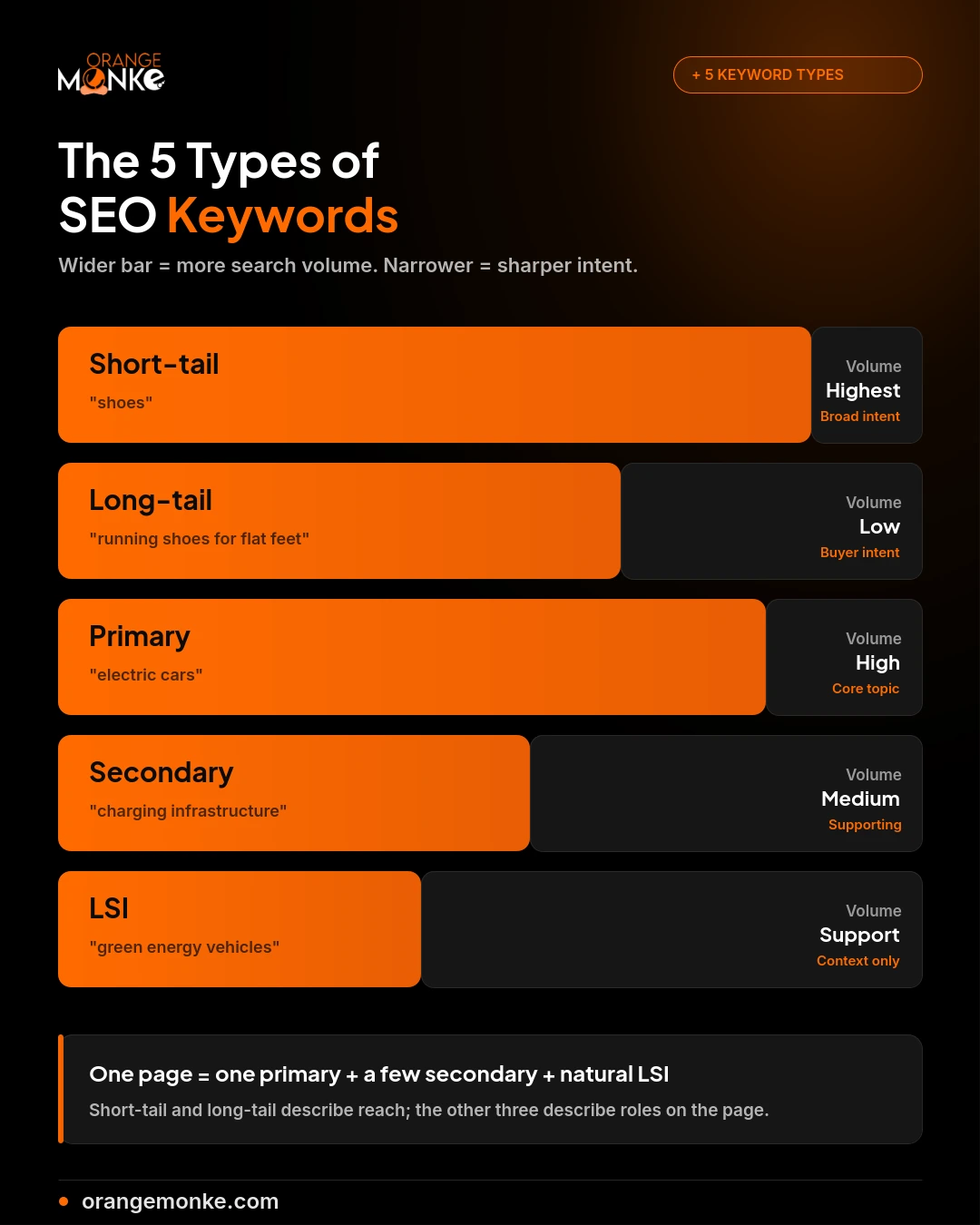
There are 5 keyword types worth knowing: short-tail, long-tail, primary, secondary, and LSI, and each plays a different role in how a page gets found. Confusing these types is one of the most common reasons a keyword strategy underperforms.
Short-tail Keywords
One or two words, broad, and high volume, like "running shoes." They're the hardest to rank for because everyone is competing for the same term, and they rarely tell you what the searcher actually wants.
Long-tail Keywords
Three or more words that get specific, like "best running shoes for flat feet." Lower search volume, much less competition, and a searcher using a phrase this specific is usually closer to a decision than someone typing "shoes."
Primary Keywords
The one main term a page is built around, the thing you'd say if someone asked "what is this page about" in five words or less. Every page should have exactly one.
Secondary Keywords
Terms that support the primary term without competing against it, adding context a search engine can use to understand the page more fully. A page targeting "email marketing software" might use "automated email campaigns" and "email list segmentation" as secondary terms.
LSI Keywords
Latent Semantic Indexing terms: conceptually related words that round out a topic without repeating the primary keyword. For a page about "coffee brewing," that might mean naturally including words like "extraction," "grind size," or "water temperature."
Quick reference:
| Type | Length | Search Volume | Competition | Example |
|---|---|---|---|---|
| Short-tail | 1-2 words | High | Very high | "running shoes" |
| Long-tail | 3+ words | Low | Low | "best running shoes for flat feet" |
| Primary | Varies | High | High | "electric cars" |
| Secondary | Varies | Medium | Medium | "charging infrastructure" |
| LSI | Varies | N/A (supporting) | N/A | "green energy vehicles" |
Put together, a single page rarely uses just one of these types in isolation. A page targeting the primary keyword "email marketing software" might use the long-tail phrase "best email marketing software for small teams" as an H2, weave in secondary terms like "automated email campaigns" throughout the body, and let LSI terms such as "deliverability," "open rate," and "subscriber list" appear naturally wherever the content genuinely calls for them. None of this requires a checklist mentality. A page that thoroughly and honestly explains its topic tends to accumulate the right mix of all five types as a side effect of being well written, not as a separate task bolted on afterward.
What Is Keyword Clustering, and Why Does It Matter?
Keyword clustering means grouping related keywords into a single content plan instead of writing a separate page for every individual term, and skipping it is how a site ends up with 10 or more thin pages competing against each other instead of one strong page that actually ranks. Search engines increasingly reward sites that demonstrate depth on a topic rather than a scattered collection of near-duplicate content.
How Keyword Clustering Works in Practice
In practice, clustering starts with the keyword research already covered above. Instead of treating "email marketing software," "best email marketing tools," and "email marketing platform comparison" as three separate keywords needing three separate pages, group them under one core topic and decide which page owns the primary term while the others become supporting sections, internal links, or closely related articles that all point back to the main page. This is sometimes called a topic cluster or a content silo, and the mechanism is the same either way: one strong, comprehensive page on the core topic, supported by a network of related content that reinforces it through internal linking.
Benefits of Keyword Clustering for SEO
The payoff shows up in two places:
- Search authority compounds: search engines see a clear signal of topical authority when several interlinked pages all reinforce the same subject area, which tends to lift rankings across the whole cluster, not just one page.
- Readers stay on your site: a logical path through related content beats a dead end that sends them back to search for the next piece of the puzzle themselves.
A site that plans content in clusters from the start avoids the common trap of writing dozens of near-duplicate pages that end up competing against each other for the same handful of rankings. Building that kind of interlinked topic cluster is exactly what our content writing team structures every engagement around, one pillar page supported by a deliberate network of related articles.
What Is Keyword Density, and How Much Is Too Much?
Keyword density is the percentage of a page's total words a specific keyword accounts for, and while older guidance commonly cited a fixed 1 to 2% target, that ratio predates today's language-model-based ranking systems and shouldn't be treated as a hard rule anymore. Search engines now judge naturalness over a specific percentage.
The old rule of thumb: keep density around 1-2%. The problem: that ratio was built for a text-matching era search engines have since moved past. Treat it as historical context, not a target to hit.
The more reliable test isn't a number, it's a read-aloud test. If a sentence sounds like it was written for a person, the keyword is probably placed naturally. If a sentence sounds like it exists only to fit the keyword in one more time, that's keyword stuffing, and search engines are specifically built to recognize and penalize it, one of the fastest ways to trip a spam filter, as our beginner's guide to white-hat SEO explains. When in doubt, write the sentence first and check whether the keyword belongs in it, not the other way around.
This is also where keyword proximity comes in, a related but distinct concept from density. Proximity refers to how close related keywords sit to each other within the text, rather than how often any single keyword repeats. A sentence that naturally places "email marketing" near "automated campaigns" signals a stronger topical connection between those two ideas than the same two phrases separated by several unrelated paragraphs. Good writing tends to produce good proximity on its own, since related ideas naturally cluster together in a well-organized paragraph. Treating proximity as a separate metric to optimize, rather than a natural byproduct of clear writing, usually produces the same forced, unnatural result as chasing an exact density percentage.
Where Should You Actually Place Your Keywords?
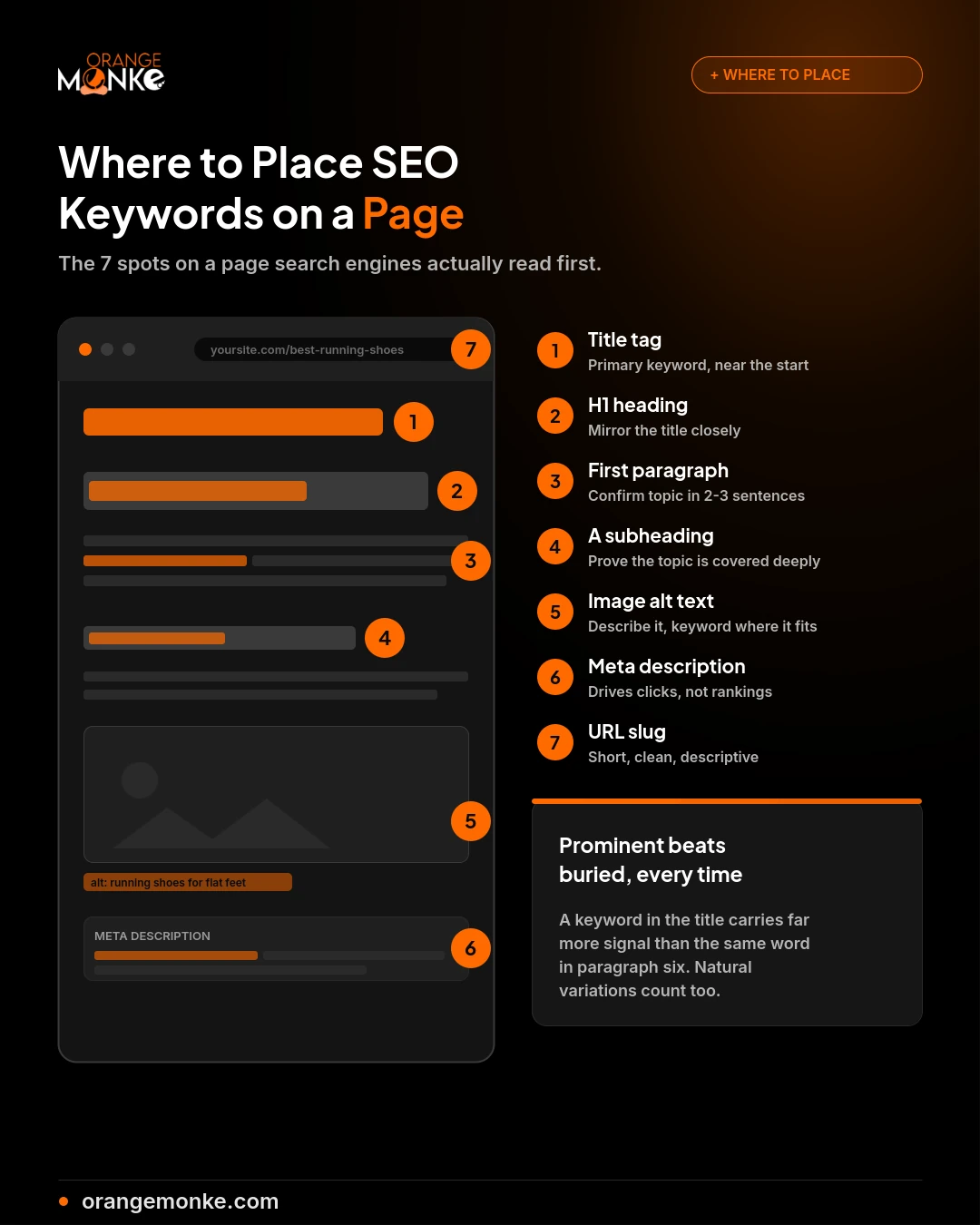
Keyword placement matters most in a handful of high-visibility spots: the title tag, the H1, the first paragraph, at least one subheading, and the meta description, since these are the positions search engines weight most heavily. Burying a keyword only in the middle of paragraph six carries far less signal than the same keyword used prominently near the top of the page.
| Location | What to Do | Why It Carries Weight |
|---|---|---|
| Title tag | Place the primary keyword near the beginning | Search engines and readers both weigh the first few words most heavily |
| H1 / main heading | Mirror the title tag closely | Reinforces the same signal instead of introducing a new phrase |
| First paragraph | Confirm the topic within the first 2-3 sentences | Skips a long, scene-setting introduction that delays the signal |
| At least one subheading | Show the topic is covered in depth | A single top-of-page mention alone reads as thin coverage |
| Meta description | Include the keyword alongside a real reason to click | Doesn't affect rankings directly, but shapes click-through rate |
| Image alt text | Describe the image accurately, keyword where it fits | Extends the same relevance signal into image search |
| URL slug | Keep it short, clean, and descriptive | Reinforces everything above without becoming a run-on string |
Not every one of these needs the exact same phrase repeated verbatim. A natural variation, a synonym, or a closely related phrase in most of these spots still carries most of the same weight as an identical match, and reads far better to an actual visitor than the same three words hammered into every available slot on the page. This is exactly the craft layer our on-page SEO work focuses on: getting keywords into the spots that count without making a page read like it was written for a robot.
How Do You Research the Right Keywords?
Keyword research means identifying the exact words your audience searches, then checking each one's search volume and competition level before you commit content to it, since even excellent writing can't rank for a term nobody searches or one that's too competitive to realistically win. Skipping this step and writing first is one of the most common reasons a page underperforms despite being genuinely well-written.
Best Keyword Research Tools for SEO
Start with tools built for this: Google Keyword Planner for volume data, and platforms like Semrush or Ahrefs for competition scoring and gap analysis, seeing which keywords competitors rank for that you don't. Prioritize search intent alongside volume. A high-volume keyword with the wrong intent, informational traffic landing on a page built to sell, will inflate your traffic numbers without moving revenue.
Keyword Research Example
A simple example of how this plays out: a business selling project management software might find that "project management" gets enormous search volume but is dominated by established players with years of authority behind them. A gap analysis might instead surface "project management software for remote teams" or "project management for construction companies," phrases with a fraction of the volume but a realistic path to ranking, and an audience already further along in deciding what they need. Chasing the biggest number on a keyword research report is rarely the same thing as chasing the best opportunity.
4 Types of Search Intent for SEO Keywords
Search intent breaks down into four broad categories worth knowing before you commit a keyword to a page:
| Intent Type | What the Searcher Wants | Example Query | Best Content Format |
|---|---|---|---|
| Informational | An answer or explanation, not a purchase | "how does email automation work" | Guide or explainer article |
| Navigational | A specific site or brand they already know | "[brand name] login" | Homepage or brand page |
| Commercial | To compare options before deciding | "best email marketing tools for small business" | Comparison or review page |
| Transactional | To act right now | "buy email marketing software" | Product or pricing page |
Matching a page's format to the right intent category matters as much as matching its keyword. An informational guide will rarely convert transactional-intent traffic, and a product page stuffed with generic informational content will rarely satisfy someone who just wants to know how something works.
Ranking for the wrong keywords is expensive, quiet, and fixable.
A free SEO audit shows which buyer-intent keywords you're missing, and exactly what it would take to rank for the ones that actually drive revenue.
Get a free SEO audit →5 Keyword Mistakes That Quietly Hurt Your Rankings
Keyword mistakes tend to fall into 5 recurring patterns, and the most common starting point is choosing terms based on guesswork instead of real search data, which then compounds into several related mistakes that quietly cap how well a page can perform.
| Mistake | Why It Hurts | Better Approach |
|---|---|---|
| Choosing keywords by guesswork | Targets terms with no real search volume behind them | Verify volume and intent with a keyword research tool first |
| Keyword stuffing | Reads unnaturally, risks a ranking penalty | Write for people first, keep placement natural |
| Ignoring search intent | Attracts the wrong kind of traffic | Match content format to what the searcher actually wants |
| Only targeting broad, short-tail terms | Extremely competitive, low conversion | Mix in long-tail variations that are easier to rank for |
| Letting multiple pages target the same keyword | Pages compete against each other instead of ranking together | Map one primary keyword to exactly one page |
Most of these mistakes share the same root cause: treating keyword strategy as a box to check quickly rather than a decision worth basing on real data. A page that avoids all five isn't guaranteed to rank, but a page that commits even one of them is fighting itself before it's even published.
Catching these mistakes after the fact is far more expensive than avoiding them upfront. A page built around a keyword nobody searches for doesn't just fail quietly, it consumes the writing, editing, and design time that could have gone into a page with a real chance of ranking. Running a quick check against this list before publishing, rather than after a page has already underperformed for months, is the difference between a fast content calendar and one that constantly circles back to fix avoidable problems.
Branded vs. Non-Branded Keywords: Which Should You Target?
Branded keywords include your company or product name, while non-branded keywords describe the topic without naming a brand, and a new business typically starts with zero search volume for its own name, which is why non-branded terms need to come first. An established brand can afford to invest in both, capturing existing brand searches while still expanding reach through broader terms.
| Branded Keywords | Non-Branded Keywords | |
|---|---|---|
| Example | "[your company] pricing" | "invoice automation software" |
| Best for | Established brands with real search volume | New businesses nobody is searching for by name yet |
| Risk of ignoring | Competitors and resellers capture your own brand traffic | Missing the audience who doesn't know you exist yet |
A new SaaS tool has no one searching its name yet, so its early content should target what the tool does ("invoice automation software"), not what it's called. Years later, once the brand has real recognition, branded search volume becomes worth defending and optimizing for directly, at which point ignoring branded terms would mean losing easy, high-intent traffic to a competitor's comparison page or an unrelated reseller instead of your own site.
Do Keywords Still Matter for AI Search and GEO?
Yes, keywords still matter for AI search, and it shows in the data: top-ranking pages supply roughly 99% of Google AI Overview citations, which means the same keyword work that earns a ranking is now what earns a citation too. A page that ranks well can still go uncited in an AI Overview or a ChatGPT response if it isn't written in a way that's easy to extract, but a page that ranks nowhere gives AI systems nothing of yours to quote at all.
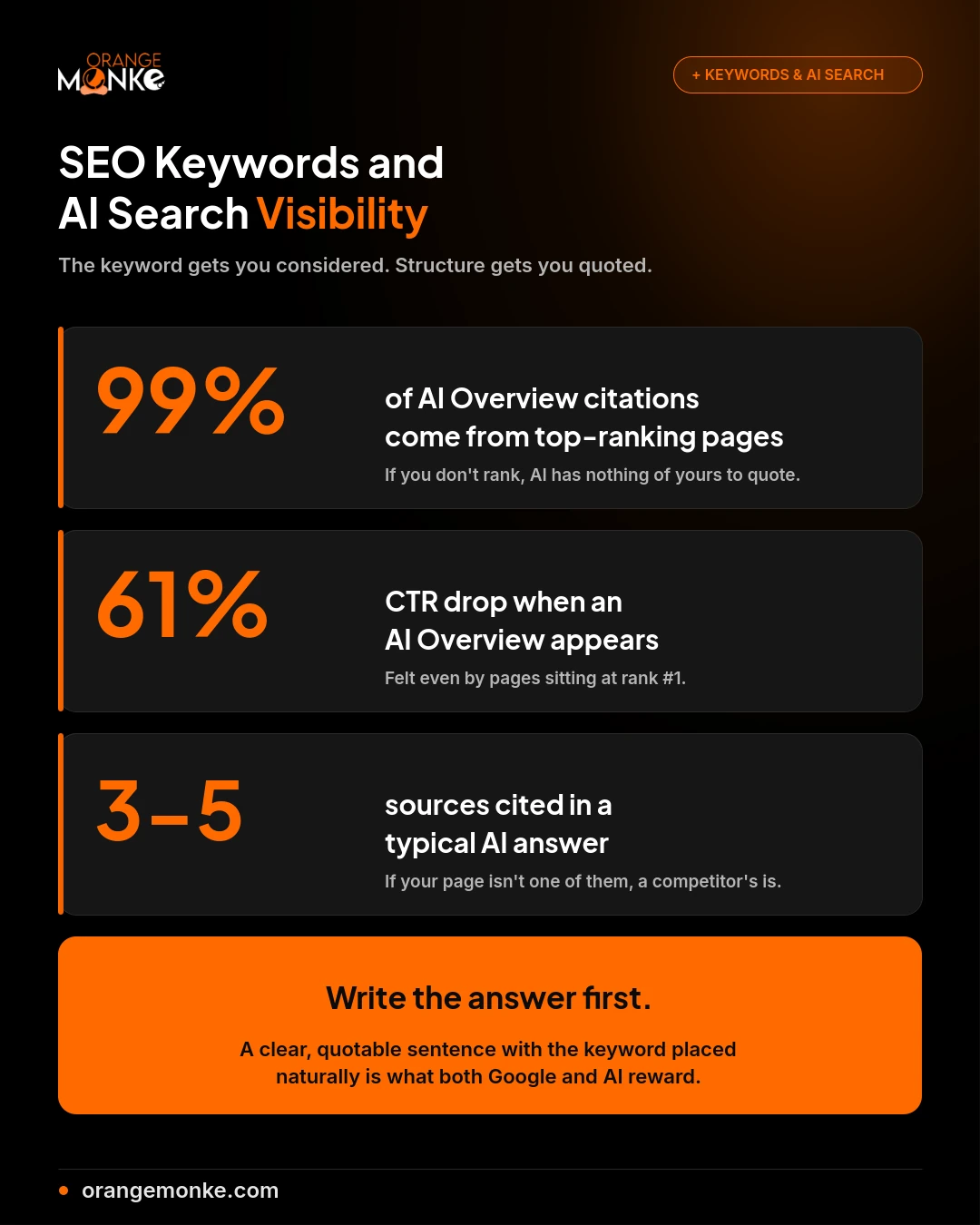
This is the same underlying discipline as generative engine optimization, GEO: clear, specific, keyword-relevant sentences that state a fact plainly enough for a system summarizing the topic to quote directly. The stakes are real, since organic click-through drops roughly 61% when an AI Overview appears, even for a page ranking first, and a typical AI answer cites only 3 to 5 sources total. If your page isn't one of them, a competitor's is.
The practical difference shows up in how a sentence gets written, not in which keywords get chosen. Traditional SEO writing often builds toward an answer, easing a reader in with context before stating the main point. AI systems tend to lift the first self-contained sentence that directly answers a question, which is exactly why the answer-first structure used throughout this guide, and increasingly across well-optimized content generally, has become standard practice rather than a stylistic preference. A paragraph that opens with a hedge, a rhetorical question, or three sentences of setup before the actual answer gives an AI system nothing clean to extract, even if the right keyword appears somewhere in the middle of it. The keyword gets you into consideration. The sentence structure around it decides whether you get quoted. It's the same reason a page can rank first on Google yet stay invisible in ChatGPT if its answers aren't written to be lifted.
Conclusion: Keywords Still Do the Job, Just Not Alone
SEO keywords still drive rankings and traffic in 2026, but they work as one signal inside a larger system rather than the whole strategy, which is exactly why guesswork, stuffing, and outdated density rules keep failing while research-backed, naturally placed keywords keep working. Everything covered in this guide, from the 5 keyword types to clustering, placement, research, and AI search, points to the same underlying habit: choose keywords based on real data, place them where they carry real weight, and write the rest for the human actually reading it.
- Start with research, not guesswork: verify search volume and intent before committing content to a keyword.
- Cluster before you write: decide how many pages a topic actually deserves before producing a dozen thin ones.
- Place keywords where they count: title, H1, first paragraph, at least one subheading, meta description, and alt text.
- Skip the fixed density rules: write naturally and let a read-aloud test catch anything that sounds forced.
- Build for AI search too: the same clear, quotable writing that ranks well is what gets cited in AI-generated answers.
At Orange MonkE, this is the same foundation we build every SEO campaign on: real keyword research, content structured to be found, and writing built to earn both rankings and AI citations rather than one at the expense of the other. If you'd rather have a team handle it, our SEO services start with a free audit of exactly where your keywords are working and where they're leaking traffic.
The system around your keywords is the rest of the job.
Research, clustering, placement, technical SEO and AI-search readiness, run as one strategy by a team that answers for the results.
Explore our SEO services →Frequently Asked Questions
There's no single fixed percentage that works as a universal target, since modern search engines judge naturalness over ratio, not a specific density number.
- Old guidance: fixed ratios like a set count per 500 words, largely outdated advice from before language-model-based ranking.
- Current approach: write naturally, then check whether the keyword still fits the sentence.
- The real test: read it aloud; if it sounds written for a keyword instead of a person, it's too dense.
Chasing an exact percentage is the wrong goal. Chasing a sentence that reads naturally while still covering the topic is the right one.
A primary keyword is the single main term a page is built around, while secondary keywords are related terms that add supporting context without competing against the primary term.
- Primary: one per page, the answer to "what is this page about" in a few words.
- Secondary: several per page, used in subheadings and body text to expand the topic.
- The risk of mixing them up: treating multiple terms as equally primary dilutes relevance for all of them.
A page with a clear one-primary, several-secondary structure consistently outperforms one that tries to rank equally for several unrelated main terms.
No, meta keywords do not matter for SEO, since Google confirmed years ago that it does not use the meta keywords tag as a ranking factor at all.
- What it used to do: let site owners declare target keywords directly in a page's HTML.
- Why it stopped working: it was widely abused with irrelevant keyword stuffing, so search engines dropped it as a signal entirely.
- What to focus on instead: the actual keywords used in your title tag, headings, and visible content, which still carry real weight.
Leave the meta keywords field blank if your CMS still has one. It does nothing today.
One page should target one primary keyword and a small number of related secondary keywords, since spreading a single page across several unrelated primary terms usually weakens its ranking for all of them.
- One primary: the core topic the page is built to answer.
- A few secondary: supporting terms that reinforce and expand that core topic.
- What to avoid: trying to rank one page for multiple, unrelated head terms at once.
If you have several genuinely distinct topics worth targeting, they usually deserve separate pages, not one page doing double duty.
LSI keywords are terms conceptually related to your main keyword, and they still matter because they help search engines confirm that your content covers a topic thoroughly rather than just mentioning it once.
- Example: a page about "coffee brewing" naturally includes words like "extraction," "grind size," and "water temperature."
- Why they help: they demonstrate topical depth without mechanically repeating the same primary keyword.
- How to use them: write comprehensively about the topic and they tend to appear naturally, rather than being inserted as a separate checklist item.
Good, thorough writing on a topic usually produces strong LSI coverage as a side effect, not as a separate task.
Yes, a page can rank without the exact-match phrase, since modern search engines understand synonyms, context, and related phrasing well enough to match intent rather than requiring an identical string of words.
- What still helps: using the keyword and its natural variations somewhere prominent on the page.
- What's no longer required: repeating the exact phrase verbatim multiple times.
- The underlying shift: search engines now match meaning, not just text strings.
This is exactly why keyword stuffing stopped working. Exact repetition was never actually the requirement, even when it appeared to help.
Yes, keywords still matter for AI search, but the goal shifts from ranking a page to producing a clean, specific sentence an AI system can quote directly in a generated answer.
- What carries over: the same clarity and relevance that keyword research and placement have always required.
- What's different: the sentence needs to be extractable on its own, not just present somewhere on the page.
- The blind spot: roughly 70% of AI-referred visits get logged as "Direct" in analytics, so the channel can look invisible even when it's already sending you buyers.
Good keyword practice and good AI search visibility turn out to reward almost the same writing habits.
Local businesses should prioritize location-based keywords tied to a specific city or neighborhood, since a generic industry term without a location signal competes against national or global results a local business realistically can't outrank.
- Add the location directly: "plumber in Austin" beats competing for the bare term "plumber."
- Use Google Business Profile categories: these often mirror the exact phrases local searchers use.
- Watch for near-me searches: these carry strong commercial intent and reward accurate location and category data.
A local bakery targeting just "bakery" is fighting a battle it was never going to win. The same bakery targeting "bakery in [neighborhood]" is fighting one it actually can.
Keyword mapping assigns one specific keyword to one specific page, while keyword clustering groups multiple related keywords together to decide how many pages a topic actually deserves, and most sites need both, done in that order.
- Clustering comes first: group related keywords and decide how many distinct pages the topic genuinely supports.
- Mapping comes second: once pages are defined, assign exactly one primary keyword to each.
- Skipping either step: leads either to thin, duplicate pages (no clustering) or a strong cluster with no clear owner for each keyword (no mapping).
Think of clustering as deciding how many rooms a house needs, and mapping as deciding what goes in each one. Both matter, and neither substitutes for the other.
how our full-stack SEO ties clustering and mapping together →