Jun 11, 2026
  16 Min Read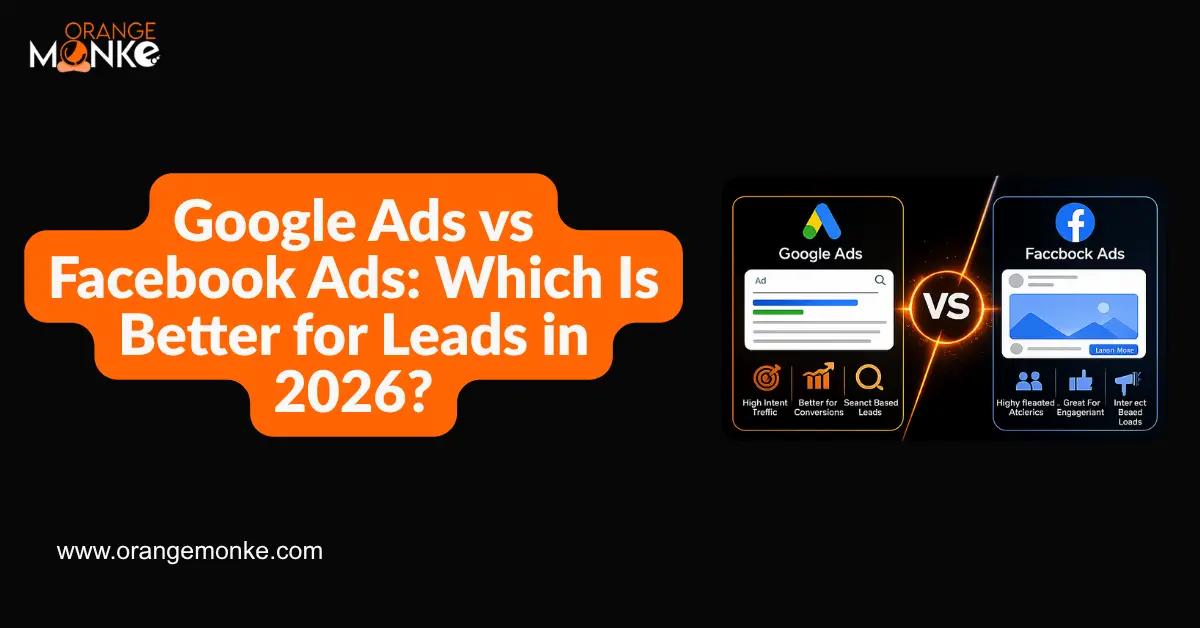
| Every marketer running paid campaigns eventually hits the same fork in the road: should the next ad dollar go to Google Ads or Facebook Ads? Both platforms can generate leads. Both can also burn through budget fast if you pick the wrong one for your business model. The honest answer in 2026 is that Google Ads usually wins on lead quality and purchase intent, while Facebook Ads usually wins on cost-per-lead and audience scale. Which is “better” depends on whether you need to capture demand that already exists or create demand that doesn’t. |
This guide breaks down the real difference between Google Ads and Facebook Ads for lead generation. Whether you’re a B2B SaaS founder, a local service business, or a D2C brand scaling paid social media ads, you’ll finish this article knowing exactly which platform deserves your budget, and when running both together makes the most sense.
What Are Google Ads and How They Generate Leads
Google Ads is Google’s pay-per-click (PPC) advertising platform. It lets advertisers bid on keywords so their ads appear across Google Search, Google Maps, YouTube, Gmail, Google Discover, and millions of partner sites on the Google Display Network. The platform holds roughly 80% of the global PPC market, making it the largest paid advertising channel on the internet.
For lead generation, Google Ads works on a simple principle: show the right offer to people who are actively searching for it. The main ad types used for Google Ads lead generation include:
- Search Ads — Text ads at the top of Google search results, triggered by keywords. The strongest format for high-intent leads.
- Performance Max — Google’s AI-powered campaign that runs across Search, Display, YouTube, Gmail, Discover and Maps from a single setup.
- Display Ads — Banner ads on partner websites, useful for retargeting and brand awareness.
- YouTube Ads — Video ads used for awareness, consideration and increasingly for direct response.
- Shopping Ads — Product-based ads for e-commerce that show image, price and store name.
The user is in “problem-solving mode” when they see a Google Ad. That single fact is why Google leads convert faster, why Google CPCs are higher, and why Google Ads is the default choice for service businesses, B2B companies and any product with a clear search query attached to it.
What Are Facebook Ads and How They Generate Leads
Facebook Ads — now part of Meta Ads — is Meta’s advertising platform spanning Facebook, Instagram, Messenger, WhatsApp and the Audience Network. According to Meta’s own reporting, the platform reaches roughly 3 billion monthly active users on Facebook alone, with over 10 million active advertisers competing for attention. That scale is one of the reasons paid social media ads continue to dominate consumer marketing budgets
Facebook Ads generates leads by putting the right offer in front of the right audience, even when that audience isn’t searching. The most-used ad formats for Facebook Lead Generation Ads include:
- Lead Form Ads (Instant Forms) — Native lead forms that open inside Facebook or Instagram. Users tap once and most of their details auto-fill from their profile. This format alone has reshaped what’s possible for paid social media ads.
- Conversion Campaigns — Ads optimized to drive form submissions, signups or purchases on your landing page.
- Click-to-Message Ads — Open a Messenger or WhatsApp conversation directly from the ad — particularly strong for local services in India and the Middle East.
- Carousel and Collection Ads — Multi-product or multi-feature layouts that work well for retail, real estate and education.
- Video and Reels Ads — Short, vertical, sound-on creatives optimized for the way users actually consume content on the platform.
Because Facebook users are in “discovery mode”, the creative has to do the heavy lifting. A weak hook in the first three seconds and the user is gone. That’s why Facebook Lead Generation Ads reward strong visuals, sharp copy, and offers compelling enough to interrupt a casual scroll.
Google Ads vs Facebook Ads: Key Differences at a Glance
Here is a side-by-side view of the most important differences between Google Ads and Facebook Ads for any business evaluating where to spend.
| Factor | Google Ads | Facebook Ads |
| User Intent | High — users actively searching for a solution | Low to medium — users discover products while browsing |
| Demand Type | Captures existing demand | Creates new demand and awareness |
| Primary Targeting | Keywords, search intent, audience layering | Interests, demographics, behaviors, and lookalike audiences |
| Audience Reach | Approximately 8.5 billion searches per day | Around 3 billion monthly active users across Meta platforms |
| Average CPC (2026) | $4.22–$5.42 across industries | $0.62–$1.92 depending on campaign objective |
| Lead Quality | Generally higher due to strong purchase intent | Varies based on audience targeting and creative quality |
| Best For | B2B companies, local services, urgent purchases, high-intent leads | B2C brands, e-commerce, lifestyle products, brand awareness |
| Creative Style | Text-focused, keyword-driven ads | Visual-first ads using images, videos, and storytelling |
| Time to Convert | Often faster, with conversions occurring in the same session | Typically longer, requiring multiple touchpoints and nurturing |
| Minimum Budget | Usually effective from $20+ per day | Can start generating results with $5–$10 per day |
Cost Comparison: CPC, CTR and CPL in 2026
Cost is where most marketers feel the difference between Facebook Ads and Google Ads most sharply. The averages below are pulled from 2026 benchmark reports by WordStream, LocaliQ and other industry data sources, and they tell a consistent story: Google clicks cost more, Facebook clicks cost less, and the gap closes when you measure cost per qualified lead instead of cost per click.
| Metric (2026 Avg.) | Google Ads (Search) | Facebook Ads |
| Average CPC | $4.22 – $5.42 | $0.62 – $1.92 |
| Average CTR | ~6.6% | ~2.2% |
| Average Conversion Rate | ~7% – 8% | ~9% (often inflated by lead-form submissions) |
| Average CPL (Cross-Industry) | ~$66 – $70 | ~$23 – $28 |
| B2B CPL Range | $100 – $800+ | $30 – $250 |
| B2C CPL Range | $30 – $120 | $10 – $50 |
| CPM (Cost per 1,000 Impressions) | $20 – $50+ | ~$11 – $17 |
| Highest-Cost Verticals | Legal ($8.58 CPC), Insurance, Finance | Finance ($3.77 CPC), B2B SaaS |
The numbers look one-sided in Facebook’s favor — until you remember that CPL is not the same as cost per customer. A $25 Facebook lead that closes 5% of the time costs $500 per customer. A $75 Google lead that closes 25% of the time costs $300 per customer. The “cheaper” platform isn’t always cheaper once revenue is factored in. This is why the comparison between Facebook Ads and Google Ads can never be answered with a single cost number — it always depends on your close rate, sales cycle and average deal size.
Google Ads Pros and Cons
Below is an honest look at what Google Ads gets right and where it falls short — relevant for any business considering it for Google Ads lead generation.
Google Ads Pros
The strengths of Google Ads pros all trace back to one thing: you are buying intent, not attention.
- High purchase intent — Users are actively searching for what you sell. That dramatically shortens the path from click to conversion.
- Masive reach — Google handles over 8.5 billion searches per day, giving advertisers access to virtually every internet user with a question.
- Granular keyword control — You decide exactly which search queries trigger your ads, including negative keywords to exclude wasted spend.
- Multiple ad surfaces — One Google Ads account unlocks Search, Display, YouTube, Gmail, Maps, Shopping and Discover.
- Strong B2B performance — Decision-makers researching software, services or vendors land on Google first. B2B lead quality on Google is consistently higher.
- Predictable lead flow — Once a campaign is profitable, scaling is largely a matter of budget — search demand is fairly stable.
- Transparent measurement — Conversion tracking, Quality Score, Enhanced Conversions and offline conversion imports give a clear path from click to revenue.
Google Ads Cons
Google Ads cons are mostly the cost of access to that intent.
- High CPCs — Average CPCs cross $5 industry-wide, with legal, insurance and B2B verticals routinely paying $15–$50 per click.
- Steep learning curve — Keyword match types, Quality Score, bidding strategies and ad extensions all need to be set up correctly or budget evaporates.
- Limited creative expression — Search ads are text-only. There is little room to build an emotional connection on the SERP.
Capped by search volume — You can only serve ads to as many people as are searching. In niche B2B markets, that might be 2,000–3,000 searches per month. - Heavy reliance on landing pages — A click is worth nothing if the landing page doesn’t convert. Performance is often a landing page problem dressed up as an ad problem.
- Increasing AI automation — Performance Max and Smart Bidding hand more control to Google’s algorithm. Great when it works, frustrating when it doesn’t.
- Brand-bidding by competitors — Competitors can bid on your brand terms, forcing you to spend just to defend your own name.
Facebook Ads Pros and Cons
Facebook Ads is the largest paid social channel in the world, and for good reason. Here are the real strengths and weaknesses for anyone evaluating Facebook Ads and Google Ads side by side.
Facebook and Meta Pros
The biggest Facebook and Meta pros come from scale, targeting depth and creative flexibility.
- Massive audience — Roughly 3 billion monthly active users across Facebook, plus Instagram, Messenger and WhatsApp inside the same ad system.
- Low cost of entry — Campaigns can run profitably on $5–$10 per day in many markets, making it accessible for small businesses and bootstrapped founders.
- Granular targeting — Demographics, interests, behaviors, life events, lookalike audiences and custom audiences from your CRM all stack on top of each other.
- Native lead forms — Instant Forms inside Facebook autofill name, phone, email and other fields, lowering friction and driving CPL down significantly.
- Creative-driven results — Strong creative can outperform sophisticated targeting. That makes the platform more accessible to brands willing to invest in video and design.
- Powerful retargeting — Pixel-based retargeting of website visitors, video viewers and engagers consistently produces the lowest CPLs on the platform.
- Better for early-funnel discovery — Ideal for introducing new brands, new products and new categories where people don’t know to search yet.
Pros of Facebook Ads
A few extra pros of Facebook Ads are worth calling out because they get lost in the cost-per-click conversation:
- Built-in A/B testing — Meta’s Advantage+ system lets you test multiple creatives, audiences and placements with very little manual setup.
- Lookalike scale — A clean list of 1,000 high-value customers can power lookalike audiences of millions of similar prospects.
- Cross-platform reach in one buy — A single Meta campaign serves Facebook, Instagram, Reels, Messenger and Audience Network without managing them separately.
- Strong format library — Carousel, collection, Reels, Stories, video and lead forms give you room to match creative to objective.
Cons of Facebook Ads
The cons of Facebook Ads have grown over the past few years, mostly around privacy changes, AI automation and lead quality.
- Lower intent — Users aren’t shopping. That makes top-of-funnel ads expensive to convert without a strong retargeting stack.
Variable lead quality — Instant Form leads convert at a lower rate than landing page leads if the form is too easy to submit by mistake. - iOS privacy impact — Apple’s App Tracking Transparency made signal loss permanent. Conversion tracking and lookalikes work, but not as cleanly as they did before 2021.
- Creative fatigue — Audiences burn through ads fast. A winning creative often loses momentum within 7–21 days at scale.
- Rising CPMs — Median CPMs sit around $13 in 2026 and $17–$23 for US advertisers, up year over year as more brands compete for the feed.
- Algorithm dependence — Advantage+ campaigns increasingly replace manual targeting. Performance can swing sharply when Meta tweaks the model.
- Restricted categories — Health, finance, legal and employment ads face heavy restrictions on targeting and creative claims.
Targeting Cmparison: Intent vs Interest
Targeting is where the philosophical difference between Google Ads and Facebook Ads becomes practical.
Google Ads targeting
The core lever is the keyword: someone types “online MBA in India”, and your ad shows up. You layer demographics, in-market audiences, custom intent audiences, remarketing lists and device targeting on top, but the keyword is what makes Google work. The targeting is narrow by design, which is why CPCs are higher and conversion rates are stronger.
Facebook Ads targeting
The core lever is the audience: stay-at-home parents aged 28–45 interested in organic baby food who have visited your site in the last 30 days. You can layer demographics, interests, behaviors, custom audiences (your CRM list, website visitors, video viewers) and lookalikes built on your best customers. The targeting is broader by design, which is why CPMs are lower and creative does most of the qualifying.
A practical way to think about it: Google Ads pulls people who are already in the market. Facebook Ads pushes the right offer to people who could be in the market if they saw the right thing. Neither is “better” — they just answer different questions.
Ad Formats and Creative Comparison
The creative requirements for each platform are wildly different, and a lot of failed ad campaigns trace back to using the wrong creative on the wrong platform.
Google Ads creative
Google Ads creative is text-led on Search, image or video on Display and YouTube, and product-led on Shopping. The headlines, descriptions and assets compete on relevance — Google’s Quality Score rewards ads that match the search query, lead to a fast and relevant landing page, and earn clicks at a healthy rate. Writing Google Ads creative is largely a copywriting and conversion-rate exercise.
Facebook Ads Creative
Facebook Ads creative is visual-first, with copy supporting the image or video. The first 3 seconds of a video, the first frame of an image, and the first line of body copy do almost all the work. Vertical, sound-on, short-form video built for Reels and Stories now consistently outperforms static creatives, and many top advertisers run separate creative for Reels and feed placements instead of relying on a single ad to do both.
Which Is Better for Leads: B2B vs B2C Breakdown
Choosing between Google Ads and Facebook Ads gets simpler once you split the conversation by business model. The “right” answer for a SaaS company is almost the opposite of the right answer for a D2C apparel brand.
Google Ads for B2B Lead Generation
For B2B, Google Ads is usually the stronger first move. B2B buyers don’t impulse-buy a $40,000 software contract; they research, compare and shortlist — and almost all of that research starts on Google. Search ads put you in front of the buyer at the exact moment they are evaluating solutions.
Higher CPCs are also justified in B2B. If a single closed deal is worth $25,000 in annual contract value and your close rate is 20%, a $150 cost per lead still translates to a $750 cost per customer — a number most B2B finance teams would happily approve. The trap is judging B2B Google Ads performance against consumer CPL expectations and pulling budget from the highest-quality lead source you have.
Facebook Ads for B2B Lead Generation
Facebook Ads still has a place in B2B, but as the awareness and nurture layer rather than the primary conversion channel. Use it for:
Reaching the broader buying committee (B2B purchases now involve 6–10 decision-makers on average)
Promoting gated content — whitepapers, benchmark reports, webinars
Retargeting website visitors who didn’t convert on the first Google click
Lookalike audiences built from closed-won customer lists
Facebook Ads for B2C Lead Generation
For B2C, the balance tips toward Facebook. Consumer purchases are often emotional, visual and impulse-driven — exactly what the Facebook and Instagram feed is built for. Pros of Facebook Ads compound for B2C: lower CPCs, granular interest targeting, lookalike audiences, native lead forms and creative formats designed for product discovery.
Industries that consistently see strong Facebook performance include fitness, beauty, fashion, food and beverage, home goods, education courses, real estate, healthcare lead generation and local services. Conversion rates on Facebook lead generation campaigns in education, healthcare and fitness regularly cross 10%, and CPLs in those verticals can run 30–60% lower than Google.
Google Ads for B2C Lead Generation
Google Ads still earns a place in B2C — especially for high-consideration purchases like cars, insurance, home services, legal help and travel. When the buyer is ready to act, they search. Google Shopping is also non-negotiable for any e-commerce brand selling physical products at scale.
When to Choose Google Ads or Facebook Ads
Stripping it down to a decision framework, here is the simplest way to choose between the two platforms.
Choose Google Ads When:
- You sell a product or service people actively search for
- You’re targeting B2B, professional services, legal, finance or healthcare
- You need leads fast and have budget for higher CPCs
- Your offer solves an urgent problem (emergency services, repairs, last-minute travel)
- You sell high-ticket items where lead quality matters more than lead volume
- You have a strong landing page and a real conversion funnel in place
Choose Facebook Ads When:
- Your product is visually appealing or lifestyle-driven
- You’re targeting a B2C audience defined by interests, age or lifestyle
- You’re building a new brand or launching a new category
- You have a smaller daily budget and need to test cheaply
- You have strong creative assets — short-form video, image, carousel
- You want native lead forms with minimal friction
- You want to scale retargeting based on website behavior and engagement
Should You Use Both Google Ads and Facebook Ads Together?
For most growing businesses, the smart answer is yes. Google Ads and Facebook Ads are not competitors — they are two halves of the same funnel.
Facebook Ads creates demand. Someone discovers your brand while scrolling through Reels, watches your founder explain the product, sees a customer testimonial, and starts forming intent. A few days later, when that same person searches your brand name or category on Google, a Google Search Ad closes the loop. The Facebook impression made the search happen. The Google click captured the lead.
This “create demand on Facebook, capture demand on Google” playbook consistently outperforms single-platform strategies for most businesses with budgets above $3,000–$5,000 per month. The split is usually weighted toward Google for high-intent B2B and high-ticket B2C, and weighted toward Facebook for low-ticket B2C, lifestyle and visual-first categories.
Conclusion
There is no universal winner in the Google Ads vs Facebook Ads debate. Google Ads excels at capturing high-intent prospects who are actively searching for solutions, while Facebook Ads shines at building awareness, generating demand, and delivering lower-cost leads.
For most businesses, the strongest strategy is using both platforms together, Facebook to introduce and nurture prospects, and Google to convert them when they’re ready to take action.
If you’re looking for expert guidance on building a profitable paid advertising strategy, Orange MonkE can help. From Google Ads and paid social media campaigns to SEO and full-funnel lead generation, our team helps businesses maximize every marketing dollar with data-driven decision-making and measurable results.
Frequently Asked Questions
Which is better for lead generation, Google Ads or Facebook Ads?

Google Ads is generally better for high-intent, ready-to-buy leads because users actively search for solutions. Facebook Ads is better for lower-cost leads, brand awareness, and reaching audiences earlier in the funnel. Many businesses get the best results by combining both for full-funnel lead generation.
What is the main difference between Google Ads and Facebook Ads?
The main difference between Google Ads and Facebook Ads is intent. Google Ads captures existing demand from users actively searching, while Facebook Ads creates demand by showing your offer to people based on their interests, behaviors, demographics and lookalike audiences.
Is Google Ads more expensive than Facebook Ads?
Yes. Google Ads has a higher average CPC of $4.22 to $5.42 across industries in 2026, while Facebook Ads CPC ranges from about $0.62 to $1.92 depending on the campaign objective. However, Google leads tend to convert at a higher rate, which often narrows the cost-per-customer gap.
Are Google Ads better for B2B leads?
Yes, Google Ads typically performs better for B2B lead generation because B2B buyers actively research solutions on search engines. Higher CPCs are justified by larger deal values, longer customer lifetimes and stronger lead-to-close rates compared to most paid social media ads.
Are Facebook Ads better for B2C leads?
Facebook Ads usually performs better for B2C lead generation, especially for impulse purchases, lifestyle products and visual offers. Lower CPCs, granular interest targeting, lookalike audiences and Facebook Lead Generation Ads with native forms make it ideal for consumer brands.
What is the average cost per lead on Google Ads vs Facebook Ads in 2026?
In 2026, the average cost per lead on Google Ads is roughly $66 to $70 across industries, while Facebook Ads averages around $23 to $28 per lead. B2B industries see significantly higher CPLs on both platforms, often crossing $200 to $800 in sectors like SaaS, legal and manufacturing.
Can I run Google Ads and Facebook Ads together?
Yes, and most growing businesses should. Running Facebook Ads and Google Ads together builds a full-funnel system where Facebook creates awareness and demand, and Google captures that demand at the search stage. This combined approach consistently outperforms single-platform campaigns for budgets above $3,000–$5,000 per month.
Which platform has better targeting, Google Ads or Facebook Ads?
Both platforms have strong but very different targeting. Google Ads excels at intent-based keyword targeting — perfect when buyers are actively searching. Facebook Ads excels at interest, behavior and lookalike targeting — perfect for reaching people based on who they are rather than what they're searching for.
What budget do I need to start with Google Ads or Facebook Ads?
Facebook Ads can be tested with as little as $5–$10 per day, making it accessible for small businesses. Google Ads typically needs at least $20–$30 per day to generate enough data for optimization, with competitive verticals like legal or insurance often requiring $100+ per day to produce reliable lead flow.
Do Facebook Lead Generation Ads work better than landing pages?
Facebook Lead Generation Ads with Instant Forms usually deliver lower cost per lead than landing pages because of auto-filled fields and reduced friction. However, lead quality from landing pages is often higher because users put in more effort, so the right choice depends on whether you're optimizing for lead volume or sales-qualified leads.