Apr 30, 2026
  10 Min Read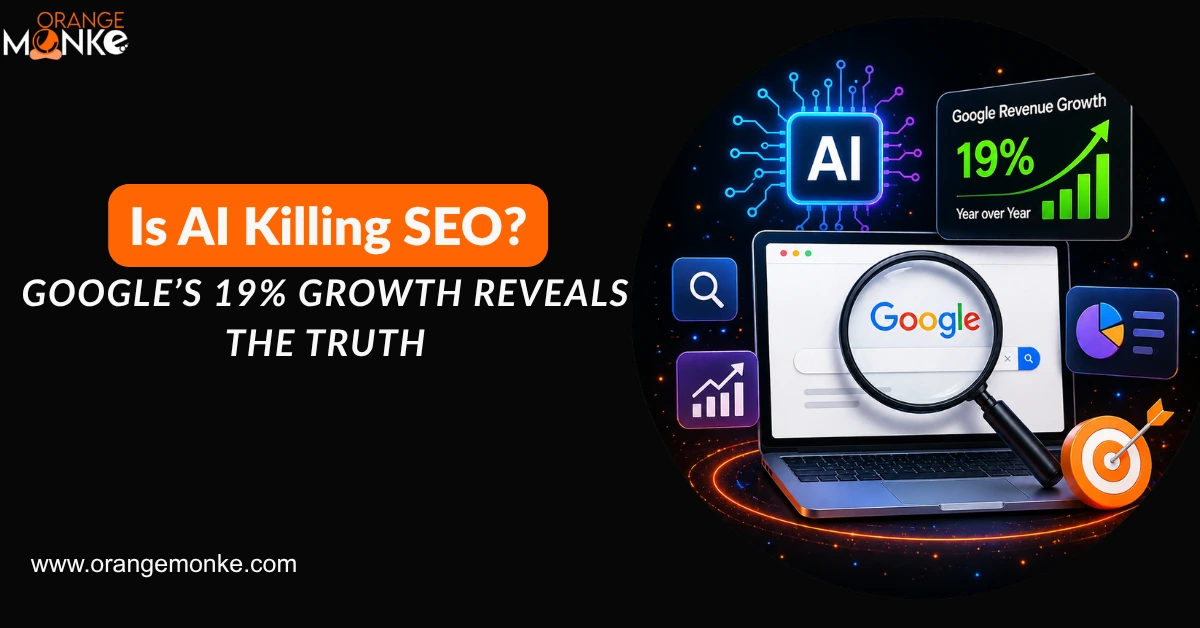
Is AI killing SEO?Quick Answer: |
Everyone’s worried that AI-generated answers are making search and SEO obsolete. Google’s latest earnings report just gave us the clearest data yet to answer that question. Here’s what it actually means for your business.
Let’s be honest. If you’ve spent any time in marketing over the past two years, you’ve heard some version of this fear: “AI is going to kill SEO.” ChatGPT answers questions. Google now summarises results before you even click. Why would anyone scroll down to your website?
It’s a fair question. And this week, we finally got a data-backed answer, straight from Google’s quarterly earnings call.
The short version: Google Search revenue grew 19% to $60.4 billion in Q1 2026, its strongest year-over-year growth in recent quarters. CEO Sundar Pichai said search queries are “at an all-time high.” And he directly attributed that growth to AI features like AI Overviews and AI Mode.
So no, AI isn’t killing SEO. But it is changing what good SEO looks like. Let’s break it down from the beginning.
Here are the Key Highlights from Google’s Q1 2026 Data:
| Metric | Value | Insight |
| Google Search Revenue (Q1 2026) | $60.4B | Massive revenue, showing strong dominance of search ads |
| Year-over-Year Growth | +19% | Rapid growth, largely driven by AI improvements |
| Search Query Volume | All-time high | More people are using Google search than ever before |
| AI Response Cost Change | −30% | Google is becoming more efficient in running AI (Gemini 3) |
What is “AI in search”?
AI in search” simply means search engines (like Google) are using artificial intelligence to understand queries better and generate smarter answers, instead of just showing a list of links.
AI OverviewWhen you search for something on Google, you may now see a shaded box at the very top of the page with an AI-written summary of the answer. That’s an AI Overview. Google generates it using its Gemini AI model, pulling from multiple sources across the web. It shows up before any website links. |
AI ModeAI Mode is a newer feature in Google Search that lets you have a full back-and-forth conversation with Google — similar to how you’d chat with ChatGPT. Instead of a list of links, you get a detailed AI response. Google is rolling this out globally and says it now has hundreds of millions of users. |
Both features represent Google’s shift from being a directory of web links to being an answer engine. That’s the change that has marketers nervous. And it’s a legitimate concern, just not for the reason most people think.
Why the “AI is killing SEO” fear makes sense
The logic behind the fear goes like this: if Google answers the question before you click, you never visit the website. No visit means no leads, no sales, no value from ranking. So why invest in SEO at all?
This concern is not entirely wrong. There is evidence that certain types of content, especially simple factual queries like “what’s the capital of France” or “how many ounces in a cup,” are getting answered directly by AI with no click-through. Publishers who built their traffic on that kind of thin, informational content have seen real declines.
| “If AI can answer your question in three sentences, the question was probably never worth a full web page anyway.” |
But that’s a very different thing from SEO being dead. It’s SEO evolving. The content that was always most valuable, detailed guides, expert opinions, original data, and trust-building pages, is still extremely valuable. In many ways, it’s more valuable because AI systems are actively scanning the web to source their answers from credible sites.
What Google’s numbers actually tell us
Let’s get back to the earnings data, because this is where the story gets interesting for marketers.
Alphabet (Google) reported total revenue of $109.9 billion for Q1 2026 — up 22% year-over-year. Search was the biggest contributor, but the fastest-growing segment was Google Cloud, which surged 63% to $20 billion. Cloud now makes up 18% of Alphabet’s total business, up from just 11.8% two years ago.
Why does the Cloud number matter for SEO? Because it tells you that Google’s AI investment is being financed by a rapidly growing, highly profitable business, not just by ad revenue. Google Cloud’s operating margin expanded from 9.4% a year ago to 32.9% this quarter. That’s a business that’s becoming enormously profitable, which means AI features in Search are fully funded and accelerating.
In other words: the AI features you see in Google today are not experiments. They are permanent, they are improving, and there are more of them coming.
AI Overviews & SEO in 2026: Myths vs Reality You Need to Know
| The Myth | The Reality |
| AI Overviews are reducing search traffic for everyone | They mainly reduce clicks on low-value, easily answered queries. High-value, expert content still gets clicks — and can even be cited in AI answers. |
| Google is replacing websites with AI answers | AI Overviews are built using website content. Google still depends on the web — being cited in AI is the new form of visibility. |
| SEO investment doesn’t make sense in 2026 | Search queries are at an all-time high. Demand is growing — but competition is also increasing. SEO is evolving, not dying. |
| Only big brands can win in AI search | AI often favors niche, authoritative, and highly specific content. Smaller sites with deep expertise can outperform big brands. |
Which Industries Are Growing The Most And What To Do About It
Google’s Chief Business Officer Philipp Schindler specifically named the sectors driving search growth this quarter: retail, finance, and health. If your business operates in any of these verticals, this is a green light to double down on search investment.
But even outside these sectors, the message is consistent. Schindler said the growth wasn’t driven by one single factor; it came from “many parts of the business showing strength and working very well together.” That points to broad-based search demand, not just a couple of hot categories.
| The honest caveat: Higher search revenue does not automatically mean more traffic to your website. Google hasn’t disclosed click-through rate data for AI-influenced results. Revenue can grow while the distribution of traffic shifts. What this means practically: even as overall search volume increases, where that traffic goes is being reshuffled. That reshuffling is the game you need to play well. |
What Good SEO Looks Like in 2026: How to Win in AI-Powered Search
The rules of SEO are evolving. It’s no longer just about ranking in traditional blue links; the real goal now is to become a trusted source that Google’s AI cites, summarizes, and recommends.
To succeed in this new search landscape, your content needs to meet higher standards of clarity, expertise, and intent. Here’s what “good SEO” looks like today:
1. Answer Questions Clearly and Upfront
AI-powered features like Google AI Overviews prioritize content that delivers direct, structured answers.
- Start with a clear answer instead of burying it deep in the content
- Use descriptive headings (H2, H3) to organize information
- Keep paragraphs short and easy to scan
Well-structured content increases your chances of being featured and cited in AI-generated results
2. Demonstrate Real Expertise (Not Just Information)
Google is getting better at identifying genuine expertise vs surface-level content. Thus, to stand out:
- Include first-hand experience or insights
- Use original data, case studies, or examples
- Go beyond basic summaries and add depth
High-quality, experience-driven content builds authority and trust signals (EEAT)
3. Optimize for Conversational Search Queries
Search is becoming more natural and conversational, especially with AI-driven experiences. Instead of writing keyword-stuffed phrases, focus on:
- How users actually ask questions in real life
- Long-tail, conversational queries
Write as your audience speaks, this improves relevance for AI Mode and voice search
4. Maintain Strong Technical SEO Foundations
Even with AI advancements, technical SEO still matters. Make sure your website:
- Loads fast (page speed optimization)
- Is mobile-friendly
- Is easy for search engines to crawl and index
Google has significantly improved search speed over time, which means:
Fast, accessible websites are still prioritized in rankings
5. Focus on Search Intent, Not Just Keywords
Modern SEO is less about keyword density and more about intent matching.
Ask yourself:
- What is the user actually trying to achieve?
- What problem are they trying to solve?
Then build content that directly fulfills that intent. Content aligned with user intent consistently outperforms keyword-focused content
The Bigger Picture: Google Is Changing, Not Disappearing
Here’s what Alphabet’s Q1 2026 results really tell us. Google is in the middle of the biggest transformation of its 28-year history. Search revenue is at record levels. Cloud is booming. AI costs are dropping, which means more AI features are coming faster than ever. Pichai mentioned agentic experiences, like AI booking restaurant reservations on your behalf, as early examples of what “search as an agent manager” will look like.
That future is coming. But it isn’t here yet for most queries. Right now, search is a hybrid, part traditional results, part AI summaries, part agentic tasks. And in that hybrid moment, investing in SEO is not just worthwhile. It’s arguably more important than it was two years ago, because the floor for what “good content” means has risen significantly.
The businesses that will struggle are those that built their digital presence on low-effort, high-volume thin content. The ones that will thrive are those that have invested in genuine expertise, clear answers, and user trust.
| The verdict
AI isn’t killing SEO. It’s raising the bar for what SEO has to be. Google Search is bigger, more used, and more AI-powered than ever. The brands winning in 2026 aren’t those who abandoned SEO, they’re those who evolved it alongside Google. |
The Bottom Line
Google’s (Alphabet) Q1 2026 numbers settle the debate: search is not shrinking. It’s growing, evolving, and becoming more AI-native by the quarter. The businesses that treat this moment as a threat are likely to fall behind. The ones that treat it as an opportunity to build deeper authority, better content, and a smarter digital presence will own the next chapter of search.
At OrangeMonkE, we’ve been tracking these shifts closely. As a digital marketing agency built for the AI era, we help brands navigate exactly this kind of transition, from understanding how AI Overviews are reshaping visibility, to building content strategies that work with Google’s new intelligence rather than against it.
Whether you’re a business owner trying to make sense of what this means for your website, a marketing manager rethinking your content calendar, or an SEO professional looking for a sharper edge, the playbook has evolved, but the fundamentals haven’t disappeared.
Authority, relevance, trust, and speed still win. They just need to be expressed in the language of 2026. The best time to adapt your SEO strategy to the AI era was a year ago. The second-best time is now.
Frequently Asked Questions
Is SEO still worth investing in with AI taking over search?

Yes, and arguably more so than before. Google's Q1 2026 earnings confirmed that search queries are at an all-time high, meaning more people are searching more often. The opportunity is larger. What's changed is the type of content that wins. Thin, generic pages are being displaced by AI summaries. But detailed, expert-led content is being rewarded, both in traditional rankings and as cited sources inside AI Overviews. Businesses that invest in quality SEO now are building an asset that compounds as Google's AI capabilities grow.
Does Google's AI Overview reduce clicks to my website?
It depends on the type of query. For simple factual questions, definitions, unit conversions, basic how-tos — AI Overviews do answer the question without a click. But for complex, high-intent queries (think: "best CRM for a 10-person team" or "how to reduce cart abandonment"), users still click through to explore their options. Google's own head of search has argued that AI Overviews reduce low-value clicks, not the clicks that actually drive business. The key is to optimize for queries where intent goes beyond a one-line answer.
How do I get my content featured in Google's AI Overviews?
There's no guaranteed formula, but Google's AI tends to pull from pages that directly and clearly answer a question, come from credible and authoritative sources, use well-structured formatting (clear headings, concise paragraphs, direct answers near the top), and are technically sound — fast-loading, mobile-friendly, and crawlable. Essentially, the same principles that have always governed good SEO still apply. The difference is that being cited in an AI Overview now delivers visibility even when users don't click — making brand presence in these answers increasingly valuable.
What industries are growing the most in Google Search right now?
According to Alphabet's Q1 2026 earnings, Google's Chief Business Officer specifically called out retail, finance, and health as the primary drivers of Search revenue growth this quarter. This suggests search intent — and competition — is particularly high in these verticals right now. If your business operates in any of these sectors, it's a strong signal to treat search as a growth investment rather than a maintenance line item. That said, broader search volume is up across the board, so the opportunity extends well beyond these three categories.
Will AI eventually replace Google Search entirely?
Not in the near future, and Google's financials suggest it's not a binary outcome. Google is actively integrating AI into search rather than replacing search with AI. Features like AI Mode and AI Overviews are layered on top of the traditional results engine, not substitutes for it. Meanwhile, Google Cloud — which powers much of this AI infrastructure — is booming, giving Google the financial runway to keep evolving search on its own terms. A more likely outcome is that search becomes increasingly AI-assisted, handling more tasks autonomously while still relying on the open web for source material.
Should I stop focusing on keywords and focus on AI optimization instead?
It's not an either/or — it's an evolution. Keywords still matter because they reflect the language people use when searching. What's changed is how you use them. Stuffing a page with keywords no longer works. Instead, keywords should guide your understanding of search intent — what is someone really trying to find or do when they type that phrase? Build content around answering that intent completely and authoritatively, use natural language (the way people actually speak to AI assistants), and structure your page so both humans and AI can easily extract the key answer. That's modern SEO.