
 Nov 19, 2025
  14 Min Read
Local SEO is crucial for businesses aiming to increase visibility on search engines and connect with their regional audience. For marketers targeting multiple regions, SEO localization ensures websites rank effectively by adapting content to local search behavior, language, and culture. With the rise of multilingual marketing, cultural adaptation and region-specific SEO strategies are becoming increasingly important.
In this guide, we’ll explore SEO localization for marketers, covering practical strategies, tools, and best practices to boost local search performance and engagement.
Let’s get started!
What is SEO Localization?
SEO localization is the process of optimizing website content so it ranks effectively in specific countries, languages, and regions by adapting it to local search behavior, culture, and user intent. Unlike simple translation, SEO localization ensures that keywords, content tone, metadata, URLs, and on-page elements align with how people actually search in a particular market.
The primary purpose of SEO localization is to make content feel native and relevant to local audiences while improving visibility in regional search results. Understanding the top local SEO factors to prioritize helps businesses connect with users in different markets by using region-specific keywords, culturally appropriate language, and search engine preferences.
When done correctly, SEO localization improves rankings, increases organic traffic, and builds trust with international audiences—driving higher engagement and conversions across global markets.
Now, let’s understand how local SEO differs from traditional SEO.
| Local SEO | Traditional SEO |
| Same content for all audiences. | Content customized for local culture and preferences. |
| Focuses on ranking for general keywords. | Focuses on local keywords in different languages/regions |
| Example: “Best coffee shop” globally. | Example: “Best coffee shop in Mexico City” with Spanish keywords. |
For example:
If you want to attract more customers to your newly-built cafe in Dubai, you would have to optimize your website as per the location of your cafe to get convertible leads. Only people in Dubai who see and know your cafe could actually pay a visit and become your customers, not somebody from the western countries.
Hence, you must optimize your business with local SEO tactics when you want online marketing to give you real time results.
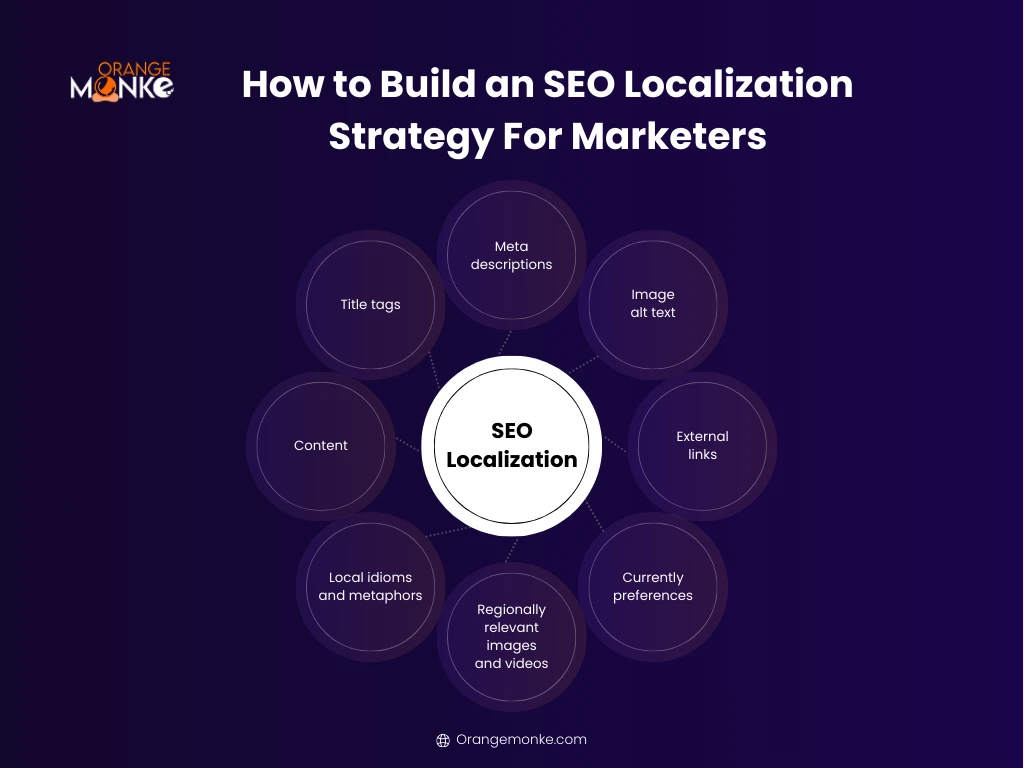
SEO Localization vs International SEO Localization
Let’s look at a brief comparison between international SEO vs localization to understand reasons you need to change your strategy.
| Comparison Aspect | Local SEO | International SEO |
| Goal | Connect with local audiences in their own context | Build a global presence with one broad strategy |
| Approach | Local keywords, cultural adaptation, regional content | Focus on language tags, country targeting, global domains |
| Audience | Specific regions, languages, and local cultures | Global audience across multiple countries |
| Content Style | Customized for local preferences and languages | One for all – generic |
| Best Suited | Brands wanting deep local engagement and conversions | Brands targeting international exposure |
Benefits of SEO Localization For Marketers
Now that you already know what local search engine optimization is, the next piece of information is to understand the benefits of SEO localization. Follow along to know more:
Increased visibility in local searches – Once you take a serious approach towards developing the local SEO of your business, you’d see how the local searches ramp up on the search engine platform. Your business page would be locally visible to a significant audience size.
Better customer engagement through cultural adaptation – Your business becomes culturally populous once the business-customer approach takes a local turn. As a result, the cultural adaptation goes viral and people engage with your business/brand on a local basis.
Higher conversion rates with personalized experiences – When people can see and search locally, the belief gets stronger and hence, the conversion rate fosters. From reach to visibility, local SEO impacts all the segments and convinces people swipe right for your products and services
Competitive advantage in multilingual markets – When you work on your multilingual SEO, you start to get engagement and conversions in various other multilingual markets.
Key Elements of SEO Localization
Once you start with the process of local keyword optimization, there are significant key elements you need to know as a marketer Part of a strong localization strategy is also targeting the right audience in local SEO ensuring your content reaches users who are most likely to convert in each region. Here they are:
Local keyword optimization – Local business SEO means that you integrate local keywords that match the audience’s search intent directly.
Multilingual content optimization – To give your audience a clear cultural context, you must take up local language translation and righteous usage.
Website localization for SEO – Making your website local SEO-optimized means that you must create more local landing pages as per your businesses’ availability in the area.
Cultural adaptation in SEO – You must make your business culturally personalized to the audience by aligning with local customs, buyer behavior and slangs. So, when optimizing local SEO, these are pointers you must keep in mind.
How to Build an SEO Localization Strategy For Marketers
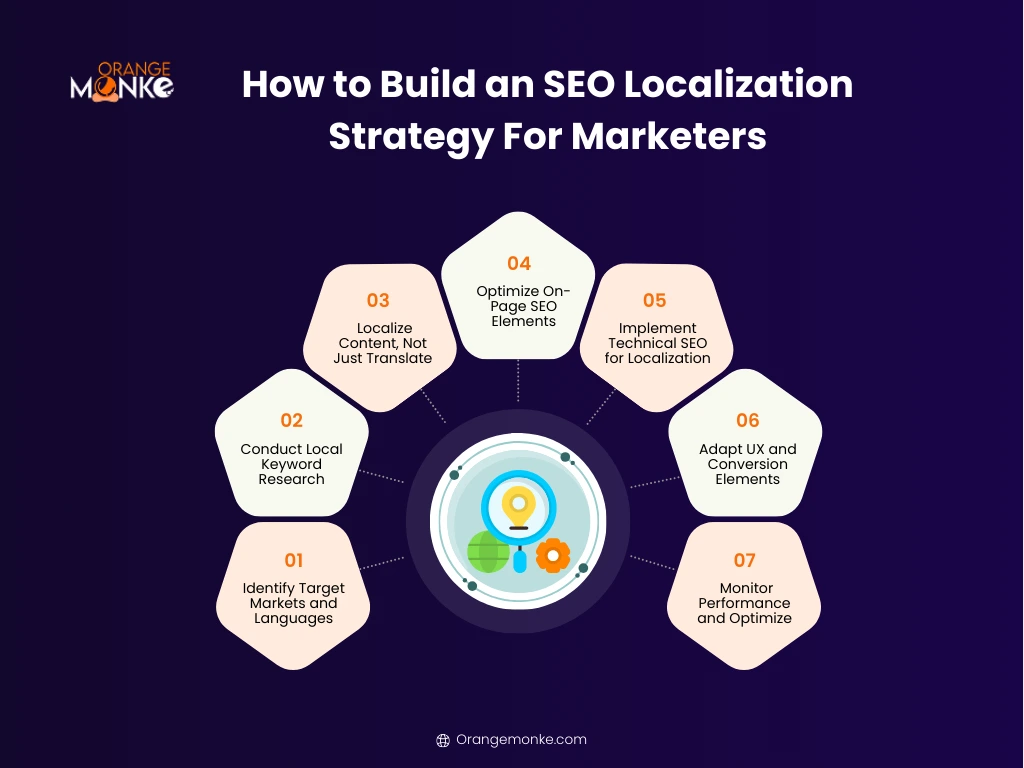
A successful SEO localization strategy goes beyond translating content. It requires a structured approach that aligns search intent, language, culture, and technical SEO for each target market. Below are the essential steps to localize your SEO effectively.
Step 1: Identify Target Markets and Languages
Start by defining which countries, regions, and languages you want to target. Consider market demand, search volume, competition, and business goals. Prioritizing high-potential regions helps focus resources where localization will have the greatest impact.
Step 2: Conduct Local Keyword Research
Keyword behavior varies by country and language. Use region-specific keyword research tools to identify how local users search for the same product or topic. Avoid direct translations—focus on search intent, slang, spelling variations, and regional terminology.
Step 3: Localize Content, Not Just Translate
Adapt content to match local culture, tone, and expectations. This includes headlines, examples, units of measurement, currency, spelling, and references. Localized content should feel natural to users, improving engagement and trust.
Step 4: Optimize On-Page SEO Elements
Localize meta titles, descriptions, headers, image alt text, and internal links using region-specific keywords. Ensure each localized page has unique metadata to avoid duplication and improve local SERP visibility.
Step 5: Implement Technical SEO for Localization
Set up proper URL structures (ccTLDs, subdomains, or subfolders) and implement hreflang tags to signal language and regional targeting to search engines. Submit localized sitemaps and configure Google Search Console for each market.
Step 6: Adapt UX and Conversion Elements
Localization also applies to calls-to-action, forms, navigation, and page layout. One area often underestimated here is building review velocity for local SEO – consistent, region-specific reviews build trust signals that directly impact local rankings.
Step 7: Monitor Performance and Optimize
Track localized performance using region-specific analytics. Measure rankings, traffic, engagement, and conversions per market. Use these insights to refine keywords, content, and technical setups continuously.
SEO Localization in Practice: Real-World Examples & Recommended Tools
To localize your SEO effectively, it’s crucial to combine real-world examples with powerful tools that help you research, implement, and measure performance across different markets. Below are actionable examples and tools you can use at each stage of your localization strategy.
1. Local Keyword Research
Example:
If you’re targeting the US vs the UK for the same topic, you might find:
- US search term: “best running shoes”
- UK search term: “top trainers for running”
This difference shows how users search differently even for the same intent.
Tools to Use:
- Google Keyword Planner – Ideal for region-specific keyword volumes and competition.
- Ahrefs / SEMrush – Use Keyword Explorer with country filters to find local variations.
- Ubersuggest – Provides region-specific keyword suggestions and difficulty scores.
2. Content Localization
Example:
A blog about food should adapt recipes and terms based on locale:
- US English: “zucchini”
- UK English: “courgette”
Local flavors and references make content feel native and relatable.
Tools to Use:
- Lokalise – Helps manage localized content workflows with translation memory.
- Phrase – Centralized platform for multilingual content with contextual editing.
- Smartling – Enterprise-grade localization platform with quality checks and AI assistance.
3. On-Page SEO Optimization
Example:
Optimize title tags and meta descriptions per locale:
- US version: “SEO Localization Tips for US Audiences”
- UK version: “SEO Localisation Guide for UK Search Users”
Small adjustments like spelling and phrasing can improve relevance.
Tools to Use:
- Yoast SEO / Rank Math – Plugins that allow localized metadata management.
- Surfer SEO – Provides region-specific content optimization recommendations.
- SEMrush On-Page SEO Checker – Delivers ideas based on local SERP competitors.
4. Technical Localization
Example:
Implement hreflang tags to prevent duplicate content and serve the correct version to the right region:
<link rel=”alternate” hreflang=”en-us” href=”https://example.com/us/” />
<link rel=”alternate” hreflang=”en-gb” href=”https://example.com/uk/” />
Tools to Use:
- Google Search Console – Monitor indexing and crawl issues per locale.
- Screaming Frog SEO Spider – Crawl site hreflang setups and detect errors.
- Ahrefs / Sitebulb – Audit hreflang configurations and flag localization issues.
5. UX & Conversion Optimization
Example:
Use localized calls-to-action (CTAs):
- US: “Learn More”
- Spain: “Aprende Más”
Cultural nuances matter in conversion phrases.
Tools to Use:
- Hotjar / Crazy Egg – Visual heatmaps to see how local audiences interact.
- Optimizely / VWO – Run A/B tests for localized versions of landing pages.
- Google Optimize – Free tool to test localized UX changes.
6. Performance Tracking & Analytics
Example:
Compare performance between markets:
- Country A seeing higher bounce rates → investigate keyword mismatch.
- Country B seeing better engagement → replicate successful patterns.
Tools to Use:
- Google Analytics (GA4) – Track user metrics by region and language.
- Google Data Studio – Create dashboards for multi-market performance insights.
- Moz Pro – Monitor local rankings and visibility trends by region.
Why These SEO Localization Examples & Tools Matter?Using real-world examples and the right SEO localization tools helps marketers move from theory to execution. This approach allows you to:
Pro Insight: SEO localization succeeds when strategy, tools, and local user intent work together. |
Best Practices for SEO Localization
You know the step-wise local SEO strategy-making, so now it’s time to understand how your websites will perform well across multiple regions. Here, using some of the best practices for SEO localization is key, and here’s what you should follow:
Maintain consistency across languages
You must maintain the brand style, voice, and key messages consistent and uniform, even when working for the local market. Such a process helps ensure that users get the same brand experience anywhere they go.
Use professional translators for cultural accuracy
We are living in a time when access to automated tools is clear without missing cultural nuances. Here, going with professional translators assures that the content is well-regulated, culturally defined, and locally relevant.
Optimize for mobile searches
Many users across local (as well as global markets) access the website through smartphones. Here, mobile-friendly websites improve the user as well as local SEO rankings.
Add structured data for regional SERPs
For the search engine to understand your content better, you can use the schema markup for pages that are location-specific. This helps display the local information like reviews, addresses, and events in search results.
Conduct local keyword research
Moving on, you must use local search terms and phrases that are direct translations, helping you connect with the most relevant users in each region.
Optimize the meta tags and URLs for specific locations
You must not take meta tags and URLs for granted; hence, it is important to include local keywords in the titles, descriptions, and URLs to improve the page’s visibility at a generic level.
Test the performance regularly
Once you have optimized, the work is not done yet! Tracking the ranks, traffic, and conversions in each specific region is equally important in redefining region-specific SEO.
Common SEO Localization Mistakes to Avoid
Even well-intentioned region-specific SEO efforts can fail if common mistakes are overlooked. Avoiding local SEO mistakes that hurt localization is just as important as implementing the right strategy , small errors in hreflang, metadata or keyword targeting can significantly hurt your regional rankings.
- Relying on direct translation only
Literal translations ignore local search intent, cultural nuances, and regional phrasing, leading to poor engagement and rankings. - Using the same keywords across all regions
Search behavior varies by location. A keyword that performs well in the US may not work in the UK, Europe, or Asia. - Ignoring hreflang implementation
Incorrect or missing hreflang tags can confuse search engines and cause the wrong language or regional page to rank. - Overlooking local SERP features
Featured snippets, local packs, and “People Also Ask” results differ by country and should influence content structure. - Inconsistent URL and site structure
Poorly planned subdirectories or subdomains make it harder for search engines and users to understand regional targeting. - Failing to localize metadata
Title tags and meta descriptions must be adapted for local language, tone, and search intent—not copied site-wide. - Not tracking performance by region
Without region-specific analytics, it’s impossible to measure success or optimize localized content effectively.
How to Measure SEO Localization Success Locally
Learn how to evaluate keyword rankings, traffic, engagement, and conversions at a local level to measure the real impact of your SEO localization efforts.
| Goal | What to Measure | Tools to Use | Why It Matters |
| Improve local visibility | Country- & language-based SEO optimization usingspecific ranking keywords | Semrush, Ahrefs, AccuRanker | Shows how well your localized pages rank in local SERPs |
| Increase regional traffic | Organic sessions by country/language | Google Analytics (GA4) | Indicates demand and reach in each target market |
| Boost user engagement | Bounce rate, engagement time, pages/session | GA4, Hotjar | Confirms content relevance for local audiences |
| Drive local conversions | Conversions by location | GA4, Google Tag Manager | Measures business impact of localization |
| Ensure technical accuracy | Indexation & hreflang validation | Google Search Console | Prevents cannibalization and wrong regional targeting |
| Win SERP features | Featured snippets, PAA, local packs | Semrush, Ahrefs | Improves visibility and click-through rates |
| Benchmark competitors | Local competitor keyword overlap | Semrush, Ahrefs | Identifies gaps and optimization opportunities |
| Track long-term growth | MoM traffic & ranking trends | GA4, Looker Studio | Measures sustainable SEO localization success |
| Pro Tip: Successful SEO localization is measured market by market, not globally. Always analyze performance at the country, language, and intent level. |
Conclusion
SEO localization is no longer optional for businesses targeting global or regional audiences—it’s essential for connecting with customers in their local context. By understanding regional search behavior, optimizing content for local intent, and using the right tools, brands can boost visibility, engagement, and conversions.
OrangeMonke’s Local SEO strategy services help businesses implement effective SEO localization strategies, track performance, and stay ahead of competitors in each target market.
Partner with Orange MonkE to ensure that your brand reaches the right audience at the right place, maximizing ROI from local search efforts.
Happy Localizing!
FAQs
What is SEO localization?
Local SEO is all about leveraging optimization techniques that help evaluate business ranking on the website on the search engine platform. The process includes adapting the content as per the language, culture, and search keywords of the locality.
How is SEO localization different from standard SEO?
Standard SEO is more about working on an international platform, while local SEO focuses more on region-specific keywords and cultural forums.
Why is SEO localization important for marketers?
Local SEO helps marketers build up the potential audience locally and enhances visibility in local searches while increasing engagement and conversion.
What are some key elements of SEO localization?
Some key elements of local SEO include local keyword research, website localization, content translation and adaptation, link building and cultural optimization.
Can SEO localization help global brands?
Yes, SEO localization does help global brands build an identity in local marketing, establishing stronger trust while improving website performance in per region.


We build the digital growth engine for businesses that don't have the time, team or clarity to do it themselves
Let's Start Your Success Story