Jun 26, 2026
  14 Min Read
| A content marketing strategy for small businesses is a structured plan that defines what content to create, who it is for, where it will be distributed, and how it supports business goals like leads, sales, or brand visibility. In 2026, successful small-business content marketing focuses on targeting specific audiences, low-competition keywords, SEO, AI-friendly formatting, and consistent publishing.
An effective strategy usually includes:
|
A content marketing strategy for a small business is a simple plan for what you publish, who you create it for, and how it reaches potential customers. You do not need a huge budget or a large team to make it work. What matters is having a clear goal, understanding your audience, choosing content types you can consistently create, and promoting that content through the right channels.
Small businesses that follow a documented content strategy are more likely to see results because consistent, focused content performs far better than random posting.
What Is A Content Marketing Strategy For A Small Business?
A content marketing strategy for a small business is a documented plan that ties the content you create to a specific business goal, a defined audience, and a publishing routine you can actually keep.
Every workable strategy, at any size, decides four things up front:
- Goal: the one business outcome the content serves, such as enquiries, bookings, or sales, not follower counts.
- Audience: the specific person you are writing for, their problem, and the stage they are at (learning, comparing, or ready to buy).
- Content types: the formats you can produce consistently with the time and people you have, whether that is blog posts, short videos, or email.
- Distribution: how each piece actually reaches people, through search, social, email, or partnerships.
For a small business, the plan looks different from an enterprise one in a few practical ways. You compete on focus rather than volume, so you target narrow, winnable topics instead of broad head terms. You lead with first-hand experience, because your own knowledge of the work is the one thing larger competitors cannot copy. And you commit to fewer channels, because spreading a small team across every platform produces weak results everywhere.
Why Small Businesses Need A Strategy, Not Just Content
Most small businesses do not have a content problem. They have a consistency and direction problem. Publishing the occasional blog post or reel without a plan rarely moves anything because the pieces do not build on each other or point anywhere.
A documented strategy fixes that, and the gap is measurable. Businesses with a documented content marketing strategy generate around three times more leads per dollar than those without one (Demand Metric / Content Marketing Institute). For a small business with a limited budget, that efficiency is the whole point.
A strategy earns a small business four things that ad spend alone cannot:
- Compounding traffic: a blog post that ranks keeps bringing visitors for months or years after you publish it, unlike a paid ad that stops the moment the budget does.
- Trust before the sale: useful content lets a buyer get to know your business before they enquire, which shortens the sales conversation.
- Niche targeting: you can write for the exact customer you want and filter out poor-fit enquiries, instead of paying to reach a broad audience.
- Lower cost per lead: content marketing’s cost per lead sits well below paid search in most industries, which matters most when the budget is tight.
The failure mode to avoid is “random acts of content”: posting sporadically, with no goal attached and no thread connecting one piece to the next. It feels productive and produces almost nothing. A one-page strategy is what turns the same effort into actual results.
How To Build A Content Marketing Strategy For A Small Business
Build a small-business content strategy in eight steps: set one goal, define a narrow audience, research winnable keywords, choose formats you can sustain, plan a light calendar, optimize each piece, distribute it, then measure and refresh.
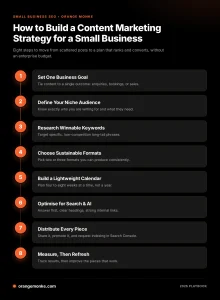
The eight-step content marketing strategy process for small businesses, from setting one goal to refreshing what works.
Step 1: Set one business goal
Pick a single business outcome before you write anything. For most small businesses that will be mostly inquiries, bookings, or sales, not likes or follower counts. Tie it to a number and a date so you can tell whether the content is working, for example, 20 inquiries a month from organic search within six months.
One clear goal keeps every later decision, from topics to formats, pointed in the same direction. Vague aims like “more brand awareness” are the main reason small-business content drifts.
Step 2: Define your niche audience and their intent
Write for one specific customer, not everyone who might buy. Note who they are, the problem that brings them to you, and whether they are still learning, comparing options, or ready to act. Look for their search intent, decide what you make: a how-to guide for someone learning, a comparison for someone deciding, a service page for someone ready to buy.
A narrow audience is an advantage for a small business because you can answer their exact questions better than a broad competitor can.
Step 3: Research winnable, low-competition keywords
Target keywords you can realistically rank for, not the biggest terms in your industry. Broad head terms are owned by high-authority sites, so chase specific long-tail phrases with clear intent, such as “content marketing strategy for a dental clinic.”
These have lower search volume but far less competition and stronger conversion. Google Keyword Planner or a paid tool like Semrush will show volume and difficulty. See our guides on keyword research for beginners and how long-tail keywords improve conversions.
Step 4: Choose content types you can sustain
Pick the two or three formats you can produce consistently, then ignore the rest. Consistency beats variety for a small team: one solid blog post a week is worth more than a scattered mix of blogs, videos, and reels you cannot keep up with.
Match the format to your strengths and your audience’s habits. If you are comfortable on camera and your audience is on Instagram, short video earns its place. If not, written guides and email often return more for less effort. If writing is the bottleneck, content writing support can carry the load.
Step 5: Build a lightweight content calendar
Plan four to eight weeks at a time, not a year. A simple calendar listing the topic, target keyword, format, and publish date is enough to stay consistent without over-planning.
Map a few pieces to each stage of your audience’s journey so you are not only publishing top-of-funnel explainers. Review it monthly and adjust based on what is performing. The calendar’s real job is to remove the weekly “what do I post” decision that stalls most small-business content.
Step 6: Optimize each piece for search and AI
Optimize every piece so both Google and AI search can understand and surface it. Put the answer to the reader’s question near the top, use clear headings, cover the topic fully, and add internal links to your related and service pages.
Write in plain language with specific facts, because AI search tools lift self-contained, factual passages straight into their answers. Our guide to writing SEO-optimised blog posts that rank walks through the on-page details.
Step 7: Distribute every piece (the step most skip)
Publishing is the halfway point, not the finish. Most small businesses write a post, wait, and then conclude that the content does not work. Share each piece where your audience already is: your email list, the relevant social platforms, and any communities or partners who would value it.
For new pages, request indexing in Google Search Console so they are found faster. More tactics in how to get organic traffic.
Step 8: Measure, then refresh
Track a few honest numbers and act on them. In Google Search Console, watch impressions, clicks, and the queries you appear for. In GA4, watch which pages bring enquiries.
After 90 days, improve the pieces that are close to ranking rather than always writing new ones: add depth, update facts, strengthen internal links. Content compounds, so refreshing winners is often the highest-return work you can do.
Content Marketing Vs Paid Ads For Small Businesses
Content marketing and paid ads solve different problems, and most small businesses need both at different stages. Paid ads buy visibility instantly but stop the moment you stop paying. Content marketing takes months to build but keeps working long after each piece is published.
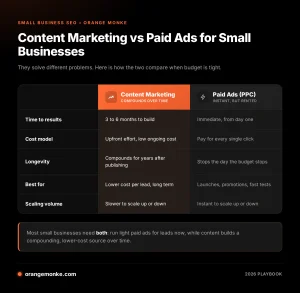
Content marketing vs paid ads: how the two compare for a small business on time, cost, and longevity.
The simple rule: use paid ads when you need leads this week, and content when you want a lead source that compounds.
| Factor | Content marketing | Paid ads (PPC) |
| Time to results | 3 to 6 months to build momentum | Immediate, from day one |
| Cost model | Upfront effort, low ongoing cost | Pay per click, every click, every time |
| Longevity | Compounds work for years after publishing | Stops the day the budget stops |
| Best for | Lower cost per lead over the long term | Launches, promotions, fast testing |
| Control over volume | Slower to scale up or down | Instant to scale up or down |
For a small business with a tight budget, the usual play is to run a small amount of paid search to bring in leads now, while building content that lowers your cost per lead over time. As the content starts to rank, you can lean less on paid. Thus, combining SEO and PPC will bring more benefit than ever.
How Much Does Content Marketing Cost For A Small Business?
Content marketing costs a small business one of three things: your time, a freelancer’s fee, or an agency retainer. There is no single price, because cost depends on how much you do yourself, the quality you need, and your market. The figures below are typical guide ranges in USD; adjust for your region, and note that GST or VAT may apply on top.
- Do it yourself: Your main cost is time, plus tools. Free tools such as Google Search Console, GA4, and Google Keyword Planner cover the basics, while a paid SEO tool runs roughly USD 100 to 200 a month. Cheapest in cash, most expensive in hours, and only sustainable if you can write consistently.
- Hire a freelancer: A skilled freelance writer typically charges around USD 100 to 500 per blog post, depending on length, research, and seniority. Useful for filling a content gap without a full retainer, though you still own the strategy, the briefs, and distribution.
Work with an agency: A managed content programme covering strategy, writing, optimisation, and reporting usually starts around USD 1,000 to 5,000 a month for a small business, and scales with output. You trade higher spend for a team that owns the whole process.
The honest trade-off is time versus money. DIY suits very early businesses with more time than budget. A freelancer makes sense once you can direct the work but cannot write it yourself. An agency fits when you want the results without running the process. To estimate what a programme could return before you commit, use the ROI calculator, and see content writing services for done-for-you production.
Common Content Marketing Mistakes Small Businesses Make
Most small-business content fails for the same handful of reasons, and all of them are avoidable. The mistakes below waste the most time and budget, so checking your own approach against them is worth doing before you publish anything else.
- Chasing head terms: Competing for broad, high-volume keywords against high-authority sites you cannot outrank. Target specific long-tail phrases with clear intent instead.
- Skipping distribution: Publishing and waiting. A piece that is never shared, indexed, or promoted rarely gets found. Distribution is half the work, not an afterthought.
- Publishing inconsistently: Three posts in a week, then nothing for two months. Search engines and audiences both reward a steady cadence over bursts.
- Ignoring search intent: Writing a how-to guide for a keyword where searchers want to buy, or a sales page where they want to learn. Match the format to what the searcher actually wants.
- Never measuring: Publishing with no goal and no tracking, so you cannot tell what works. A few honest numbers in Search Console and GA4 are enough to steer by.
- Writing for algorithms, not people: Stuffing keywords or padding word count. Both read badly and now work against you. Write the genuinely useful version.
The thread running through all six is the same: effort without direction. Fixing them does not take more content, just a plan attached to the content you already make.
Content marketing strategy by business type
The eight steps stay the same for every small business, but the formats and channels that pay off depend on what you sell and who buys it. Here is where to focus by business type.
Local service business
Lead with local search and trust signals. Write content that answers the questions local customers ask before they call, and pair it with a strong Google Business Profile so you appear in map results. Service-area pages, FAQs, and customer stories do most of the work. Reviews and clear contact details matter more here than publishing volume.
Ecommerce
Build content around how people research products, not just the products themselves. Buying guides, comparisons, and how-to content catch shoppers earlier in their decision and feed them toward product pages. Strong category-page copy and product FAQs also help you rank for the terms shoppers actually search.
B2B or SaaS
Sell to a longer, more considered buying process. In-depth guides, comparisons, and case studies build the credibility a business buyer needs before they enquire. Because the audience is narrow and high-value, depth and expertise matter more than reach. One authoritative piece can earn more than a dozen shallow ones.
Solo or founder-led business
Use your single biggest advantage: you. First-hand experience, a clear point of view, and a recognizable voice are things larger competitors cannot copy. Pick one channel you can sustain, whether that is a blog, a newsletter, or one social platform, and show up on it consistently rather than spreading yourself thin.
What To Do After Your First 90 Days Of Content Marketing Strategy
After 90 days, stop guessing and let your data set the direction. By now Search Console and GA4 will show which pieces are gaining impressions, which are close to ranking, and which brought enquiries. That signal tells you where to put the next quarter’s effort.
Three moves return the most at this stage. First, improve the pieces that are nearly there: a page sitting on page two often needs more depth, fresher facts, and a few internal links rather than a brand-new post. Second, build out your winners into a cluster by writing the related topics that support a piece already working, which strengthens the whole group. Third, repurpose what performs: turn a strong blog post into an email, a short video, or a social thread so one idea earns its keep across channels.
This is also the point to decide whether to keep doing it yourself or bring in help. If the strategy is sound but production is the bottleneck, that is the natural moment to add a freelancer or an agency. The strategy you built in the first 90 days is what makes that handover work, because you know exactly what good looks like.
Conclusion
A strong content marketing strategy helps small businesses grow without relying only on paid ads. By creating useful, targeted, and consistent content, you can attract the right audience, build trust, and generate long-term traffic and leads. The key is to stay focused on your goals, understand your audience, and publish content that genuinely solves customer problems.
If you want expert support in building a strategy that ranks and converts, Orange MonkE helps small businesses create SEO-focused content marketing campaigns designed for real growth and measurable results.
Frequently Asked Questions
How do I start content marketing with a small budget?

Start with free tools and one sustainable format rather than spend, because direction matters far more than budget at the beginning. A small business can launch a working content programme for almost nothing if the effort is focused on the right things.
The most common budget mistake is spreading a small spend thinly across many channels at once. One channel done consistently for six months will almost always beat five channels done occasionally, because content compounds only when you stay with it long enough to build momentum.
How long does content marketing take to work for a small business?
Most small businesses see meaningful results in three to six months, with returns compounding well beyond that. Content marketing is a long-term channel that builds an asset over time, not a switch that produces leads in week one.
The exact timeline depends on how competitive your keywords are, how consistently you publish, and how genuinely useful the content is. The single biggest reason small businesses conclude content "does not work" is stopping at month two, before anything has had time to rank. Patience and consistency are part of the strategy, not a sign it is failing.
Can a small business do content marketing without an agency?
Yes, and many small businesses run effective content marketing entirely in-house, particularly in the early stages. An agency adds speed, scale, and expertise, but it is not a requirement for results.
The deciding factor is usually time rather than ability. The strategy stays the same, whoever executes it, so the most important thing is having a clear plan first. A business that knows its goal, audience, and target keywords can hand any part of the work to a freelancer or agency and still keep control, because it knows what good output looks like.
How often should a small business publish content?
Publish as often as you can sustain without dropping quality, and keep that rhythm steady. Consistency matters far more than raw frequency for a small business.
A small business that publishes one strong post a week, every week, will outperform one that publishes daily for a month and then burns out. The aim is a pace you can hold for a year, not a sprint you abandon, because the compounding returns only arrive for those who stay consistent.
Is content marketing better than paid ads for a small business?
Neither is better; they do different jobs, and most small businesses benefit from running both. The right balance depends on your timeline and how much budget you can commit.
Use paid ads when you need results this week or want to test offers quickly, and use content when you want a lead source that does not switch off with the budget. Treating them as partners rather than rivals is what gives a small business both immediate leads and long-term growth from the same marketing effort.
What content types work best for small businesses?
The best content types are the ones you can produce consistently and that match how your audience searches and buys. For most small businesses, written content does the heaviest lifting.
Match the format to your strengths and your resources rather than chasing whatever is trending. A founder who writes well should lean on blogs and email; one who is natural on camera should lean on video. Trying to do every format at once is how small teams spread themselves too thin and produce weak results everywhere.
How do I measure content marketing ROI for a small business?
Measure ROI by tracking the business outcomes your content drives, not vanity metrics like likes or follower counts. A small set of honest numbers is enough to tell whether it is working.
Focus on enquiries and sales rather than surface metrics, and review the numbers monthly rather than daily. If a piece is sitting just outside the top results, improving it is usually a higher return than publishing something new, because you are building on traffic you have nearly earned rather than starting from zero.