
 Jan 13, 2026
  35 Min Read
Quick Overview: Is SEO Dead in 2026?The answer is, no, SEO is not dead in 2026—it has evolved for the Search Everywhere era. Modern SEO focuses on user intent, content quality, technical performance, and authority-building, rather than outdated tricks like keyword stuffing or gaining mass backlinks. With AI tools, large language models (LLMs) like ChatGPT, Claude, Perplexity, social media platforms like TikTok, YouTube, and Google AI overviews, and growing zero-click search trends, the user search behavior is rapidly changing which is a clear sign that SEO is not dead; it’s for sure evolving. Thus, in 2026, the site owners must adapt to the latest SEO strategies. Businesses that follow these SEO principles remain visible, authoritative, and discoverable across all search platforms. |
If you’ve been hearing the phrase “SEO is dead” echoing through marketing forums, LinkedIn posts, and industry blogs, you’re not alone. As we navigate through 2026, this question has become more urgent than ever. With AI Overviews dominating search results, zero-click searches hitting 60%, and ChatGPT emerging as a search alternative, the panic is understandable. According to a research done by Bain “About 80% of search users rely on AI summaries at least 40% of the time”. So does this mean SEO is dead?
But here’s the truth that might surprise you: SEO isn’t dead. It’s evolved into something far more sophisticated – and far more important.
After more than a decade in SEO, I’ve watched the industry evolve through Core algorithm updates, changing user behavior, and the rise of new platforms that redefine how people search. From analyzing trends and helping brands grow online, I can confidently say that SEO is not dead—it’s evolving.
If you are a site owner looking to attract traffic, build authority, and grow your brand, success today means thriving in the “Search Everywhere era.” This involves creating content that is discoverable, credible, and genuinely useful across multiple platforms, not just Google.
This blog brings you the truth about SEO in 2026, helping you understand what’s really working, what’s changing, and how to stay ahead in an ever-evolving digital landscape.
Is SEO Dead in 2026? Why Is Everyone Panicking?
For new business owners who want to grow through organic marketing in the long run, their anxiety around SEO’s demise isn’t baseless. Real changes are happening that make the old playbook obsolete but SEO is not dead.
What is dying is the old SEO rulebook, earlier publishing dozens of low-effort blogs, targeting easy keywords, were alone effective to drive traffic and ranking. But now, that approach no longer delivers sustainable results.
SEO today is less about manipulating algorithms and more about earning trust, authority, and visibility across multiple search environments.
So below are a few reasons most of them think that SEO is dead:
Reason 1: Zero-Click Searches and AI Overviews
A growing number of searches in 2025-2026 never result in a website visit. Google’s AI overviews, featured snippets, and instant answers now resolve many queries directly on the search results page.
Take a common query like “best time to post on Instagram.”
Earlier, users would click through blog posts comparing studies, time zones, and engagement data. Today, Google often displays:
- A summarized recommendation
- Time slots by day
- Platform-specific suggestions
- Quick tips pulled from multiple sources
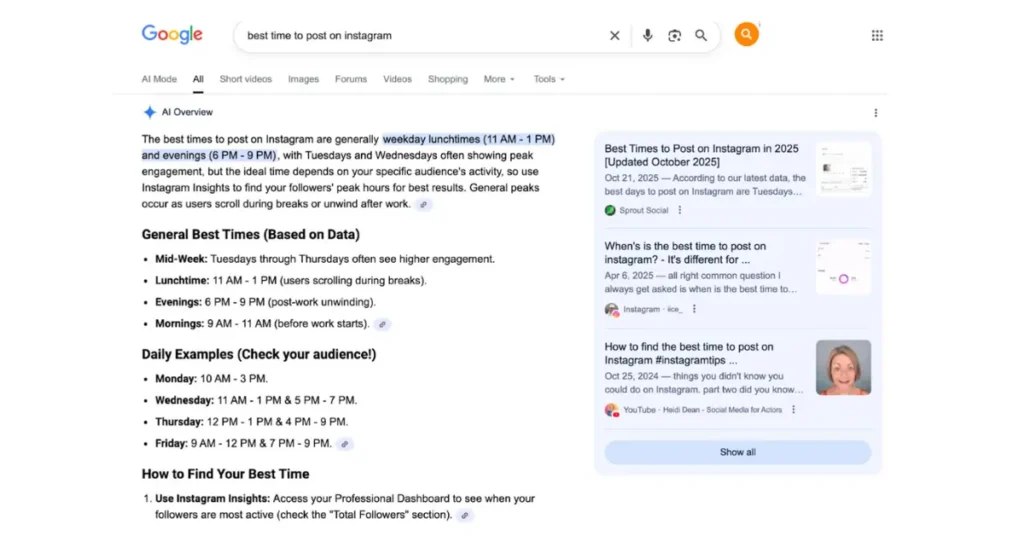
All the answers to your query appear instantly in the AI overview. The user gets what they need without opening a single article.
Google’s objective is clear: solve the searcher’s intent as fast as possible. While this improves user experience, it significantly reduces organic clicks for informational content.
That doesn’t mean websites are irrelevant. Google’s AI pulls insights from authoritative sources and highlights them as references. Appearing as a cited brand within AI overviews still builds trust, recognition, and long-term visibility—even if fewer users click immediately.
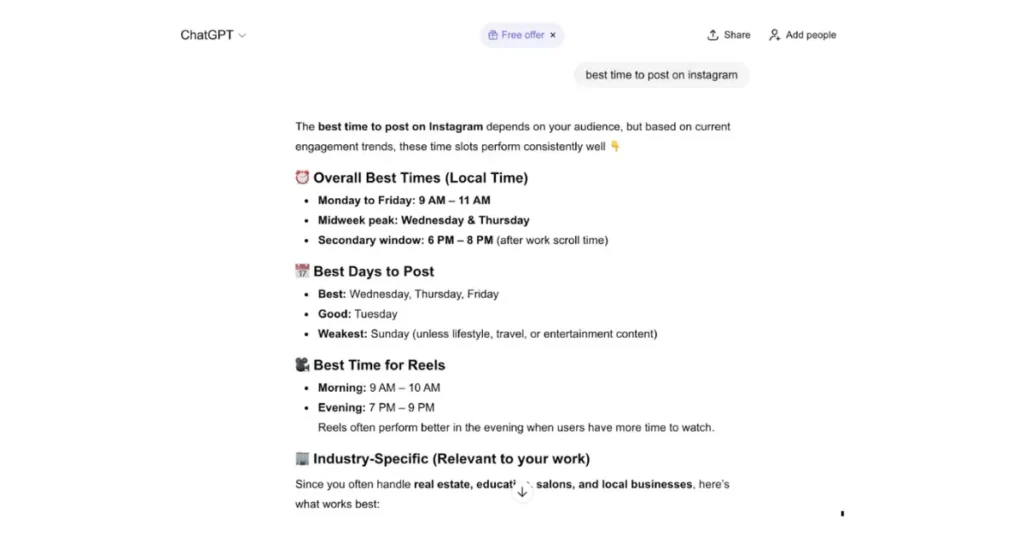
At the same time, LLMs such as ChatGPT, Perplexity, and Claude have rapidly evolved into mainstream search alternatives, fundamentally changing how users seek information online. Instead of opening Google and browsing multiple links, people increasingly turn to AI tools to ask questions directly and receive instant, synthesized responses, often detailed enough to eliminate the need to visit individual websites.
To illustrate this shift, the same query, when entered into ChatGPT, is resolved immediately with a clear, step-by-step response, demonstrating how AI-driven search experiences can satisfy user intent without traditional browsing behavior.
Reason 2: The Changing Landscape of SERP and Content Overload
The internet today is overflowing with content, much of it AI-generated, which often sounds repetitive and adds little real value. With anyone able to publish hundreds of articles each month, search results have become crowded with similar, low-quality posts that fail to truly help users.
At the same time, people are no longer relying solely on Google to find answers. Different platforms now serve different purposes:
- TikTok for quick how-to tutorials and visual guides
- Reddit for honest product opinions and community discussions
- YouTube as a go-to learning platform for deeper explanations
- Amazon for reviews and buying guidance
- Pinterest as a visual search engine for ideas and inspiration
Search has become everywhere, and every platform serves a different purpose. So SEO is not just for Google or Bing now, it’s for every search platform, every AI, and every place your user is binging.
Still some say SEO is dead, but here’s what no one tells openly about growing impact of right SEO:
→ Google search grew by over 21% in 2024, despite AI Overviews.
→ 91% of marketers said SEO had a positive impact on their website performance and marketing goals in 2024.
→ The global SEO services market is expected to grow at a CAGR of 16.2%. Companies aren’t cutting SEO budgets—they’re investing more.
→ According to BrightEdge data from 2026, over 68% of clicks still come from organic search, even with AI-driven answers taking the top section.
→ Only 30% of ChatGPT prompts are similar to how people use search. The rest are for chatting, writing, or brainstorming—not search replacement.
New Meaning of SEO 2026SEO is no longer just about ranking high on Google. We are now entering the “Search Everywhere Era”, where the goal is to be discoverable across multiple platforms, AI tools, and social networks. SEO in 2026 means understanding how and where people search, creating content that is genuinely useful and worth citing, and building a brand that users and AI platforms can recognize and trust. |
Popular SEO Strategies That Are Dead Today
In my opinion and constant research, a lot of SEO strategies no longer work (kinda dead). Understanding which SEO practices are fading will help you avoid wasted effort and focus on modern, effective SEO tactics that actually work in today’s Search Everywhere era.
1. Keyword Stuffing Without Context or Intent is dead
There was a time when repeating a target keyword multiple times could push a page to the top of search results. But let me tell you, that era is over. Today, keyword stuffing disrupts readability, signals low-quality content and majorly fails to satisfy user intent.
For example, in this blog my primary keyword is “Is SEO Dead” which I have used around 7 times (fully natural) in this 5000 words article. But as per recommended keyword density of primary keyword I should have mentioned this around 25-75 times (for a 5k words blog). Check reference below:
Why I have not done so is because Google now uses advanced natural language processing (NLP) to understand meaning, context, and relationships between words. They prioritize content that answers questions comprehensively, builds topic clusters not pages that force keywords into every sentence.
| Quick Example: I Will Explain How Google Uses NLP with this keyword “Is SEO Dead” Primary Query:Is SEO Dead This query does not have a literal or factual answer. It represents industry doubt and change anxiety, which Google classifies as an intent + sentiment query, not a keyword lookup. Keyword Behavior: Entity & Topic Mapping: People Also Ask Expansion: Multi-Keyword Ranking Outcome: Conclusion: |
| What works in modern SEO instead of keyword stuffing? Semantic SEO and Keyword Clustering — using related terms, natural phrasing, and topic depth that matches search intent. It’s about creating topical depth and establishing yourself as an expert in what you do rather than forcing keywords. So do this:- Use secondary and LSI keywords, find a lot of related terms which includes variations, sub topics, long queries, and all this can be possible when you understand the intent of the topic. – Find and add only the latest information which can add value by filtering old or outdated info. |
2. Publishing Thin, AI-Generated Content at Scale
Mass-produced content created solely to rank — especially without human review — is one of the fastest ways to lose visibility today. Do you know that after the 2025 December Core Update, Google now evaluates content collectively, not page by page, meaning it checks site-wide quality patterns. And, AI content (non-edited by humans) holds a lot of similarities and Google’s algorithms detect synthetic similarity across the site. Thin AI content typically mentions entities without explaining them and lists points without real-world context which fails SEO on NLP concept wherein Google evaluates entity relationships and content depth.
Google’s quality systems increasingly prioritize Experience, Expertise, Authority, and Trust (E-E-A-T). Generic AI content rarely meets these standards unless refined by human expertise.
| What works instead: Human-edited, research-driven content supported by AI — not replaced by it. Your edits are required to rank your content, AI alone can never make your content rank, thus failing old SEO practice of mass content production. |
3. Buying Backlinks or Using Link Farms
Buying backlinks or relying on link farms is not just risky today — it’s structurally incompatible with how Google evaluates authority in 2026. I am not saying that backlinks don’t matter, but I am saying manipulative link-building tactics are no longer effective. Dead backlinking SEO practices include:
- Paid link networks
- Irrelevant directory submissions
- Spam comments with anchor links
- Private Blog Networks (PBNs)
Modern algorithms evaluate link quality, relevance, and context, not just quantity. Low-quality backlinks can now trigger ranking suppression instead of boosts.
Here’s one real-life example shared by a user on Reddit:
A site owner shared that their small SaaS site (~8 K monthly organic visits) lost ~60 % of traffic after buying a cheap “premium backlink package” of 50 links from a shady vendor in late 2025. Those links came from obvious private blog networks (PBNs) with irrelevant anchor text, and Google issued a manual action for “Unnatural links to your site.” – Source RedditThe recovery process took months, and attempts to counter it with more paid links only worsened the situation.
| What works instead: Earning links through high-value content, digital PR, thought leadership, and brand mentions. |
4. Using Exact-Match Domains and Keyword-Heavy URLs
Owning a domain packed with keywords used to give a ranking advantage. Today, it offers little benefit and can even appear spammy. Keyword-heavy URLs face a similar issue. Adding extra keywords beyond a clean, descriptive structure rarely improves rankings. In many cases, it does the opposite by reducing clarity, hurting click-through rates, and making URLs look spammy to users.
But is EMD (Exact Match Domain) SEO strategy fully dead?
The short answer is no, but they don’t guarantee success on their own.
– No Built-In Ranking Advantage:
A domain like bestlaptopdeals.com does not automatically rank higher just because it matches a search query. Domain keywords are now treated as a weak contextual signal, not a ranking shortcut.
– Quality Neutralization, Not Penalty:
Google doesn’t apply a blanket “EMD penalty.” Instead, low-quality or keyword-stuffed sites that rely on exact-match domains are algorithmically neutralized, meaning they fail to gain trust unless supported by strong content, links, and user signals.
Where EMDs Still Help (Marginally):
In highly competitive niches, an exact-match domain can offer a small relevance cue – mainly in click perception and topical clarity—but only when content quality, authority, and trust signals are already on par with competitors. On its own, it provides no sustainable edge. And thus the concept of PDM (Partial Match Domain) or Branded Domain is thriving.
Also, in 2026, Modern SEO best practices favor short, readable URLs that help users understand the page, not impress search engines.
Search engines now focus on:
- Brand authority
- Content relevance
- User trust signals
A strong brand with valuable content consistently outperforms keyword-stuffed domains.
| What works instead: Brand-focused domains with clean, user-friendly URLs optimized for readability. |
5. Deploying Over-Optimized Anchor Text
Using the same keyword-rich anchor text repeatedly was once a popular link-building tactic. Today, it’s a red flag. Over-optimized anchor text doesn’t fail because Google “hates exact match anchors.” It fails because the role of anchors in SEO has fundamentally changed.
While anchor text remains a critical ranking factor for providing topical context, Google now evaluates anchors as part of a broader semantic and trust framework rather than as isolated keyword signals.
Why it’s risky:
- Looks unnatural
- Signals manipulation
- Can trigger algorithmic penalties
Search engines expect anchor text to reflect natural language patterns.
Earlier:
- Anchor = relevance signal
- Exact-match = stronger relevance
Now:
- Anchor = semantic hint
- Meaning > wording
- Context > repetition
And yes, not to forget this old SEO practice is totally dead – Generic phrases like “click here” or “read more” add little value in modern SEO.
| What works instead: A healthy mix of branded, contextual, and natural anchor text. To maintain authority without triggering over-optimization risks, Our SEO team at Orange MonkE focus on anchor balance, context, and semantic clarity rather than aggressive keyword control. The following benchmarks reflect how healthy link profiles are built today. Maintain a Balanced Anchor MixA natural backlink profile shows language variety, not repetition. As a general guideline we follow 40-40-20 rule:
This distribution mirrors how real editorial links are written across the web. |
6. Ignoring User Experience and Page Performance
SEO used to be content only, that’s no longer the case. If you struggle to rank, regardless of content quality, then your pages might be:
- Slow to load
- Hard to navigate
- Not mobile-friendly
- Overloaded with ads
Search engines now incorporate Core Web Vitals, mobile usability, and engagement signals into ranking decisions.
| What works instead: Fast, mobile-optimized pages that offer seamless navigation and real value. |
7. Writing Content Primarily for Search Systems (Not Humans)
One of the clearest signals from Google today is that content created primarily to satisfy ranking systems — whether traditional algorithms or newer AI/LLM-driven systems — is no longer a sustainable SEO strategy.
This includes attempts to:
- Write content “for Google” instead of readers
- Create LLM-specific or AI-only versions of pages
- Break content into artificial “bite-sized” chunks just to appear more machine-readable
- Follow rigid templates, averages, or tool-driven formulas
Google explicitly discourages producing content tailored to ranking systems rather than humans, warning that even if such tactics appear to work temporarily, they fail as systems evolve to better reward authentic, people-focused content. Google has consistently stated that successful sites do not win because they follow formulas, averages, or system-specific tricks. They win because they focus on creating genuinely useful content for people — and let search systems do the work of understanding and surfacing it Source
Signs of this approach:
- Robotic tone
- No real examples or insights
- Content that answers “what” but not “why” or “how”
Search engines measure how users interact with content. If readers don’t engage, rankings drop. In other words, optimizing for systems instead of users creates fragile SEO. It may exploit short-term gaps, but it does not compound long-term authority. As search systems improve, the advantage disappears — while content written for humans continues to perform.
What’s dead isn’t SEO itself — it’s the mindset that search engines should be “pleased” instead of users.
| What works instead: People-first content that educates, solves problems, and builds trust works. What works now is creating fewer pages with clearer purpose, deeper coverage, and original insight — then continuously improving them based on real user needs. Instead of publishing endlessly, successful sites consolidate overlapping content, update near-ranking pages, and build topical authority by fully answering a subject rather than fragmenting it into keyword variations. Authority is reinforced not through mechanical SEO signals, but through genuine editorial mentions, brand recognition, and content that earns citations because it adds something new.Also, to make the most of content, you need to understand that E-E-A-T is not:
E-E-A-T is actually about proof — demonstrated through content itself. It shows up when pages reflect real experience, informed judgment, and first-hand understanding of the topic. It’s visible in how clearly a problem is explained, how accurately trade-offs are discussed, how current information is handled, and whether the content helps users make better decisions. |
Other Fully Black Hat SEO practices which are dead in 2026:
- Private Blog Networks (PBNs) – Networks of high-authority sites created solely to link to your main site are increasingly detectable and risky.
- Cloaking – Showing different content to search engines than to users violates Google’s guidelines and will result in penalties.
- Hidden Text– Text that’s invisible to users but readable by search engines is an instant red flag.
- Link Farms and Spam Comments– Mass-produced links from irrelevant sites or blog comment spam are not only ineffective but can trigger penalties.
- Expired Domain Abuse– Buying old domains with backlinks and repurposing them with low-quality content is a deceptive practice Google is cracking down on.
- Site Reputation Abuse– High-authority sites hosting low-quality third-party content (often called “parasite SEO”) are being targeted by Google.
- Fake Reviews– Creating fake positive reviews or fake negative reviews for competitors can result in removal from platforms and legal consequences (EU’s DSA: €10,000 per violation; US FTC: $43,000 per fake review).
- Content Scraping– Stealing content from other sites and reposting it, even with minor modifications, will not rank.
New SEO KPIs Businesses Should Track in 2026:
- Visibility Score: Presence across all search platforms (Google, AI tools, social)
- Citation Frequency: How often you’re referenced in AI Overviews and LLM responses
- Brand Search Volume: Direct searches for your brand name
- Zero-Click Impressions: How many people see your brand without clicking
- Conversion Rate: Traffic quality matters more than quantity
- Engagement Metrics: Time on page, scroll depth, interactions
De-Emphasize (But Don’t Ignore These SEO Metrics):
- Individual keyword rankings
- Total traffic volume without context
- Domain authority scores
- Generic backlink counts
SEO Strategies That Actually Work in 2026
From years of experience in SEO and analyzing the latest Google Search documentation and algorithm shifts, it’s clear that modern SEO still drives real results when executed properly.
In 2026, Google has recently updated its ranking systems to give site owners better guidance on traffic changes and valuable signals, including how AI Overviews are recorded in Search Console performance reports and how the Helpful Content system has become part of core ranking logic rather than a standalone classifier.
This evolution shows that Google continues to reward useful, reliable, people-first content, even as zero‑click and AI‑driven interactions rise.
Here’s a deep dive into the SEO strategies that are still working in 2026:
1. Creating Intent-Driven, High-Quality Content
Content is still king — but not just any content. Google now favors deep, well-researched, and actionable content that fully satisfies search intent. Long-form, original content that provides real insights consistently outperforms short, generic posts.
For example, take our detailed guide “is SEO dead” when someone searches this on Google, the intent for business owners searching this keyword is “reassurance + analysis” and thus Google will rank those pages that:
→ explain why the question is being asked
→ address uncertainty, trade-offs, and outcomes
→ incorporate current industry realities (AI Overviews, zero-click SERPs, brand signals)
→ go beyond definitions and into decision guidance
Pages that simply “cover the topic” — even if well-optimized — stagnate or decay after core updates. And the key reason is, old-school SEO practices which are truly dead now like targeting keyword variants instead of intents, repeating obvious information already present in SERPs, relying on summarization rather than insight.
2. Dive deep inside the concept of Semantic SEO
To understand this concept, we need to understand what semantic SEO means. Semantic SEO is building content around entities + relationships + intent-completion, not synonyms. Let me dig deeper with you with help of a real example:
Consider this Query: “carpet cleaning SEO services”
When I gave this page for SEO research, a junior approached, targeted the keyword and wrote a generic agency page. But, this was not going to rank my page. Because semantic + intent-driven approach starts by identifying the actual intent stack, which is:
Primary intent (commercial):
“I’m a carpet cleaning business owner; I want an SEO partner who understands my industry and can drive calls/bookings.”
Secondary intents Google expects you to satisfy (semantic requirements):
- What results look like (calls, bookings, local rankings)
- What’s included (GBP optimization, local pages, reviews, service-area targeting, tracking)
- Proof (case studies, before/after, timelines, constraints)
- Pricing model (packages, what affects cost)
- Fit qualifiers (service area, seasonality, competition, ad vs organic)
Now look at what semantics means here: Google doesn’t need you to repeat “carpet cleaning SEO services.” It needs signals that you cover the entity universe around this buyer journey:
Entities/topics that naturally belong on the page using Semantic SEO approach (and why they matter):
- Google Business Profile (GBP), Local Pack, maps rankings (local demand capture)
- Service-area pages vs location pages (doorway risk vs legit differentiation)
- Reviews & reputation (conversion + local trust)
- Job types (pet stains, deep cleaning, steam cleaning) and how they map to search demand
- Calls/booking tracking (business outcome validation)
- Seasonality (real-world experience signal)
That’s semantic SEO where you’re not adding LSI keywords but fulfilling the intent with conceptual completeness. This is visible directly in SERPs:
- Pages ranking for one query also rank for multiple PAA questions
- Strong pages surface across reformulations (“future of SEO”, “SEO after AI”, “is SEO worth it”)
3. Fixing Technical SEO & Core Web Vitals
Search visibility today starts with technical reliability. Before content quality, intent alignment, or authority can influence rankings, search systems must be able to crawl, render, and evaluate a site consistently. When that foundation is weak, even well-written content struggles to gain or sustain visibility.
Modern search engines operate under heavy scale constraints. They selectively allocate crawl and evaluation resources based on signals of predictability and stability. Technical SEO and Core Web Vitals provide those signals. They indicate whether a site behaves consistently enough for deeper analysis and competitive comparison.
Sites with unresolved technical gaps often experience slow indexing, inconsistent rankings, or limited growth ceilings — not due to penalties, but because search systems reduce how aggressively they process them.
An SEO Case Study Reference:During a technical audit of hairthetics, a healthcare services website that had been live for over a year, we identified foundational issues that explained its lack of organic visibility. The most critical findings were:
The site was accessible, functional, and actively offering services. However, search engines had not indexed important pages reliably. This was not caused by content quality, backlinks, or keyword targeting. It was a technical trust issue. The absence of a robots.txt file removed a basic communication signal that search engines expect when interacting with a site. Combined with other technical inconsistencies, this led to conservative crawling behavior and delayed indexation. As a result, the site remained largely invisible in search results despite being live and legitimate. |
Modern Technical SEO Practices in 2026
In 2026, technical SEO is shifting from surface-level optimization to infrastructure-level intelligence. The biggest gains now come from reducing system-level friction rather than fixing visible errors. Most SEO experts are still using basic-level technical SEO fixes — which creates a quiet advantage for those who adapt early. Below table showcase what’s working in 2026 when it comes to technical SEO:
| Real Technical SEO Problem Observed | What Google Is Doing Internally | What You Change |
| Important pages take months to index | Google prioritizes crawl resources elsewhere due to URL overload | Identify URL patterns creating infinite or low-value URLs (filters, params, pagination); block via robots.txt or noindex; keep only intent-driven URLs indexable |
| Updates don’t reflect in rankings | Google reduces recrawl frequency on low-trust sections | Consolidate thin/duplicate pages into one canonical URL; remove dead sections from internal links |
| “Crawled – currently not indexed” keeps growing | Google crawls but deprioritizes evaluation due to weak signals | Improve page uniqueness and reduce number of similar URLs competing for the same intent |
| Rankings stuck between positions 6–15 | Google sees pages as relevant but not clearly important | Re-wire internal links so top pages receive links from content, not just navigation |
| New content ranks briefly then drops | Google tests pages but reduces confidence | Ensure consistent template structure, stable HTML, and clear primary topic signals |
| Site loses ground after core updates | Google takes longer to re-evaluate complex sites | Remove unused scripts, old tracking, redundant CSS (technical debt) |
| JavaScript-heavy pages index inconsistently | Google renders pages in multiple passes | Move primary content and links to server-rendered HTML |
| Crawl stats fluctuate without errors | Google throttles crawl due to inefficiency | Reduce internal link depth for priority pages (≤3 clicks) |
4. Switch to Revenue-First Measurement For SEO Outputs
For business owners, the only thing which works in SEO is revenue-first measurement because search visibility is no longer proportional to traffic, and traffic is no longer proportional to revenue. Two forces broke the old SEO reporting model (“rankings → clicks → sales”)
→ AI/answer experiences reduce clicks even when you appear.Pew Research found that when an AI summary appears, users click traditional results less often (8% vs 15% of visits). Google’s own guidance on AI features (AI Overviews/AI Mode) reinforces that site owners should think about how content participates in these experiences.
→ Attribution is increasingly noisy (cookie consent, cross-device, “Direct” swallowing conversions, SPA tracking issues). This isn’t theory — practitioners constantly report GA4 attribution gaps and “everything becomes Direct” patterns.
So if you keep measuring SEO by rankings/traffic alone, you’ll either:
- celebrate “growth” that doesn’t turn into money, or
- declare SEO “dead” while revenue is quietly being influenced upstream.
What revenue-first measurement actually changes?
Revenue-first measurement doesn’t ignore SEO metrics — it reorders them into a causal chain:
Visibility (GSC) → Qualified demand (landing pages + query intent) → Conversions (events) → Revenue/pipeline (CRM) → Efficiency (CAC/LTV, payback)
That’s the difference between SEO reporting and growth measurement. Platforms like Search Engine Land’s SEO reporting guidance is blunt on this: you must track revenue from organic traffic (GA4 is commonly used to tie pages to revenue).
The 2026 reality is that SEO has two jobs:
Job #1: Capture demand that already exists (high intent).
Measure: organic revenue / qualified leads from “money queries” and their landing pages.
Job #2: Create demand and preference (influence).
Measure: assisted conversions, branded search lift, and pipeline influenced by informational content that earns trust before the sale.
This matters because AI Overviews and compressed SERPs often reduce clicks for top-funnel queries — but those pages can still create measurable downstream impact.
A concrete example (how pros avoid vanity metrics):
If a blog cluster gets +40% impressions and flat clicks, a traffic-first team calls it a failure. A revenue-first team checks:
- Did branded queries rise after publishing?
- Did demo/call starts increase from returning users?
- Did assisted conversions rise for visitors who first landed on that cluster?
Because in an SEO era where AI summaries reduce clicks, influence becomes more valuable than raw sessions.
If your current SEO agency is only focused on sending vanity reports of 1M+ impressions with a message that “SEO Takes Time” “We are in the right direction”, it’s time to find an SEO agency who knows real SEO efforts results pipelines for businesses and profit, not simply charts.
How Search Optimization Has Evolved From 2020-2026
SEO in 2026 looks fundamentally different from SEO in 2020. While the core goal – visibility in search – remains the same, how rankings are earned has shifted dramatically. Search engines have moved from keyword detection to intent understanding, experience evaluation, and trust validation.
Below is a clear breakdown of how SEO has evolved – and why outdated approaches no longer work.
Key Differences Between SEO in 2020 and SEO in 2026
| Aspect | SEO in 2020 | SEO in 2026 |
| Keyword Strategy | Single-keyword focus | Intent-driven & semantic SEO |
| Content Approach | Volume-based publishing | Depth, originality & usefulness |
| Ranking Signals | Keywords + backlinks | E-E-A-T, engagement & trust |
| Backlinks | Quantity mattered | Relevance & authority matter |
| User Experience | Secondary consideration | Core ranking factor |
| AI Influence | Minimal | Central to search & discovery |
| SERP Visibility | Blue links | AI summaries, snippets, voice, video |
| Content Updates | Optional | Essential for sustained rankings |
What to do in 2026 –Actionable SEO Framework
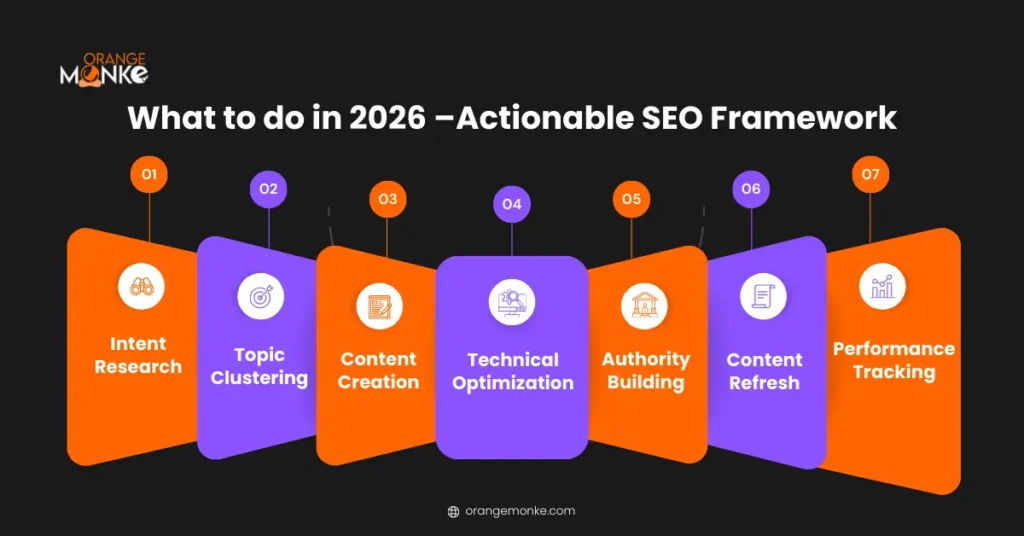
SEO in 2026 is no longer about isolated tactics. Sustainable rankings now come from a structured, repeatable framework that aligns search intent, content quality, technical excellence, and authority building. Below is a modern SEO framework designed to deliver long-term visibility across traditional and AI-powered search results.
Step 1: Intent Research
Modern SEO begins with understanding why users search, not just what they type. Intent research focuses on identifying informational, commercial, transactional, and navigational queries, ensuring content aligns precisely with user expectations at each stage of the search journey.
Step 2: Topic Clustering
Instead of creating isolated pages, SEO in 2026 relies on topic clusters. A central pillar page covers the core subject in depth, while supporting pages address related subtopics, collectively signaling topical authority to search engines and AI systems.
Step 3: Content Creation
High-performing content today prioritizes depth, originality, and real-world relevance. Pages that demonstrate expertise, include practical insights, and answer questions comprehensively are more likely to rank, earn citations, and be referenced in AI-generated search responses.
Step 4: Technical Optimization
Even the strongest content depends on a solid technical foundation. Technical SEO ensures fast loading speeds, mobile responsiveness, clean site architecture, proper indexing, and structured data, making content easily accessible to both users and search engines.
Step 5: Authority Building
Authority is built through trust signals rather than manipulation. In 2026, this includes earning high-quality backlinks, securing brand mentions, publishing expert-led content, and gaining recognition from authoritative sources within your industry.
Step 6: Content Refresh
SEO is not a one-time effort. Regularly updating existing content with fresh data, improved structure, and expanded insights helps maintain relevance, improve rankings, and align pages with evolving search intent and algorithm expectations.
Step 7: Performance Tracking
Continuous performance tracking ensures SEO efforts remain effective. Monitoring rankings, organic traffic behavior, engagement metrics, and conversions allows for data-driven optimization, helping refine strategy and sustain growth over time.
SEO for Different Business Types–A Segmented SEO Strategy for 2026
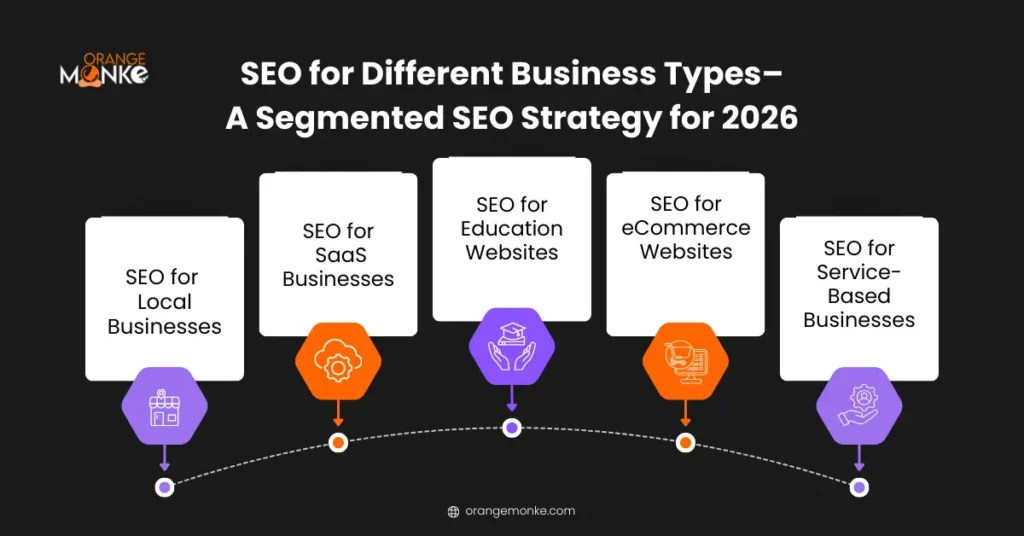
SEO is not a one-size-fits-all strategy. In 2026, search engines evaluate relevance and intent at a granular level, making it essential for businesses to tailor SEO efforts based on industry, audience behavior, and conversion goals.
Segmenting SEO by business type allows brands to attract higher-intent traffic and improve ranking consistency.
SEO for Local Businesses
- Focuses on capturing high-intent, location-based searches.
- Relies heavily on Google Business Profile optimization and local citations.
- Reviews, proximity signals, and localized content directly impact rankings.
- Best for driving calls, visits, and immediate conversions.
SEO for SaaS Businesses
- Targets long, research-driven buyer journeys.
- Emphasizes educational content, comparisons, and use-case pages.
- Product pages rank better when supported by blogs and guides.
- Builds authority through thought leadership and topical depth.
SEO for Education Websites
- Prioritizes informational and enrollment-based queries.
- Requires clear course structures, curriculum pages, and FAQs.
- Trust signals such as accreditations and expertise improve rankings
- Content depth supports long decision-making cycles.
SEO for eCommerce Websites
- Focuses on product, category, and transactional keywords.
- Structured data improves visibility in rich results and shopping search.
- User reviews and page speed strongly influence rankings.
- Internal linking helps distribute authority across product pages.
SEO for Service-Based Businesses
- Centers around problem-solution and commercial intent keywords.
- Service pages act as primary conversion drivers.
- Case studies and expertise content increase trust and visibility.
- Local and authority signals help outperform competitors.
Why Segmented SEO Works Now:First, Aligns SEO efforts with user intent specific to each business model. Second, expands keyword reach without creating multiple standalone blogs. Third, improves relevance, engagement, and conversion performance. Fourth, helps search engines clearly understand business offerings. |
Common SEO Myths in 2026
<img ” src=”https://orangemonke.com/wp-content/uploads/2026/01/common-seo-myths-1024×536.webp” alt=”Common SEO myths in 2026 about AI, backlinks, keywords, and ranking speed” />
Believing outdated SEO myths leads to wasted effort and missed opportunities. Businesses that understand how modern SEO truly works are better positioned to build visibility, authority, and long-term growth in an AI-driven search landscape.
Myth 1: AI Will Replace SEO
AI has changed how search works, but it hasn’t replaced SEO. AI systems still rely on indexed, optimized websites for data. Without strong SEO foundations, content cannot be discovered, trusted, or referenced in AI-generated search responses.
Myth 2: Backlinks Don’t Matter Anymore
Backlinks remain a powerful ranking signal in 2026. What has changed is quality over quantity. Search engines now evaluate relevance, authority, and context, making genuine, high-quality backlinks more valuable than mass link-building tactics.
Myth 3: You Need to Publish Content Daily to Rank
Ranking success is no longer tied to publishing frequency. Search engines prioritize content quality, depth, and relevance. A well-researched, authoritative page updated periodically can outperform dozens of low-value posts published daily.
Myth 4: SEO Is Only About Keywords
SEO has evolved far beyond keywords. Modern SEO focuses on search intent, user experience, content credibility, technical performance, and authority signals. Keywords help with relevance, but they no longer define ranking success on their own.
Myth 5: AI-Generated Content Automatically Ranks
AI-generated content does not rank by default. Without human editing, experience, and original insights, such content often lacks credibility. Search engines favor content that demonstrates expertise and real-world value, regardless of how it’s created.
Myth 6: SEO Results Are Instant
SEO is not an overnight strategy. Sustainable results come from consistent optimization, authority building, and performance monitoring. While quick wins are possible, long-term rankings require patience and strategic execution.
How Site Owners and Marketers Can Win at SEO in 2026
If you’re a site owner, marketer, or business leader, here’s how to leverage SEO effectively in the AI-driven “Search Everywhere” era to drive traffic, build authority, and grow your brand.”
- Audit your current SEO: Identify gaps in content, backlinks, technical SEO, and user experience. Tools like Google Search Console, PageSpeed Insights, and Lighthouse are critical.
- Map content to search intent: Organize your blog and website content around informational, commercial, transactional, and navigational queries to capture users at every stage of the funnel.
- Focus on authority and trust: Invest in high-quality content, citations, and backlinks. Being cited in AI summaries or appearing in featured snippets signals authority.
- Embrace multi-platform visibility: Google isn’t the only place users search. TikTok, YouTube, Pinterest, and voice search are increasingly important. Optimize content accordingly.
- Regular content refresh: Update your top-performing pages every 6–12 months. Add new insights, statistics, and internal links to stay relevant.
- Monitor results continuously: Track traffic, engagement, and AI visibility. Adjust strategies based on what works, not assumptions.
Bonus Box:Does Optimizing for Google’s AI Overviews Still Drive Traffic?SEO has always been about getting people to visit your website. But in 2026, with Google showing answers directly on the results page through AI overviews, many wonder if this still works. The truth is, it does—but in a different way. AI overviews usually answer simple questions like definitions, summaries, or “how-to” steps. Users get what they need immediately, which can reduce clicks for these basic queries. However, appearing as a cited source in these overviews still gives your website visibility and credibility. People see your brand as a trusted source, making them more likely to visit your site when they want deeper guidance, comparisons, or expert advice. Traffic now comes more from mid- and bottom-of-funnel searches, where users are ready to take action or make decisions. Being referenced in AI overviews helps your site perform better in these searches because Google already recognizes your content as authoritative and trustworthy. Optimizing for AI overviews also improves your content overall. Clear structure, accurate information, and original insights not only help AI feature your content but also improve your rankings in regular search results. This way, AI visibility doesn’t replace traffic—it attracts more qualified visitors who are genuinely interested in your content or services. In short, SEO in 2026 is about being visible, trusted, and useful. Appearing in Google’s AI overviews helps your website get noticed at the right time, leading to better long-term traffic and engagement. |
Conclusion
SEO in 2026 isn’t about chasing keywords or following outdated tactics—it’s about adapting to the Search Everywhere era. With AI-driven answers, zero-click searches, and platforms like ChatGPT, Google, TikTok, and YouTube shaping how people discover content, site owners need to focus on creating authoritative, helpful, and discoverable content across multiple channels.
Success now means:
- Understanding where and how your audience searches
- Producing content that’s genuinely useful and worth citing
- Building a trusted brand that both users and AI platforms recognize
At Orange MonkE, our SEO services are designed for this new era of SEO. We help businesses:
- Create content that ranks and gets cited by AI platforms
- Optimize technical SEO, structured data, and Core Web Vitals
- Build authority through high-quality backlinks and digital PR
- Stay ahead in Google, YouTube, TikTok, and other key platforms
With Orange MonkE, you’re not just keeping up—you’re thriving in the Search Everywhere era. SEO isn’t dead. It’s evolving—and the future belongs to those who adapt.
FAQs
1. Did AI results kill SEO?
No, AI search results have not killed SEO. AI still relies on websites as its primary data source. Optimized, credible, and authoritative content is more likely to be cited in AI summaries, featured snippets, and voice search results. SEO now complements AI rather than competing with it.
2. Is SEO still important in 2026?
Absolutely, SEO remains critical for driving high-intent organic traffic, improving brand credibility, and maintaining visibility across both traditional search and AI-powered results. Businesses that ignore SEO risk losing discoverability and authority in their industry.
3. Is SEO dead in 2026?
No, SEO is not dead in 2026. It has evolved to focus on user intent, content quality, technical optimization, and authority building. Modern SEO works alongside AI to ensure content is discoverable, trustworthy, and relevant in search results.
4. How has SEO changed in 2026 compared to previous years?
SEO in 2026 prioritizes intent-driven content, E-E-A-T signals (Experience, Expertise, Authority, Trust), structured data, and user experience. Outdated tactics like keyword stuffing or mass backlinks no longer work, and modern SEO emphasizes credibility, engagement, and AI visibility.
5. Will AI replace SEO completely?
No, AI does not replace SEO. AI relies on optimized websites as its primary data source. Businesses that invest in quality SEO are more likely to have their content cited in AI summaries, voice search, and featured snippets.
6. What SEO strategies still work in 2026?
In 2026, effective SEO focuses on creating high-quality, intent-driven content that addresses user needs, optimizing technical SEO including Core Web Vitals, building authoritative backlinks, implementing structured data and schema, regularly refreshing evergreen content, and prioritizing user experience and engagement throughout the site.
7. Can AI-generated content rank in 2026?
AI-generated content can rank only if it’s human-edited, original, and valuable. Search engines prioritize expertise and trustworthiness, so purely AI-produced content without human insight is unlikely to rank well.
8. How long does it take to see results from SEO in 2026?
SEO is a long-term strategy. Depending on competition and site authority, results may appear in 3–6 months, but consistent optimization, content updates, and authority-building efforts compound rankings over time.
9. Is SEO worth investing in 2026?
Yes, SEO drives organic traffic, builds authority, supports conversions, and ensures brand visibility across traditional and AI-driven search platforms. Companies that invest in SEO maintain a competitive edge in an increasingly AI-influenced search landscape.


We build the digital growth engine for businesses that don't have the time, team or clarity to do it themselves
Let's Start Your Success Story