Jan 31, 2026
  24 Min Read
| People Also Search For (PASF) is a Google feature that shows follow-up queries users search after their initial query, revealing real user intent. For SEO professionals and website owners, PASF uncovers high-intent, long-tail keywords, helps address multiple search intents in one page, fills content gaps, and drives sustainable organic traffic. Optimizing for PASF aligns content with user behavior and Google’s helpful content signals.
PASF reveals what users want next, helping websites capture multiple intent layers in one page |
Struggling to boost traffic and make your website shine?
Here’s what you need to know, the “People Also Search For” (PASF) section on Google. This section isn’t just a list of related queries but a real-time map of what users search next when your content doesn’t fully satisfy their intent.
With over 70% of search journeys involving follow-up queries, losing traffic isn’t always about ranking — it’s about missing the questions users have after landing on your page. PASF exposes these gaps, giving SEOs a direct blueprint to expand content, capture high-intent traffic, and turn every page into a traffic magnet.
Come on, let’s uncover how PASF works and turn these insights into more traffic, better rankings, and a website that truly shines.
What Is People Also Search For (PASF)?
| People Also Search For (PASF) is a Google feature that shows follow-up queries users commonly search after an initial search, revealing real user intent and helping SEOs discover related, high-value keywords for content optimization. |
People Also Search For (PASF) suggestions are generated based on aggregated user behavior and reflect how people naturally refine, expand, or adjust their searches when their original query does not fully satisfy their intent.
Unlike traditional keyword suggestions, PASF queries are not based solely on semantic similarity. They are based on what users actually do next. This makes PASF one of the most accurate indicators of evolving search intent available to SEOs and content creators.
In simple terms, PASF answers the question:
“What do people usually search for after this?”
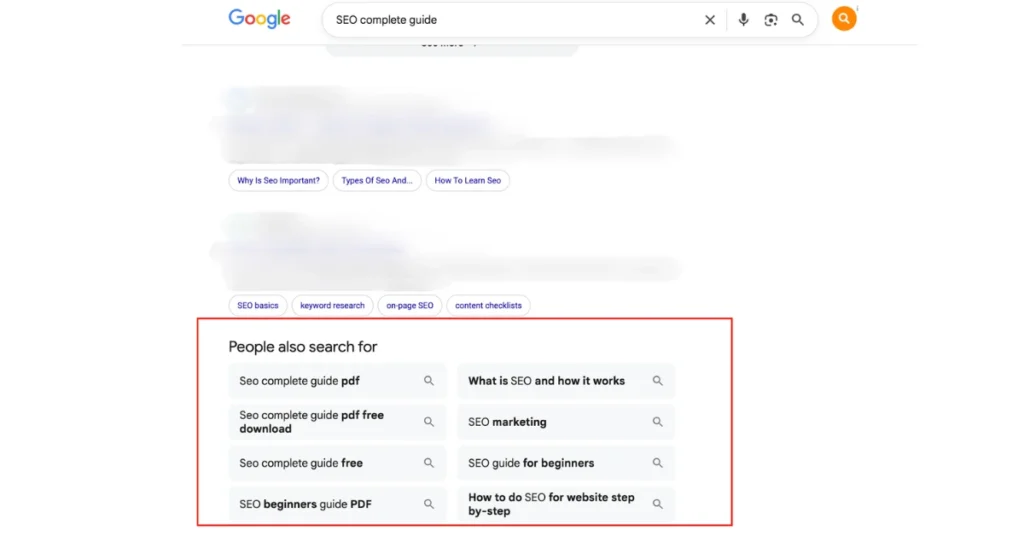
Let me simplify this with an example – How People Also Search For Appears in Google Results!
Desktop:
Mobile:
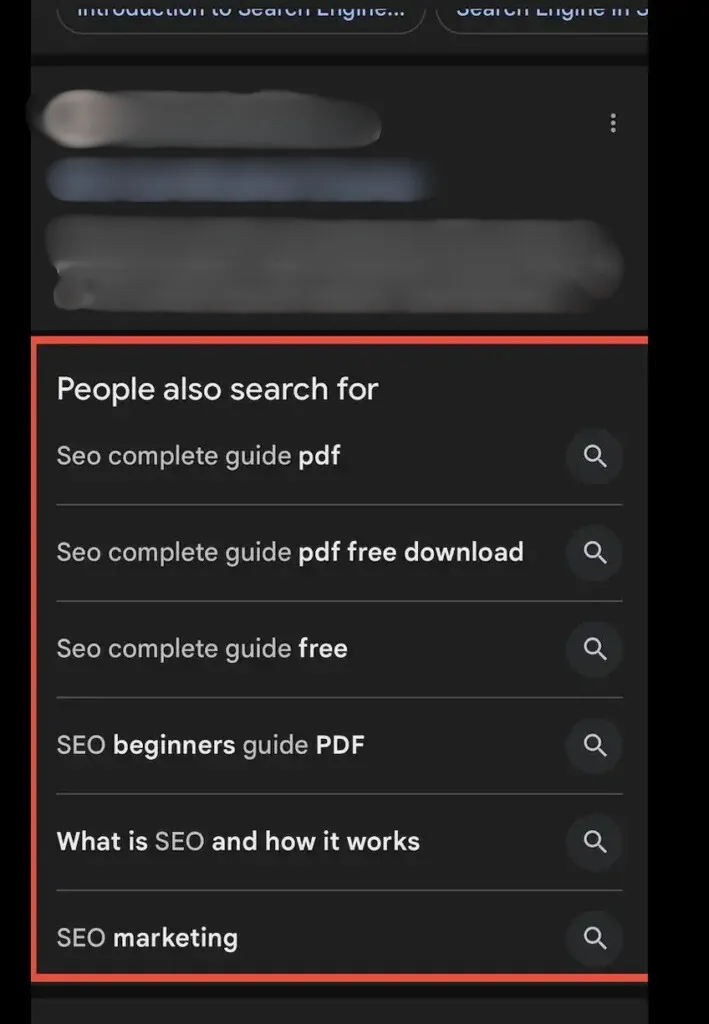
To understand People Also Search For (PASF) in action, look at the example above.
In this case, the user searched for “SEO complete guide.” Google first displays standard organic results from authoritative websites like Search Engine Land and Backlinko. However, just below these results, Google shows a People Also Search For section.
This section includes queries such as:
- SEO complete guide PDF
- SEO complete guide free
- What is SEO and how it works
- SEO guide for beginners
- How to do SEO for website step by step
These are not random suggestions but represent common follow-up searches made by users who started with the same query but then refined their intent. Some users are clearly looking for a downloadable resource, others want beginner-friendly explanations, while some are trying to understand SEO step by step.
What This Example Tells Us About User Intent
This PASF box reveals multiple intent layers behind a single keyword:
- Informational intent: “What is SEO and how it works”
- Beginner intent: “SEO guide for beginners”
- Transactional / resource intent: “SEO complete guide PDF free download”
- How-to intent: “How to do SEO for website step by step”
Instead of guessing what users want, Google surfaces these intent variations directly through PASF.
Why This Matters for SEO Content
If your content only explains what SEO is, you satisfy just one part of the intent.
But if your page also addresses:
- beginner questions
- step-by-step processes
- downloadable expectations
- practical SEO implementation
You will align your content with how users actually search. This is exactly why PASF is so valuable for SEO — it shows not just what users searched for, but what they needed next.
| Pro Tip: Pages that naturally cover PASF-related queries tend to rank better because they reduce the need for users to return to Google and search again. |
Let’s understand more about “People Also Search For”
Why Google Displays “People Also Search For” Queries
Google displays these related queries based on real user behavior to help searchers refine intent and find more accurate information faster.
1. To help users refine unclear or broad searches
Many users begin with a general or imperfect query because they are still exploring a topic. Google displays related queries to help users narrow down, clarify, or adjust their search without starting from scratch. These suggestions guide users toward more precise searches that better match their actual intent.
2. To improve search satisfaction when initial results fall short
When users click a result and return to the search page, it often indicates that their question was not fully answered. Google responds by showing related queries that others have searched for in similar situations, increasing the chances that the user finds a more relevant result the next time.
3. To reflect real user behavior, not assumptions
Related queries in People Also Search For are generated from aggregated search behavior. Google identifies patterns in how users move from one query to another and surfaces those commonly repeated paths. This ensures the suggestions are based on real actions, not theoretical keyword relationships.
4. To support different intent variations behind one keyword
A single search term can represent multiple intentions. Some users want explanations, others want step-by-step guidance, and some may be looking for resources or downloads. By displaying related queries, Google acknowledges these different intent layers and helps users reach the type of content they actually need.
5. To reduce friction in the search journey
Instead of forcing users to manually rethink and retype new queries, Google proactively offers the next logical searches. This makes the search process smoother, faster, and more intuitive, improving the overall user experience.
6. To continuously learn and improve result relevance
Each interaction with related queries feeds back into Google’s learning systems. As user behavior evolves, the related queries shown also change, allowing Google to stay aligned with emerging trends, shifting interests, and new information needs.
What’s the Difference Between “People Also Search For” and “People Also Ask”?
While People Also Search For (PASF) and People Also Ask (PAA) might seem similar, they serve different purposes in Google’s search ecosystem and reveal unique user behavior patterns. Understanding this distinction is key to optimizing your content effectively.
| Feature | People Also Search For (PASF) | People Also Ask (PAA) |
| Location on SERP | Appears below a search result after users click and return to the results page. | Appears within the search results, usually as a collapsible question box. |
| Purpose | Shows what users search next after an initial query — a follow-up query map of actual user behavior. | Shows common questions related to the current search — intended to clarify or expand the topic. |
| Data Source | Aggregated real user behavior and follow-up searches. | Aggregated questions users frequently type in relation to the main query. |
| SEO Use | Ideal for discovering high-intent, long-tail keywords and multiple search intents. | Ideal for FAQ sections, snippet optimization, and addressing specific questions. |
| Intent Insight | Reveals what users do next, helping content creators map the full search journey. | Reveals what users want to know about a topic, helping answer queries directly on-page. |
| Content Strategy Impact | Helps create multi-intent content and expand topic coverage to capture traffic. | Helps create concise, question-focused content for snippets and engagement. |
For better and quick understanding:
PASF is behavior-driven, showing what users search after your page, while PAA is question-driven, showing what users want to know about the topic upfront. Combining both strategies allows SEOs to capture multiple intent layers and dominate both SERP features.
| Pro Tip for SEOs:
● Use PASF for expanding content depth and uncovering micro-niches. ● Use PAA for FAQ sections and optimizing for featured snippets. ● Together, they create a comprehensive, user-first content strategy that improves rankings, engagement, and traffic retention. |
Why People Also Search For Matters for SEO and Traffic Growth
If you’re a business owner, the People Also Search For section shows you exactly where potential customers hesitate, get confused, or want more clarity.
These follow-up searches reveal missed opportunities on your website. When you address them, you don’t just improve rankings—you keep visitors longer, build trust faster, and turn search traffic into real business outcomes. Learn the six best reasons why People also search is important for traffic!
Reason 1: Shows Users’ Next Moves
Unlike traditional keyword suggestions, People Also Search For shows the actual follow-up queries users type after their initial search. These queries represent active intent, making them far more valuable for attracting qualified traffic.
Reason 2: Uncovers High-Intent Long-Tail Keywords
Most PASF queries are longer and more specific. These long-tail searches usually have lower competition but stronger intent, which means they are easier to rank for and more likely to convert compared to broad keywords.
Reason 3: Captures Multiple Search Intents in One Page
A single primary keyword often hides several intent variations—beginner, informational, how-to, or resource-based. PASF exposes these variations, allowing you to address them within one well-structured page and attract traffic from multiple related searches.
Reason 4: Reveals Competitor Content Gaps
When users repeatedly refine their searches, it often signals that existing content isn’t fully answering their needs. By covering PASF topics thoroughly, you can fill these gaps and create more complete, higher-performing content than competing pages.
Reason 5: Aligns Content with Google’s Usefulness Signals
Google rewards pages that reduce the need for users to return to the search results. By naturally addressing PASF queries, your content is more likely to satisfy users in one visit, improving engagement signals such as time on page and reducing bounce rates.
Reason 6: Drives Steady Traffic Through Relevance
Even PASF queries with low search volume can drive consistent traffic because they match very specific user needs. Ranking for multiple such queries adds up over time, creating a steady and sustainable traffic stream.
Using “People Also Search For” Data to Optimize Your Content
Once you’ve collected People Also Search For (PASF) data, the real value comes from applying it strategically to your content so that it better matches what users are actually searching for — not just the original keyword you targeted.
1. Incorporate PASF Keywords Naturally
PASF suggestions are essentially user-driven long-tail queries — they reveal how people refine their searches after the initial query. Adding these keywords:
- Into headlines and subheadings
- In body copy where contextually relevant
- Into meta descriptions and image alt text
It makes your content more aligned with real user language and intent, which helps search engines understand and rank your page for additional queries. PASF terms often represent specific questions or niche variations of a topic, they can improve relevance without keyword stuffing.
2. Expand Your Topic Coverage With New Sections
Each PASF query you gather represents a topic users care about, but that your page may not yet answer. Treat these as ideas for:
- New sub-sections
- Dedicated call-out blocks
- FAQ sections
This lets you turn a single article into a comprehensive, multi-intent resource that satisfies broader search behavior — which both improves user engagement and increases the number of keywords your content can rank for.
3. Surface User Pain Points and Missing Answers
PASF queries are implicit feedback on current search results — they highlight the questions users aren’t getting answered by existing pages. By analyzing common PASF refinements, you can identify:
- Unclear explanations
- Missing clarifications
- Sub-topics competitors skipped
Then you can directly address those gaps in your content, making it more complete and useful than alternatives on the SERP.
4. Improve Internal Linking Structure
Once you’ve integrated PASF topics into your content, look for opportunities to internally link between related pages on your site. For example:
- link from a broad overview page to more specific PASF-driven sub-topics
- connect related questions with contextual anchor text
Internal links help search engines understand topical relationships across your site and spread ranking authority, boosting visibility for both the main page and supporting content.
5. Combine PASF With Other SERP Features
PASF should not be used in isolation, when you overlap PASF suggestions with other Google SERP features — such as People Also Ask (PAA) and featured snippets — you can build a more robust content structure that ranks well for multiple snippets and query types.
For example, PASF keywords can inform subheading topics, while PAA questions can be used in FAQ sections or as answer targets within your content. This strengthens your chances of appearing across various SERP features, not just organic listings.
How To Conduct Keyword Research Using People Also Search For (PASF)
Unlock the hidden long-tail opportunities your competitors are missing. By analyzing PASF data, you can discover what users actually search for after your main keywords, identify high-intent queries, and structure your content to capture more qualified traffic and conversions.
Step 1: Choose a Strong Seed Keyword
Start with a primary keyword closely related to your product, service, or core topic. This keyword should already have search demand and relevance to your business goals. PASF works best when the seed keyword reflects a real user problem or interest.
Step 2: Observe PASF Suggestions on Google
Search your seed keyword on Google, click a ranking result, then return to the search results page. The People Also Search For section will appear at the bottom, showing follow-up queries users commonly search for. These suggestions reflect real refinements users make when their intent isn’t fully satisfied.
Step 3: Expand PASF Queries Iteratively
Treat each PASF suggestion as a new keyword opportunity. Search these queries individually and collect additional PASF variations. This recursive approach helps uncover deeper long-tail keywords and related topics that standard keyword tools often miss.
Step 4: Group PASF Keywords by Search Intent
Once collected, organize PASF keywords into intent-based groups such as:
- Informational (learning and awareness)
- Comparative (evaluation and alternatives)
- Commercial or transactional (ready to act)
This grouping helps you plan content that aligns with different stages of the buyer’s journey.
Step 5: Validate Keywords Using SEO Tools
Use keyword research tools like Google Keyword Planner, SemRush, ahrefs to evaluate PASF terms for:
- Search volume
- Keyword difficulty
- SERP competitiveness
Focus on PASF keywords with lower competition and clear relevance, as they often offer faster ranking opportunities.
Step 6: Analyze Competitor Coverage
Check how competitors address these PASF keywords. Identify gaps where topics are missing, thin, or poorly explained. These gaps represent opportunities to create more comprehensive and higher-quality content.
Step 7: Integrate PASF Keywords Into Content
Use validated PASF keywords to structure your content:
- Add them as H2/H3 subheadings
- Use them naturally in explanations
- Include them in FAQ sections where appropriate
This allows a single page to rank for multiple related queries without keyword stuffing.
Step 8: Monitor and Update Regularly
PASF suggestions change as user behavior evolves. Revisit your target keywords periodically and update your content to reflect new PASF insights. This keeps your pages relevant and competitive over time.
Tracking PASF Keyword Performance With Analytics Tools
Once you’ve identified and targeted People Also Search For (PASF) keywords in your content, the next step is measuring how well those keywords are performing. Analytics tools help you understand not just whether PASF keywords are driving traffic, but how that traffic behaves and contributes to your SEO goals.
1. Set Up Core Tracking Infrastructure
Before you track PASF performance, ensure you have the basics in place:
- Google Analytics: Tracks user behavior, sessions, engagement metrics, and conversion funnels from organic search.
- Google Search Console (GSC): Shows impressions, clicks, and average positions for the queries that bring users to your site — including PASF‑related searches.
- Linking GSC with Google Analytics provides a more complete view of how PASF keywords translate into on‑site behavior.
2. Identify Which Queries Are PASF‑Driven
Use Google Search Console to isolate keywords that match the PASF terms you targeted:
- Go to the Performance tab
- Filter queries or create a custom label for PASF keywords
- Review impressions, clicks, CTR, and average position specifically for those terms
This reveals which PASF keywords are gaining traction and how they stack up against other organic traffic.
3. Segment User Behavior by PASF Traffic
Once PASF traffic is identified in your analytics:
- Analyze engagement metrics like average session duration and pages per session for PASF visitors
- Compare bounce rate for PASF traffic vs general organic traffic
- See if PASF visitors are converting at a higher or lower rate than other segments
This helps you understand whether PASF traffic is more qualified or engaged, which is valuable for refining content strategy and conversion optimization.
4. Use Advanced SEO Platforms for Ranking Insights
SEO platforms such as Ahrefs, SEMrush, and similar tools can monitor how your site ranks for PASF‑related keywords over time. These tools offer:
- Position tracking: Monitor ranking movement for specific PASF keywords
- Keyword gap analysis: View PASF terms competitors rank for that you don’t
- Trend insights: See how certain PASF keyword rankings change month to month
This adds a competitive lens to your PASF strategy and helps prioritize keywords with the best opportunity.
5. Refine Strategy Based on KPI Trends
Once you start tracking, use the data to make informed decisions:
- Improve underperforming content by better addressing PASF topics that attract clicks but not engagement
- Double down on PASF keywords that drive both clicks and conversions
- Test layout or content updates for pages with high PASF visibility but low engagement
Consistent measurement ensures you’re not just targeting PASF keywords — you’re optimizing for real SEO impact.
6. Schedule Regular Check‑Ins
PASF suggestions and user behavior evolve over time, so set a recurring cadence (monthly or quarterly) to:
- Reevaluate which PASF keywords are driving the most value
- Update content with new PASF terms as they emerge
- Adjust tracking segments to reflect fresh keyword data
This makes your PASF optimization a living strategy rather than a one‑time task.
Challenges and Proven Strategies for Optimizing People Also Search For (PASF) Keywords
Optimizing content for People Also Search For (PASF) can significantly boost organic traffic, but it comes with unique challenges. Understanding these challenges and applying smart strategies ensures PASF optimization translates into measurable SEO gains.
Challenge 1: Low Search Volume for PASF Queries
Problem: Many PASF keywords are long-tail or niche, often showing very low search volume, which can make it hard to justify targeting them.
Strategy:
- Focus on intent, not volume. Even low-volume queries can attract highly qualified traffic because they reflect specific user needs.
- Combine multiple PASF keywords with similar intent in one content piece to capture broader traffic.
Challenge 2: Identifying the Right Intent
Problem: Not every PASF keyword is relevant to your audience — some may be informational when you need commercial intent, or vice versa.
Strategy:
- Cluster PASF keywords by intent (informational, comparison, transactional).
- Target the cluster that aligns with your business goals.
- Use PASF to enhance existing pages rather than creating unrelated content.
Challenge 3: Integrating PASF Keywords Naturally
Problem: Adding too many PASF keywords can lead to awkward copy or keyword stuffing.
Strategy:
- Use PASF terms in subheadings, FAQs, or naturally in content paragraphs.
- Leverage semantic variations of PASF queries to maintain readability and relevance.
- Prioritize user-first content — Google rewards helpful pages over keyword-dense content.
Challenge 4: Tracking PASF Keyword Performance
Problem: PASF keywords are often long-tail and may not have standalone tracking metrics in traditional SEO tools.
Strategy:
- Use Google Search Console filters to monitor clicks and impressions for PASF queries.
- Track engagement metrics like time on page, bounce rate, and conversion to measure quality traffic.
- Complement with Ahrefs, SEMrush, or other rank trackers to monitor keyword movement.
Challenge 5: Keeping Up With Changing PASF Suggestions
Problem: PASF queries evolve over time as Google updates results based on search behavior.
Strategy:
- Revisit PASF suggestions monthly or quarterly for high-priority pages.
- Update content to reflect new queries, user phrasing, and emerging intent.
- Treat PASF optimization as a living process, not a one-time activity.
Challenge 6: Balancing PASF With Core Keywords
Problem: Over-focusing on PASF keywords can dilute the page’s focus on primary high-volume keywords.
Strategy:
- Use PASF as a supportive tool, not the main keyword target.
- Integrate PASF into subtopics, examples, FAQs, and internal linking to strengthen topical relevance.
- Ensure the primary keyword and intent remain central to the page.
Advanced Tips for People Also Search For (PASF) Optimization
Optimizing for People Also Search For (PASF) goes beyond collecting keywords — advanced strategies can help you unlock hidden opportunities, scale your content, and capture highly targeted traffic.
Here’s how pro marketers are leveraging PASF in innovative ways:
| Advanced PASF Strategy | How to Apply It | Expected SEO & Business Benefit |
| Combine PASF with AI Content Tools | Feed PASF keywords into AI tools (ChatGPT, Jasper, Surfer SEO) to generate outlines, FAQs, or draft content. Edit for clarity and relevance. | Scales content creation, addresses multiple queries per page, improves topical relevance. |
| Use PASF for Local SEO Targeting | Identify location-specific PASF queries (e.g., “plumber in [city]”) and integrate into landing pages, FAQs, meta titles/descriptions. | Captures hyper-targeted local traffic, boosts visibility in Google Maps and local packs. |
| Discover Micro-Niches | Analyze PASF refinements for subtopics competitors overlook (e.g., “digital marketing for SaaS startups”) and create dedicated content. | Ranks faster for low-competition, high-intent terms; captures niche audiences; establishes authority. |
| Integrate PASF with Voice Search | Convert PASF queries into natural, question-based headings and short, snippet-ready answers; use structured data & FAQ schema. | Optimizes for voice search, mobile assistants, and featured snippets; increases discoverability across devices. |
Future Trends for People Also Search For (PASF)
People Also Search For (PASF) is no longer just a helpful SERP feature — it’s becoming a core signal of how Google understands evolving search intent. As search behavior shifts toward AI-driven discovery, PASF will play a much bigger role in how content is evaluated, ranked, and surfaced.
Below are the key trends shaping the future of PASF and what they mean for SEO.
PASF Will Become a Stronger Intent-Mapping Signal
Search is moving from keyword matching to intent resolution. PASF reflects real-time user refinement — what people search next when their intent isn’t fully met.
Prediction:
Google will increasingly use PASF-style behavior patterns to:
- Evaluate whether content satisfies multiple intent layers
- Determine topical depth and usefulness
- Rank pages that reduce repeat searches
SEO implication:
Pages optimized around PASF queries will outperform single-intent content, especially for competitive keywords.
PASF Will Influence AI-Generated Search Results
With AI Overviews and generative SERPs expanding, Google needs reliable signals to decide:
- Which topics deserve inclusion
- What follow-up questions matter most
- Which sources provide complete answers
PASF offers Google a behavior-backed roadmap of user curiosity.
Prediction:
PASF-aligned content will be more likely to:
- Be cited in AI Overviews
- Influence conversational follow-ups
- Power multi-question answer blocks
SEO implication:
Optimizing for PASF improves visibility beyond traditional blue links.
Long-Tail and Micro-Intent Queries Will Drive More Traffic
Broad keywords are becoming harder to own. Growth is shifting toward clusters of specific, intent-driven searches — exactly where PASF lives.
Prediction:
Traffic growth will increasingly come from:
- PASF-style refinements
- Low-volume but high-intent queries
- Topic clusters rather than single keywords
SEO implication:
Sites that systematically target PASF queries will build more stable, compounding traffic over time.
PASF Will Play a Bigger Role in Local & Voice Search
Voice searches and local queries are naturally conversational and exploratory. Users often refine these searches multiple times — a pattern PASF captures well.
Prediction:
PASF data will increasingly overlap with:
- Voice search follow-up queries
- “Near me” and location-based refinements
- Service comparison and decision-stage searches
SEO implication:
Local businesses that integrate PASF into service pages and FAQs will gain an edge in mobile and voice-driven results.
PASF Optimization Will Shift From Optional to Essential
As more sites adopt basic SEO best practices, competitive advantage will come from how well content matches real search journeys — not just keywords.
Prediction:
PASF-driven optimization will become a standard part of:
- Content audits
- On-page SEO strategies
- AI-assisted content workflows
SEO implication:
Early adopters will benefit most, while late adopters will struggle to compete on relevance and engagement.
| The future of SEO belongs to content that understands what users need next. People Also Search For is Google’s most transparent signal of that journey — and one of the most underused ranking advantages available today. |
BONUS BOX:Why PASF Belongs in Your SEO ToolkitPeople Also Search For (PASF) isn’t just a curiosity—it’s a goldmine for smart SEO. Here’s why you should include it in your strategy: ● Uncovers Next-Step Queries: PASF shows exactly what users search after your main keyword, revealing high-intent opportunities. ● Boosts Content Depth: Integrating PASF keywords helps cover multiple search intents on one page. ● Fills Competitor Gaps: Identify topics competitors miss and create more comprehensive content. ● Improves Engagement Metrics: Pages that answer PASF queries reduce bounce rates and keep visitors longer. ● Supports AI & Voice Search: PASF queries align naturally with voice search and AI-generated results, enhancing discoverability. |
Conclusion
If you want your website to stop losing traffic after the click, People Also Search For (PASF) is your secret weapon. It shows exactly what users search next, uncovers high-intent keywords, and helps you craft content that ranks, engages, and converts.
Website owners and SEO pros who leverage PASF don’t just chase keywords — they own the search journey. Start mapping PASF queries, fill the gaps competitors ignore, and watch your organic traffic climb while your website shines.
For deeper insights and actionable strategies on mastering PASF and modern SEO, check out Orange MonkE — a resource built to help SEOs and business owners turn search behavior into real results.
FAQs
1. What is People Also Search For (PASF) in Google?
People Also Search For (PASF) is a Google SERP feature that shows follow-up queries users commonly search after an initial query. It’s based on real user behavior and reveals how search intent evolves when results don’t fully satisfy users.
2. How is People Also Search For different from People Also Ask?
People Also Ask displays question-based expansions within results, while PASF appears after users return to the SERP. PASF reflects what users search next, making it a stronger indicator of refined intent rather than related informational questions.
3. Why is PASF important for SEO?
PASF is important because it reveals high-intent, long-tail queries users actively search next. Optimizing for these queries helps capture multiple intent layers, improve engagement, and increase organic visibility beyond a single primary keyword.
4. How can PASF help improve content rankings?
By addressing PASF queries within your content, you reduce the need for users to return to Google. This improves engagement signals like time on page and satisfaction, which align closely with Google’s helpful content and relevance evaluation systems.
5. Can PASF keywords drive traffic despite low search volume?
Yes, PASF keywords often have low volume but strong intent. When combined strategically, multiple PASF queries can drive consistent, highly qualified traffic that converts better than broad, high-competition keywords over time.
6. How do you use PASF data in keyword research?
PASF data is used by identifying follow-up queries shown after a search, grouping them by intent, validating them with SEO tools, and integrating them as subtopics or FAQs. This helps uncover keyword opportunities traditional tools often miss.
7. Does PASF impact AI Overviews and voice search?
Yes, PASF aligns closely with conversational and follow-up queries used in AI Overviews and voice search. Content that naturally answers PASF-style refinements is more likely to be surfaced in AI-generated summaries and voice responses.
8. How often do PASF queries change?
PASF queries change frequently as user behavior evolves. Monitoring them monthly or quarterly helps keep content aligned with current search intent, emerging trends, and shifting user expectations, making PASF optimization an ongoing SEO process.